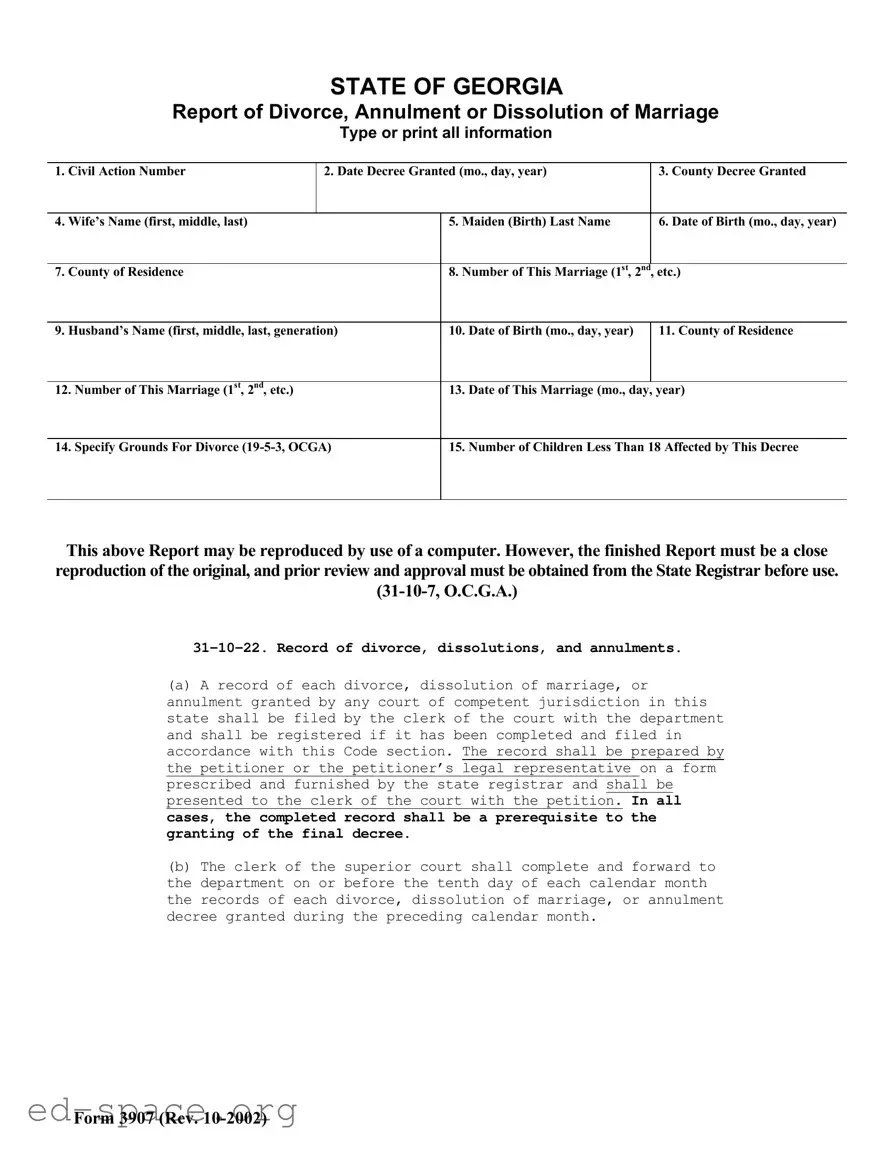
The Georgia 3907 form plays a crucial role in the process of documenting the legal end of a marriage through divorce, annulment, or dissolution. This form is essential for ensuring that all pertinent information regarding the marriage and the parties involved is officially recorded. Key details required on the form include the civil action number, the date the decree was granted, and the counties of residence for both parties. Additionally, it asks for the names and birth dates of both the husband and wife, along with the number of this marriage for each party. It also prompts the petitioner to specify the grounds for divorce as outlined in the relevant state code. Importantly, the form addresses the impact of the decree on any children under the age of 18, ensuring that their welfare is considered in the proceedings. The completed form must be filed with the court and is a prerequisite for the final decree, underlining its significance in the legal process. For anyone navigating this complex situation, understanding the requirements and implications of the Georgia 3907 form is vital for a smooth transition through this challenging time.
STATE OF GEORGIA
Report of Divorce, Annulment or Dissolution of Marriage
Type or print all information
1. |
Civil Action Number |
2. Date Decree Granted (mo., day, year) |
3. |
County Decree Granted |
|||
|
|
|
|
|
|
||
4. |
Wife’s Name (first, middle, last) |
|
5. Maiden (Birth) Last Name |
6. |
Date of Birth (mo., day, year) |
||
|
|
|
|
|
|||
7. |
County of Residence |
|
8. Number of This Marriage (1st, 2nd, etc.) |
||||
|
|
|
|
|
|||
9. |
Husband’s Name (first, middle, last, generation) |
10. |
Date of Birth (mo., day, year) |
11. County of Residence |
|||
|
|
|
|
|
|
||
12. |
Number of This Marriage (1st, 2nd, etc.) |
|
13. |
Date of This Marriage (mo., day, year) |
|||
|
|
|
|
||||
14. |
Specify Grounds For Divorce |
15. |
Number of Children Less Than 18 Affected by This Decree |
||||
|
|
|
|
|
|
|
|
This above Report may be reproduced by use of a computer. However, the finished Report must be a close reproduction of the original, and prior review and approval must be obtained from the State Registrar before use.
(a)A record of each divorce, dissolution of marriage, or annulment granted by any court of competent jurisdiction in this state shall be filed by the clerk of the court with the department and shall be registered if it has been completed and filed in accordance with this Code section. The record shall be prepared by the petitioner or the petitioner’s legal representative on a form prescribed and furnished by the state registrar and shall be presented to the clerk of the court with the petition. In all cases, the completed record shall be a prerequisite to the granting of the final decree.
(b)The clerk of the superior court shall complete and forward to the department on or before the tenth day of each calendar month the records of each divorce, dissolution of marriage, or annulment decree granted during the preceding calendar month.
Form 3907 (Rev.
| Fact Name | Details |
|---|---|
| Form Purpose | The Georgia 3907 form is used to report a divorce, annulment, or dissolution of marriage. |
| Governing Law | This form is governed by O.C.G.A. § 19-5-3 and O.C.G.A. § 31-10-7. |
| Civil Action Number | The form requires the civil action number assigned to the divorce case. |
| Date Decree Granted | Users must provide the date the divorce decree was granted, formatted as month, day, year. |
| Wife’s Information | The form collects the wife's full name and maiden name, along with her date of birth. |
| Husband’s Information | It also requires the husband's full name and date of birth. |
| Marriage Details | The form asks for the number of this marriage and the date of this marriage. |
| Grounds for Divorce | Users must specify the grounds for divorce according to O.C.G.A. § 19-5-3. |
| Children Affected | The form requires information on the number of children under 18 affected by the decree. |
| Reproduction Guidelines | The report may be reproduced digitally, but must closely resemble the original and require prior approval. |
Completing the Georgia 3907 form is an important step following a divorce, annulment, or dissolution of marriage. This form collects essential information that will be filed with the state to officially document the legal changes in marital status. Follow these steps carefully to ensure accurate completion.
After completing the form, review all entries for accuracy. Once verified, submit the form to the appropriate court clerk to ensure it is officially recorded.
What is the Georgia 3907 form?
The Georgia 3907 form is a legal document used to report the details of a divorce, annulment, or dissolution of marriage in the state of Georgia. This form must be completed and filed with the court to officially record the divorce proceedings. It captures essential information about both parties involved and the circumstances surrounding the dissolution of the marriage.
Who needs to fill out the Georgia 3907 form?
The form must be filled out by the petitioner, or the person initiating the divorce, or their legal representative. It is crucial for ensuring that the divorce is properly documented and recognized by the state. Both spouses' information is required, regardless of who files for divorce.
What information is required on the form?
The Georgia 3907 form requires various pieces of information, including the civil action number, the date the decree was granted, the names and birth dates of both spouses, their counties of residence, the number of the marriage, the grounds for divorce, and details about any children under 18 affected by the decree. Each section must be completed accurately to avoid delays in processing.
How is the Georgia 3907 form submitted?
The completed form must be submitted to the clerk of the court along with the divorce petition. After the decree is granted, the clerk will file the form with the appropriate department to ensure it is officially recorded. It is important to submit the form promptly to comply with legal requirements.
What happens if the form is not filed?
If the Georgia 3907 form is not filed, the divorce may not be officially recognized by the state. This can lead to complications in legal matters such as property division, custody arrangements, and future legal proceedings. It is essential to ensure that this form is completed and submitted as part of the divorce process.
Can the form be reproduced?
Yes, the Georgia 3907 form can be reproduced using a computer, but it must closely resemble the original document. Before using a reproduced version, it is necessary to obtain prior review and approval from the State Registrar. This ensures that the form meets all legal standards and requirements.
What are the grounds for divorce listed on the form?
The form allows for the specification of grounds for divorce as outlined in Georgia law (OCGA 19-5-3). Common grounds include irreconcilable differences, adultery, abandonment, and other reasons recognized by the state. It is important to select the correct grounds, as they may impact the proceedings.
How does the filing process work after the divorce is granted?
Once the divorce decree is granted, the clerk of the superior court is responsible for completing and forwarding the Georgia 3907 form to the appropriate department. This must be done by the tenth day of the following month to ensure timely registration of the divorce record. Proper filing is crucial for maintaining accurate public records.
Is there a fee associated with filing the Georgia 3907 form?
While there may be fees associated with filing for divorce in general, the specific cost for submitting the Georgia 3907 form can vary by county. It is advisable to check with the local court clerk's office for any applicable fees or requirements related to the filing process.
Incomplete Information: Failing to provide all required details can lead to delays. Each section must be filled out, including names, dates, and locations.
Incorrect Dates: Entering incorrect dates, especially for the decree granted or marriage date, can result in complications. Double-check the format and accuracy.
Omitting Grounds for Divorce: Neglecting to specify the grounds for divorce is a common error. This section is crucial for processing the form correctly.
Misidentifying Marriage Number: Indicating the wrong number of the marriage can create confusion. Ensure that you accurately state whether it is your first, second, etc.
Errors in Names: Spelling mistakes in the names of either spouse, including the maiden name, can lead to issues. Verify the names are correct and complete.
Failure to Review: Not reviewing the completed form before submission can result in overlooked mistakes. Take the time to ensure all information is accurate and complete.
The Georgia 3907 form is an important document used to report the details of a divorce, annulment, or dissolution of marriage in the state of Georgia. Along with this form, several other documents may be required to ensure a smooth legal process. Below is a list of commonly used forms and documents that often accompany the Georgia 3907.
Understanding these documents is essential for anyone going through a divorce in Georgia. Each form plays a crucial role in ensuring that the legal process is followed correctly and that both parties' rights are protected.
The Georgia 3907 form serves as a formal report of divorce, annulment, or dissolution of marriage. Several other documents share similarities with this form, primarily in their purpose of documenting marital status changes. Below is a list of nine such documents, highlighting their similarities to the Georgia 3907 form.
When filling out the Georgia 3907 form, it’s important to approach the task with care. Here are some key dos and don’ts to keep in mind:
Misconception 1: The Georgia 3907 form is only necessary for the final decree.
This form must be filed alongside the petition for divorce. It is a prerequisite for the final decree, not just a formality afterward.
Misconception 2: Only one spouse needs to complete the form.
Both parties must provide their information. Accurate details from both spouses are crucial for the form's validity.
Misconception 3: The form can be submitted without prior approval.
The completed report must be a close reproduction of the original, and it requires review and approval from the State Registrar before use.
Misconception 4: The form is not needed if children are not involved.
Even if there are no children, the Georgia 3907 form is still necessary to document the dissolution of the marriage.
Misconception 5: You can submit the form electronically without restrictions.
While the form may be reproduced using a computer, it must closely match the original format and receive prior approval.
Misconception 6: The grounds for divorce can be left blank.
It is essential to specify the grounds for divorce in section 14. Omitting this information can delay the process.
Misconception 7: The form is only relevant for divorces.
The Georgia 3907 form is also applicable for annulments and dissolutions of marriage, not just traditional divorces.
When completing the Georgia 3907 form, it is important to keep the following key points in mind:
Completing the Georgia 3907 form accurately and thoroughly is crucial for the successful processing of your divorce or annulment. Ensure all required fields are filled out and that you follow the submission guidelines carefully.