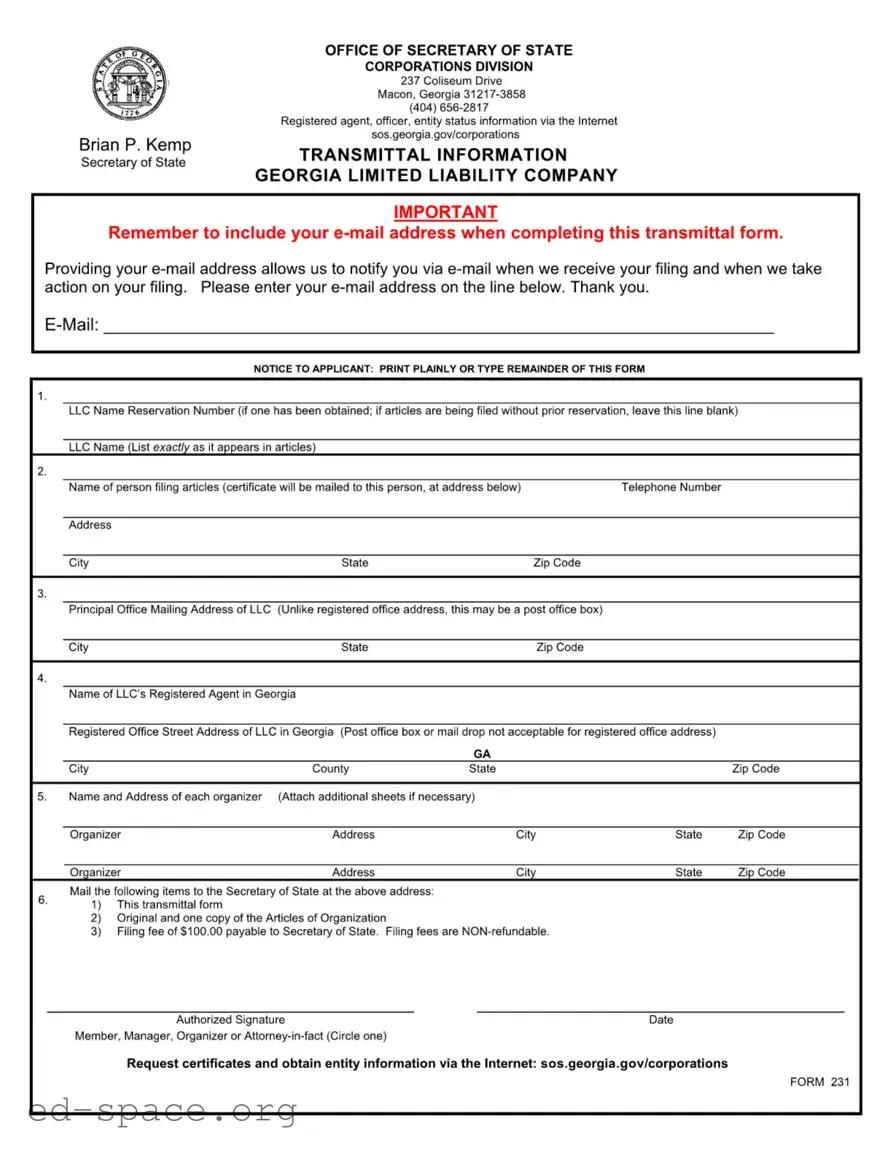
Homepage Blank Georgia 231 PDF Form
Article Guide

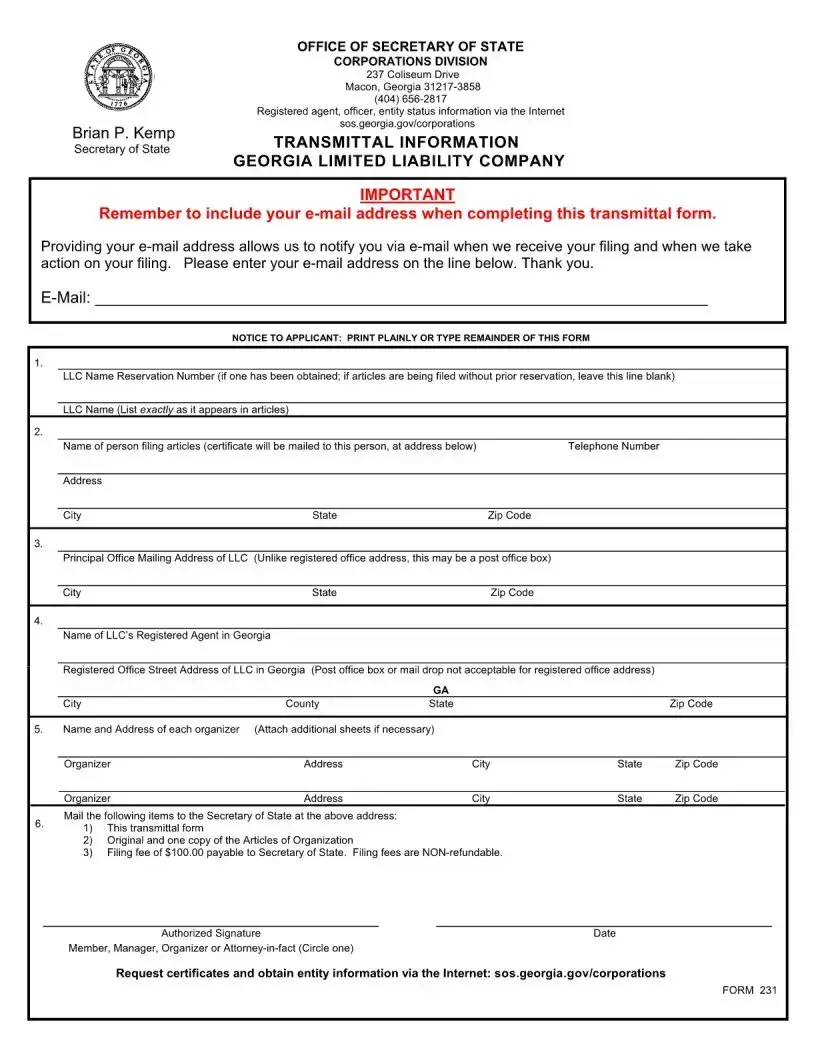
The Georgia 231 form is an essential document for individuals looking to establish a Limited Liability Company (LLC) in the state of Georgia. This form serves as a transmittal for submitting the Articles of Organization, which officially create the LLC. It requires specific information, including the name of the LLC, the name of the person filing the articles, and the principal office mailing address. Additionally, the form prompts applicants to provide details about the registered agent and their registered office address, which must comply with state requirements. Applicants must also include the names and addresses of each organizer involved in the LLC's formation. A filing fee of $100 is required, and the form emphasizes the importance of including an email address for timely notifications regarding the status of the filing. All these components work together to ensure a smooth and compliant registration process for new LLCs in Georgia.
Document Preview

Form Specifications

Fact Name Description
Purpose The Georgia 231 form is used for filing Articles of Organization for a Limited Liability Company (LLC) in the state of Georgia.
Filing Fee A filing fee of $100.00 is required when submitting the form. This fee is non-refundable.
Registered Agent Requirement Every LLC must designate a registered agent with a physical address in Georgia. A post office box is not acceptable for this address.
Email Notification Providing an email address on the form allows the Secretary of State to notify the applicant about the status of the filing.
Governing Law The Georgia 231 form is governed by the Georgia Limited Liability Company Act, O.C.G.A. § 14-11-1001 et seq.

Georgia 231: Usage Guidelines

Completing the Georgia 231 form is a crucial step in establishing your Limited Liability Company (LLC). After filling out the form, you will need to submit it along with the necessary documents and fees to the Secretary of State. Ensure that all information is accurate and complete to avoid delays in processing.

  1. Provide your email address: Enter your email address in the designated line. This will allow you to receive notifications about your filing.
  2. Fill in the LLC Name Reservation Number: If you have obtained a name reservation, write the number here. If not, leave this line blank.
  3. Enter the LLC Name: Write the name of your LLC exactly as it appears in the articles.
  4. Provide the name of the person filing the articles: This will be the individual who receives the certificate. Include their address, telephone number, city, state, and zip code.
  5. Principal Office Mailing Address: Enter the mailing address for the LLC. A post office box is acceptable here.
  6. Registered Agent Information: Write the name of the registered agent in Georgia, along with their street address, city, county, state, and zip code. Note that a post office box is not acceptable for the registered office address.
  7. List the Name and Address of each organizer: Include the names and addresses of all organizers. Attach additional sheets if necessary.
  8. Prepare for submission: Gather the following items: the completed transmittal form, the original and one copy of the Articles of Organization, and a filing fee of $100.00 made payable to the Secretary of State.
  9. Sign the form: An authorized member, manager, organizer, or attorney-in-fact must sign and date the form.
  10. Mail your documents: Send the completed form and all required items to the Secretary of State at the address provided on the form.

Your Questions, Answered

What is the Georgia 231 form?

The Georgia 231 form is a transmittal form used for filing Articles of Organization for a Limited Liability Company (LLC) in the state of Georgia. This form is essential for those looking to legally establish their LLC, as it provides the necessary information to the Secretary of State's office for processing the application.

What information do I need to provide on the Georgia 231 form?

When completing the Georgia 231 form, you will need to provide several key pieces of information. This includes the LLC name, any reservation number if applicable, the name and address of the person filing the articles, the principal office mailing address, the registered agent's name and address, and the names and addresses of each organizer. It's important to ensure that all details are accurate and clearly printed or typed.

Is there a fee associated with filing the Georgia 231 form?

Yes, there is a filing fee of $100.00 associated with submitting the Georgia 231 form. This fee is payable to the Secretary of State and is non-refundable, regardless of the outcome of your application. Make sure to include this payment when you submit your form to avoid delays in processing.

Can I use a P.O. Box for the registered office address?

No, a P.O. Box cannot be used for the registered office address on the Georgia 231 form. The registered office must have a physical street address in Georgia. This ensures that legal documents can be delivered to the LLC in a timely manner.

How can I check the status of my filing after submitting the Georgia 231 form?

You can check the status of your filing by visiting the Georgia Secretary of State's website at sos.georgia.gov/corporations. It is advisable to provide your email address on the form, as this allows the Secretary of State's office to notify you via email when they receive your filing and when they take action on it.

What should I do if I need to make changes after submitting the Georgia 231 form?

If you need to make changes after submitting the Georgia 231 form, you may need to file an amendment. The process for amendments can vary, so it is best to consult the Secretary of State's office or their website for specific instructions on how to proceed with changes to your LLC's information.

Who can sign the Georgia 231 form?

The Georgia 231 form must be signed by an authorized individual, which can be a member, manager, organizer, or attorney-in-fact of the LLC. It is important to circle the appropriate title next to the signature to clarify the signer's role in relation to the LLC.

Common mistakes

  1. Neglecting to Provide an Email Address: One of the most common mistakes is failing to include an email address. This contact information is crucial as it allows the Secretary of State's office to communicate important updates regarding the filing status.

  2. Incorrect LLC Name: Applicants often make the error of not listing the LLC name exactly as it appears in the articles. Any deviation can lead to delays or rejections of the filing.

  3. Improper Registered Office Address: Some individuals mistakenly use a post office box or mail drop for the registered office address. The form explicitly requires a physical street address, which must be adhered to for compliance.

  4. Incomplete Organizer Information: Failing to provide the names and addresses of all organizers is another frequent oversight. Each organizer's details must be included, and additional sheets should be attached if necessary.

  5. Missing Signature: Lastly, applicants sometimes forget to sign the form. An authorized signature is mandatory for the submission to be valid, so this step should not be overlooked.

Documents used along the form

The Georgia 231 form is essential for establishing a Limited Liability Company (LLC) in Georgia. Alongside this form, several other documents are commonly required to ensure compliance with state regulations and to facilitate the formation process. Below is a list of five documents that are often used in conjunction with the Georgia 231 form, along with brief descriptions of each.

  • Articles of Organization: This document formally establishes the LLC by outlining key details such as the company name, registered agent, and purpose. It must be filed with the Secretary of State and is a critical component of the LLC formation process.
  • Operating Agreement: Although not mandatory, this internal document outlines the management structure and operating procedures of the LLC. It details the rights and responsibilities of members and managers, providing clarity on how the business will be run.
  • Registered Agent Consent Form: This form is used to confirm that the registered agent has agreed to serve in this capacity. It ensures that the agent is aware of their responsibilities, including receiving legal documents on behalf of the LLC.
  • Employer Identification Number (EIN) Application: An EIN is necessary for tax purposes and is required if the LLC plans to hire employees or open a bank account. The application can be submitted online through the IRS website.
  • Business License Application: Depending on the type of business and location, an LLC may need to obtain local or state business licenses. This application ensures compliance with local regulations and permits the operation of the business within the jurisdiction.

Understanding these documents and their roles in the LLC formation process is crucial for entrepreneurs. Proper preparation can streamline the establishment of a business and help avoid potential legal complications in the future.

Similar forms

  • Articles of Organization: This document is essential for forming a limited liability company (LLC) in Georgia. Like the Georgia 231 form, it includes information about the LLC's name, registered agent, and principal office. Both documents must be filed with the Secretary of State to officially establish the LLC.
  • Certificate of Formation: Similar to the Articles of Organization, this certificate serves as proof that an LLC has been legally created. It outlines the same fundamental details regarding the company and is required for compliance with state regulations.
  • Operating Agreement: While not filed with the state, this internal document outlines the management structure and operating procedures of the LLC. It complements the Georgia 231 form by detailing how the LLC will be run and the rights of its members.
  • Annual Registration: This document must be filed each year to maintain the LLC's good standing. Like the Georgia 231 form, it requires updated information about the LLC, including its registered agent and principal office address.
  • Foreign LLC Registration: If an LLC formed in another state wishes to operate in Georgia, it must file this registration. This document shares similarities with the Georgia 231 form in that it collects information about the LLC and its registered agent in Georgia.
  • Business License Application: This document is necessary for obtaining a business license to operate legally in a specific locality. It often requires similar information about the business structure, such as the name and registered agent, paralleling the requirements of the Georgia 231 form.

Dos and Don'ts

When filling out the Georgia 231 form, attention to detail is crucial. Here are four important dos and don'ts to ensure your submission is accurate and complete.

  • Do include your e-mail address. This allows the Secretary of State to notify you when they receive and process your filing.
  • Do print plainly or type the information. Clear legibility is essential for processing your form without delays.
  • Don't leave the LLC Name Reservation Number blank if you have one. Always provide it to avoid confusion.
  • Don't use a post office box for the registered office address. This must be a physical street address in Georgia.

Completing the form correctly can save time and prevent complications. Be sure to double-check all entries before submission.

Misconceptions

Misconceptions about the Georgia 231 form can lead to confusion during the filing process. Here are seven common misunderstandings:

  • It’s only for new LLCs. Many believe the Georgia 231 form is exclusively for new Limited Liability Companies. In reality, it can also be used for amendments or updates to existing LLCs.
  • You don’t need an email address. Some applicants think providing an email address is optional. However, including your email ensures you receive important notifications about your filing.
  • A registered office can be a P.O. Box. There is a misconception that using a P.O. Box for the registered office address is acceptable. In fact, a physical street address is required.
  • Filing fees are refundable. Many assume that if their filing is rejected, they can get their $100 filing fee back. This is incorrect; filing fees are non-refundable regardless of the outcome.
  • Only one organizer is needed. Some people think they can only list one organizer on the form. You can include multiple organizers if necessary.
  • The form can be submitted without a reservation number. While it’s true that you can file without a name reservation, many believe it’s always advisable to obtain one first to avoid name conflicts.
  • Filing can be done verbally. There is a belief that you can complete the process by simply calling the Secretary of State’s office. However, the form must be filled out and submitted in writing.

Understanding these misconceptions can help streamline the filing process and ensure compliance with Georgia regulations.

Key takeaways

Filling out and using the Georgia 231 form is a crucial step for establishing a Limited Liability Company (LLC) in Georgia. Here are some key takeaways to consider:

  • Email Address Requirement: Always include your email address on the form. This ensures you receive timely notifications regarding your filing status.
  • Accurate LLC Name: Enter the LLC name exactly as it appears in your articles. If you have a name reservation number, include it; otherwise, leave that section blank.
  • Contact Information: Provide the name and contact details of the person filing the articles. The certificate will be mailed to this individual.
  • Principal Office Address: The mailing address for the LLC can be a P.O. Box. Ensure it is clearly indicated on the form.
  • Registered Agent Information: Clearly state the name and address of your registered agent. Remember, a P.O. Box is not acceptable for the registered office address.
  • Organizer Details: List the names and addresses of each organizer. If you have more than two organizers, attach additional sheets as necessary.
  • Submission Requirements: Mail the completed form along with the Articles of Organization and a $100 filing fee to the Secretary of State. Note that this fee is non-refundable.

By following these guidelines, you can ensure that your filing process is smooth and compliant with Georgia's regulations.