A General Power of Attorney (GPOA) is a powerful legal document that grants an individual, known as the agent or attorney-in-fact, the authority to act on behalf of another person, referred to as the principal. This form is versatile and can be tailored to fit various needs, allowing the agent to handle financial matters, make healthcare decisions, or manage legal affairs, depending on the specific permissions granted. The principal can specify the extent of the agent's authority, which can range from broad powers to limited functions. It’s essential to note that a GPOA can be effective immediately or become effective only upon the principal's incapacitation. Additionally, the principal retains the right to revoke the power at any time, as long as they are mentally competent. Understanding the implications of this document is crucial, as it can significantly impact personal and financial decisions. Proper execution of the form is vital, including signatures and witness requirements, to ensure its validity and enforceability.
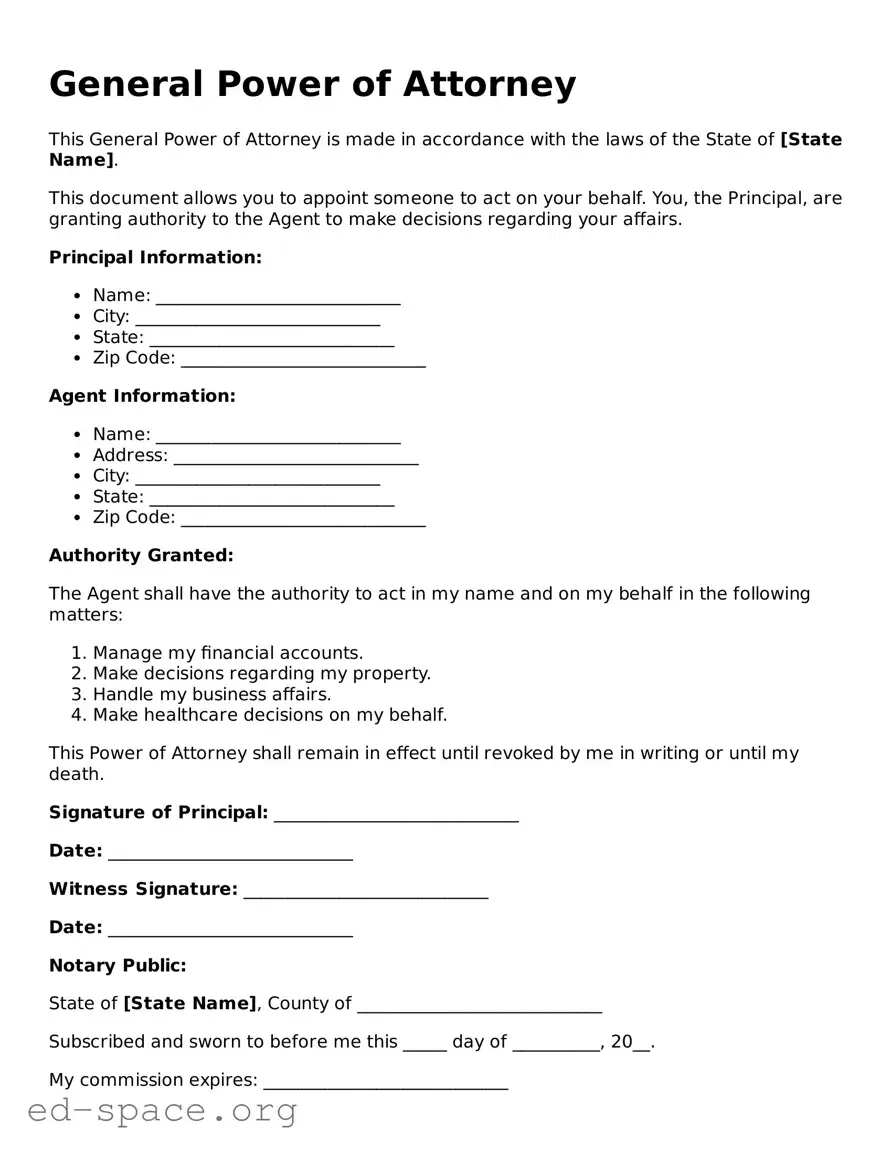
General Power of Attorney
This General Power of Attorney is made in accordance with the laws of the State of [State Name].
This document allows you to appoint someone to act on your behalf. You, the Principal, are granting authority to the Agent to make decisions regarding your affairs.
Principal Information:
Agent Information:
Authority Granted:
The Agent shall have the authority to act in my name and on my behalf in the following matters:
This Power of Attorney shall remain in effect until revoked by me in writing or until my death.
Signature of Principal: ____________________________
Date: ____________________________
Witness Signature: ____________________________
Date: ____________________________
Notary Public:
State of [State Name], County of ____________________________
Subscribed and sworn to before me this _____ day of __________, 20__.
My commission expires: ____________________________
| Fact Name | Description |
|---|---|
| Definition | A General Power of Attorney allows one person to act on behalf of another in legal and financial matters. |
| Scope of Authority | This document grants broad powers, enabling the agent to make decisions about finances, property, and legal affairs. |
| State-Specific Laws | Each state has its own laws governing the use of a General Power of Attorney. For example, in California, it is governed by the California Probate Code. |
| Durability | A General Power of Attorney can be durable, meaning it remains effective even if the principal becomes incapacitated, depending on the wording of the document. |
Filling out a General Power of Attorney form is a straightforward process. This document allows you to appoint someone to make decisions on your behalf. It’s essential to ensure all information is accurate and complete to avoid any issues in the future.
What is a General Power of Attorney?
A General Power of Attorney is a legal document that allows one person, known as the "principal," to appoint another person, called the "agent," to act on their behalf. This can include making decisions about finances, property, and other legal matters when the principal is unable to do so themselves.
Who can be an agent under a General Power of Attorney?
Any competent adult can serve as an agent. This can be a family member, friend, or a professional, such as an attorney. It’s important to choose someone you trust, as they will have significant control over your affairs.
What powers does a General Power of Attorney grant?
The General Power of Attorney grants broad powers to the agent. This can include managing bank accounts, buying or selling property, handling tax matters, and making legal decisions. However, the specific powers can be tailored to meet the principal's needs.
Is a General Power of Attorney effective immediately?
Yes, a General Power of Attorney is typically effective immediately upon signing. However, the principal can choose to have it become effective at a later date or upon a specific event, such as incapacitation.
Can I revoke a General Power of Attorney?
Yes, a principal can revoke a General Power of Attorney at any time as long as they are competent. This can be done by creating a new document or by providing written notice to the agent.
Do I need a lawyer to create a General Power of Attorney?
While it is not required to have a lawyer, consulting one can be beneficial. A lawyer can help ensure the document meets all legal requirements and accurately reflects your wishes.
What happens if the agent cannot perform their duties?
If the agent is unable or unwilling to act, the principal may need to appoint a new agent. In some cases, a court may appoint a guardian or conservator if there is no one available to take over the responsibilities.
Can a General Power of Attorney be used after the principal becomes incapacitated?
Yes, a General Power of Attorney can continue to be effective after the principal becomes incapacitated, but this depends on the specific terms of the document. If it is a "durable" power of attorney, it remains valid even if the principal loses capacity.
How long does a General Power of Attorney last?
A General Power of Attorney remains in effect until it is revoked by the principal, the principal dies, or the powers specified in the document are fulfilled. It is important to review it periodically to ensure it still meets your needs.
Where should I keep my General Power of Attorney document?
It is advisable to keep the General Power of Attorney document in a safe place, such as a locked file or safe. Additionally, share copies with your agent, family members, and any financial institutions or healthcare providers that may need it.
Not understanding the purpose of the General Power of Attorney (GPOA). Many people fill out the form without fully grasping what it entails. A GPOA allows someone to make decisions on your behalf, so it’s crucial to know what powers you are granting.
Failing to choose the right agent. Selecting someone who is not trustworthy or lacks the ability to handle financial matters can lead to complications. It’s important to choose an individual who is responsible and reliable.
Not specifying the powers granted. Some individuals leave the powers vague or too broad. Clearly outlining what your agent can and cannot do helps prevent misunderstandings later on.
Ignoring state-specific requirements. Each state has its own rules regarding the GPOA. Not adhering to these requirements can render the document invalid.
Not signing the document properly. A GPOA typically requires your signature, and in some states, it may also need to be notarized or witnessed. Skipping these steps can invalidate the form.
Neglecting to date the document. Failing to include a date can create confusion about when the powers take effect. Always include the date to avoid potential issues.
Not discussing the decision with the agent. It’s a mistake to assume that the chosen agent understands your wishes without having a conversation. Open communication ensures that your intentions are clear.
Overlooking the need for updates. Life circumstances change, and so do relationships. Regularly reviewing and updating your GPOA is essential to ensure it reflects your current wishes.
Failing to store the document safely. After completing the form, it’s important to keep it in a secure location. Inform your agent and family members where it can be found when needed.
A General Power of Attorney (GPOA) is a crucial document that allows one person to act on behalf of another in a variety of matters. Along with the GPOA, several other forms and documents may be relevant to ensure comprehensive management of legal and financial affairs. Below are some commonly used documents that often accompany a GPOA.
In summary, these documents complement the General Power of Attorney by addressing various aspects of personal and financial management. It is advisable to consider each of these documents carefully to ensure that all preferences and needs are adequately addressed.
The General Power of Attorney form shares similarities with several other legal documents. Each of these documents serves a specific purpose, often related to the delegation of authority or management of affairs. Here are seven documents that are similar to the General Power of Attorney:
When filling out a General Power of Attorney form, it’s essential to approach the task with care. Here’s a list of things to do and avoid to ensure the document is completed accurately and effectively.
By following these guidelines, you can help ensure that your General Power of Attorney form is filled out correctly and serves its intended purpose.
Understanding the General Power of Attorney (GPOA) can be challenging, and misconceptions often arise. Here are seven common misunderstandings about this important legal document:
Many people believe that a GPOA gives the agent unrestricted authority. In reality, the powers granted can be tailored to specific needs and can be limited to certain transactions or decisions.
Some think that a GPOA continues to be effective even after the person who created it passes away. However, once the principal dies, the GPOA is no longer valid, and the authority of the agent ceases.
While many associate GPOAs with older adults or those facing health issues, anyone can benefit from having one. Life is unpredictable, and a GPOA can provide peace of mind for people of all ages.
A GPOA typically does not cover medical decisions. For healthcare-related choices, a separate document, often called a healthcare power of attorney or advance directive, is required.
While notarization is a common practice that adds credibility, it is not always a legal requirement. Some states allow a GPOA to be valid with just the principal's signature, though it is wise to check local laws.
Another misconception is that once a GPOA is created, it cannot be undone. In fact, the principal has the right to revoke or change the GPOA at any time, as long as they are mentally competent.
While both documents allow someone to act on behalf of another, a durable power of attorney remains effective even if the principal becomes incapacitated. A GPOA does not have this durability unless specifically stated.
By dispelling these misconceptions, individuals can make informed decisions about using a General Power of Attorney effectively and appropriately.
When filling out and using a General Power of Attorney (POA) form, it is essential to understand its implications and requirements. Here are six key takeaways: