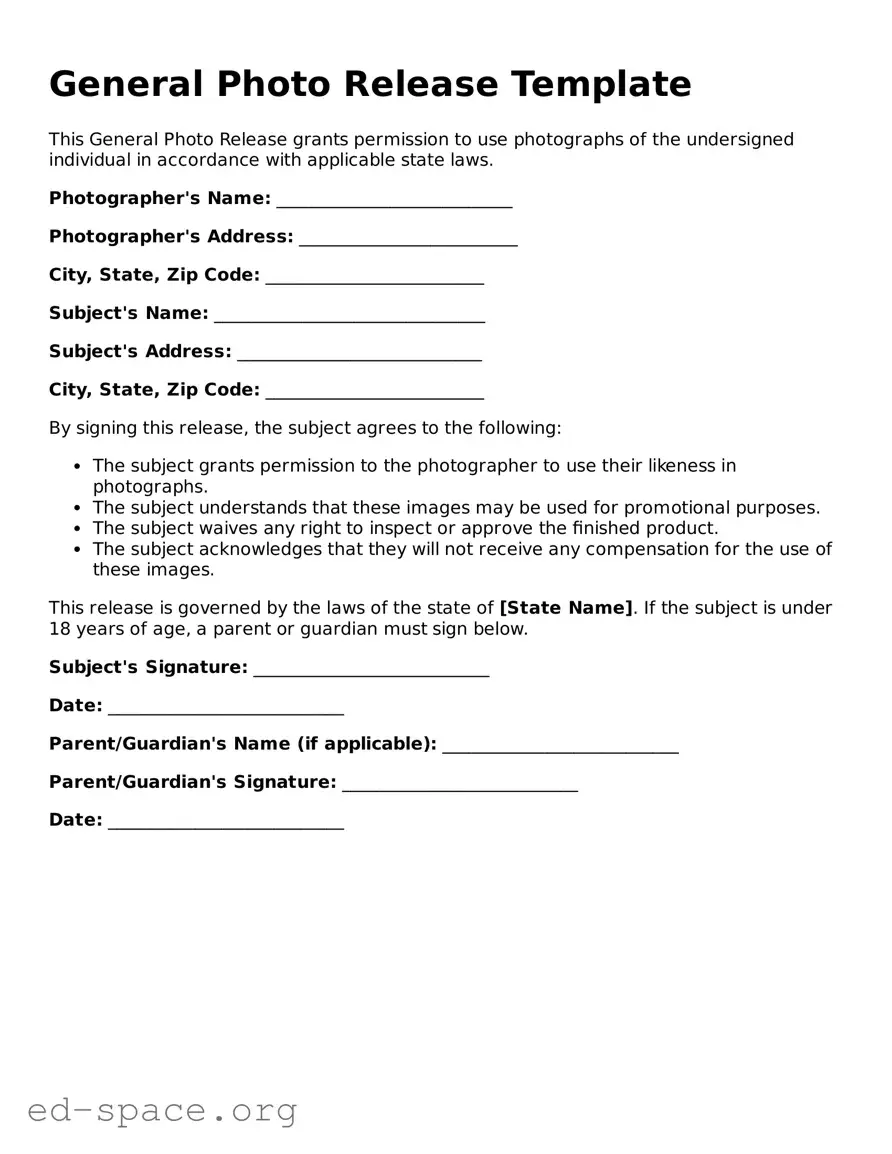
The General Photo Release form serves as an essential tool for individuals and organizations seeking to obtain permission to use photographs of people for various purposes. This form outlines the rights and responsibilities of both the photographer and the subjects featured in the images. By signing this document, individuals grant permission for their likeness to be used in promotional materials, websites, social media, and other platforms, ensuring that the photographer or organization can utilize the images without legal complications. The form typically includes important details such as the scope of use, duration of permission, and any compensation involved. It also clarifies whether the subjects have the right to revoke their consent in the future. Understanding the implications of the General Photo Release form is crucial for anyone involved in photography, marketing, or public relations, as it helps protect both the creator's interests and the rights of individuals being photographed.
General Photo Release Template
This General Photo Release grants permission to use photographs of the undersigned individual in accordance with applicable state laws.
Photographer's Name: ___________________________
Photographer's Address: _________________________
City, State, Zip Code: _________________________
Subject's Name: _______________________________
Subject's Address: ____________________________
City, State, Zip Code: _________________________
By signing this release, the subject agrees to the following:
This release is governed by the laws of the state of [State Name]. If the subject is under 18 years of age, a parent or guardian must sign below.
Subject's Signature: ___________________________
Date: ___________________________
Parent/Guardian's Name (if applicable): ___________________________
Parent/Guardian's Signature: ___________________________
Date: ___________________________
| Fact Name | Description |
|---|---|
| Purpose | A General Photo Release form grants permission to use an individual's image for various purposes, such as marketing or promotional materials. |
| Consent | By signing the form, individuals provide their consent for the use of their photographs, ensuring that their rights are respected. |
| Scope of Use | The release typically specifies how the images may be used, which can include print, online, and social media platforms. |
| Compensation | Some releases may include terms regarding compensation, though many are signed without any financial exchange. |
| Revocation | Individuals may have the right to revoke their consent, but this often depends on the terms outlined in the release. |
| State-Specific Forms | Different states may have specific requirements for photo releases, governed by local laws regarding privacy and publicity rights. |
| Minors | When a minor is involved, a parent or guardian must sign the release to provide legal consent. |
| Duration | The release may specify a duration for which the permission is granted, or it may be indefinite. |
| Legal Protection | A signed release can protect the photographer or organization from potential legal disputes regarding the use of images. |
| Best Practices | It is advisable to keep a copy of the signed release for record-keeping and to ensure compliance with its terms. |
Filling out the General Photo Release form is a straightforward process that allows you to give permission for your images to be used. This form is essential for ensuring that both parties understand the terms of use for the photographs. Follow the steps below to complete the form accurately.
Once you have filled out the form, make sure to keep a copy for your records. This will help you reference the agreement if needed in the future.
What is a General Photo Release form?
A General Photo Release form is a document that allows a photographer or organization to use images of individuals for various purposes. This can include marketing materials, websites, social media, and other promotional uses. By signing this form, individuals give permission for their likeness to be used without compensation.
Why should I sign a General Photo Release form?
Signing a General Photo Release form helps protect both the photographer and the person being photographed. It ensures that there is clear consent for the use of images. This can be especially important in commercial settings, where the images may be used to promote products or services. It also helps avoid any misunderstandings about how the images will be used.
Can I revoke my permission after signing the form?
Once you sign a General Photo Release form, it generally means you give permission for the use of your images as outlined in the document. However, if you have concerns or wish to revoke your permission, it's best to discuss this with the photographer or organization. They may have policies in place regarding revocation, but it is not guaranteed that you can withdraw your consent after the fact.
Do I get paid for my photos if I sign a General Photo Release?
Typically, signing a General Photo Release form does not guarantee payment for the use of your photos. Many times, individuals sign these forms in exchange for the opportunity to be featured in promotional materials. If payment is a concern, it’s important to clarify this with the photographer or organization before signing.
Are there any age restrictions for signing a General Photo Release form?
Yes, there are usually age restrictions. Individuals under the age of 18 typically cannot sign a General Photo Release form without parental consent. A parent or guardian may need to sign the form on behalf of a minor. This ensures that the rights of the minor are protected and that the parent or guardian is aware of how the images will be used.
Not Reading the Entire Form
Many individuals rush through the General Photo Release form without fully understanding its contents. This can lead to misunderstandings about what rights they are granting. It’s essential to take the time to read every section carefully.
Failing to Specify Usage
Another common mistake is not clearly specifying how the photos will be used. Without clear terms, the release may be too broad or vague, which could lead to future disputes. Always clarify the intended use of the images.
Not Including a Date
Some people forget to include the date when signing the form. This is crucial, as it establishes when the consent was given. Without a date, there may be confusion regarding the timeline of the agreement.
Ignoring Revocation Rights
Many do not realize that they have the right to revoke the release under certain circumstances. It’s important to understand these rights and ensure they are clearly stated in the form. Ignoring this aspect can lead to complications down the line.
When using a General Photo Release form, several other documents can complement it to ensure a comprehensive understanding of rights and responsibilities. These documents help clarify usage, permissions, and any associated agreements. Below are some commonly used forms alongside the General Photo Release.
Using these forms in conjunction with the General Photo Release can provide clear guidelines and protect the interests of all parties involved. Understanding each document's purpose is essential for effective collaboration and legal compliance in photography projects.
The General Photo Release form is an important document that allows photographers and organizations to obtain permission to use images of individuals for various purposes. Several other documents serve similar functions, each with its unique focus and application. Here are eight documents that share similarities with the General Photo Release form:
Each of these documents serves to protect the rights of individuals and creators while facilitating the use of images in various contexts. Understanding their similarities can help ensure that all parties are informed and consent is properly obtained.
When filling out a General Photo Release form, it is important to approach the task with care. Here are some dos and don'ts to consider:
Misconception 1: A photo release form is only necessary for professional photographers.
Many people believe that only professional photographers need to use a photo release form. In reality, anyone taking photos of individuals, including amateurs, should consider obtaining a release to protect themselves legally.
Misconception 2: A photo release form is the same as a model release form.
While both forms serve similar purposes, a photo release form typically covers the right to use the image for any purpose, while a model release specifically pertains to the use of a person's likeness for commercial purposes.
Misconception 3: You only need a photo release if the subject is a minor.
It is a common belief that releases are only necessary for minors. However, obtaining a release from adults is equally important to avoid potential legal issues.
Misconception 4: Verbal consent is sufficient.
Some individuals think that a simple verbal agreement is enough. In most cases, written consent is preferable as it provides clear evidence of permission.
Misconception 5: A photo release form is only needed for commercial use.
While commercial use is a primary reason for obtaining a release, it is also wise to have one for personal or non-commercial projects to avoid any misunderstandings.
Misconception 6: Once signed, a photo release form cannot be revoked.
Many people assume that a signed release is permanent. However, individuals can revoke their consent in certain circumstances, especially if the use of the image changes significantly.
Misconception 7: All photo release forms are the same.
Not all forms are created equal. Different situations may require different terms and conditions, so it is important to tailor the form to the specific use case.
Misconception 8: A photo release form protects only the photographer.
While the photographer does benefit from having a release, the subject also gains protection by clearly defining how their image will be used.
Misconception 9: You can use a photo without a release if the subject is in a public place.
This is a common misunderstanding. Even in public spaces, individuals have rights regarding the use of their likeness, and a release is often still advisable.
Misconception 10: A photo release form is only necessary for still images.
Many people think releases are only needed for photographs. However, video recordings also require similar consent to ensure proper usage rights.
When it comes to filling out and using a General Photo Release form, there are several important points to keep in mind. Here are some key takeaways:
Using a General Photo Release form correctly can protect both the individual and the entity using the images. Always approach the process with care and consideration.