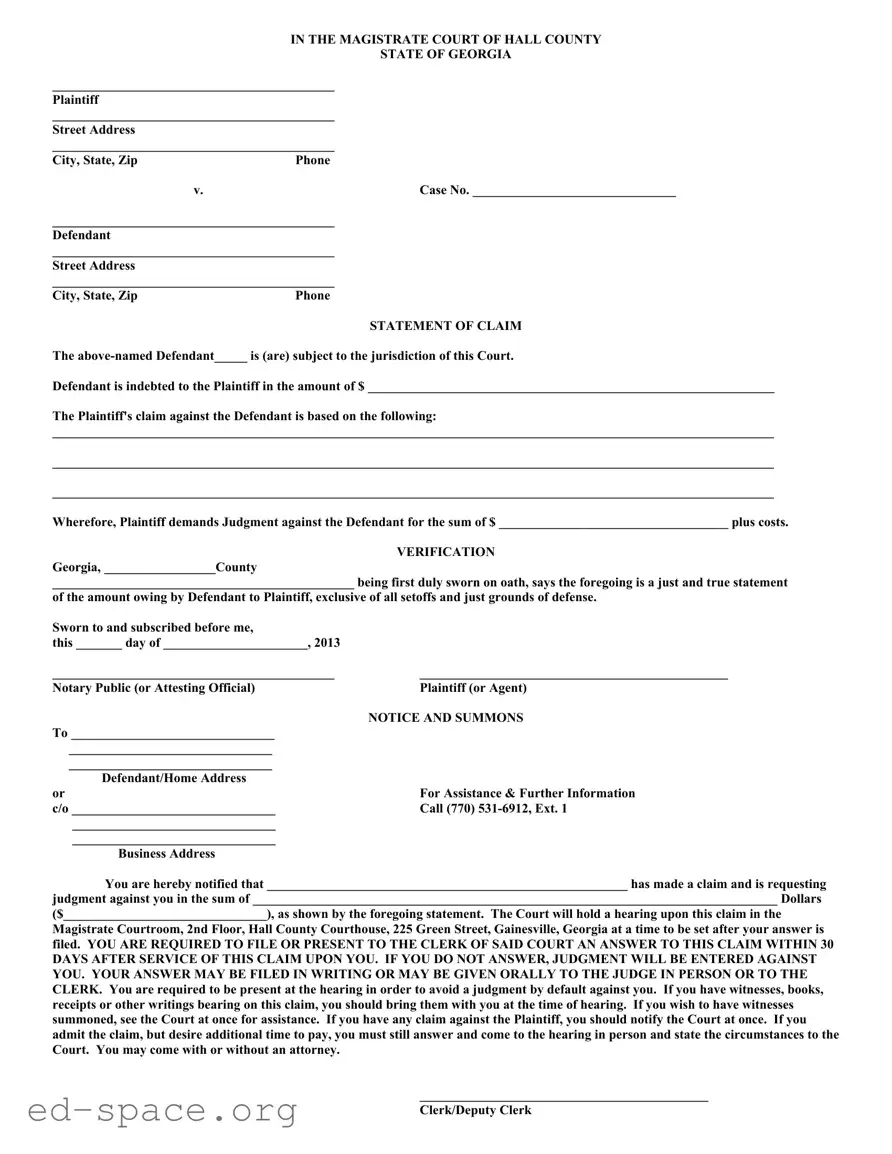
In Fulton County, Georgia, the Writ of Form serves as a critical document within the legal framework of the Magistrate Court, facilitating the resolution of disputes between parties. This form initiates a process whereby a plaintiff asserts a claim against a defendant, outlining the specific amounts owed and the basis for the claim. Essential components of the form include the identification of both parties, the statement of claim detailing the nature of the debt, and the verification section, which ensures the accuracy of the information provided. Furthermore, the form includes a notice and summons, informing the defendant of the impending legal action and the necessity of responding within a designated timeframe. The document emphasizes the importance of attending the scheduled court hearing, where both parties can present their cases. This procedural structure is designed to uphold fairness and transparency, allowing individuals to address their grievances and seek justice in a manner that respects their rights and responsibilities.
IN THE MAGISTRATE COURT OF HALL COUNTY
STATE OF GEORGIA
___________________________________________
Plaintiff
___________________________________________
Street Address
___________________________________________
City, State, Zip |
Phone |
v. |
Case No. _______________________________ |
___________________________________________
Defendant
___________________________________________
Street Address
___________________________________________
City, State, Zip |
Phone |
|
STATEMENT OF CLAIM |
The
Defendant is indebted to the Plaintiff in the amount of $ ______________________________________________________________
The Plaintiff's claim against the Defendant is based on the following:
______________________________________________________________________________________________________________
______________________________________________________________________________________________________________
______________________________________________________________________________________________________________
Wherefore, Plaintiff demands Judgment against the Defendant for the sum of $ ___________________________________ plus costs.
VERIFICATION
Georgia, _________________County
______________________________________________ being first duly sworn on oath, says the foregoing is a just and true statement
of the amount owing by Defendant to Plaintiff, exclusive of all setoffs and just grounds of defense.
Sworn to and subscribed before me,
this _______ day of ______________________, 2013
___________________________________________ |
_______________________________________________ |
Notary Public (or Attesting Official) |
Plaintiff (or Agent) |
|
NOTICE AND SUMMONS |
To _______________________________ |
|
_______________________________ |
|
_______________________________ |
|
Defendant/Home Address |
|
or |
For Assistance & Further Information |
c/o _______________________________ |
Call (770) |
_______________________________ |
|
_______________________________ |
|
Business Address |
|
You are hereby notified that _______________________________________________________ has made a claim and is requesting
judgment against you in the sum of ________________________________________________________________________________ Dollars
($_______________________________), as shown by the foregoing statement. The Court will hold a hearing upon this claim in the
Magistrate Courtroom, 2nd Floor, Hall County Courthouse, 225 Green Street, Gainesville, Georgia at a time to be set after your answer is filed. YOU ARE REQUIRED TO FILE OR PRESENT TO THE CLERK OF SAID COURT AN ANSWER TO THIS CLAIM WITHIN 30 DAYS AFTER SERVICE OF THIS CLAIM UPON YOU. IF YOU DO NOT ANSWER, JUDGMENT WILL BE ENTERED AGAINST YOU. YOUR ANSWER MAY BE FILED IN WRITING OR MAY BE GIVEN ORALLY TO THE JUDGE IN PERSON OR TO THE CLERK. You are required to be present at the hearing in order to avoid a judgment by default against you. If you have witnesses, books, receipts or other writings bearing on this claim, you should bring them with you at the time of hearing. If you wish to have witnesses summoned, see the Court at once for assistance. If you have any claim against the Plaintiff, you should notify the Court at once. If you admit the claim, but desire additional time to pay, you must still answer and come to the hearing in person and state the circumstances to the Court. You may come with or without an attorney.
____________________________________________
Clerk/Deputy Clerk
| Fact Name | Description |
|---|---|
| Governing Law | The Writ of Claim in Fulton County, Georgia, is governed by the Official Code of Georgia Annotated (O.C.G.A.) § 15-10-1 et seq. |
| Court Jurisdiction | The Magistrate Court has jurisdiction over claims involving amounts up to $15,000. |
| Filing Deadline | Defendants must file an answer within 30 days of receiving the claim to avoid a default judgment. |
| Hearing Location | The hearing takes place in the Magistrate Courtroom on the 2nd Floor of the Hall County Courthouse. |
| Claim Amount | The Plaintiff must specify the exact amount owed by the Defendant in the claim. |
| Verification Requirement | The Plaintiff must verify the claim under oath, attesting to its truthfulness. |
| Witnesses | Parties are encouraged to bring witnesses and relevant documents to the hearing. |
| Legal Representation | Defendants may attend the hearing with or without an attorney. |
| Default Judgment | If the Defendant fails to respond, the court may enter a judgment in favor of the Plaintiff automatically. |
Filling out the Fulton County Georgia Writ Of form is a straightforward process. After completing the form, you will need to file it with the appropriate court. Ensure that all information is accurate to avoid delays in your case.
What is a Writ of Form in Fulton County, Georgia?
A Writ of Form is a legal document filed in the Magistrate Court that initiates a claim against a defendant. It outlines the plaintiff's allegations and requests a judgment for a specific amount of money owed. This form is essential for starting a legal process to recover debts or resolve disputes in Fulton County.
How do I fill out the Writ of Form?
To fill out the Writ of Form, you need to provide details about both the plaintiff and the defendant, including names, addresses, and phone numbers. You must also state the amount owed and the basis for the claim. Be clear and concise in your description. After completing the form, it needs to be signed and verified before a notary public.
What happens after I file the Writ of Form?
Once you file the Writ of Form, the court will notify the defendant of the claim. A hearing will be scheduled, and both parties will have the opportunity to present their cases. The defendant must respond within 30 days, or a judgment may be entered against them by default.
What if the defendant does not respond to the Writ of Form?
If the defendant fails to respond within the 30-day period, the court may issue a judgment in favor of the plaintiff. This means the plaintiff can then take steps to collect the amount owed, which may include garnishing wages or placing liens on property.
Can I attend the hearing without an attorney?
Yes, you can attend the hearing without an attorney. However, having legal representation can be beneficial. If you choose to represent yourself, be prepared to present your case clearly and bring any supporting documents or witnesses to strengthen your argument.
What should I do if I have a counterclaim against the plaintiff?
If you have a counterclaim against the plaintiff, it’s crucial to notify the court immediately. You can include your counterclaim in your response to the Writ of Form. Make sure to provide evidence and details to support your claim during the hearing.
Incomplete Information: Failing to fill out all required fields can lead to delays or dismissals. Ensure every section, including names and addresses, is complete.
Incorrect Case Number: Always double-check that the case number is accurate. An incorrect number can confuse the court and parties involved.
Missing Signature: Omitting your signature on the form is a common mistake. Always sign the document to validate your claim.
Vague Statements: Providing unclear or vague statements about the claim can weaken your case. Be specific about the nature of the debt and the amount owed.
Not Meeting Deadlines: Failing to file the form within the required time frame can result in losing your right to claim. Be aware of all deadlines.
Ignoring Verification Requirements: Not including a verification statement can lead to your claim being dismissed. Ensure you include the necessary sworn statement.
Incorrect Jurisdiction: Make sure the defendant is subject to the jurisdiction of the court you are filing in. Misplacing jurisdiction can invalidate your claim.
Failure to Notify the Defendant: Not properly notifying the defendant can result in a default judgment. Follow all procedures for serving the defendant to ensure they are aware of the claim.
When dealing with a Fulton County Georgia Writ of form, several other documents may be necessary to support your case. Each of these documents serves a specific purpose and can help clarify the situation at hand. Below is a list of common forms and documents often used alongside the Writ of form.
Understanding these documents can help you navigate the legal process more effectively. Each form plays an important role in ensuring that your case is presented clearly and fairly in court.
The Fulton County Georgia Writ of form shares similarities with several other legal documents. Each serves a specific purpose in the legal process, often related to claims and judgments. Here are five documents that are comparable to the Writ of form:
When filling out the Fulton County Georgia Writ Of form, there are important guidelines to follow. Here’s a list of things you should and shouldn't do:
Misconceptions about the Fulton County Georgia Writ Of form can lead to confusion. Here are four common misunderstandings:
Understanding these points can help you navigate the process more effectively. Stay informed and proactive to protect your rights.
Filling out and using the Fulton County Georgia Writ Of form requires attention to detail and understanding of the process. Here are key takeaways to consider:
Understanding these aspects can help navigate the process more effectively and ensure that all necessary steps are taken.