The Fourth Step Inventory form is a vital tool for individuals seeking to reflect on their character and behaviors in a structured manner. Rooted in the principles of Alcoholics Anonymous, this form encourages users to identify both their strengths and weaknesses. The worksheets draw directly from the Big Book, specifically pages 63-71, and emphasize the importance of honesty and fairness during this introspective process. While some sections are labeled as optional, many find that writing down their perceived flaws and assets enhances their understanding of personal growth. This inventory is not merely about cataloging defects; it is an opportunity to explore one’s moral values and how they align with current behaviors. Users are advised to focus on the flaws that create the most significant challenges in their lives, prioritizing their insights for deeper reflection. The form also highlights that this exercise is about the present self, rather than past actions influenced by substance use. It serves as a reminder that self-improvement is an ongoing journey, with the acknowledgment that character defects may not vanish immediately after completing the subsequent steps. Ultimately, the Fourth Step Inventory form provides a comprehensive framework for self-examination, enabling individuals to take actionable steps towards personal accountability and growth.

FOURTH STEP INVENTORY
These Fourth Step worksheets use the wording from Alcoholics Anonymous (the Big Book) pages
Remember, these worksheets are meant to be helpful, but do not feel restricted by them.
You can get the latest version of these worksheets and other AA materials at www.royy.com.
These worksheets are not officially produced or approved by Alcoholics Anonymous. They have been circulating unofficially
among AA members for at least 50 years in various versions. Their origin is unknown to the producer of this version.
hR 1/1/2005

HELPFUL HINTS
PREPARATION: before you start this written Fourth Step, read pages
NOTE:
1.This inventory is not an exercise in beating yourself up. Be scrupulously honest but be fair to yourself. Inventory your strengths as well as your defects.
2.The following checklist merely suggests what some people consider flaws. You must decide how they fit with your own moral code. Do not be limited by this
functional and dysfunctional
3.This inventory is about who you are now, not who you were when you were drinking and taking drugs. Be careful, however, not to blame all past bad behavior on drinking and drugs if the seed of that bad behavior still exists in you.
4.Don't be discouraged when your character defects are not immediately lifted after you
have completed your 5th
5.Prioritize! Spend most of your time on
the 20% of your flaws that cause 80% of the trouble in your life. You can initially check off as many flaws as you want on the checklist but then prioritize to the 12 that cause the most trouble. If you list more
than 12 flaws, you are probably beating yourself up! You must check at lease twice as many assets as you check flaws or you really are beating yourself up.
INTO ACTION: On the following list, check all of your defects and all of your assets. This is an inventory of both bad and good characteristics. Then discuss your defects (with your best example of each) on the Review of Flaws form.
ROYY@ROYY.COM
Glossary of Words Used in Steps Four and Five
Moral Inventory |
..A list of personality defects, violations of moral |
|
principles, defects in character, maladjustments, |
|
and dysfunctional behavior. |
Character |
Moral vigor or firmness, especially as acquired |
|
through |
Defect |
Lack of something necessary for completeness; flaw; |
|
weakness, fault; same as Shortcoming. |
Dishonest |
The act or practice of telling a lie, or of cheating, |
|
deceiving, stealing, etc. |
Exact |
Precise, detailed. |
Fault |
Something done wrongly, an error or mistake. |
Fear |
Painful emotion marked by alarm, dread, anxiety, |
|
agitation, uneasiness, apprehension, etc. |
Frightened |
A temporary or continual state of Fear. Anxious. |
Inconsiderate |
Without thought or consideration of others. |
Nature |
The essential characteristic of a thing. |
Occupying or concerned only with one’s own affairs |
|
|
(same as Selfish). |
A person who seeks only or mainly to further his |
|
|
own interests. |
Selfish |
Too much concerned with one’s own welfare or |
|
interests and having little or no concern for others |
|
(same as |
Shortcoming |
Falling short of what is expected or required (same |
|
as Defect). |
Wrong |
Immoral, improper; not suitable or appropriate. |
Footnotes to the list on following page:
1Dr. Bob’s Fourth Step List; in “He Sold Himself Short,” (Alcoholics Anonymous, p. 292)
2 Seven Deadly Sins (Twelve Steps and Twelve Traditions, p. 48)
3Clarence Snyder’s Fourth Step List (one of the original 40 members of AA, see “Home Brewmeister,” Alcoholics Anonymous, pp.
4 Boy Scout Law, Robert Binkey's The Official Boy Scout Handbook (10th edition, 1990)(so?
- 1 -

4 Character Defect |
|
|
|
Opposite Asset 4 |
|
aggressive, belligerent |
|
||||
angry2 |
|
|
forgiving, calm, generous |
||
apathetic |
|
|
interested, concerned, alert |
||
apprehensive, afraid |
|
|
|
calm, courageous |
|
argumentative, quarrelsome |
|
agreeable |
|||
arrogant, insolent |
|
|
unassuming, humble |
||
attacking, critical |
|
|
|
fair, |
|
avoidant |
|
|
faces problems and acts |
||
blocking |
|
|
|
|
honest, intuitive |
boastful |
|
|
|
|
modest, humble |
careless1 |
|
careful, painstaking, concerned |
|||
cheating |
|
|
|
|
honest |
competitive (socially) |
|
|
cooperative |
||
compulsive |
|
|
|
|
free |
|
humble, modest |
||||
contradictory, oppositional| |
reasonable, agreeable |
||||
contrary, intractable, pigheaded |
reasonable |
||||
controlling |
|
|
lets go, esp. of other's lives |
||
cowardly |
|
|
|
|
brave 4 |
critical 3 |
|||||
cynical |
|
|
|
|
|
deceitful |
|
|
|
|
guileless, honest |
defensive |
|
|
|
|
open to criticism |
defiant, contemptuous |
|
|
respectful |
||
denying |
|
|
|
|
honest, accepting |
dependent |
|
accepts help but is |
|||
depressed, morose| |
hopeful, optimistic, cheerful 4 |
||||
dirty, poor hygiene |
|
|
|
clean 4 |
|
dishonest3 |
|
|
|
|
honest |
disloyal, treacherous |
|
|
faithful, loyal 4 |
||
disobedient |
|
|
|
|
obedient 4 |
disrespectful, insolent |
|
respectful, reverent 4 |
|||
enabling |
|
setting boundaries, tough love |
|||
envying2,3 |
|
empathetic, generous, admiring |
|||
evasive, deceitful |
|
candid, straightforward |
|||
exaggerating |
|
|
|
|
honest, realistic |
faithless, disloyal |
|
|
|
reliable, faithful |
|
falsely modest |
|
|
honest, has |
||
falsely prideful2,3 |
|
|
|
modest, humble |
|
fantasizing, unrealistic |
|
|
practical, realistic |
||
fearful3 |
|
|
|
confidant, courageous |
|
Checklist of Flaws and Assets
forgetful |
|
responsible |
gluttonous2, excessive |
moderate |
|
gossiping3 |
|
|
greedy 2,3 |
|
moderate, generous, sharing |
hateful3 |
forgiving, loving, concerned for others |
|
hypersensitive |
tolerant, doesn't personalize |
|
impatient3 |
|
patient |
impulsive, reckless| |
consistent, considered actions |
||
inconsiderate |
|
|
thoughtful, considerate |
indecisive, timid |
|
firm, decisive |
|
indifferent, apathetic, aloof |
caring |
||
inflexible, stubborn |
|
||
insecure, anxious |
|
||
insincere3, hypocritical |
sincere, honest |
||
intolerant1 |
|
tolerant, understanding, patient |
|
irresponsible, reckless |
responsible |
||
isolating, solitary |
|
sociable, outgoing |
|
jealous1,3 |
|
trusting, generous, admiring |
|
judgmental |
|
|
broadminded, tolerant |
justifying (own actions) |
honest, frank, candid |
||
lack of purpose |
|
purposeful |
|
lazy, indolent |
|
industrious, conscientious |
|
loud |
|
|
tasteful, quiet |
lustful2 |
|
|
healthy sexuality |
lying3 |
|
|
honest |
manipulative |
|
candid, honest, |
|
masked, closed |
|
honest, open, candid |
|
nagging |
|
|
supportive |
narrow minded |
|
open minded |
|
obscene, crude |
|
modest, courteous |
|
over emotional |
|
emotionally stable |
|
perfectionistic |
|
realistic goals |
|
pessimistic| |
realistic, hopeful, optimistic, trusting |
||
possessive |
|
|
generous |
prejudiced |
|
|
|
procrastinates3 |
disciplined, acts promptly |
||
projecting (negative) |
clear sighted, optimistic |
||
rationalizing |
|
|
candid, honest |
resentful1,3, |
bitter, hateful |
forgiving |
|
resisting growing |
|
willing to grow |
|
rude, discourteous |
|
polite, courteous 4 |
|
sarcastic1 |
|
praising, tolerant |
|
|
humble, modest |
||
|
caring of others |
||
|
|||
|
admitting wrongs, humble |
||
|
grateful, realistic, accepting |
||
|
humble, understanding |
||
|
selfless, concerned for others |
||
selfish1,3 |
altruistic, concerned with others |
||
shy |
|
|
outgoing |
slothful (lazy)2,3 |
|
industrious, taking action |
|
spiteful, malicious |
|
|
forgiving |
stealing |
|
|
honest |
stubborn |
|
||
sullen |
|
|
cheerful |
superior, grandiose, pretentious |
humble |
||
superstitious |
|
realistic, no magical thinking |
|
suspicious |
|
|
trusting |
tense |
|
|
calm, serene |
thinking negatively3 |
|
being positive |
|
treacherous |
|
|
trustworthy |
undisciplined, |
disciplined |
||
unfair |
|
|
fair |
unfriendly, hostile, bitchy |
friendly4 |
||
ungrateful |
|
thankful, grateful |
|
unkind, mean, malicious, spiteful |
kind 4 |
||
unsupportive of others |
|
supportive |
|
untrustworthy, unreliable, dishonest| |
trustworthy 4 |
||
useless, destructive |
|
|
helpful 4 |
vain |
|
modest, humble |
|
vindictive |
|
|
forgiving |
violent |
|
|
gentle |
vulgar3 |
|
|
polite |
wasteful |
|
|
thrifty 4 |
willful |
|
accepting of the inevitable |
|
withdrawn |
|
|
outgoing |
wordy, verbose |
|
frank, to the point, succinct |
|
Other dysfunctional ways of acting, feeling or thinking which cause others or me pain (specify in the following Review of Flaws).
See source footnotes on page 2.
- 2 -

Instructions for Completion |
REVIEW OF FLAWS |
First, we searched out the flaws in our |
(optional) |
FLAW
Give your best example of this specific flaw in your life.
1
2
3
4
5
6
7
8
9
- 3 -

10
11
12
FLAW
Give your best example of this specific flaw in your life.
If you must list additional flaws do so below. Do not beat yourself up.
- 4 -
RESENTMENTS
Do not be restricted by this list. It is just to help you get started. List your resentments on the next pages.
PEOPLE |
||
Father |
Judges |
|
Mother |
Lawyers |
|
Boy Friends/Lovers |
||
Brothers |
Parole Officers |
|
Sisters |
Police |
|
Sponsors |
Probation Officers |
|
Employers |
School Friends |
|
A.A. Friends |
Teachers |
|
Acquaintances |
Uncles |
|
Aunts |
Wives |
|
Best Friends |
INSTITUTIONS |
|
C.A. Friends |
||
Authority |
||
Childhood Friends |
||
Bible |
||
Clergy |
||
Child Protection |
||
Church |
||
Cousins |
||
Correctional System |
||
Creditors |
||
Education System |
||
Doctors |
||
Government |
||
Employees |
||
Law |
||
Girl Friends |
||
Marriage |
||
Husbands |
||
Health/Mental Health System |
||
|
Nationality
Philosophy
Races
Religion
Society
PRINCIPLES
Adultery
Death
Golden Rule
Heaven
Hell
Homophobia
Jesus Christ
Life After Death
Original Sin
Retribution
Satan
Seven Deadly Sins
Sin
Ten Commandments
MORE from your experience!
- 5 -
Step Four Resentments Checklist Column 4*
“Putting out of our minds the wrongs others had done, we resolutely looked for our own mistakes. Where had we been selfish, dishonest,
SELFISH
•Not seeing others point of view, problems or needs
•Wanting things my way
•Wanting special treatment
•Wanting others to meet my needs– dependence
•Wanting what others have
•Wanting to
•Thinking I'm
•Wanting to be the best
•Thinking others are jealous
•Wanting others to be like me
•Being miserly, possessive
•Wanting more than my share
•Reacting from self loathing, self righteousness
•Too concerned about me
•Not trying to be a friend
•Wanting to look good or be liked
•Concerned only with my needs
DISHONEST
•Not seeing or admitting where I was at fault
•Having a superior
•Blaming others for my problems
•Not admitting I've done the same thing
•Not expressing feelings or ideas
•Not being clear about motives
•Lying, cheating, stealing
•Hiding
•Stubbornly holding on to inaccurate beliefs
•Breaking rules
•Lying to myself
•Exaggerating, minimalizing
•Setting myself up to be “wronged”
•Expecting others to be what they are not
•Being perfectionistic
SELF SEEKING
•Manipulating others to do my will
•Putting others down internally or externally to build me up
•Engaging in character assassination
•Acting superior
•Acting to fill a void
•Engaging in gluttony or lusting at the expense of another person
•Ignoring others’ needs
•Trying to control others
•Getting revenge when I don't get what I want
•Holding a resentment
•Acting to make me feel good
FRIGHTENED (OF)
•Peoples' opinions
•Rejection, abandonment
•Loneliness
•Physical injury, abuse
•Not being able to control or change someone
•My inferiority, inadequacy
•Criticism
•Expressing ideas or feelings
•Getting trapped
•Expo sure, embarrassment
_______________
*Thanks to Anonymous in New England.
- 6 -
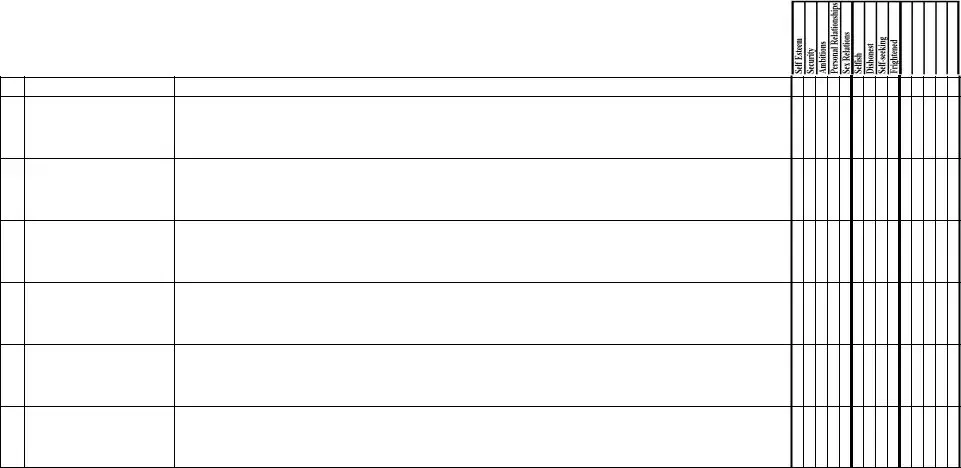
Instructions for Completion
Complete each column top to bottom before proceeding to the next column.
Thus, for instance, fill in all the names of those you are resentful at
before filling in the column for the cause of each resentment. List real resentments, not imaginary or theoretical resentments. Is the resentment a problem for you, does it cause you pain?
Column 1 In dealing with resentments we set them on paper. We listed people, institutions or principles with whom we were angry. Column 2 We asked ourselves why we were angry.
Column 3 On our grudge list we set opposite each name our injuries. Was it our
Column 4 Referring to our list again. Putting out of our minds the wrongs others had done, we resolutely looked for our own mistakes. Where had we been selfish, dishonest,
Column 5 This Column is optional. List specific other defects to show your participation in the resentments.
Reading from left to right we now see the resentment (Column 1), the cause (Column 2), the part of self that had been affected (Column 3), and the exact nature of the defect within us that allowed the resentment to surface and block us off from God’s will (Columns 4 and 5).
COLUMN 1 |
COLUMN 2 |
REVIEW OF RESENTMENTS
“SELF”
COLUMN 3 |
COL. 4 |
COLUMN 5 |
Affects My |
My |
Specific |
|
Own |
Defects |
|
Mistakes |
(optional) |
I’m RESENTFUL at:
The Cause:
1
2
3
4
5
6
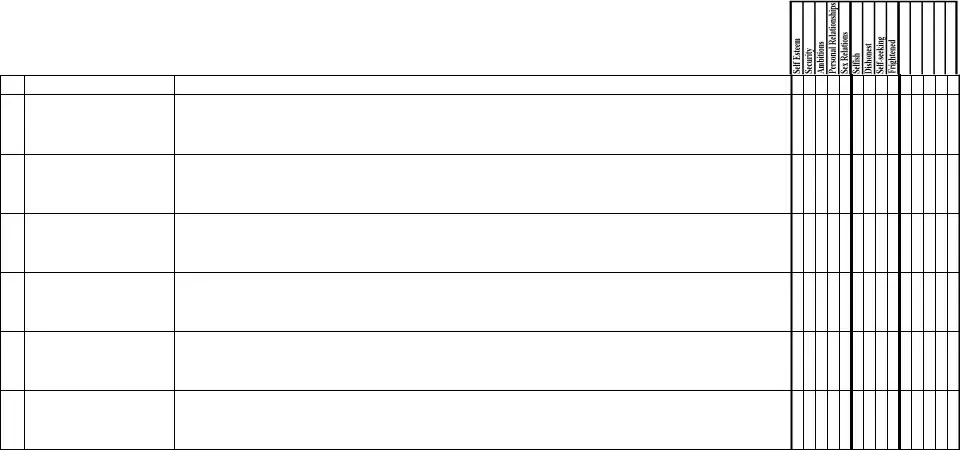
I’m RESENTFUL at:
The Cause
7
8
9
10
11
12
If you must list additional resentments do so below.
- 8 -
FEARS
Do not be restricted by this list. It is just to help you get started. List your fears on the next pages
abandonment |
flying |
needing anyone |
aging |
fourth & fifth steps |
not being good enough |
anger |
future, the |
not being happy |
authority figures |
getting fat or thin |
not being liked |
being alone |
God |
not being perfect |
being deceived |
going home |
people (specify who) |
being found out |
going out on a “whim” |
police, the |
being myself |
having children |
poverty |
change |
homelessness |
procrastination |
compliments |
homosexuality |
rape |
confrontation |
honesty |
rejection |
creditors |
humiliation |
relationships |
death |
hurting others |
resentments, my |
denial, my |
I’m a fraud and others will find out |
responsibility |
disapproval |
incarceration |
risks |
disease |
intimacy |
saying that I can’t do something |
divorce |
IRS, the |
sex |
embarrassment |
letting go |
sponsor, my |
employment |
living |
success |
facing myself |
loneliness |
unemployment |
failure |
losing hope |
unknown, the |
fear |
love |
violence |
feelings |
mediocrity |
work |
financial insecurity |
money |
Search your own experience for other fears.. |
| Fact Name | Description |
|---|---|
| Source | The Fourth Step Inventory form is based on the wording from Alcoholics Anonymous (the Big Book), specifically pages 63-71. |
| Optional Elements | The form includes optional sections, suggesting that while writing down flaws can be beneficial, it is not required. |
| History | This form has been used informally among AA members for over 50 years, though it is not officially recognized by Alcoholics Anonymous. |
| Purpose | The inventory aims to help individuals identify both their flaws and strengths, promoting a balanced self-assessment. |
Filling out the Fourth Step Inventory form is a personal journey that allows you to reflect on your character traits, both positive and negative. This process is designed to help you identify areas of growth and understanding, leading to a deeper awareness of your values and behaviors. Once you complete this inventory, you will be ready to discuss your findings in the next steps of your journey.
What is the Fourth Step Inventory form?
The Fourth Step Inventory form is a tool used in the recovery process, particularly within Alcoholics Anonymous (AA). It helps individuals identify and assess their personal flaws and strengths. The form is based on the principles outlined in the Big Book of Alcoholics Anonymous, specifically pages 63-71. It encourages self-reflection and honesty while guiding users to understand their moral values and behaviors.
How should I prepare to complete the Fourth Step Inventory?
Before starting the Fourth Step Inventory, it is recommended to read pages 63-71 in the Big Book, as well as the Fourth Step in the Twelve Steps and Twelve Traditions. This preparation will provide context and understanding of the process. It is important to approach this inventory with an open mind and a willingness to be honest about both strengths and weaknesses.
Is it necessary to write down my flaws and assets?
While the Big Book suggests that writing is optional, many individuals find it beneficial to document their flaws and assets. Writing them down can help clarify thoughts and feelings, making it easier to discuss them later. It is important to remember that the worksheets are meant to be helpful, and individuals should not feel restricted by them.
What if I feel overwhelmed by my flaws?
It is common to feel overwhelmed when confronting personal flaws. The process is not meant to be punitive. Focus on being fair to yourself and recognize that everyone has strengths and weaknesses. Prioritize the flaws that cause the most trouble in your life. If you find yourself listing too many flaws, consider narrowing it down to the twelve that are most significant.
Can I include additional flaws or assets not listed on the form?
Yes, individuals are encouraged to add any other flaws or assets that may not be included in the checklist. The checklist serves as a guide, but it is important to personalize the inventory to reflect one's own moral code and experiences. This self-assessment is about understanding oneself more deeply.
What should I do after completing the Fourth Step Inventory?
After completing the inventory, the next step is to review the identified flaws. This involves discussing each flaw and providing a personal example of how it has manifested in your life. This discussion can take place with a sponsor, a trusted friend, or in a support group setting. This step is crucial for accountability and growth.
How does this inventory relate to the other steps in the recovery process?
The Fourth Step Inventory is part of a larger recovery process that includes several other steps. It is important to understand that addressing character defects is an ongoing journey. While the inventory may reveal flaws, it is the subsequent steps that focus on growth and healing. Do not expect immediate changes; the work continues through the 6th, 7th, and 10th Steps.
Neglecting to Read the Big Book: Many individuals jump straight into filling out the Fourth Step Inventory without first reading pages 63-71 of the Big Book. This crucial step provides context and guidance, helping to ensure that the inventory is meaningful and aligned with the principles of Alcoholics Anonymous.
Focusing Solely on Flaws: It's easy to get caught up in identifying defects without balancing them with personal strengths. The inventory is designed to include both flaws and assets, promoting a more comprehensive self-assessment.
Blaming Past Behavior on Substance Use: Some people mistakenly attribute all their past actions to alcohol or drugs. While these substances may have influenced behavior, it’s essential to recognize that the underlying issues may still exist independently.
Listing Too Many Flaws: A common mistake is checking off numerous flaws without prioritizing them. It’s recommended to focus on the 12 most troubling defects rather than overwhelming oneself with an extensive list, which can lead to feelings of self-condemnation.
Ignoring the Importance of Assets: People often forget to check their positive traits. For every flaw identified, it is suggested to acknowledge at least twice as many assets to maintain a balanced perspective and avoid unnecessary self-criticism.
Rushing Through the Process: Some individuals may feel pressured to complete the inventory quickly. Taking time to reflect on each flaw and asset is vital for a thorough and honest assessment.
Not Discussing Findings with a Trusted Person: After completing the inventory, it’s beneficial to share insights with a sponsor or trusted friend. This discussion can provide clarity and support, helping to navigate the next steps in the recovery process.
The Fourth Step Inventory form is a vital tool for self-reflection and personal growth. It encourages individuals to examine both their strengths and weaknesses. Alongside this form, several other documents can enhance the process of self-discovery and recovery. Here’s a brief overview of some commonly used forms.
Utilizing these forms alongside the Fourth Step Inventory can provide a comprehensive approach to personal growth. Each document serves a unique purpose, guiding individuals through their journey of self-discovery and recovery.
The Fourth Step Inventory form has similarities with several other documents that focus on self-reflection and personal growth. Here are four such documents:
When filling out the Fourth Step Inventory form, there are several important considerations to keep in mind. Here’s a list of things you should and shouldn’t do:
Misconceptions about the Fourth Step Inventory form can lead to confusion and hinder personal growth. Here are ten common misunderstandings, along with clarifications for each:
Key Takeaways for Filling Out and Using the Fourth Step Inventory Form: