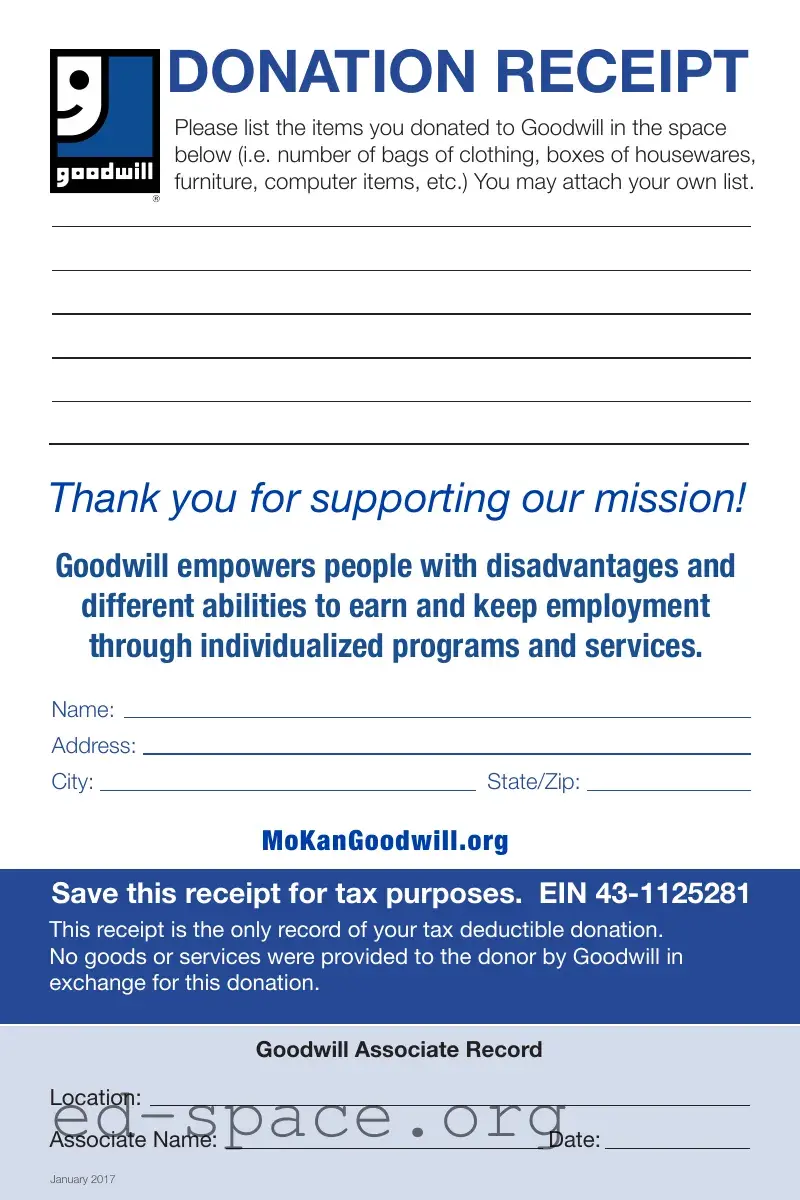
The For Goodwill Donated Goods form serves as an essential document for individuals who contribute items to Goodwill, ensuring that their donations are properly recorded and acknowledged. This form provides a designated space for donors to list the items they are donating, which can include various categories such as clothing, housewares, furniture, and electronics. Donors are encouraged to keep this receipt for tax purposes, as it is the sole record of their tax-deductible contributions. Goodwill emphasizes its commitment to empowering individuals with disadvantages and different abilities, using the funds generated from donations to support programs that help them secure employment. The form also includes important details such as the donor's name, address, and the date of the donation. Additionally, Goodwill ensures transparency by noting that no goods or services were provided in exchange for the donation. By donating, individuals not only give their items a second life but also contribute to a cycle that supports local job seekers, fostering community growth and resilience. Goodwill's mission is reflected in its operations, as 90 cents of every dollar raised goes directly to services that enhance job skills and confidence, ultimately leading to meaningful employment opportunities.
DONATION RECEIPT
Please list the items you donated to Goodwill in the space below (i.e. number of bags of clothing, boxes of housewares, furniture, computer items, etc.) You may attach your own list.
Thank you for supporting our mission!
Goodwill empowers people with disadvantages and different abilities to earn and keep employment through individualized programs and services.
Name:
Address:
City:State/Zip:
MoKanGoodwill.org
Save this receipt for tax purposes. EIN
This receipt is the only record of your tax deductible donation. No goods or services were provided to the donor by Goodwill in exchange for this donation.
|
Goodwill Associate Record |
Location: |
|
Associate Name: |
Date: |
January 2017

Goodwill spends 90¢ of every dollar on programs & services for local job seekers.
When you donate to Goodwill, your stuff gets a second chance in another person’s life instead of laying in a landfill.
High quality & unique items sell in our thrift stores & online at mokangoodwill.org/shoponline.
Unsold items get one last chance at the Goodwill Outlet in Kansas City. Here, amazing deals are purchased by the pound.
What remains is recycled or salvaged. This gets the most value out of every donation – and keeps items out of landfills.
Your donation funds programs and services for local job seekers to get the skills and confidence they need to find competitive employment.
Employment is more than a paycheck. It’s a resounding victory for the individual, for their family and for the community. When jobs thrive,
communities thrive.
MoKanGoodwill.org
| Fact Name | Details |
|---|---|
| Donation Receipt Purpose | This form serves as a receipt for tax-deductible donations made to Goodwill. |
| Tax Deductibility | The receipt is the only record needed for claiming tax deductions on your donations. |
| Goodwill's Mission | Goodwill empowers individuals with disadvantages and different abilities through job training and support services. |
| Item Listing | Donors should list donated items, such as clothing, furniture, or electronics, on the form. |
| State-Specific Forms | Some states may have specific requirements for donation receipts; check local laws for compliance. |
| Employer Identification Number (EIN) | Goodwill's EIN is 43-1125281, which is necessary for tax documentation. |
| Donation Impact | Goodwill uses 90¢ of every dollar from sales to fund programs for job seekers. |
| Environmental Benefits | Donations help reduce landfill waste by giving items a second chance at life. |
| Unsold Items | Items that do not sell in stores are sent to the Goodwill Outlet for recycling or salvaging. |
| Community Impact | Employment through Goodwill not only benefits individuals but also strengthens families and communities. |
After gathering your donated items, you will need to fill out the For Goodwill Donated Goods form. This form serves as a receipt for your donation, which is important for tax purposes. Follow the steps below to complete the form accurately.
Once you have completed the form, keep it in a safe place. You may need it for tax filing or to verify your donation. Thank you for your support of Goodwill and its mission!
What is the For Goodwill Donated Goods form?
The For Goodwill Donated Goods form is a receipt that donors receive when they contribute items to Goodwill. It serves as a record of the donation for tax purposes. Donors can list the items they donated and keep this receipt to claim their tax deduction.
What types of items can I donate to Goodwill?
You can donate a wide variety of items to Goodwill. This includes clothing, housewares, furniture, and electronics. If you have multiple bags or boxes, feel free to list them on the form. Goodwill appreciates all donations, as they help fund valuable programs and services.
Why should I keep the donation receipt?
It is important to keep the donation receipt for your records. This receipt is the only proof of your tax-deductible donation. When you file your taxes, you can use this receipt to claim your deduction, which may help reduce your taxable income.
How does Goodwill use the donations?
Goodwill uses donations to support programs that empower individuals with disadvantages and different abilities. These programs help people gain the skills and confidence they need to find and maintain employment. By donating, you are directly contributing to the betterment of your community.
What happens to items that don’t sell in Goodwill stores?
If items do not sell in the Goodwill stores, they are given a second chance at the Goodwill Outlet in Kansas City. Here, customers can purchase items by the pound at amazing deals. If any items remain unsold, they are recycled or salvaged, ensuring that as little as possible ends up in landfills.
How can I ensure my donation is valuable?
To maximize the value of your donation, consider giving high-quality and unique items. These items are more likely to sell in stores or online. Remember, when you donate, you are not just clearing out your space; you are also providing opportunities for others.
Is there a limit to how much I can donate?
There is no specific limit to how much you can donate to Goodwill. However, it is advisable to ensure that the items are in good condition. If you have a large quantity of items, it may be helpful to contact your local Goodwill to discuss the best way to make your donation.
Can I attach my own list of donated items?
Yes, you can attach your own list of donated items to the For Goodwill Donated Goods form. This can be helpful if you have a significant number of items or if you want to provide a detailed account of your donation. Goodwill appreciates your thoroughness and care.
How does donating to Goodwill benefit the community?
Donating to Goodwill benefits the community by supporting job training and employment programs. When individuals gain employment, it leads to stronger families and healthier communities. Your donations help create opportunities that extend beyond just financial support.
Failing to list all donated items clearly. Donors should provide a detailed account of what they are donating, including quantities and types of items, such as number of bags of clothing or boxes of housewares.
Not saving the donation receipt. This receipt serves as the only record of the tax-deductible donation and should be kept for future reference.
Neglecting to include personal information. Complete information such as name, address, and city/state/zip is essential for proper record-keeping.
Overlooking the need for an itemized list. While the form allows for a general description, attaching a detailed list can help substantiate the value of the donation.
Not checking the form for accuracy. Mistakes in the information provided can lead to complications when claiming tax deductions.
Ignoring the guidelines for high-value items. Donors should be aware of how to properly value items, especially those that are unique or high-quality.
Forgetting to sign the form. A signature may be required to validate the donation and confirm that no goods or services were received in exchange.
When donating goods to Goodwill, several forms and documents may accompany the For Goodwill Donated Goods form. Each of these documents serves a unique purpose, helping both the donor and Goodwill in the donation process. Below is a list of commonly used documents related to charitable donations.
Each of these documents plays a role in the donation process, helping to ensure that both donors and Goodwill have clear records and understandings of the contributions made. Proper documentation can enhance the donation experience and facilitate tax benefits for the donor.
The For Goodwill Donated Goods form is similar to several other documents related to charitable donations. Here’s a list of those documents and how they compare:
When filling out the For Goodwill Donated Goods form, there are some important dos and don'ts to keep in mind. Here’s a helpful list:
Following these guidelines will help ensure your donation process goes smoothly and that you receive the benefits you deserve.
Many people hold misconceptions about the For Goodwill Donated Goods form. Understanding these can help clarify the donation process and its benefits. Below is a list of ten common misconceptions:
By addressing these misconceptions, potential donors can better understand the impact of their contributions and the importance of the For Goodwill Donated Goods form.
When filling out and using the For Goodwill Donated Goods form, keep these key takeaways in mind:
By understanding these points, you can make the most of your donation experience while positively impacting your community and the environment.