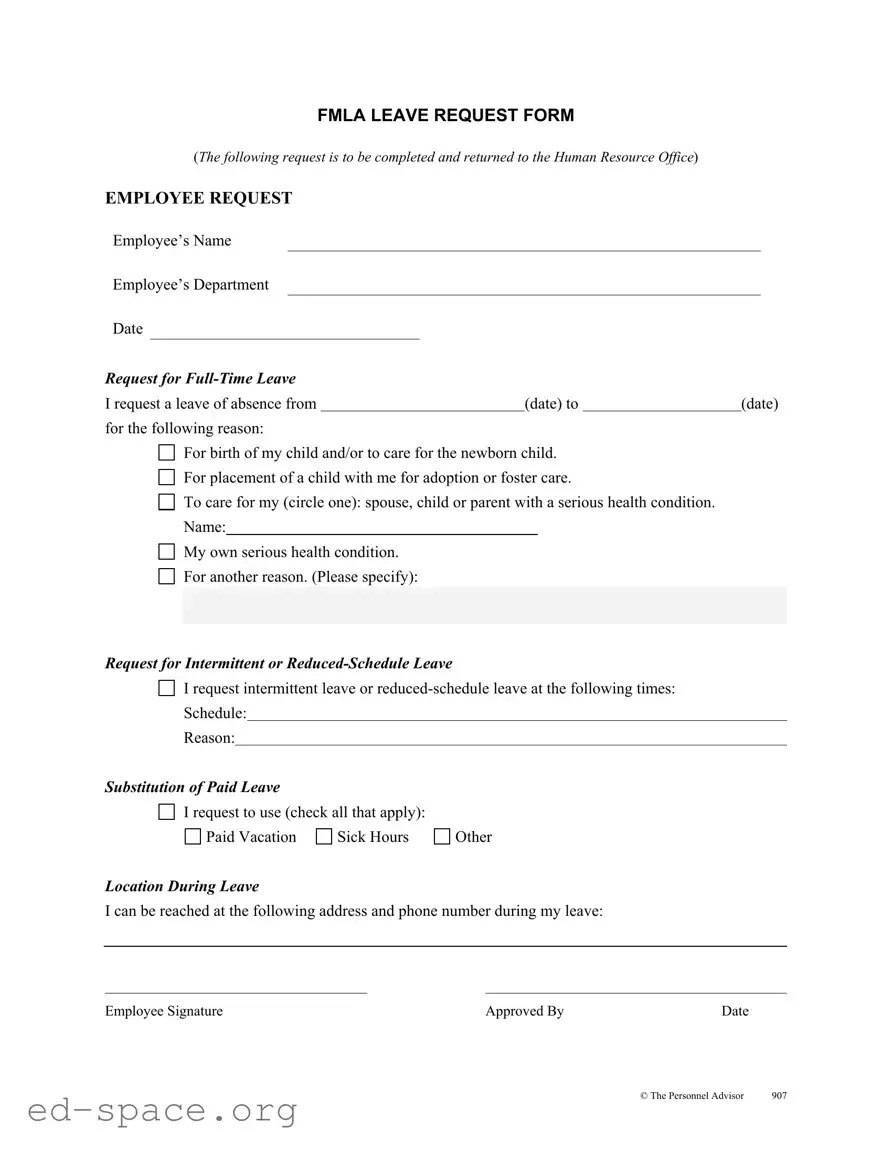
The Family and Medical Leave Act (FMLA) Leave Form is an essential document for employees seeking time off for specific family or medical reasons. This form must be completed and submitted to the Human Resource Office to initiate the leave request process. Employees can request a full-time leave for various reasons, including the birth of a child, adoption, or caring for a family member with a serious health condition. Additionally, the form allows for intermittent or reduced-schedule leave, providing flexibility for those who may need to take time off in smaller increments. Employees can also indicate their preference for using paid leave options, such as vacation or sick hours, during their absence. It is important to provide accurate contact information, ensuring that communication remains open during the leave period. Completing this form accurately is crucial for a smooth approval process and to protect the employee’s rights under the FMLA.
FMLA LEAVE REQUEST FORM
(The following request is to be completed and returned to the Human Resource Office)
EMPLOYEE REQUEST
Employee’s Name
Employee’s Department
Date
Request for |
|
|
I request a leave of absence from |
(date) to |
(date) |
for the following reason:
For birth of my child and/or to care for the newborn child.
For placement of a child with me for adoption or foster care.
To care for my (circle one): spouse, child or parent with a serious health condition. Name:
My own serious health condition.
For another reason. (Please specify):
Request for Intermittent or
I request intermittent leave or
Schedule:
Reason:
Substitution of Paid Leave
I request to use (check all that apply):
Paid Vacation |
Sick Hours |
Location During Leave |
|
Other
I can be reached at the following address and phone number during my leave:
Employee Signature |
Approved By |
Date |
© The Personnel Advisor |
907 |
| Fact Name | Description |
|---|---|
| Purpose of FMLA | The Family and Medical Leave Act (FMLA) allows eligible employees to take unpaid leave for specific family and medical reasons. |
| Eligibility Criteria | To qualify for FMLA leave, an employee must have worked for their employer for at least 12 months and have completed at least 1,250 hours of work in the past year. |
| Reasons for Leave | Employees can request leave for the birth or adoption of a child, to care for a family member with a serious health condition, or for their own serious health condition. |
| Intermittent Leave | FMLA leave can be taken intermittently, allowing employees to take leave in separate blocks of time rather than a single continuous period. |
| Paid Leave Substitution | Employees may choose to substitute paid leave (such as vacation or sick leave) for unpaid FMLA leave, ensuring some income during their time off. |
| Notification Requirement | Employees must notify their employer of the need for FMLA leave at least 30 days in advance when the leave is foreseeable. |
| State-Specific Forms | Some states have additional requirements or specific forms for FMLA leave. For example, California's Family Rights Act governs similar leave rights. |
| Health Insurance Protection | During FMLA leave, employers must maintain the employee's health insurance coverage under the same terms as if the employee had not taken leave. |
| Job Protection | Upon returning from FMLA leave, employees are entitled to be reinstated to their original job or an equivalent position with the same pay and benefits. |
| FMLA Enforcement | The U.S. Department of Labor enforces FMLA regulations, and employees can file complaints if their rights under the act are violated. |
Completing the FMLA Leave Request Form is an important step in securing your leave. Follow these steps carefully to ensure all necessary information is accurately provided. Once submitted, the Human Resource Office will review your request and inform you of the next steps.
What is the FMLA Leave Request Form?
The FMLA Leave Request Form is a document that employees use to formally request leave under the Family and Medical Leave Act (FMLA). This form allows employees to specify the reason for their leave, whether it is for the birth of a child, to care for a family member, or for their own serious health condition. It must be completed and submitted to the Human Resource Office.
Who is eligible to request FMLA leave?
To be eligible for FMLA leave, an employee must have worked for their employer for at least 12 months and have completed at least 1,250 hours of service during the previous 12 months. Additionally, the employer must have 50 or more employees within a 75-mile radius. Eligibility may also depend on the specific reason for the leave.
What reasons can I provide for requesting FMLA leave?
You can request FMLA leave for several reasons. These include the birth of a child, placement of a child for adoption or foster care, caring for a spouse, child, or parent with a serious health condition, or for your own serious health condition. If your reason does not fit these categories, you may specify another reason on the form.
Can I take FMLA leave intermittently?
Yes, FMLA leave can be taken intermittently or on a reduced schedule, depending on your needs and the approval of your employer. When requesting intermittent leave, you will need to provide specific details about the schedule and the reason for the leave on the form.
What if I want to use paid leave during my FMLA leave?
You have the option to use paid leave during your FMLA leave. On the form, you can indicate which types of paid leave you wish to use, such as vacation or sick hours. This can help maintain your income while you are on leave.
How do I stay in contact with my employer during my leave?
It is important to provide your contact information on the FMLA Leave Request Form. This includes your address and phone number. Your employer may need to reach you for updates or to discuss your leave status, so keeping communication open is essential.
Not Providing Complete Dates: One common mistake is failing to clearly state the start and end dates of the leave. Without this information, the request cannot be processed.
Choosing the Wrong Reason for Leave: Another error is selecting an incorrect reason for the leave. It's crucial to circle the appropriate option that reflects the actual situation, whether it’s for a newborn, adoption, or a serious health condition.
Missing Contact Information: Many people forget to include their contact information. Providing an address and phone number ensures that Human Resources can reach you if they have questions about your request.
Not Indicating Intermittent Leave: If you are requesting intermittent or reduced-schedule leave, it’s important to specify the times you will be absent. Failing to do so can lead to misunderstandings about your schedule.
Neglecting to Sign the Form: Lastly, some individuals forget to sign the form. Without a signature, the request is incomplete and cannot be approved.
The Family and Medical Leave Act (FMLA) Leave Form is essential for employees seeking time off for specific family or medical reasons. Along with this form, there are several other documents that may be required to support the leave request. Each of these documents serves a unique purpose in the process.
These documents work together to ensure that both the employee's needs and the employer's requirements are met during the leave process. Understanding each document's role can help facilitate a smoother experience for everyone involved.
The FMLA Leave form is an important document for employees seeking time off for specific family and medical reasons. Several other documents share similarities with the FMLA Leave form. Here are seven of them:
When filling out the FMLA Leave form, there are important dos and don'ts to keep in mind. Follow these guidelines to ensure a smooth process.
Following these steps will help you avoid delays and ensure that your request is processed efficiently.
Understanding the Family and Medical Leave Act (FMLA) can be challenging, and several misconceptions often arise regarding the FMLA Leave form. Below are some common misunderstandings and clarifications to help you navigate the process.
Clarifying these misconceptions can help employees make informed decisions regarding their FMLA Leave and ensure they understand their rights and responsibilities.
When filling out the FMLA Leave form, there are several important points to consider. Here are key takeaways to ensure a smooth process:
By keeping these points in mind, you can navigate the FMLA Leave process more effectively and ensure that your needs are met during your time away from work.