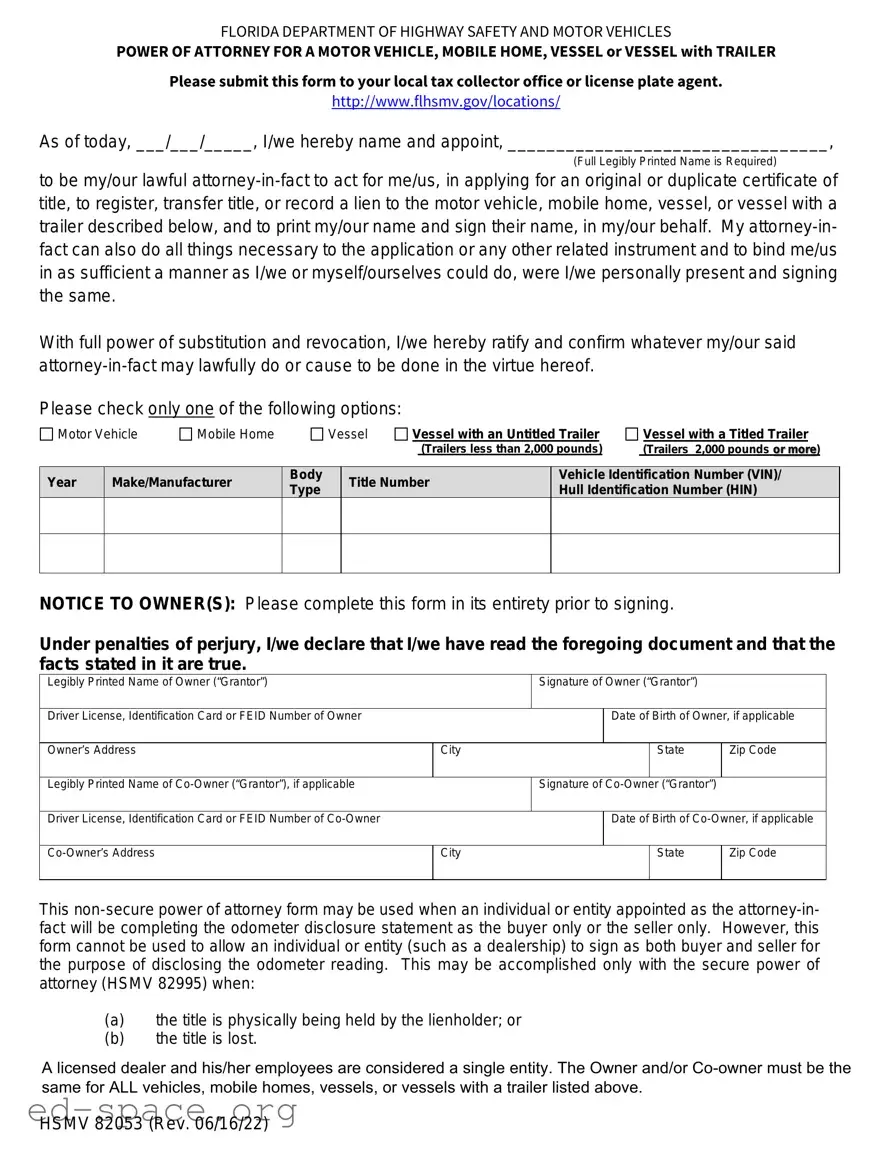
The Florida Vehicle Power of Attorney (POA) form 82053 is an essential document for anyone needing to delegate authority over vehicle-related matters. This form allows an individual, known as the principal, to appoint another person, referred to as the agent, to act on their behalf in various vehicle transactions. These transactions can include signing titles, registering vehicles, or even handling the sale of a vehicle. By using this form, the principal ensures that their agent has the legal authority to manage these tasks efficiently, which can be particularly useful in situations where the principal is unavailable or unable to attend to these matters personally. The form must be completed accurately, including the names and signatures of both parties, to be legally binding. Additionally, it’s important to note that the authority granted can be limited to specific actions or can cover a broader range of vehicle-related issues, depending on the principal's needs. Understanding the nuances of the Florida Vehicle POA form 82053 is crucial for anyone looking to streamline their vehicle transactions while ensuring compliance with state laws.

FLORIDA DEPARTMENT OF HIGHWAY SAFETY AND MOTOR VEHICLES
POWER OF ATTORNEY FOR A MOTOR VEHICLE, MOBILE HOME, VESSEL or VESSEL with TRAILER
Please submit this form to your local tax collector office or license plate agent.
http://www.flhsmv.gov/locations/
As of today, ___/___/_____, I/we hereby name and appoint, _________________________________,
(Full Legibly Printed Name is Required)
to be my/our lawful
With full power of substitution and revocation, I/we hereby ratify and confirm whatever my/our said
Please check only one of the following options:
Motor Vehicle |
Mobile Home |
Vessel |
Vessel with an Untitled Trailer |
Vessel with a Titled Trailer |
|
|
|
(Trailers less than 2,000 pounds) |
(Trailers 2,000 pounds or more) |
Year
Make/Manufacturer
Body
Type
Title Number
Vehicle Identification Number (VIN)/
Hull Identification Number (HIN)
NOTICE TO OWNER(S): Please complete this form in its entirety prior to signing.
Under penalties of perjury, I/we declare that I/we have read the foregoing document and that the facts stated in it are true.
Legibly Printed Name of Owner (“Grantor”) |
|
Signature of Owner (“Grantor”) |
|
||
|
|
|
|
|
|
Driver License, Identification Card or FEID Number of Owner |
|
|
Date of Birth of Owner, if applicable |
||
|
|
|
|
|
|
Owner’s Address |
City |
|
|
State |
Zip Code |
|
|
|
|
|
|
Legibly Printed Name of |
|
Signature of |
|
||
|
|
|
|
||
Driver License, Identification Card or FEID Number of |
|
|
Date of Birth of |
||
|
|
|
|
|
|
City |
|
|
State |
Zip Code |
|
|
|
|
|
|
|
This
(a)the title is physically being held by the lienholder; or
(b)the title is lost.
A licensed dealer and his/her employees are considered a single entity. The Owner and/or
HSMV 82053 (Rev. 06/16/22)
| Fact Name | Description |
|---|---|
| Purpose | The Florida Vehicle POA Form 82053 is used to grant someone the authority to act on behalf of a vehicle owner in matters related to vehicle transactions. |
| Governing Law | This form is governed by the Florida Statutes, specifically Section 709.08, which outlines the requirements for powers of attorney in the state. |
| Signatures Required | The form must be signed by the vehicle owner and, in some cases, a witness may be required to validate the document. |
| Revocation | The power of attorney can be revoked by the vehicle owner at any time, provided that a written notice is given to the agent and any relevant parties. |
| Expiration | The authority granted by this form does not have a set expiration date unless specified by the vehicle owner within the document. |
| Usage | This form is commonly used for transactions such as title transfers, registration renewals, and other vehicle-related dealings. |
Filling out the Florida Vehicle Power of Attorney (POA) form 82053 is a straightforward process. After completing the form, you will be ready to authorize someone else to act on your behalf regarding vehicle-related matters. This can include tasks such as registering a vehicle, obtaining a title, or handling other administrative duties. Below are the steps to guide you through filling out the form.
Once you have completed the form, keep a copy for your records and provide the original to the person you are granting power of attorney. They will need it to perform the designated tasks on your behalf.
What is the Florida Vehicle POA form 82053?
The Florida Vehicle Power of Attorney (POA) form 82053 is a legal document that allows an individual to designate another person to act on their behalf regarding vehicle-related matters. This can include the transfer of title, registration, and other transactions involving motor vehicles in Florida.
Who can use the Florida Vehicle POA form 82053?
This form can be used by any individual who owns a vehicle in Florida and wishes to grant authority to another person to handle vehicle transactions. It is commonly used when the vehicle owner cannot be present for a transaction due to various reasons, such as being out of state or having health issues.
How do I complete the Florida Vehicle POA form 82053?
To complete the form, the vehicle owner must provide their personal information, including name and address, as well as details about the vehicle, such as the VIN (Vehicle Identification Number). The person being granted power of attorney must also be identified. Finally, both parties must sign and date the form to make it valid.
Is the Florida Vehicle POA form 82053 legally binding?
Yes, once properly completed and signed, the Florida Vehicle POA form 82053 is legally binding. It grants the designated person the authority to act on behalf of the vehicle owner in specified matters. It is important to ensure that the form is filled out accurately to avoid any legal complications.
Do I need to have the Florida Vehicle POA form 82053 notarized?
While notarization is not a requirement for the Florida Vehicle POA form 82053, it is highly recommended. Having the document notarized can help verify the identities of the parties involved and strengthen the validity of the form if challenged.
How long is the Florida Vehicle POA form 82053 valid?
The validity of the Florida Vehicle POA form 82053 typically remains in effect until the specified tasks are completed or until the vehicle owner revokes the power of attorney. It is advisable to specify any expiration date or conditions under which the authority will end to avoid confusion.
Can I revoke the Florida Vehicle POA form 82053?
Yes, the vehicle owner can revoke the Florida Vehicle POA at any time. To do so, a written notice of revocation should be provided to the designated person and any relevant institutions, such as the Florida Department of Highway Safety and Motor Vehicles.
Where can I obtain the Florida Vehicle POA form 82053?
The Florida Vehicle POA form 82053 can be obtained from the Florida Department of Highway Safety and Motor Vehicles website or from local tax collector offices. It is important to ensure that you are using the most current version of the form.
What should I do if I have more questions about the Florida Vehicle POA form 82053?
If you have additional questions regarding the Florida Vehicle POA form 82053, it is advisable to consult with a legal professional or contact the Florida Department of Highway Safety and Motor Vehicles for guidance. They can provide detailed information and assistance based on your specific situation.
Incorrect Signatures: One of the most common mistakes is failing to sign the form correctly. Ensure that the designated signer’s name matches the name on the vehicle title.
Missing Information: People often overlook filling in all required fields. Double-check that all sections are complete, including the vehicle identification number (VIN) and the owner's details.
Not Notarizing: Some forget that the Florida Vehicle POA form requires notarization. A signature without a notary can render the document invalid.
Using Incorrect Dates: Filling in the date incorrectly can lead to confusion. Make sure to use the correct format and ensure the date reflects when the form is being executed.
Failing to Specify Powers: It's essential to clearly outline the powers being granted. Vague descriptions can lead to misunderstandings about what the agent is authorized to do.
Not Reviewing the Form: Rushing through the form without a thorough review can lead to mistakes. Take the time to read everything carefully before submitting.
Ignoring State-Specific Requirements: Each state may have specific requirements for vehicle power of attorney forms. Ensure that you are following Florida's rules to avoid issues.
The Florida Vehicle Power of Attorney (POA) form 82053 is a crucial document for individuals who need to authorize someone else to act on their behalf regarding vehicle-related matters. Along with this form, there are several other documents that may be required to ensure a smooth transaction. Below is a list of common forms and documents often used in conjunction with the Florida Vehicle POA form.
Understanding these documents can facilitate the process of vehicle transactions in Florida. Each plays a vital role in ensuring that all legal requirements are met, thereby protecting the interests of all parties involved.
The Florida Vehicle Power of Attorney (POA) form 82053 allows an individual to authorize another person to act on their behalf regarding vehicle-related matters. This form is similar to several other documents that grant authority or permission in various contexts. Here are eight such documents:
When filling out the Florida Vehicle Power of Attorney (POA) form 82053, there are important dos and don'ts to consider. Following these guidelines will help ensure that the process goes smoothly and that the document is valid.
By adhering to these guidelines, you can help prevent delays and complications in the processing of your vehicle's power of attorney.
Many people have misunderstandings about the Florida Vehicle Power of Attorney (POA) form 82053. Here are four common misconceptions:
When dealing with the Florida Vehicle Power of Attorney (POA) form 82053, it’s important to understand its purpose and how to complete it effectively. Here are some key takeaways: