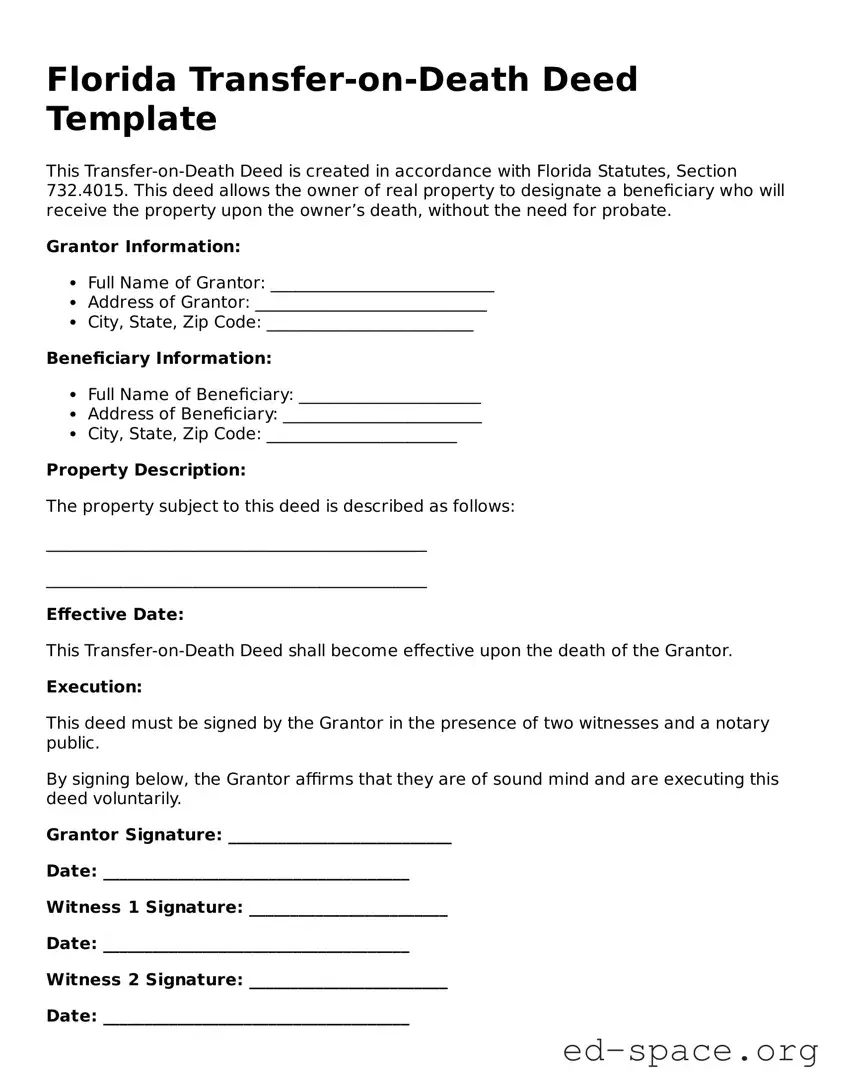
In Florida, the Transfer-on-Death Deed (TODD) offers a straightforward way for property owners to pass their real estate to beneficiaries without the need for probate. This legal tool allows individuals to name one or more beneficiaries who will automatically receive the property upon the owner's death. The deed is effective immediately upon signing, but the transfer of ownership only occurs after the owner’s passing. Importantly, the property remains under the owner's control during their lifetime, allowing for continued use, sale, or mortgage of the property without interference. Additionally, the TODD can be revoked or changed at any time before the owner's death, providing flexibility in estate planning. Understanding the nuances of this form can help individuals make informed decisions about their property and ensure that their wishes are honored after they are gone.
Florida Transfer-on-Death Deed Template
This Transfer-on-Death Deed is created in accordance with Florida Statutes, Section 732.4015. This deed allows the owner of real property to designate a beneficiary who will receive the property upon the owner’s death, without the need for probate.
Grantor Information:
Beneficiary Information:
Property Description:
The property subject to this deed is described as follows:
______________________________________________
______________________________________________
Effective Date:
This Transfer-on-Death Deed shall become effective upon the death of the Grantor.
Execution:
This deed must be signed by the Grantor in the presence of two witnesses and a notary public.
By signing below, the Grantor affirms that they are of sound mind and are executing this deed voluntarily.
Grantor Signature: ___________________________
Date: _____________________________________
Witness 1 Signature: ________________________
Date: _____________________________________
Witness 2 Signature: ________________________
Date: _____________________________________
Notary Public:
State of Florida
County of ___________________________
Subscribed and sworn to before me this ______ day of __________, 20__.
Notary Signature: _________________________
My Commission Expires: ___________________
| Fact Name | Description |
|---|---|
| Definition | A Transfer-on-Death Deed allows property owners to transfer real estate to beneficiaries upon their death without going through probate. |
| Governing Law | The Florida Transfer-on-Death Deed is governed by Florida Statutes, Chapter 732.4015. |
| Eligibility | Any individual who owns real property in Florida can create a Transfer-on-Death Deed. |
| Beneficiaries | Property owners can name one or more beneficiaries in the deed. |
| Revocation | A Transfer-on-Death Deed can be revoked at any time before the owner's death by executing a new deed or a revocation document. |
| Execution Requirements | The deed must be signed by the property owner and witnessed by two individuals who are not beneficiaries. |
| Filing | The deed must be recorded with the county clerk in the county where the property is located to be effective. |
| Tax Implications | Transferring property via a Transfer-on-Death Deed does not trigger gift tax, but it may have estate tax implications. |
| Limitations | Transfer-on-Death Deeds cannot be used for certain types of property, such as timeshares or property held in a trust. |
After obtaining the Florida Transfer-on-Death Deed form, you will need to carefully complete it to ensure that your property transfer is executed according to your wishes. Follow these steps to fill out the form accurately.
Once the deed is recorded, it will be a matter of public record. The transfer will occur automatically upon the owner's death, ensuring that the designated beneficiary receives the property without the need for probate.
What is a Florida Transfer-on-Death Deed?
A Florida Transfer-on-Death Deed (TOD) is a legal document that allows property owners to transfer their real estate to a designated beneficiary upon their death, without the need for probate. This deed is effective immediately upon signing, but the transfer only occurs after the owner's death. It simplifies the transfer process and can help avoid complications for heirs.
How do I create a Transfer-on-Death Deed in Florida?
To create a TOD deed, you need to complete the appropriate form, which includes information about the property and the beneficiary. The deed must be signed by the property owner in the presence of a notary public. After signing, it must be recorded in the county where the property is located. This recording is crucial, as it makes the deed effective and ensures that the beneficiary's interest is protected.
Can I revoke or change a Transfer-on-Death Deed?
Yes, you can revoke or change a TOD deed at any time while you are alive. To do this, you must create a new deed that explicitly revokes the previous one or file a formal revocation document with the county clerk. It’s important to ensure that any changes are properly recorded to avoid confusion later on.
Are there any limitations to using a Transfer-on-Death Deed?
While a TOD deed offers many benefits, there are some limitations. For example, it cannot be used for certain types of property, such as properties held in a trust or properties subject to a mortgage that prohibits transfers. Additionally, if the beneficiary predeceases the property owner, the transfer will not occur unless alternative provisions are made. Always consider consulting with a legal professional to ensure it meets your specific needs.
Not including the legal description of the property. This is crucial for identifying the property being transferred.
Failing to sign the deed. Without a signature, the deed is not valid.
Not having the deed notarized. A notary's signature is necessary to make the document official.
Using incorrect names for the beneficiaries. Ensure that names are spelled correctly and match legal documents.
Leaving out the date. The date of signing is important for legal purposes.
Not providing the required witness signatures. Florida law requires two witnesses for the deed to be valid.
Filing the deed in the wrong county. The deed must be recorded in the county where the property is located.
Not reviewing the form for errors before submission. Small mistakes can lead to significant issues later.
Failing to understand the implications of the deed. It's important to know how this affects estate planning.
Not keeping a copy of the recorded deed. Always retain a copy for personal records.
The Florida Transfer-on-Death Deed is a valuable tool for estate planning, allowing individuals to transfer real property directly to beneficiaries upon their death without going through probate. However, several other forms and documents are often used in conjunction with this deed to ensure a smooth transition of assets and to address various legal requirements. Below is a list of related documents that may be necessary or beneficial in this process.
Utilizing these forms and documents in conjunction with the Florida Transfer-on-Death Deed can help ensure that your estate planning is comprehensive and effective. Each document serves a specific purpose and contributes to a clearer understanding of how your assets will be managed and distributed.
The Transfer-on-Death Deed (TOD Deed) is a unique legal document that allows individuals to transfer property to a beneficiary upon their death, bypassing the probate process. Several other documents serve similar purposes in estate planning and property transfer. Below are four documents that share similarities with the TOD Deed:
When filling out the Florida Transfer-on-Death Deed form, it’s important to follow certain guidelines to ensure the process goes smoothly. Here are six things to do and not do:
Understanding the Florida Transfer-on-Death Deed can be challenging due to several misconceptions. Here are nine common misunderstandings about this legal document:
Clarifying these misconceptions can help individuals make informed decisions regarding their estate planning in Florida.
Filling out and using the Florida Transfer-on-Death Deed form is a critical step for property owners who wish to ensure a smooth transfer of their property upon death. Here are key takeaways to consider:
Understanding these points is crucial for ensuring that the Transfer-on-Death Deed serves its intended purpose effectively.