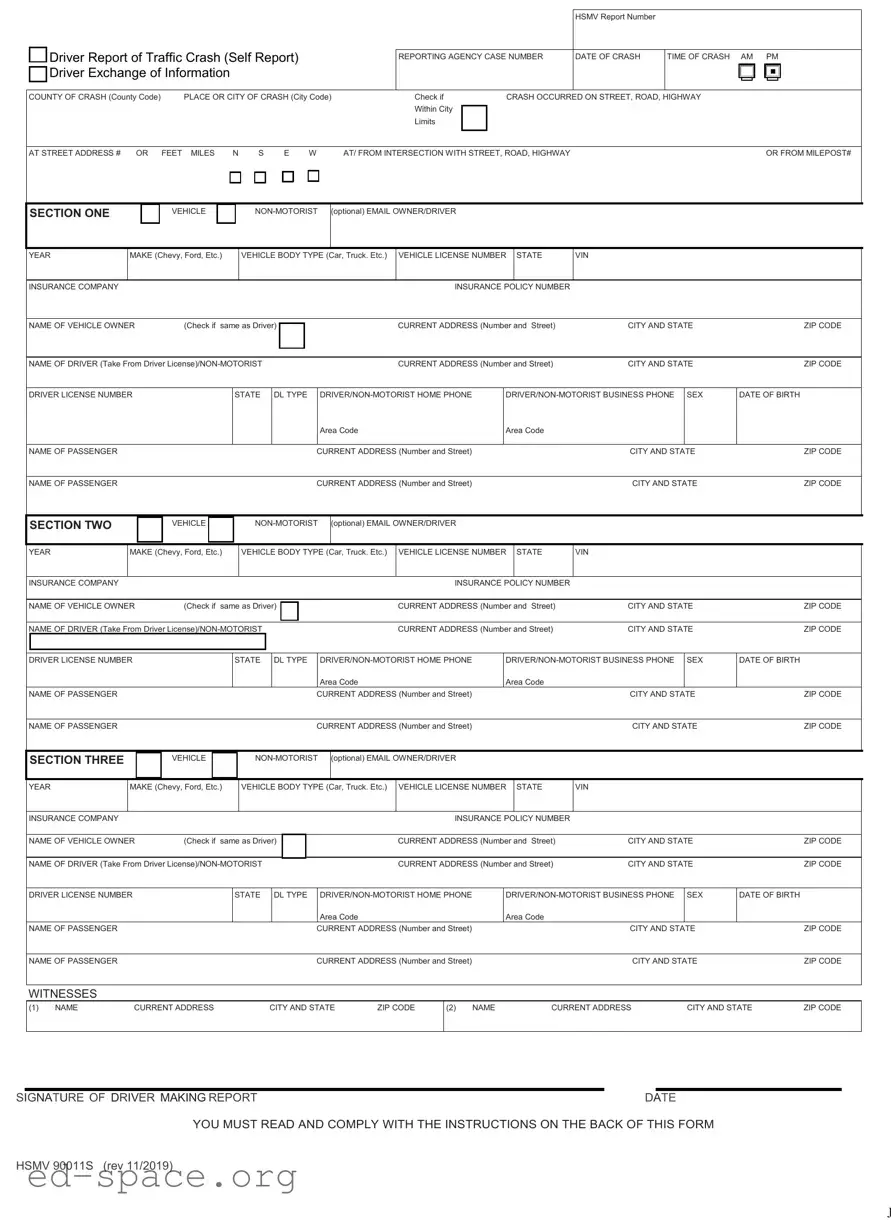
The Florida Traffic Crash Report form is an essential document designed for drivers involved in accidents that do not require a law enforcement report. This form facilitates the exchange of crucial information among involved parties and serves as a record for insurance purposes. Key sections of the form include details about the crash, such as the date, time, and location, including the county and city codes. It also captures vital information about the vehicles involved, including the make, model, license numbers, and insurance details. Personal information about the drivers, non-motorists, and passengers is required, ensuring that all parties are accurately documented. Witness information can also be included, providing additional context to the incident. The form emphasizes the importance of compliance with state regulations, requiring drivers to submit their report within ten days of the crash. Clear instructions are provided for submission, whether via email or traditional mail, ensuring that the process is straightforward and accessible for all involved.

Driver Report of Traffic Crash (Self Report) Driver Exchange of Information
|
HSMV Report Number |
|
|
|
|
REPORTING AGENCY CASE NUMBER |
DATE OF CRASH |
TIME OF CRASH AM PM |
|
|
|
|
COUNTY OF CRASH (County Code) |
PLACE OR CITY OF CRASH (City Code) |
|
Check if |
|
|
CRASH OCCURRED ON STREET, ROAD, HIGHWAY |
|
|
|
|||||||||||||
|
|
|
|
|
|
|
|
|
|
|
|
Within City |
|
|
|
|
|
|
|
|
|
|
|
|
|
|
|
|
|
|
|
|
|
|
|
Limits |
|
|
|
|
|
|
|
|
|
|
|
|
|
|
|
|
|
|
|
|
|
|
|
|
|
|
|
|
|
|
|
||||
|
AT STREET ADDRESS # |
OR |
FEET MILES |
N |
S |
|
E |
W |
|
AT/ FROM INTERSECTION WITH STREET, ROAD, HIGHWAY |
|
|
|
|
OR FROM MILEPOST# |
||||||||
|
|
|
|
|
|
|
|
|
|
|
|
|
|
|
|
|
|
|
|
|
|||
|
SECTION ONE |
|
VEHICLE |
|
|
(optional) EMAIL OWNER/DRIVER |
|
|
|
|
|
|
|
|
|
|
|||||||
|
|
|
|
|
|
|
|
|
|
|
|
|
|
|
|
|
|
||||||
|
YEAR |
MAKE (Chevy, Ford, Etc.) |
|
VEHICLE BODY TYPE (Car, Truck. Etc.) |
VEHICLE LICENSE NUMBER |
|
STATE |
VIN |
|
|
|
|
|||||||||||
|
|
|
|
|
|
|
|
|
|
|
|
|
|
|
|
|
|
|
|
|
|
|
|
|
INSURANCE COMPANY |
|
|
|
|
|
|
|
|
|
|
|
INSURANCE POLICY NUMBER |
|
|
|
|
|
|
|
|||
|
|
|
|
|
|
|
|
|
|
|
|
|
|
|
|
|
|||||||
|
NAME OF VEHICLE OWNER |
(Check if same as Driver) |
|
|
|
|
CURRENT ADDRESS (Number and Street) |
|
CITY AND STATE |
|
ZIP CODE |
||||||||||||
|
|
|
|
|
|
|
|
|
|
|
|
|
|
|
|
|
|||||||
|
NAME OF DRIVER (Take From Driver |
|
|
|
|
|
|
CURRENT ADDRESS (Number and Street) |
|
CITY AND STATE |
|
ZIP CODE |
|||||||||||
|
|
|
|
|
|
|
|
|
|
|
|
|
|
|
|||||||||
|
DRIVER LICENSE NUMBER |
|
STATE |
|
DL TYPE |
|
SEX |
DATE OF BIRTH |
|
|
|||||||||||||
|
|
|
|
|
|
|
|
|
Area Code |
|
|
|
Area Code |
|
|
|
|
|
|
|
|||
|
|
|
|
|
|
|
|
|
|
|
|
|
|
|
|
|
|
|
|||||
|
NAME OF PASSENGER |
|
|
|
|
|
|
|
CURRENT ADDRESS (Number and Street) |
|
|
|
|
CITY AND STATE |
|
ZIP CODE |
|||||||
|
|
|
|
|
|
|
|
|
|
|
|
|
|
|
|
|
|
||||||
|
NAME OF PASSENGER |
|
|
|
|
|
|
|
CURRENT ADDRESS (Number and Street) |
|
|
|
|
CITY AND STATE |
|
ZIP CODE |
|||||||
|
|
|
|
|
|
|
|
|
|
|
|
|
|
|
|
|
|
|
|
|
|||
|
SECTION TWO |
|
VEHICLE |
|
|
(optional) EMAIL OWNER/DRIVER |
|
|
|
|
|
|
|
|
|
|
|||||||
|
|
|
|
|
|
|
|
|
|
|
|
|
|
|
|||||||||
|
YEAR |
MAKE (Chevy, Ford, Etc.) |
|
VEHICLE BODY TYPE (Car, Truck. Etc.) |
VEHICLE LICENSE NUMBER |
|
STATE |
VIN |
|
|
|
|
|||||||||||
|
|
|
|
|
|
|
|
|
|
|
|
|
|
|
|
|
|
|
|
|
|
||
|
INSURANCE COMPANY |
|
|
|
|
|
|
|
|
|
|
|
INSURANCE POLICY NUMBER |
|
|
|
|
|
|
|
|||
|
|
|
|
|
|
|
|
|
|
|
|
|
|||||||||||
|
NAME OF VEHICLE OWNER |
(Check if same as Driver) |
|
|
|
|
CURRENT ADDRESS (Number and Street) |
|
CITY AND STATE |
|
ZIP CODE |
||||||||||||
|
|
|
|
|
|
|
|
|
|
|
|
|
|
||||||||||
|
NAME OF DRIVER (Take From Driver |
|
|
|
|
|
|
CURRENT ADDRESS (Number and Street) |
|
CITY AND STATE |
|
ZIP CODE |
|||||||||||
|
|
|
|
|
|
|
|
|
|
|
|
|
|
||||||||||
|
DRIVER LICENSE NUMBER |
|
STATE |
|
DL TYPE |
|
SEX |
DATE OF BIRTH |
|
|
|||||||||||||
|
|
|
|
|
|
|
|
|
Area Code |
|
|
|
Area Code |
|
|
|
|
|
|
|
|||
|
NAME OF PASSENGER |
|
|
|
|
|
|
|
CURRENT ADDRESS (Number and Street) |
|
|
|
|
CITY AND STATE |
|
ZIP CODE |
|||||||
|
|
|
|
|
|
|
|
|
|
|
|
|
|
|
|
|
|
||||||
|
NAME OF PASSENGER |
|
|
|
|
|
|
|
CURRENT ADDRESS (Number and Street) |
|
|
|
|
CITY AND STATE |
|
ZIP CODE |
|||||||
|
|
|
|
|
|
|
|
|
|
|
|
|
|
|
|
|
|
|
|||||
|
SECTION THREE |
|
VEHICLE |
|
|
(optional) EMAIL OWNER/DRIVER |
|
|
|
|
|
|
|
|
|
|
|||||||
|
|
|
|
|
|
|
|
|
|
|
|
|
|
|
|||||||||
|
YEAR |
MAKE (Chevy, Ford, Etc.) |
|
VEHICLE BODY TYPE (Car, Truck. Etc.) |
VEHICLE LICENSE NUMBER |
|
STATE |
VIN |
|
|
|
|
|||||||||||
|
|
|
|
|
|
|
|
|
|
|
|
|
|
|
|
|
|
|
|
|
|
||
|
INSURANCE COMPANY |
|
|
|
|
|
|
|
|
|
|
|
INSURANCE POLICY NUMBER |
|
|
|
|
|
|
|
|||
|
|
|
|
|
|
|
|
|
|
|
|
|
|||||||||||
|
NAME OF VEHICLE OWNER |
(Check if same as Driver) |
|
|
|
|
CURRENT ADDRESS (Number and Street) |
|
CITY AND STATE |
|
ZIP CODE |
||||||||||||
|
|
|
|
|
|
|
|
|
|
|
|
|
|
||||||||||
|
NAME OF DRIVER (Take From Driver |
|
|
|
|
|
|
CURRENT ADDRESS (Number and Street) |
|
CITY AND STATE |
|
ZIP CODE |
|||||||||||
|
|
|
|
|
|
|
|
|
|
|
|
|
|
||||||||||
|
DRIVER LICENSE NUMBER |
|
STATE |
|
DL TYPE |
|
SEX |
DATE OF BIRTH |
|
|
|||||||||||||
|
|
|
|
|
|
|
|
|
Area Code |
|
|
|
Area Code |
|
|
|
|
|
|
|
|||
|
NAME OF PASSENGER |
|
|
|
|
|
|
|
CURRENT ADDRESS (Number and Street) |
|
|
|
|
CITY AND STATE |
|
ZIP CODE |
|||||||
|
|
|
|
|
|
|
|
|
|
|
|
|
|
|
|
|
|
||||||
|
NAME OF PASSENGER |
|
|
|
|
|
|
|
CURRENT ADDRESS (Number and Street) |
|
|
|
|
CITY AND STATE |
|
ZIP CODE |
|||||||
|
|
|
|
|
|
|
|
|
|
|
|
|
|
|
|
|
|
|
|
|
|
|
|
|
WITNESSES |
|
|
|
|
|
|
|
|
|
|
|
|
|
|
|
|
|
|
|
|
|
|
|
(1) NAME |
CURRENT ADDRESS |
|
|
CITY AND STATE |
ZIP CODE |
(2) NAME |
|
|
CURRENT ADDRESS |
CITY AND STATE |
ZIP CODE |
|||||||||||
|
|
|
|
|
|
|
|
|
|
|
|
|
|
|
|
|
|
|
|
|
|
|
|
S |
|
|
|
|
|
|
|
|
|
|
|
|
|
|
|
|
|
|
|
|
|
|
|
IGNATURE OF DRIVER MAKING REPORT |
|
|
|
|
|
|
|
|
|
|
|
|
DATE |
|
|
|
|
||||||
YOU MUST READ AND COMPLY WITH THE INSTRUCTIONS ON THE BACK OF THIS FORM
HSMV 90011S (rev 11/2019)
J

IF YOU WERE TOLD TO COMPLETE AND FORWARD THIS REPORT TO THE DEPARTMENT, PLEASE REFER TO THE FOLLOWING INSTRUCTIONS AND EXAMPLE:
|
|
|
|
|
|
|
HSMV Report Number |
|
Driver Report of Traffic Crash (Self Report) |
|
|
|
|
||||
|
REPORTING AGENCY CASE NUMBER |
DATE OF CRASH |
TIME OF CRASH AM PM |
|||||
Driver Exchange of Information |
|
|
|
|
|
11:30 |
||
|
|
|
|
|
|
|
||
COUNTY OF CRASH (County Code) |
PLACE OR CITY OF CRASH (City Code) |
|
Check if |
CRASH OCCURRED ON STREET, ROAD, HIGHWAY |
||||
PINELLAS (04) |
ST. PETERSBURG (64) |
|
Within City |
2ND STREET SOUTH |
|
|||
|
|
|
|
|
Limits |
|
|
|
|
|
|
|
|
|
|
||
AT STREET ADDRESS # OR |
FEET MILES N |
S |
E W |
AT/ FROM INTERSECTION WITH STREET, ROAD, HIGHWAY |
|
OR FROM MILEPOST# |
||
0
U.S. 19
SECTION ONE
VEHICLE
YEAR |
MAKE (Chevy, Ford, Etc.) |
|
VEHICLE BODY TYPE (Car, Truck. Etc.) |
VEHICLE LICENSE NUMBER |
STATE |
VIN |
|
||||||
80 |
|
FORD |
|
|
|
CAR |
|
FL |
|
|
|
||
|
|
|
|
|
|
|
|
|
|
|
|
|
|
INSURANCE COMPANY |
|
|
|
|
|
|
|
INSURANCE POLICY NUMBER |
|
|
|
||
INSURANCE COMPANY OF FL |
|
|
|
|
|
I.C.F. 120000 |
|
|
|
||||
|
|
|
|
|
|
|
|
|
|
|
|||
NAME OF VEHICLE OWNER |
(Check if same as Driver) |
|
|
CURRENT ADDRESS (Number and Street) |
CITY AND STATE |
ZIP CODE |
|||||||
JOHN DOE |
|
|
|
|
|
|
|
1111 FIRST STREET NORTH |
PETERSBURG, FL |
33731 |
|||
|
|
|
|
|
|
|
|
|
|
||||
NAME OF DRIVER (Take From Driver |
|
|
CURRENT ADDRESS (Number and Street) |
CITY AND STATE |
ZIP CODE |
||||||||
BILL DOE |
|
|
|
|
|
|
|
SAME AS OWNER |
|
|
|
|
|
|
|
|
|
|
|
|
|
|
|||||
DRIVER LICENSE NUMBER |
|
STATE |
DL TYPE |
|
SEX |
DATE OF BIRTH |
|||||||
D 561345706000 |
|
FL |
|
|
|
|
|
|
|
M |
|||
|
|
|
|
|
|
|
|
|
|
|
|
|
|
NAME OF PASSENGER |
|
|
|
|
|
CURRENT ADDRESS (Number and Street) |
|
|
CITY AND STATE |
ZIP CODE |
|||
SALLEY DOE |
|
|
|
|
|
|
|
SAME AS OWNER |
|
|
|
|
|
|
|
|
|
|
|
|
|
|
|
|
|||
NAME OF PASSENGER |
|
|
|
|
|
CURRENT ADDRESS (Number and Street) |
|
|
CITY AND STATE |
ZIP CODE |
|||
|
|
|
|
|
|
|
|
|
|
|
|
|
|
Effective July 1, 2012, Section 316.066(1)(e),Florida Statute, requires that "The driver of a vehicle that was in any manner involved in a crash resulting in damage to a vehicle or other property which does not require a law enforcement report shall, within 10 days after the crash, submit a written report of the crash to the department. The report shall be submitted on a form approved by the department."
•Keep a copy of this report for your records and for insurance purposes.
•Sign the report at the bottom of the front page.
•Submit this via email to [email protected], OR;
•Mail this report to: Florida Highway Safety & Motor Vehicles Self Report Crash Team
2900 Apalachee Pkwy, MS 28 Tallahassee, Florida 32399
Please use this space for comments and for listing any witnesses and/or additional passengers, stating which vehicle the passenger was in. For additional vehicles or other involved parties, please add additional front pages for this Driver Report of Traffic Crash.
| Fact Name | Details |
|---|---|
| Form Purpose | The Florida Traffic Crash Report form allows drivers involved in a crash to report details of the incident, especially when a law enforcement report is not required. |
| Governing Law | Florida Statute Section 316.066(1)(e) mandates that drivers submit a written report within 10 days if a crash results in property damage but does not require a law enforcement report. |
| Submission Methods | Drivers can submit the report via email or mail. Email submissions go to [email protected], while mailed reports should be sent to the Florida Highway Safety & Motor Vehicles. |
| Required Information | Key information includes the date and time of the crash, the location, vehicle details, and personal information of the drivers and passengers involved. |
| Witness Information | The form provides space to include details about witnesses, which can be crucial for clarifying the circumstances of the crash. |
| Signature Requirement | Drivers must sign the report, affirming that the information provided is accurate and complete. |
| Record Keeping | It is advisable for drivers to keep a copy of the report for their records and for insurance purposes, ensuring they have documentation of the incident. |
Filling out the Florida Traffic Crash Report form is an important step after being involved in a traffic accident. This report helps document the details of the crash for insurance and legal purposes. Follow these steps carefully to ensure all necessary information is provided.
After completing the form, ensure all information is accurate and clear. This will help streamline the process for any follow-up actions regarding the crash.
What is the Florida Traffic Crash Report form?
The Florida Traffic Crash Report form is a document that drivers involved in a traffic accident are required to complete if the crash results in property damage and does not require a law enforcement report. This form helps to document the details of the crash for the Florida Department of Highway Safety and Motor Vehicles.
Who is required to submit the report?
According to Florida law, any driver involved in a crash that results in damage to a vehicle or property must submit this report within 10 days of the incident. This requirement applies when a law enforcement report is not made.
How do I submit the Florida Traffic Crash Report?
You can submit the report by email or by mail. To email, send the completed form to [email protected]. Alternatively, you can mail it to the Florida Highway Safety & Motor Vehicles Self Report Crash Team at 2900 Apalachee Parkway, MS 28, Tallahassee, Florida 32399.
What information do I need to provide on the form?
The form requires detailed information including the date and time of the crash, the location, details about the vehicles involved, and information about the drivers and passengers. You will also need to provide your insurance information and contact details.
Is there a deadline for submitting the report?
Yes, the report must be submitted within 10 days of the crash. It is important to adhere to this timeline to comply with Florida law.
What should I do if I need to add more vehicles or witnesses?
If there are additional vehicles or witnesses involved in the crash, you can use extra front pages of the Driver Report of Traffic Crash form to provide that information. Ensure all relevant details are included for accurate reporting.
Do I need to keep a copy of the report?
Yes, it is advisable to keep a copy of the completed report for your records and for insurance purposes. This can be useful in case of any disputes or claims that arise from the accident.
What if I have questions about filling out the form?
If you have questions or need assistance while completing the form, consider reaching out to the Florida Department of Highway Safety and Motor Vehicles. They can provide guidance on how to fill out the report correctly.
Incomplete Information: Failing to fill out all required fields can lead to delays or complications. Make sure to provide details such as the HSMV Report Number, date, and time of the crash.
Incorrect Vehicle Details: Entering wrong vehicle information, such as the license number or VIN, can create issues with insurance claims. Double-check these details for accuracy.
Neglecting Witness Information: Not including witnesses can weaken your report. Collect names and addresses of any witnesses present at the scene, as their accounts may be crucial.
Failure to Sign the Report: Omitting your signature at the bottom of the form can render the report invalid. Always ensure that you sign and date the document before submission.
When involved in a traffic crash in Florida, it is essential to complete the Florida Traffic Crash Report form. However, several other forms and documents may also be necessary to ensure proper reporting and processing of the incident. Below is a list of commonly used forms that accompany the Florida Traffic Crash Report.
Each of these forms plays a vital role in the aftermath of a traffic crash. Completing them accurately can help ensure that all parties receive the necessary support and compensation. It is important to keep copies of all documents for your records and future reference.
The Florida Traffic Crash Report form serves an essential purpose in documenting accidents on the road. Several other documents share similarities with this form, each designed to capture specific information about traffic incidents. Below is a list of eight documents that resemble the Florida Traffic Crash Report form, along with explanations of how they are similar.
Each of these documents plays a vital role in the aftermath of a traffic crash, contributing to a clearer picture of the events that occurred. They help ensure that all necessary information is documented for legal, insurance, and safety purposes.
When filling out the Florida Traffic Crash Report form, keep the following tips in mind:
Avoid these common mistakes:
Understanding the Florida Traffic Crash Report form is crucial for anyone involved in a vehicle accident. However, several misconceptions can lead to confusion. Here are six common misunderstandings:
Addressing these misconceptions can help ensure that drivers fulfill their legal obligations and protect their rights after an accident. Understanding the importance of accurate reporting can also streamline the claims process with insurance companies.