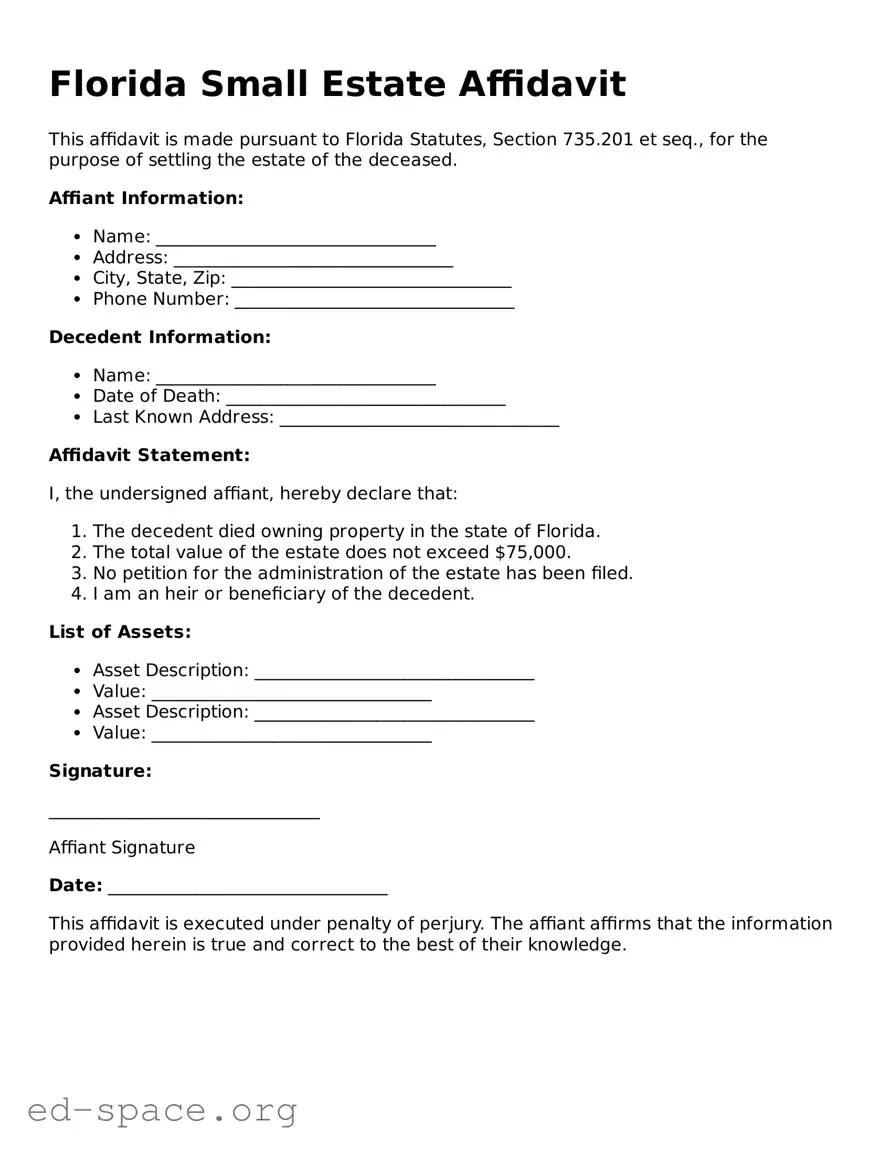
In Florida, navigating the complexities of estate management can be daunting, especially when a loved one passes away. For those dealing with smaller estates, the Florida Small Estate Affidavit offers a streamlined process to help heirs and beneficiaries transfer assets without the need for formal probate proceedings. This form is particularly beneficial when the total value of the estate does not exceed a specified threshold, making it an accessible option for many families. By completing this affidavit, individuals can assert their right to inherit property, such as bank accounts, vehicles, or personal belongings, while minimizing the time and costs typically associated with probate. It is important to understand the eligibility requirements, the necessary documentation, and the steps involved in filing this affidavit to ensure a smooth transition of assets. With careful attention to detail, the Small Estate Affidavit can serve as a valuable tool in honoring the wishes of the deceased while providing peace of mind to those left behind.
Florida Small Estate Affidavit
This affidavit is made pursuant to Florida Statutes, Section 735.201 et seq., for the purpose of settling the estate of the deceased.
Affiant Information:
Decedent Information:
Affidavit Statement:
I, the undersigned affiant, hereby declare that:
List of Assets:
Signature:
_______________________________
Affiant Signature
Date: ________________________________
This affidavit is executed under penalty of perjury. The affiant affirms that the information provided herein is true and correct to the best of their knowledge.
| Fact Name | Description |
|---|---|
| Definition | The Florida Small Estate Affidavit is a legal document that allows heirs to claim assets of a deceased person without going through formal probate, provided the estate meets certain criteria. |
| Governing Law | This form is governed by Florida Statutes, specifically Section 735.201, which outlines the procedures for small estates. |
| Eligibility | To use this affidavit, the total value of the estate must not exceed $75,000, excluding exempt property. |
| Timeframe | The affidavit can be filed at any time after the death of the decedent, but it is often done shortly thereafter to expedite access to assets. |
| Required Information | The form requires details such as the decedent's name, date of death, and a list of assets, including their estimated values. |
| Signatures | All heirs must sign the affidavit, affirming their relationship to the deceased and their entitlement to the assets. |
| Filing Process | The completed affidavit must be filed with the appropriate county clerk's office to formally claim the assets. |
After gathering the necessary information, you can begin filling out the Florida Small Estate Affidavit form. Ensure that you have all required details about the deceased, their assets, and the heirs. This form will allow you to proceed with settling the estate without going through formal probate proceedings.
What is a Florida Small Estate Affidavit?
A Florida Small Estate Affidavit is a legal document that allows individuals to claim the assets of a deceased person without going through the formal probate process. This affidavit can simplify the transfer of property and is typically used when the total value of the estate is below a certain threshold, which is currently set at $75,000, excluding exempt property.
Who can use a Small Estate Affidavit in Florida?
The Small Estate Affidavit can be used by the surviving spouse, heirs, or beneficiaries of the deceased person. To qualify, the individual must be entitled to the assets under Florida law and must not have been convicted of a felony or a crime involving moral turpitude.
What assets are eligible under the Small Estate Affidavit?
Eligible assets typically include personal property, bank accounts, and real estate. However, the total value of these assets must not exceed the $75,000 limit, excluding exempt property such as homestead property. It is important to list all assets accurately when completing the affidavit.
How do I complete a Small Estate Affidavit?
To complete a Small Estate Affidavit, gather all necessary information about the deceased, including their full name, date of death, and a list of assets. Fill out the affidavit form, ensuring all details are correct. The form must be signed in the presence of a notary public. After notarization, it can be submitted to the appropriate financial institutions or courts.
Is a Small Estate Affidavit the same as a will?
No, a Small Estate Affidavit is not the same as a will. A will is a legal document that outlines how a person wishes their assets to be distributed after their death. In contrast, the Small Estate Affidavit is a tool used to expedite the transfer of assets without formal probate when the estate is small enough to qualify.
What happens if the estate exceeds the Small Estate limit?
If the estate exceeds the $75,000 limit, the Small Estate Affidavit cannot be used. In this case, the estate will likely need to go through the formal probate process. It is advisable to consult with an attorney to explore the best options for handling larger estates.
How long does it take to process a Small Estate Affidavit?
The processing time for a Small Estate Affidavit can vary. Once the affidavit is completed and notarized, it can be presented to banks or other institutions immediately. However, the time it takes to access assets may depend on the specific policies of those institutions.
Can I use a Small Estate Affidavit if there are debts owed by the deceased?
Yes, you can still use a Small Estate Affidavit if there are debts owed by the deceased. However, it is important to understand that debts must be settled before any assets are distributed. The estate's assets may be used to pay off outstanding debts, and the remaining assets can then be distributed to heirs or beneficiaries.
Incorrect Information: Providing inaccurate details about the decedent, such as name or date of death, can lead to delays or rejection of the affidavit.
Missing Signatures: Not having the required signatures from all interested parties can invalidate the affidavit. Ensure everyone who needs to sign has done so.
Failure to Meet Value Limits: The estate must meet Florida's small estate value limits. Failing to check this can result in the affidavit being unusable.
Not Including All Assets: Omitting any assets from the affidavit can create complications. List all assets that fall under the small estate threshold.
Incorrect Notarization: The affidavit must be notarized correctly. Notaries should verify identities and ensure proper execution of the document.
Inadequate Documentation: Supporting documents, such as death certificates or wills, may be required. Failing to attach these can lead to issues.
Ignoring Local Requirements: Different counties may have specific rules. Always check with local courts for any additional requirements.
Filing in the Wrong Court: The affidavit should be filed in the appropriate court. Filing in the wrong jurisdiction can cause delays or rejections.
When dealing with the Florida Small Estate Affidavit, several other forms and documents may be necessary to ensure a smooth process. Each of these documents serves a specific purpose in managing the estate of a deceased person. Below is a list of common forms that are often used alongside the Small Estate Affidavit.
Gathering these documents can help streamline the process of settling an estate. Each form plays a vital role in ensuring that the wishes of the deceased are honored and that the heirs receive their rightful inheritance.
When filling out the Florida Small Estate Affidavit form, it’s important to approach the process with care. Here’s a list of things you should and shouldn’t do to ensure that your affidavit is completed correctly.
Following these guidelines will help streamline the process and reduce the chances of complications down the line.
Many people have misunderstandings about the Florida Small Estate Affidavit form. Here are eight common misconceptions:
This is not true. The Small Estate Affidavit is designed for estates that do not exceed a certain value, which is relatively modest. It is accessible to a wide range of individuals.
In reality, this form is limited to certain types of assets, such as personal property and bank accounts. Real estate and other complex assets typically require different procedures.
While it simplifies the process, it does not completely eliminate probate. It only streamlines the handling of smaller estates.
This is a misconception. Only the person who files the affidavit needs to sign it, although it is advisable to have the consent of other heirs to avoid disputes.
There is a time limit for filing the affidavit. It must be submitted within a certain period after the death of the individual to be valid.
While some individuals may feel comfortable proceeding without help, it is often beneficial to consult with a legal advisor to ensure all requirements are met.
This is incorrect. Each state has its own laws and forms regarding small estates, so it is crucial to understand Florida's specific requirements.
This is a misconception. While it simplifies the process, the affidavit can still be challenged in court by interested parties.
When dealing with the Florida Small Estate Affidavit form, it is essential to understand its purpose and requirements. Here are key takeaways to consider: