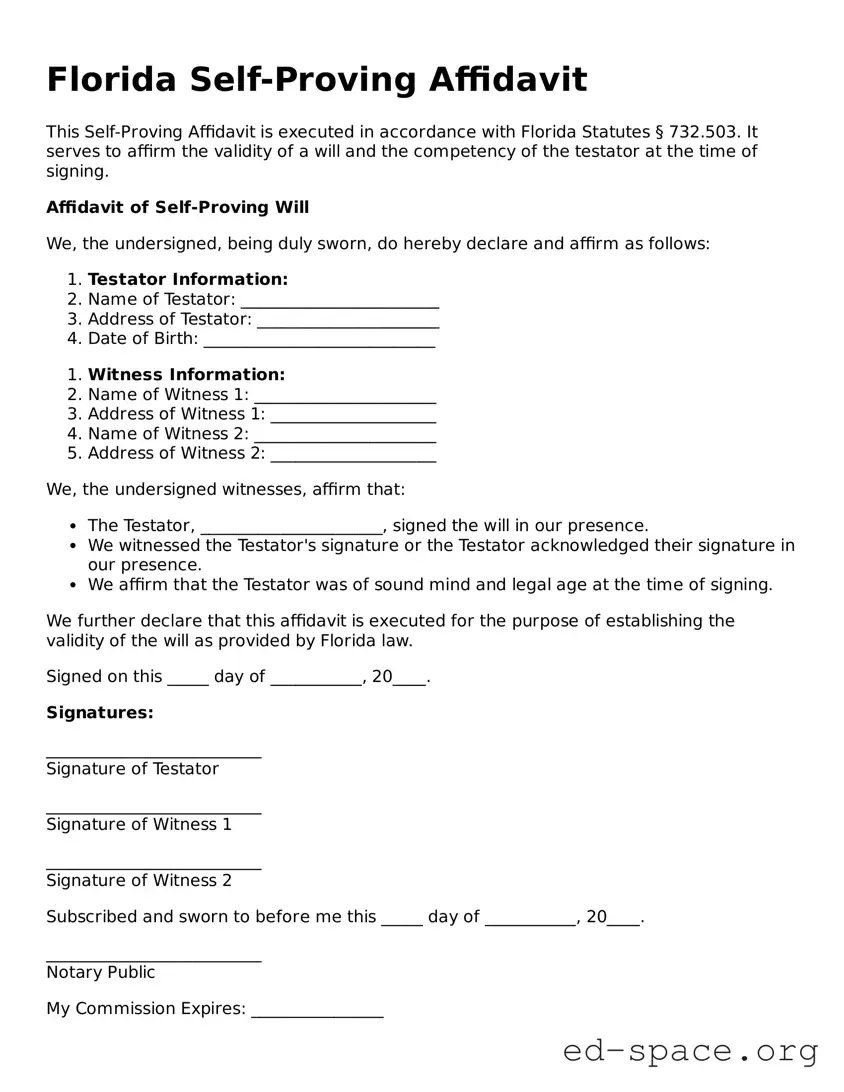
The Florida Self-Proving Affidavit is an essential legal document designed to streamline the probate process for wills. This form allows a testator, the person who creates a will, to affirm the validity of their will at the time of signing, eliminating the need for witnesses to appear in court after the testator's passing. By including this affidavit, the testator and witnesses can provide sworn statements confirming that the will was executed properly, ensuring that the testator's wishes are honored without unnecessary delays. The affidavit must be signed by the testator and witnessed by at least two individuals who are present at the same time. Additionally, the form includes a notary public’s acknowledgment, which adds another layer of authenticity. Overall, the Florida Self-Proving Affidavit simplifies the legal process, providing peace of mind to individuals and their families during a difficult time.
Florida Self-Proving Affidavit
This Self-Proving Affidavit is executed in accordance with Florida Statutes § 732.503. It serves to affirm the validity of a will and the competency of the testator at the time of signing.
Affidavit of Self-Proving Will
We, the undersigned, being duly sworn, do hereby declare and affirm as follows:
We, the undersigned witnesses, affirm that:
We further declare that this affidavit is executed for the purpose of establishing the validity of the will as provided by Florida law.
Signed on this _____ day of ___________, 20____.
Signatures:
__________________________
Signature of Testator
__________________________
Signature of Witness 1
__________________________
Signature of Witness 2
Subscribed and sworn to before me this _____ day of ___________, 20____.
__________________________
Notary Public
My Commission Expires: ________________
| Fact Name | Description |
|---|---|
| Purpose | The Florida Self-Proving Affidavit is used to simplify the probate process by allowing a will to be accepted without requiring witnesses to testify. |
| Governing Law | This form is governed by Florida Statutes Section 732.503. |
| Signatories | The testator and two witnesses must sign the affidavit in the presence of a notary public. |
| Notarization | A notary public must acknowledge the signatures on the affidavit to validate it. |
| Effectiveness | The self-proving affidavit allows the will to be probated without the witnesses being present, streamlining the process. |
| Form Availability | The form is available through various legal resources and can also be customized to fit individual needs. |
| Revocation | The affidavit does not revoke the will; it merely serves as a tool to support its validity. |
| Filing Requirements | The self-proving affidavit should be filed with the will during the probate process to ensure it is recognized. |
After gathering the necessary information, you will be ready to complete the Florida Self-Proving Affidavit form. This document must be filled out accurately to ensure its validity in court. Follow these steps carefully to complete the form.
What is a Florida Self-Proving Affidavit?
A Florida Self-Proving Affidavit is a legal document that allows a will to be validated without the need for witnesses to testify in court. This affidavit is signed by the testator (the person making the will) and witnesses in the presence of a notary public. By including this affidavit with the will, the probate process can be simplified and expedited.
Why should I use a Self-Proving Affidavit?
Using a Self-Proving Affidavit can streamline the probate process. When a will is self-proving, it eliminates the need for witnesses to appear in court to verify the will's authenticity. This can save time and reduce potential disputes among heirs or interested parties, making the administration of the estate more efficient.
How do I create a Self-Proving Affidavit in Florida?
To create a Self-Proving Affidavit in Florida, you must include specific language that complies with state law. The document should state that the testator and witnesses affirm their signatures in front of a notary public. It is advisable to consult an attorney or use a reputable template to ensure that all legal requirements are met.
Do I need to have a notary present when signing the Self-Proving Affidavit?
Yes, a notary public must be present when the testator and witnesses sign the Self-Proving Affidavit. The notary will verify the identities of the individuals involved and ensure that the signatures are made voluntarily. This step is crucial for the affidavit to be considered valid in court.
Can I add a Self-Proving Affidavit to an existing will?
Yes, you can add a Self-Proving Affidavit to an existing will. However, it is important to ensure that the addition does not alter any of the original terms of the will. It may be wise to consult with an attorney to draft the affidavit properly and confirm that it complies with Florida law.
What happens if my will does not include a Self-Proving Affidavit?
If your will does not include a Self-Proving Affidavit, the probate process may require witnesses to testify about the validity of the will. This can lead to delays and additional costs, especially if witnesses are unavailable or if there are disputes regarding the will's authenticity.
Is there a specific form for the Self-Proving Affidavit in Florida?
While there is no mandatory form for the Self-Proving Affidavit in Florida, it must contain certain elements to be valid. Many attorneys use a standard template that includes the necessary language and format. Utilizing a widely accepted form can help ensure compliance with state laws.
How long is a Self-Proving Affidavit valid in Florida?
A Self-Proving Affidavit remains valid as long as the will it accompanies is valid. There is no expiration date on the affidavit itself, but if the will is revoked or replaced, the affidavit would no longer be applicable. It is important to keep all estate planning documents updated to reflect current wishes.
Can I revoke a Self-Proving Affidavit?
Yes, you can revoke a Self-Proving Affidavit, but the process generally involves revoking the will itself or creating a new will that supersedes the previous one. If you wish to revoke an affidavit specifically, it is advisable to consult with an attorney to ensure that the revocation is properly documented and executed.
Incomplete Information: Many people forget to fill in all required fields. This includes names, addresses, and dates. Leaving any section blank can lead to complications later.
Incorrect Signatures: Signatures must match the names on the document. If a person signs with a nickname or a different name, it may cause issues when validating the affidavit.
Not Having Witnesses: The affidavit must be signed in the presence of at least two witnesses. Failing to have witnesses present during the signing can invalidate the document.
Improper Notarization: A notary public must properly notarize the affidavit. If the notary does not sign or stamp the document correctly, it may not be considered valid.
Using Outdated Forms: Laws can change, and so can the forms. Using an outdated version of the Self-Proving Affidavit can lead to legal issues.
Failing to Date the Document: The date of signing is crucial. Not including the date can lead to confusion about when the affidavit was executed.
Not Understanding the Purpose: Some people fill out the affidavit without fully understanding its purpose. This can lead to errors in how the document is completed.
Neglecting to Review: After filling out the form, it’s essential to review it for errors. Skipping this step can result in mistakes that might be hard to fix later.
The Florida Self-Proving Affidavit is a useful document that allows a testator's will to be validated without the need for witnesses to testify in court. However, there are other forms and documents that often accompany it. Here’s a list of some key documents that may be used in conjunction with the Self-Proving Affidavit:
These documents play important roles in the probate process and help ensure that the wishes of the deceased are honored while complying with legal requirements. Understanding each of these forms can make navigating the probate process smoother for everyone involved.
The Self-Proving Affidavit is a legal document that serves to affirm the validity of a will, often used to streamline the probate process. There are several other documents that share similarities with the Self-Proving Affidavit, each serving distinct purposes but also aiming to validate or authenticate certain legal processes. Here’s a list of seven such documents:
Each of these documents plays a crucial role in estate planning and legal processes, helping to clarify intentions and reduce potential conflicts among parties involved.
When filling out the Florida Self-Proving Affidavit form, it's important to approach the task with care. This document serves as a legal declaration that validates a will, making it essential to get it right. Here’s a helpful list of things you should and shouldn't do:
By following these guidelines, you can help ensure that your Florida Self-Proving Affidavit is completed correctly and effectively. This not only streamlines the probate process but also provides peace of mind for all involved.
When it comes to the Florida Self-Proving Affidavit form, several misconceptions can lead to confusion. Here are five common misunderstandings:
Many people think that only those with significant assets need a Self-Proving Affidavit. In reality, this form is beneficial for anyone who wants to simplify the probate process, regardless of their financial situation.
Some believe that a Self-Proving Affidavit can take the place of a will. This is not true. The affidavit serves as a supplement to a valid will, making it easier to prove the will's authenticity during probate.
There is a misconception that a Self-Proving Affidavit can be executed after someone has passed away. However, this form must be signed in the presence of the testator and witnesses while the testator is still alive.
Some individuals think that a Self-Proving Affidavit can be valid without witnesses. In Florida, the affidavit must be signed by the testator and two witnesses to be legally binding.
Many people shy away from using a Self-Proving Affidavit because they believe it’s too complex. In truth, the process is straightforward, especially with the right guidance, and can save time and hassle in the long run.
Understanding these misconceptions can help individuals navigate the estate planning process more effectively and ensure their wishes are honored.
Understanding the Florida Self-Proving Affidavit form is essential for ensuring that your will is valid and can be executed without complications. Here are some key takeaways to consider:
By following these guidelines, you can help ensure that your estate planning process runs smoothly and effectively.