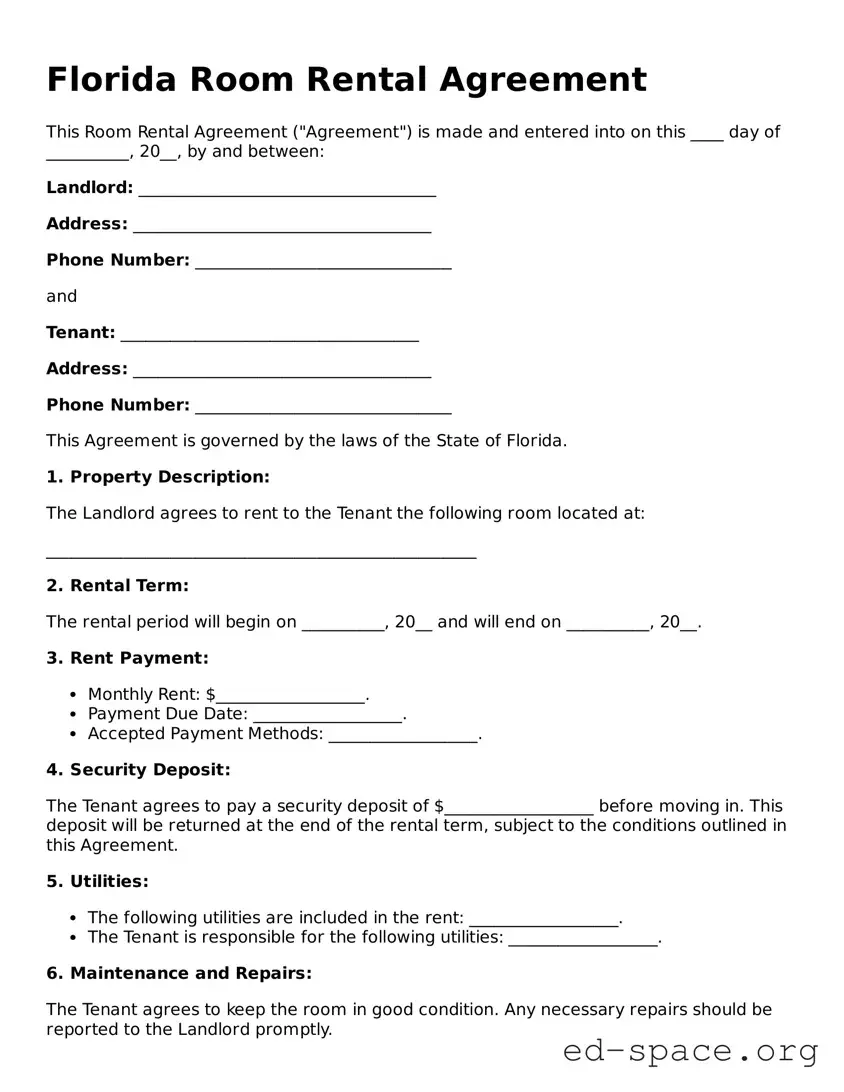
The Florida Room Rental Agreement form serves as a crucial document for individuals seeking to rent a room in the state of Florida. This agreement outlines the terms and conditions that govern the rental arrangement between the landlord and the tenant. Key aspects include the rental amount, payment due dates, and the duration of the rental period. Additionally, the form addresses security deposits, maintenance responsibilities, and rules regarding the use of shared spaces. Both parties are encouraged to review their rights and obligations as stipulated in the agreement. By clearly defining these elements, the form aims to prevent misunderstandings and provide a framework for a positive rental experience. Furthermore, it is important for both landlords and tenants to understand the implications of the agreement, as it serves to protect their interests throughout the rental period.
Florida Room Rental Agreement
This Room Rental Agreement ("Agreement") is made and entered into on this ____ day of __________, 20__, by and between:
Landlord: ____________________________________
Address: ____________________________________
Phone Number: _______________________________
and
Tenant: ____________________________________
Address: ____________________________________
Phone Number: _______________________________
This Agreement is governed by the laws of the State of Florida.
1. Property Description:
The Landlord agrees to rent to the Tenant the following room located at:
____________________________________________________
2. Rental Term:
The rental period will begin on __________, 20__ and will end on __________, 20__.
3. Rent Payment:
4. Security Deposit:
The Tenant agrees to pay a security deposit of $__________________ before moving in. This deposit will be returned at the end of the rental term, subject to the conditions outlined in this Agreement.
5. Utilities:
6. Maintenance and Repairs:
The Tenant agrees to keep the room in good condition. Any necessary repairs should be reported to the Landlord promptly.
7. Termination:
Either party may terminate this Agreement by providing written notice at least ____ days prior to the desired termination date.
8. Governing Law:
This Agreement shall be governed by the laws of the State of Florida.
9. Signatures:
By signing below, both parties agree to the terms outlined in this Room Rental Agreement.
Landlord Signature: ___________________________ Date: _______________
Tenant Signature: ____________________________ Date: _______________
| Fact Name | Description |
|---|---|
| Purpose | The Florida Room Rental Agreement form is used to outline the terms and conditions for renting a room in Florida. |
| Governing Law | This agreement is governed by the Florida Statutes, particularly Chapter 83, which deals with residential tenancies. |
| Parties Involved | The form identifies the landlord and tenant, ensuring both parties are clearly defined. |
| Lease Duration | The agreement specifies the length of the rental period, which can be monthly, yearly, or any other agreed-upon term. |
| Rent Amount | The form includes the total rent due, payment frequency, and acceptable payment methods. |
| Security Deposit | Details regarding the security deposit, including the amount and conditions for its return, are outlined in the agreement. |
| Maintenance Responsibilities | The responsibilities for maintenance and repairs are clearly delineated between the landlord and tenant. |
| Termination Clause | The form provides guidelines on how either party can terminate the agreement, including notice requirements. |
Filling out the Florida Room Rental Agreement form is an important step for both landlords and tenants. This document outlines the terms of the rental arrangement, ensuring that everyone is on the same page. Once completed, this agreement serves as a legal contract that protects the interests of both parties.
After completing these steps, make sure to keep a copy of the signed agreement for your records. This will serve as a reference point throughout the rental period, ensuring that both parties adhere to the agreed-upon terms.
What is a Florida Room Rental Agreement?
A Florida Room Rental Agreement is a legal document that outlines the terms and conditions between a landlord and a tenant for renting a room in a property. It specifies the rights and responsibilities of both parties, ensuring clarity and protection in the rental relationship.
What key elements should be included in the agreement?
The agreement should include essential details such as the names of the landlord and tenant, the rental property address, the duration of the rental period, the amount of rent, payment due dates, security deposit information, and any rules or regulations that apply to the property.
How long is a typical rental agreement in Florida?
In Florida, rental agreements can vary in length. They may be short-term, lasting a few months, or long-term, extending for a year or more. The duration should be clearly stated in the agreement to avoid confusion.
Is a security deposit required?
Yes, a security deposit is often required. This deposit serves as protection for the landlord against potential damages or unpaid rent. Florida law limits the amount that can be charged, and the terms regarding its return should be clearly outlined in the agreement.
What happens if the tenant wants to terminate the agreement early?
If a tenant wishes to terminate the agreement early, they should refer to the specific terms outlined in the document. Many agreements include a notice period or penalties for early termination. Communication with the landlord is crucial to address any potential issues.
Can a landlord enter the rented room without permission?
Generally, a landlord cannot enter a rented room without the tenant's permission, except in emergencies or for necessary repairs. The agreement should specify the notice required before the landlord can enter the premises.
What happens if the tenant fails to pay rent on time?
If a tenant fails to pay rent on time, the landlord may have the right to charge late fees as specified in the agreement. Continued non-payment could lead to eviction proceedings, but landlords must follow Florida's legal process to do so.
Are there any specific laws governing room rentals in Florida?
Yes, Florida has specific laws that govern rental agreements, including the Florida Residential Landlord and Tenant Act. This law outlines the rights and responsibilities of both landlords and tenants, ensuring fair treatment in rental situations.
Can the rental agreement be modified after signing?
Modifications to the rental agreement can be made, but they typically require written consent from both the landlord and tenant. It's essential to document any changes to maintain clarity and avoid future disputes.
What should a tenant do if they have a dispute with the landlord?
If a tenant has a dispute with the landlord, they should first attempt to resolve the issue through direct communication. If that fails, they may seek mediation or legal advice. Keeping records of all communications can be helpful in resolving disputes.
Not reading the entire agreement thoroughly. Many people skip sections, which can lead to misunderstandings about terms and conditions.
Failing to provide accurate personal information. Incorrect names, addresses, or contact details can cause issues in communication and legal matters.
Overlooking the rental payment details. It is essential to confirm the amount, due date, and payment methods to avoid late fees.
Neglecting to specify the duration of the rental. Clearly stating the start and end dates helps prevent disputes later on.
Not including any additional agreements or conditions. If there are specific rules or arrangements, they should be documented in the agreement.
Ignoring the need for signatures. Both parties must sign the document to make it legally binding.
Failing to keep a copy of the signed agreement. Retaining a copy is important for reference and in case of disputes.
Assuming verbal agreements are sufficient. Always put agreements in writing to ensure clarity and enforceability.
The Florida Room Rental Agreement form is an essential document for establishing the terms of a rental arrangement. However, several other forms and documents are often used in conjunction with it to ensure a comprehensive understanding between the landlord and tenant. Below is a list of these important documents.
Using these documents in conjunction with the Florida Room Rental Agreement can help clarify the responsibilities and expectations of both landlords and tenants. Proper documentation is key to a smooth rental experience.
When filling out the Florida Room Rental Agreement form, it is important to adhere to certain guidelines to ensure accuracy and compliance. Below is a list of things to do and avoid during this process.
Many people have misunderstandings about the Florida Room Rental Agreement form. Here are four common misconceptions:
Many believe that the Florida Room Rental Agreement is solely for long-term rentals. In reality, this form can be used for both short-term and long-term agreements. Whether you’re renting for a weekend or a year, this document can serve your needs.
Some individuals think that the agreement lacks legal weight. However, when properly filled out and signed by both parties, it is a legally binding contract. This means it can be enforced in a court of law if necessary.
Another misconception is that the form is only required for large rental properties. In truth, even small rentals or individual rooms benefit from having a written agreement. It protects both the landlord and the tenant by clearly outlining expectations.
Many assume that all rental agreements are interchangeable. This is not the case. The Florida Room Rental Agreement is specifically tailored to meet the legal requirements and standards of Florida, ensuring that all local laws are followed.
When it comes to renting a room in Florida, understanding the Room Rental Agreement form is crucial. Here are some key takeaways to keep in mind:
By paying attention to these key aspects, both landlords and tenants can create a clear and effective Room Rental Agreement that meets their needs.