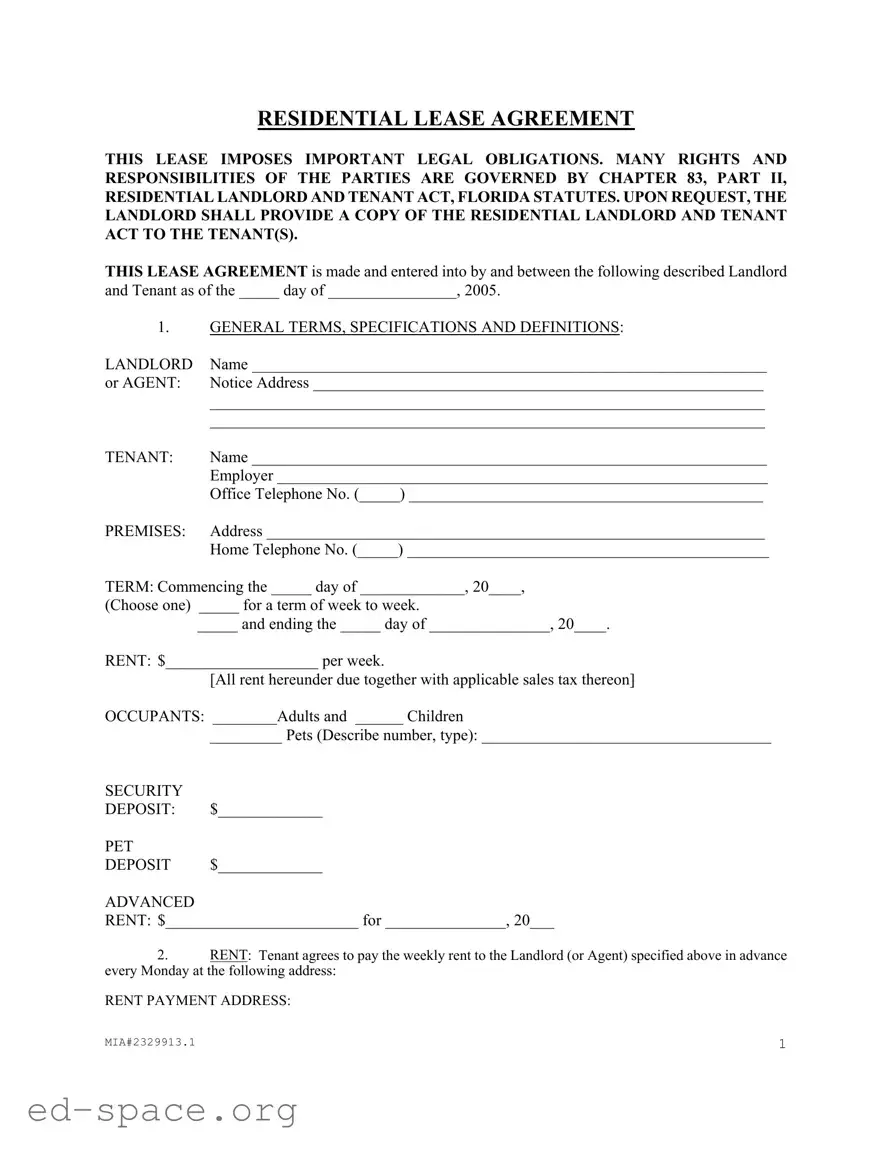
The Florida Residential Lease Agreement is a crucial document that outlines the rights and responsibilities of both landlords and tenants in a rental arrangement. This form serves as a binding contract, detailing essential elements such as the identities of the parties involved, the rental amount, and the duration of the lease. It specifies the obligations regarding rent payment, security deposits, and maintenance responsibilities, ensuring that both parties understand their commitments. Additionally, it addresses the use of the premises, including restrictions on alterations and the keeping of pets, while also outlining rules for inspections and entry by the landlord. The agreement emphasizes the importance of compliance with local laws and regulations, particularly those found in the Florida Residential Landlord and Tenant Act. In essence, this form is designed to foster a harmonious living environment while protecting the interests of both landlords and tenants, making it an indispensable tool in the rental process.
RESIDENTIAL LEASE AGREEMENT
THIS LEASE IMPOSES IMPORTANT LEGAL OBLIGATIONS. MANY RIGHTS AND RESPONSIBILITIES OF THE PARTIES ARE GOVERNED BY CHAPTER 83, PART II, RESIDENTIAL LANDLORD AND TENANT ACT, FLORIDA STATUTES. UPON REQUEST, THE LANDLORD SHALL PROVIDE A COPY OF THE RESIDENTIAL LANDLORD AND TENANT ACT TO THE TENANT(S).
THIS LEASE AGREEMENT is made and entered into by and between the following described Landlord and Tenant as of the _____ day of ________________, 2005.
1.GENERAL TERMS, SPECIFICATIONS AND DEFINITIONS:
LANDLORD |
Name ________________________________________________________________ |
or AGENT: |
Notice Address ________________________________________________________ |
|
_____________________________________________________________________ |
|
_____________________________________________________________________ |
TENANT: |
Name ________________________________________________________________ |
|
Employer _____________________________________________________________ |
|
Office Telephone No. (_____) ____________________________________________ |
PREMISES: |
Address ______________________________________________________________ |
|
Home Telephone No. (_____) _____________________________________________ |
TERM: Commencing the _____ day of _____________, 20____,
(Choose one) _____ for a term of week to week.
_____ and ending the _____ day of _______________, 20____.
RENT: $___________________ per week.
[All rent hereunder due together with applicable sales tax thereon]
OCCUPANTS: ________Adults and ______ Children
_________ Pets (Describe number, type): ____________________________________
SECURITY
DEPOSIT: $_____________
PET
DEPOSIT $_____________
ADVANCED
RENT: $________________________ for _______________, 20___
2.RENT: Tenant agrees to pay the weekly rent to the Landlord (or Agent) specified above in advance every Monday at the following address:
RENT PAYMENT ADDRESS:
MIA#2329913.1 |
1 |
Tenant agrees to pay the rent with a check or cash. In the event Tenant's bank does not honor the check, Tenant agrees to replace it with a cashier's check. Tenant consents to Landlord making any and all lawful credit checks or inquiries as a condition to entering into this Lease; and Tenant shall execute any further documents in the nature of consents and authorization in respect thereof as Landlord may require. To facilitate same, Tenant shall truthfully provide Tenant’s social security number.
3.SECURITY AND DAMAGE DEPOSIT: Tenant is depositing with Landlord the security and damage (and Pet, as applicable) deposit(s) in the amount(s) specified above (collectively, the “Security Deposit”). The Security Deposit together with any advanced rent payment other than the first week's rent shall be held in a separate
4.CONDITION OF PREMISES: Tenant has examined the Premises, including the grounds and all buildings and improvements, and agrees that they are in good order and repair and in a safe, clean and tenantable condition. The Premises are rented (choose one) ____furnished ____unfurnished. However, the following items are included: any
_____________________________________________________________________________________________
______________________________________________________________________________________________.
5.USE OF PREMISES: Tenant agrees to use the Premises exclusively as a private
6.RULES; DANGEROUS USES OR MATERIALS: Tenant shall abide by Landlord’s rules and regulations as promulgated from time to time. Tenant agrees not to keep or otherwise possess, carry, store or discharge any guns or other firearms of any kind whatsoever, nor will Tenant allow any of its guests or invitees to do so. Tenant agrees that a violation of this rule against guns and firearms will permit Landlord to immediately terminate this Lease and the Security Deposit will be applied in full to partially reimburse Landlord’s resultant damages, including
7.MAINTENANCE AND REPAIR / LOCKS AND KEYS: Tenant agrees to maintain the Premises in a clean and sanitary manner and in good condition and repair. Tenant's obligation shall include, but not be limited to, (i) regularly changing or cleaning
Tenant acknowledges receipt of one (l) set of keys to the Premises and agrees to return the same at the end of the Lease, together with any duplicates made. Tenant authorizes Landlord to replace any lost keys that are not returned at the end or sooner termination of this Lease, and Landlord may use the Security Deposit to cover the cost thereof.
8.ALTERATIONS AND IMPROVEMENTS: Tenant agrees to not make any alterations or
MIA#2329913.1 |
2 |
improvements to the Premises without Landlord's prior written consent, which consent Landlord is not obligated to give and which consent may be unreasonably withheld.
9.ANIMALS: Tenant agrees to not keep any animals on the Premises without Landlord's prior written consent, which consent Landlord is not obligated to give and which consent may be unreasonably withheld. In the event Landlord consents to Tenant having an animal on the Premises, Tenant agrees to have the Premises professionally cleaned and treated for infestation at the end of this Lease at his own expense; failing which Landlord may apply the Security Deposit toward such expense.
10.INSPECTION OF PREMISES: Tenant understands Landlord has a right to enter and inspect the Premises from time to time during reasonable daytime hours, and to enter the Premises to make necessary repairs, alterations, and improvements and Tenant agrees to not unreasonably withhold his consent for Landlord's entry and inspection. Tenant agrees Landlord may enter the Premises at any time either in case of an emergency to protect or preserve the Premises or if Tenant unreasonably withholds his consent for Landlord to enter and inspect the Premises.
11.ASSIGNMENT AND SUBLETTING: Tenant agrees to not assign this Lease and to not sublet the Premises without Landlord's prior written consent, which consent the Landlord is not obligated to give and which consent may be unreasonably withheld.
12.DAMAGE TO PREMISES BY FIRE OR OTHER CASUALTY: Landlord agrees that in the event the Premises are damaged by fire or other casualty, not caused by negligence on the part of Tenant, Tenant's family, employees, or visitors, Landlord will promptly repair the damages and rent shall not be paid until the Premises are tenantable. If the damages exceed $5,000.00, Landlord or Tenant may cancel the Lease and the rent for the week of the casualty shall be prorated.
13.UTILITIES: Tenant agrees to arrange for and pay for all utilities and services, including without limitation, electricity, telephone, gas, water, cable, and pest extermination (monthly); and including the
14.DISPLAY OF SIGNS AND EXHIBITION: Tenant agrees to not unreasonably withhold his consent for Landlord to exhibit the Premises to prospective or actual purchasers or tenants and during the term of this Lease, Landlord may display either a "FOR RENT" or "FOR SALE" sign on the Premises. Upon reasonable telephone notice, Tenant shall make the Premises available to Landlord or Landlord's agent for the purpose of showing the Premises to prospective purchasers and Tenant shall cause the Premises to have a neat and clean appearance at such times that the Premises are to be so shown.
15.SURRENDER OF PREMISES: At the end of this Lease, Tenant agrees to surrender the Premises to Landlord in as good condition as they were at the beginning of this Lease, reasonable use and wear excepted.
16.DEFAULT AND TERMINATION: If Tenant fails to comply with the provisions of this Lease, except Tenant's
17.LATE FEES, INTEREST, BAD CHECKS: Tenant agrees to pay a late fee of the greater of $50.00 or five (5%)of any aggregate rent or additional rent not timely paid in full, such late fee being payable in good, collected funds within seven (7) days of the date when same is due. All amounts payable by Tenant to Landlord as rent shall bear interest at the annual rate of eighteen (l8%) percent from the date due (or the maximum lesser rate if otherwise mandated by law). Neither the late fee nor the interest charge shall be exclusive of any other remedies permitted hereunder or by law. A bad check fee in the amount of $20.00 (provided such amount shall not exceed the greater of $20.00 or 5% of the rental payment due hereunder per week) if Tenant makes any payment of rents hereunder with a bad check (that is, a check returned for insufficient funds or otherwise not collected in due course upon deposit for any reason whatsoever other than a banking error on the part of Landlord’s bank). In case of any such bad check payment, even where cured by
3
MIA#2329913.1
Tenant, Landlord expressly reserves the right in Landlord’s sole discretion to require Tenant to pay all future rents and charges under this Lease in cash or by money order; in which event Tenant hereby expressly agrees and covenants that Tenant shall do so.
18.ABANDONMENT: If at any time during this Lease Tenant abandons the Premises and the rent is not current, Tenant agrees Landlord may retake possession of the Premises. Tenant agrees Landlord may also take possession of any personal property left in the abandoned premises and may sell or dispose of the personal property at private or public sale or in any manner Landlord deems proper, subject to applicable law. The proceeds from the sale or disposal shall be applied to any amounts Tenant owes under this Lease, subject to applicable law. In case of a reletting of the Premises by Landlord after default and/or abandonment by Tenant, Tenant agrees to be liable for the difference between any rent collected under the reletting of the Premises and the amount that would have had to be paid as rent; provided, under no circumstances shall Landlord be liable to Tenant for any excess collected. Notwithstanding the foregoing, however, under no circumstances shall Landlord be obligated to relet the Premises, to attempt to relet the Premises or to otherwise attempt to mitigate any damages which Landlord may suffer as a consequence of the Tenant's default. Subject to applicable law, Tenant agrees that the Security Deposit shall be released to Landlord and shall be applied to any amounts owed under this Lease.
19.ATTORNEYS' FEES AND COSTS: Tenant understands that in connection with any litigation arising out of this Agreement, including appeals, the prevailing party shall be entitled to recover all costs incurred, including reasonable attorneys' fees.
20.QUIET ENJOYMENT: Landlord covenants and agrees with Tenant that upon Tenant's paying the rent and observing and performing all the terms, covenants and conditions on Tenant's part to be performed and observed, Tenant may peaceably and quietly enjoy the Premises subject, nevertheless, to the terms and conditions of this Lease, and all zoning restrictions, conditions, limitations, easements and encumbrances now or hereafter affecting the Premises.
21.HOLDING OVER: If Tenant shall be in possession of the Premises after the expiration or sooner termination of this Lease, in the absence of any written agreement extending the term hereof, the tenancy under this Lease shall become, at Lessor's option, a tenancy at sufferance, and Lessor shall be entitled to double rent.
22.INDEMNIFICATION AND HOLD HARMLESS: Tenant hereby agrees to pay all costs of Landlord's defense, and to indemnify and hold Landlord harmless from and against any and all claims, demands, suits, actions and judgments of any kind or nature and from damages whether compensatory, punitive or otherwise, resulting from or in connection with loss of life, bodily or personal injury or property damage arising, directly or indirectly, out of or from or on account of any occurrence in, upon, or from the Premises or occasioned through the use and occupancy of the Premises, or by any act, omission or negligence of Tenant or Tenant's agents, family, contractors or invitees, in, upon, at or from the Premises, or any part thereof, or in the common areas thereof. TENANT ACKNOWLEDGES AND
AGREES THAT THE LANDLORD IS NOT RESPONSIBLE OR LIABLE FOR LOSS OR THEFT OF, OR DAMAGE TO, ANY PERSONAL PROPERTY OR EFFECTS, INCLUDING WITHOUT LIMITATION, MONEY, COINS, JEWELRY, CLOTHING, ROOM DECORATIONS, ELECTRONIC DEVICES, ART, MEMENTOS, COLLECTIBLES, AND FURNITURE (“LOSSES”). TENANT ACKNOWLEDGES AND AGREES THAT THE LANDLORD IS NOT AN INSURER AGAINST SUCH LOSSES. TENANT EXPRESSLY RELEASES THE LANDLORD FROM ANY CLAIM, LOSS OR LIABILITY ARISING OUT OF OR RELATED TO SUCH LOSSES. TENANT IS ENCOURAGED TO SECURE RENTER’S INSURANCE TO PROTECT AGAINST THESE LOSSES.
23.INSURANCE: (Choose one)
_____ Tenant shall not be required to provide liability insurance.
_____ Throughout the term of this Lease, Tenant shall pay all premiums for liability insurance coverage on the
Premises, in such amount and with such companies as may be determined prudent and adequate by Landlord. Landlord shall be named as an insured on all said insurance and shall be provided with a certificate of said coverage. Any insurance procured by Tenant as herein required shall be issued in the name of Landlord and Tenant by a company licensed to do business in the state in which the Premises is located and shall contain endorsements that: (a) such insurance may not be cancelled or amended with respect to Landlord without thirty (30) days written notice by certified mail, return receipt requested, to Landlord by the insurance company; (b) Tenant shall be solely responsible for payment of premiums and Landlord shall not be required to pay any premiums for such insurance; and (c) in the event of payment of any loss covered by such policy, Landlord shall be paid first by the insurance company for its loss. The original policy
4
MIA#2329913.1
of all such insurance shall be delivered to Landlord prior to the commencement of the term of the Lease.
24.
25.SALES TAX: Tenant hereby agrees to pay to Landlord, together with the weekly payment of rent, any tax in the form of sales, rent or use tax on said weekly rental payments, as the same may be required under Florida law.
26.SUBORDINATION: This Lease shall be subordinate and inferior to the interests and liens of any existing or future mortgagee in or upon the Premises or the larger property or tract of which it is a part and/or the underlying land thereof (the “Subordination”), and Tenant agrees to fully recognize the rights and interests of any such existing or future mortgagee who may succeed to ownership of, or an ownership interest in, the Premises or such property or improvements. The Subordination shall be automatically effective and
27.LIENS. Tenant shall not have the right or authority to encumber the Premises or to permit any person to claim or assert any lien for the improvement or repair of the Premises made by Tenant; all such liens or encumbrances being hereby expressly prohibited. Tenant shall notify all parties performing work on the Premises at Tenant’s request that the Lease does not allow any liens to attach to Landlord’s interest.
28.NO BROKERS: Tenant represents and warrants that there was no broker instrumental in consummating this Lease; no broker was the procuring cause hereof, and no conversations or prior negotiations were had by Tenant with any broker concerning this Lease or the provisions hereof (any such broker or conversations or negotiations, if they had taken place, would be referred to as “Broker Discussions”), other than with Landlord and Landlord’s managing agent. Tenant agrees to protect, defend, indemnify and hold Landlord harmless from and against any and all liabilities, including attorneys' fees and costs incurred through all levels of proceedings, arising from or in connection with any Broker Discussions had by Tenant.
29.NOTICE: Any notice under this Lease must be in writing and sent by certified mail, return receipt requested, to the last address of the party to whom the notice is to be given, as designated by such party in writing. Initially, Landlord’s and Tenant’s notice addresses, respectively, shall be as set out at the commencement of this Lease; provided Landlord shall always be entitled to deliver effective notice hereunder to the Premises (including through posting or
30.MISCELLANEOUS: Time is of the essence of the Lease. The Lease shall be binding upon and for the benefit of the heirs, personal representatives, successors, and permitted assigns of Landlord and Tenant, subject to the requirements specifically mentioned in the Lease. Whenever used, the singular number shall include the plural or singular and the use of any gender shall include all appropriate genders. The agreements contained in the Lease set forth the complete understanding of the parties and may not be changed or terminated orally. The parties acknowledge that there are no other promises, agreements, conditions, undertakings, warranties, or representations, oral or written, express or implied, between and among them, except as set forth, referenced, or incorporated herein. This Lease shall not be modified except only as set forth in a writing duly signed by all the parties hereto. In the event any provision of this Lease is prohibited, unenforceable or invalid under the laws of any jurisdiction, including those of the State of Florida, such prohibition, unenforceable or invalid provision shall not in any fashion affect the enforceability or validity of the remaining provisions hereof. No delay or omission by any party to exercise any right, power or remedy available under this Lease shall be deemed to impair any such right, power or remedy or to constitute a waiver of or acquiescence in any breach or default of any other party hereto. All questions concerning the meaning, execution, construction, effect, validity, and enforcement of the Lease shall be determined pursuant to the laws of Florida. This Lease shall be governed by the laws of the State of Florida. Jurisdiction and venue for any litigation arising out of or in connection herewith shall lie and be exclusively in the County Court or the Circuit Court of Walton County, Florida. Landlord and Tenant will use good faith in performing their obligations under the Lease. This Lease shall not be construed more strictly against one party than against the other merely by virtue of the fact that it may have been prepared by counsel for one of the parties.
NO AGREEMENT TO ACCEPT SURRENDER OF THE PREMISES FROM TENANT WILL EVER BE VALID UNLESS IN WRITING AND SIGNED BY LANDLORD, EXPRESSLY INDICATING LANDLORD ACCEPTS SUCH A SURRENDER. THIS LEASE SHALL NOT BE RECORDED IN THE PUBLIC RECORDS AND ANY ATTEMPT TO DO SO SHALL BE VOID AB INITIO.
5
MIA#2329913.1
31.RADON: Section 404.056 (6), Fla. Stat., requires the inclusion of the following "Notification on Real Estate Documents" at the time of, or prior to, contract for sale and purchase of any building or execution of a rental agreement for any building: "Radon is a naturally occurring radioactive gas that, when it has accumulated in a building in sufficient quantities, may present health risks to persons who are exposed to it over time. Levels of radon that exceed Federal and State guidelines have been found in buildings in Florida. Additional information regarding radon and radon testing may be obtained from your county health department."
32.WAIVER OF TRIAL BY JURY. THE PARTIES HEREBY WAIVE TRIAL BY JURY IN ANY ACTION, PROCEEDING OR
33.
Lead Warning Statement
Housing built before 1978 may contain
Landlord's Disclosure (initial)
______(a) Presence of
(i)____Known
_________________________________________________________________________________
_________________________________________________________________________________
______
(ii)__xx__Landlord has no knowledge of
______(b) Records and reports available to the lessor (check (i) or (ii) below):
(i)____Landlord has provided the Tenant with all available records and reports pertaining to
(ii)_xx___Landlord has no reports or records pertaining to
Tenant's Acknowledgment (initial)
_________(c) Tenant has received copies of all information listed above.
_________(d) Tenant has received the pamphlet Protect Your Family From Lead in Your Home.
Agent's Acknowledgment (initial)
__N/A – NO AGENT INVOLVED___(e) Agent has informed the Landlord of the Landlord's obligations under 42 U.S.C. 4852d and is aware of his/her responsibility to ensure compliance.
Certification of Accuracy
The following parties (executing below) have reviewed the information above and certify, to the best of their knowledge, that the information provided by the signatory is true and accurate.
6
MIA#2329913.1
IN WITNESS WHEREOF, the parties have executed this Residential Lease Agreement on the day and year first above written.
Witnesses:
|
"Landlord" |
_________________________________ |
_______________________________ |
Witness |
|
_________________________________ |
|
Witness |
|
|
"Tenant" |
_________________________________ |
________________________________ |
Witness |
|
_________________________________ |
________________________________ |
Witness |
|
7
MIA#2329913.1
Security Deposit Notification
This Security Deposit Notification is given pursuant to Chapter 83, Florida Statutes, and is given immediately after (and in any case within thirty [30] days after) the date of execution and delivery of the Lease and Security Deposit described below, respecting the Landlord and Tenant described below, and respecting the Premises described below:
LANDLORD:
TENANT:
PREMISES:
SECURITY
DEPOSIT
(TOTAL):$
FINANCIAL OR DEPOSITORY INSTITUTION HOLDING SECURITY DEPOSIT:
NAME OF INSTITUTION:
ADDRESS OF INSTITUTION:
NOTIFICATION: Tenant is hereby notified by receipt in person of this writing, that: The Security Deposit (i) is commingled with the security deposits of other tenants and is held in a separate,
8
MIA#2329913.1
“83.49 Deposit money or advance rent; duty of landlord and tenant. ...
(3)(a) Upon the vacating of the premises for termination of the lease, the landlord shall have 15 days to return the Security Deposit together with interest if otherwise required, or in which to give the tenant written notice by certified mail to the tenant's last known mailing address of his or her intention to impose a claim on the deposit and the reason for imposing the claim. The notice shall contain a statement in substantially the following form:
This is a notice of my intention to impose a claim for damages in the amount of _____ upon
your security deposit, due to _____. It is sent to you as required by s. 83.49(3), Florida
Statutes. You are hereby notified that you must object in writing to this deduction from your security deposit within 15 days from the time you receive this notice or I will be authorized to deduct my claim from your security deposit. Your objection must be sent to (landlord's address) .
If the landlord fails to give the required notice within the
(b)Unless the tenant objects to the imposition of the landlord's claim or the amount thereof within 15 days after receipt of the landlord's notice of intention to impose a claim, the landlord may then deduct the amount of his or her claim and shall remit the balance of the deposit to the tenant within 30 days after the date of the notice of intention to impose a claim for damages.
(c)If either party institutes an action in a court of competent jurisdiction to adjudicate the party's right to the security deposit, the prevailing party is entitled to receive his or her court costs plus a reasonable fee for his or her attorney. The court shall advance the cause on the calendar.
(d)Compliance with this section by an individual or business entity authorized to conduct business in this state, including
9
MIA#2329913.1
| Fact Name | Details |
|---|---|
| Governing Law | The lease is governed by Chapter 83, Part II, Residential Landlord and Tenant Act, Florida Statutes. |
| Lease Type | This is a residential lease agreement for a single-family residence. |
| Security Deposit | Landlord must hold the security deposit in a non-interest bearing account for the tenant's benefit. |
| Rent Payment | Rent is due weekly, every Monday, at a specified address. |
| Inspection Rights | Landlord has the right to enter and inspect the premises during reasonable hours. |
| Alterations | Tenants cannot make alterations without prior written consent from the landlord. |
| Animals | Tenants must obtain written consent from the landlord to keep any animals on the premises. |
| Utilities | Tenants are responsible for arranging and paying for all utilities and services. |
| Late Fees | A late fee of $50 or 5% of unpaid rent may apply if rent is not paid on time. |
| Termination Conditions | The landlord can terminate the lease for non-compliance after a 7-day notice period. |
Completing the Florida Residential Agreement form is a straightforward process that requires careful attention to detail. Each section of the form must be filled out accurately to ensure that both parties understand their rights and responsibilities. After filling out the form, both the landlord and tenant will need to sign it to make it legally binding.
What is the Florida Residential Agreement form?
The Florida Residential Agreement form is a legal document that outlines the terms and conditions of a rental agreement between a landlord and tenant in Florida. It includes important information such as the rent amount, security deposit, term of the lease, and the responsibilities of both parties. This agreement is governed by the Florida Residential Landlord and Tenant Act, ensuring that both landlords and tenants understand their rights and obligations.
What should I include in the Florida Residential Agreement form?
When completing the Florida Residential Agreement form, you should include essential details such as the names of the landlord and tenant, the address of the rental property, the duration of the lease, and the amount of rent due. Additionally, specify any security deposits, pet deposits, and the number of occupants. It’s also crucial to outline any specific rules regarding maintenance, use of the premises, and any restrictions on alterations or pets.
How is the security deposit handled in the Florida Residential Agreement?
The security deposit is an amount paid by the tenant to the landlord to cover potential damages or unpaid rent. According to the Florida Residential Agreement, the landlord must hold this deposit in a separate non-interest bearing account. Upon termination of the lease, the landlord has 15 days to return the deposit or provide notice of any claims against it. If the tenant does not dispute the claim within 15 days, the landlord may retain the necessary amount from the deposit.
What happens if the tenant fails to pay rent on time?
If the tenant does not pay rent by the due date, the Florida Residential Agreement allows the landlord to impose a late fee. This fee is typically the greater of $50 or 5% of the overdue rent. The tenant has a grace period of three days to pay the rent after receiving a written demand from the landlord. Failure to pay may lead to termination of the lease and potential eviction proceedings.
Can the landlord enter the rental property without notice?
The landlord has the right to enter the rental property for inspections, repairs, or to show the property to prospective tenants or buyers. However, they must provide reasonable notice to the tenant, typically 24 hours, unless there is an emergency. The tenant should not unreasonably withhold consent for the landlord to enter the premises.
What should tenants know about making changes to the rental property?
Tenants are generally not allowed to make alterations or improvements to the rental property without obtaining prior written consent from the landlord. This includes changes such as painting walls or installing fixtures. If the landlord agrees to any changes, it is important to document this in writing to avoid disputes later.
Incomplete Information: One common mistake is failing to fill out all required fields, such as names, addresses, and contact numbers for both the landlord and tenant. Omitting this information can lead to confusion and potential disputes.
Incorrect Dates: Many people overlook the importance of entering the correct dates for the lease term. Missing or incorrect dates can complicate the agreement and lead to misunderstandings regarding the lease duration.
Misunderstanding Rent Amount: Some tenants mistakenly enter the wrong rent amount or fail to include applicable taxes. This can result in financial issues down the line, so it is crucial to verify the total rent due.
Ignoring Security Deposit Details: Not specifying the security deposit amount or failing to understand the terms related to its return can create problems when the lease ends. It is vital to clarify these details upfront.
Failure to List Occupants: Some tenants neglect to list all occupants, including children and pets. This omission can lead to violations of the lease terms and potential eviction.
Not Understanding Maintenance Responsibilities: Tenants often overlook their maintenance obligations. Failing to acknowledge these responsibilities can result in unexpected costs and disputes with the landlord.
Inadequate Knowledge of Rules: Some tenants do not read or understand the rules regarding the use of the premises, such as restrictions on pets or alterations. Ignoring these rules can lead to lease violations.
Neglecting Insurance Requirements: If the lease requires liability insurance, tenants may forget to procure it. This oversight can leave them financially vulnerable in case of accidents or damages.
Not Reviewing Termination Clauses: Many tenants fail to fully understand the termination clauses. This can lead to unexpected consequences if they need to end the lease early.
Ignoring the Importance of Signatures: Lastly, some individuals may forget to sign the lease or have the landlord sign it. Without proper signatures, the lease may not be legally binding.
The Florida Residential Agreement form is a critical document for landlords and tenants in Florida. It outlines the terms and conditions of the lease, ensuring that both parties understand their rights and responsibilities. In addition to this agreement, several other forms and documents are commonly used to facilitate the leasing process. Below is a list of these documents, along with brief descriptions of each.
These documents play essential roles in the landlord-tenant relationship, providing clarity and legal protection for both parties. Proper use of these forms can help prevent misunderstandings and disputes during the lease term.
When filling out the Florida Residential Agreement form, attention to detail is crucial. Here is a list of ten important dos and don’ts to guide you through the process.
By following these guidelines, you can help ensure a smoother leasing experience and protect your rights as a tenant. It is essential to approach this process with diligence and care.
Understanding the Florida Residential Lease Agreement is crucial for both landlords and tenants. However, several misconceptions can lead to confusion. Here are some common misunderstandings:
Being aware of these misconceptions can help both landlords and tenants navigate their responsibilities and rights more effectively. Clear communication and understanding of the lease terms are essential for a positive rental experience.
The Florida Residential Agreement form outlines the legal obligations of both landlords and tenants, emphasizing the importance of understanding the rights and responsibilities established by the Florida Residential Landlord and Tenant Act.
It is crucial for tenants to accurately fill out personal information, including names, contact details, and employment information, as this ensures effective communication and legal clarity throughout the lease term.
Tenants must be aware of their financial obligations, including rent payments, security deposits, and any applicable sales taxes, which should be clearly stated in the agreement.
Landlords have the right to enter the premises for inspections and necessary repairs, but tenants should not unreasonably withhold consent for such entries, ensuring a cooperative living environment.
Both parties should understand the process for resolving disputes, including the potential for late fees, the handling of abandoned property, and the conditions under which the lease may be terminated.