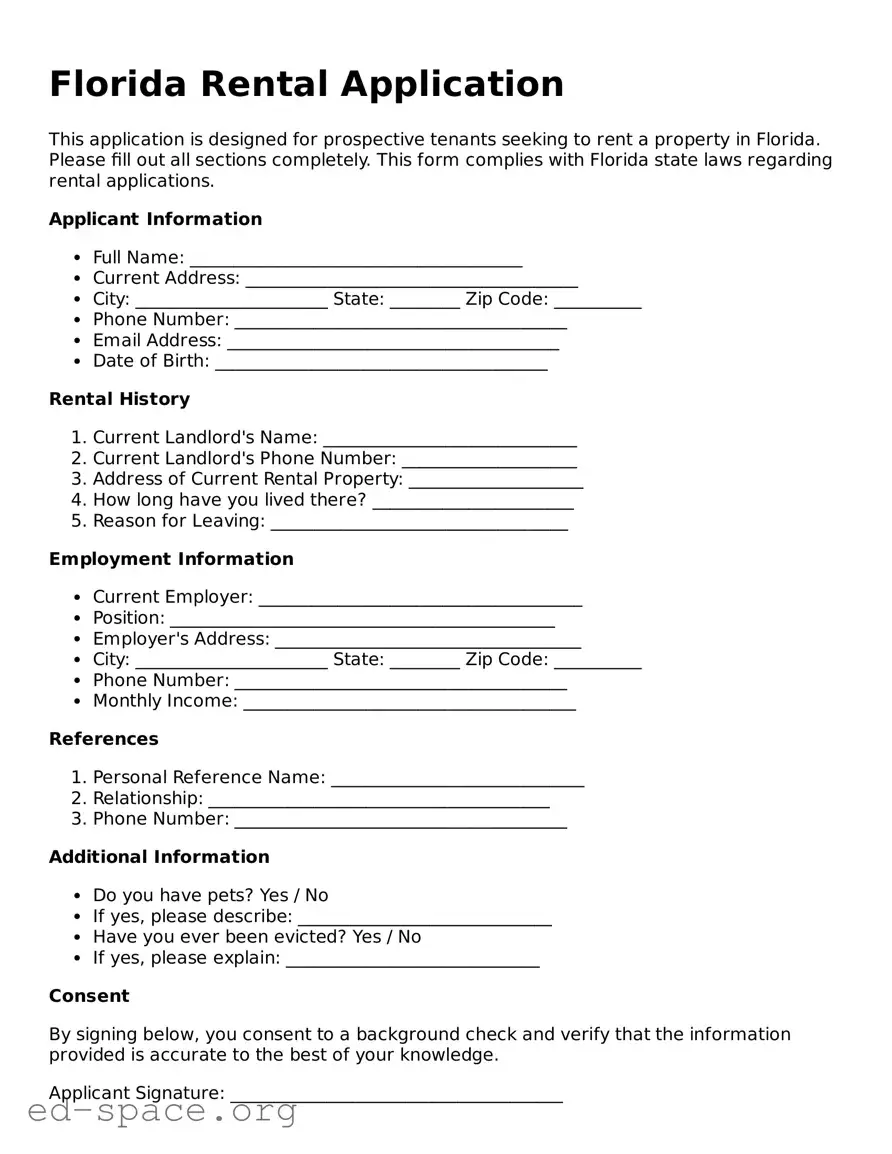
The Florida Rental Application form serves as a critical tool for both landlords and prospective tenants, streamlining the process of securing rental properties across the state. This document typically includes essential sections that require applicants to provide personal information, such as their name, contact details, and Social Security number. Additionally, it often prompts applicants to disclose their employment history and income, allowing landlords to assess financial stability. References from previous landlords or personal contacts may also be requested to gauge the applicant's reliability. Furthermore, the form might contain questions related to credit history and criminal background, which are pivotal for landlords in making informed decisions. Understanding the nuances of this form can significantly impact the rental experience, ensuring that both parties are aligned in their expectations and obligations.
Florida Rental Application
This application is designed for prospective tenants seeking to rent a property in Florida. Please fill out all sections completely. This form complies with Florida state laws regarding rental applications.
Applicant Information
Rental History
Employment Information
References
Additional Information
Consent
By signing below, you consent to a background check and verify that the information provided is accurate to the best of your knowledge.
Applicant Signature: ______________________________________
Date: _______________
| Fact Name | Description |
|---|---|
| Purpose | The Florida Rental Application form is used by landlords to screen potential tenants. |
| Information Required | Applicants typically provide personal information, rental history, and employment details. |
| Application Fee | Landlords may charge an application fee to cover the cost of background checks. |
| Background Checks | Landlords often conduct credit and criminal background checks based on the information provided. |
| Fair Housing Act | The application process must comply with the Fair Housing Act, prohibiting discrimination. |
| Disclosure Requirements | Florida law requires landlords to disclose if they will be conducting background checks. |
| Tenant Rights | Applicants have the right to know if their application is denied and the reasons for denial. |
| Timeframe for Processing | Landlords should process applications in a timely manner, typically within a few days. |
| State-Specific Laws | The Florida Residential Landlord and Tenant Act governs rental applications and tenant rights. |
| Record Keeping | Landlords are advised to keep records of applications for a certain period, usually one year. |
Filling out a rental application in Florida is a straightforward process. Once you have completed the form, you can submit it to the landlord or property manager for consideration. Make sure to provide accurate information to avoid any delays in the application process.
What is a Florida Rental Application form?
The Florida Rental Application form is a document used by landlords to collect information from potential tenants. This form typically includes personal details, rental history, employment information, and references. It helps landlords assess the suitability of applicants for their rental properties.
What information do I need to provide on the application?
You will generally need to provide your full name, contact information, Social Security number, and employment details. Additionally, you may need to list your rental history, including previous addresses and landlord contact information. Some applications may also ask for personal references and financial information.
Is there a fee for submitting a rental application?
How long does the application process take?
Can I be denied a rental application?
What should I do if I have a criminal record?
Failing to provide complete personal information. Applicants often leave out essential details like their full name, current address, or contact information.
Not disclosing rental history accurately. Some individuals forget to include previous addresses or provide incorrect dates of residence.
Omitting employment information. It's important to include current employer details, including job title and length of employment.
Neglecting to include income verification. Many applicants do not attach necessary documents, such as pay stubs or bank statements.
Providing inaccurate references. Some applicants list friends or family instead of professional or previous landlords, which may not be taken seriously.
Forgetting to sign and date the application. An unsigned application is often considered incomplete and may be rejected.
Not checking for spelling or grammatical errors. Mistakes in the application can create a negative impression.
Failing to read the application instructions carefully. Some applicants overlook specific requirements or guidelines outlined in the form.
Not being honest about credit history. Misrepresenting credit issues can lead to disqualification.
Ignoring the application fee. Some people forget to include the required payment, which can delay the processing of their application.
When applying for a rental property in Florida, the Rental Application form is just one piece of the puzzle. Several other documents often accompany this application to ensure a smooth and thorough screening process. Each document serves a specific purpose, helping landlords assess potential tenants more effectively.
By gathering these additional documents, landlords can make informed decisions about potential tenants. Each piece of information contributes to a comprehensive understanding of an applicant's suitability for the rental property.
Lease Agreement: Like the rental application, a lease agreement outlines the terms of renting a property. It includes details such as the rental amount, duration of the lease, and responsibilities of both the tenant and landlord. This document is typically signed after the application is approved.
Credit Report: A credit report provides a snapshot of an individual's financial history, much like a rental application which often requires personal and financial information. Both documents help landlords assess the reliability of a potential tenant.
Background Check Authorization: This document allows landlords to verify a tenant’s history, including criminal records and previous rental experiences. It is similar to a rental application, as both seek to ensure the safety and security of the rental property.
Employment Verification: Employment verification confirms a tenant's job status and income, which is often requested in a rental application. Both documents aim to ensure that the applicant has the financial means to meet rental obligations.
When filling out a Florida Rental Application form, it is important to approach the process with care and attention to detail. Here are seven guidelines to consider, including both actions to take and pitfalls to avoid.
Following these guidelines can help ensure a smooth application process and increase the likelihood of securing the rental you desire.
Understanding the Florida Rental Application form is crucial for both tenants and landlords. However, several misconceptions can lead to confusion. Here are seven common misconceptions explained.
This is not true. Each landlord or property management company may have their own unique application form with different requirements and criteria.
Submitting a rental application does not guarantee that you will be approved for the rental. Approval depends on various factors, including background checks and landlord references.
While credit history is important, landlords often consider other factors such as income, rental history, and personal references when evaluating applications.
Many landlords charge application fees, but it’s important to check their policy. Some may refund the fee if the application is denied.
While landlords are generally required to keep personal information private, they may still share certain details with credit reporting agencies or other relevant parties.
Approval of the application does not automatically mean a lease will be signed. Final terms must still be agreed upon by both parties.
Applications can be submitted by individuals, couples, or groups. However, all applicants may need to provide their information and meet the landlord's criteria.
Being aware of these misconceptions can help both tenants and landlords navigate the rental process more effectively.
Filling out and using the Florida Rental Application form is an essential step for both landlords and tenants. Here are key takeaways to keep in mind:
Understanding these aspects can facilitate a smoother rental process for both parties involved.