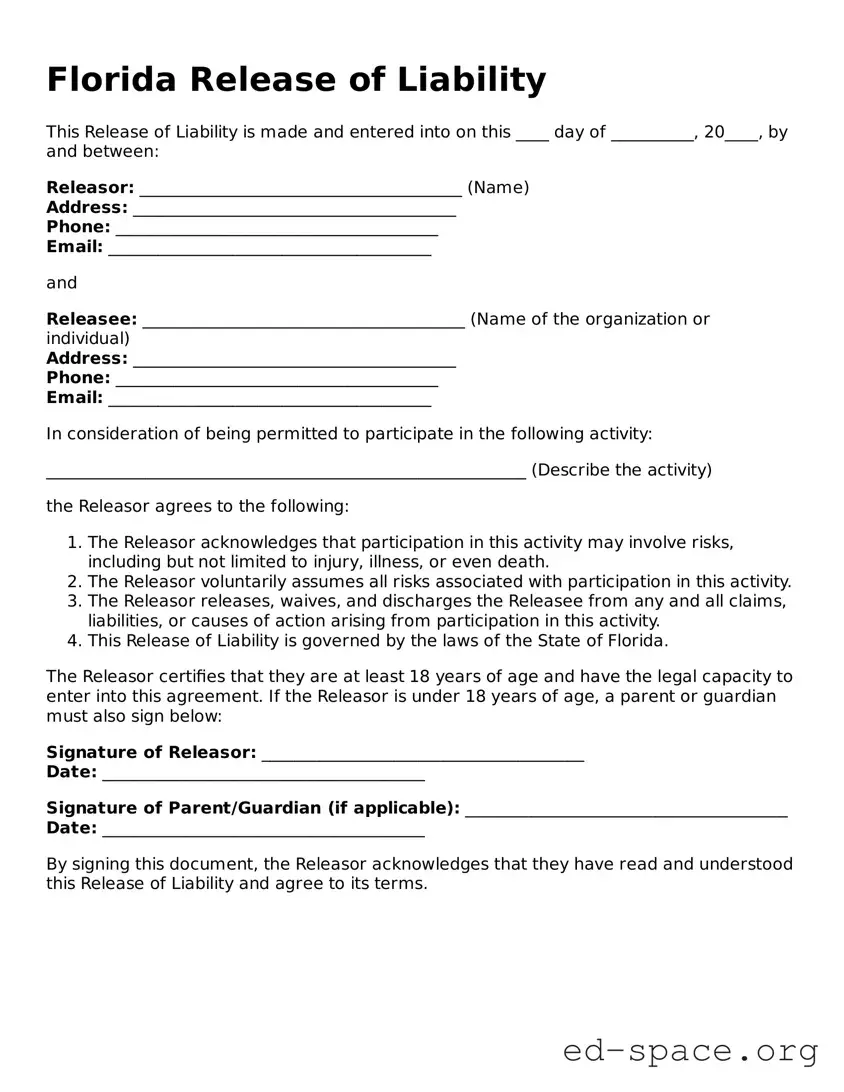
The Florida Release of Liability form is an important document that helps protect individuals and organizations from legal claims arising from injuries or damages that may occur during specific activities. This form is commonly used in various contexts, including recreational events, sports activities, and other situations where participants may face inherent risks. By signing this form, participants acknowledge the potential dangers involved and agree to waive their right to hold the organization or individual responsible for any accidents or injuries that may occur. It typically includes sections outlining the nature of the activity, the risks involved, and a statement of understanding and acceptance. Additionally, the form often requires the participant's signature, which signifies their consent and understanding of the terms. Properly executing this form can help mitigate legal exposure for organizers while ensuring that participants are fully aware of the risks they are undertaking.
Florida Release of Liability
This Release of Liability is made and entered into on this ____ day of __________, 20____, by and between:
Releasor: _______________________________________ (Name)
Address: _______________________________________
Phone: _______________________________________
Email: _______________________________________
and
Releasee: _______________________________________ (Name of the organization or individual)
Address: _______________________________________
Phone: _______________________________________
Email: _______________________________________
In consideration of being permitted to participate in the following activity:
__________________________________________________________ (Describe the activity)
the Releasor agrees to the following:
The Releasor certifies that they are at least 18 years of age and have the legal capacity to enter into this agreement. If the Releasor is under 18 years of age, a parent or guardian must also sign below:
Signature of Releasor: _______________________________________
Date: _______________________________________
Signature of Parent/Guardian (if applicable): _______________________________________
Date: _______________________________________
By signing this document, the Releasor acknowledges that they have read and understood this Release of Liability and agree to its terms.
| Fact Name | Description |
|---|---|
| Purpose | The Florida Release of Liability form is designed to protect businesses and individuals from legal claims arising from injuries or damages that may occur during an activity. |
| Governing Law | This form is governed by Florida state law, particularly under the Florida Statutes, Chapter 673, which addresses liability waivers. |
| Voluntary Agreement | Signing the form indicates that the participant voluntarily agrees to assume the risks associated with the activity. |
| Scope of Release | The release typically covers all forms of liability, including negligence, but may exclude gross negligence or intentional misconduct. |
| Minors | If the participant is a minor, a parent or guardian must sign the form on their behalf to ensure legal validity. |
| Enforceability | To be enforceable, the form must be clear, concise, and not overly broad. Courts may refuse to enforce vague or misleading releases. |
| Consideration | For the release to be valid, there must be some form of consideration, such as participation in the activity or payment of a fee. |
Once you have the Florida Release of Liability form in front of you, it’s time to fill it out. This form is important for protecting parties involved in activities that may carry risks. Make sure to have all necessary information at hand before you start.
What is a Florida Release of Liability form?
A Florida Release of Liability form is a legal document that protects individuals or organizations from being held liable for injuries or damages that may occur during an activity. By signing this form, participants acknowledge the risks involved and agree not to hold the organizer responsible for any accidents or injuries that may arise.
When should I use a Release of Liability form?
This form is commonly used in situations involving physical activities, such as sports events, recreational activities, or other events where there is a potential for injury. If you are organizing an event that involves risk, using this form can help ensure that participants understand and accept those risks.
Is a Release of Liability form legally binding in Florida?
Yes, a properly executed Release of Liability form can be legally binding in Florida, provided it meets certain requirements. The form must clearly state the risks involved, be signed voluntarily, and not contain any misleading information. However, courts may still review the circumstances surrounding the case to determine enforceability.
Can minors sign a Release of Liability form?
Minors cannot legally sign a Release of Liability form on their own. Instead, a parent or legal guardian must sign on behalf of the minor. This ensures that the minor's interests are protected and that the risks are clearly communicated to the adult responsible for them.
What if I don't sign the Release of Liability form?
If you choose not to sign the form, you may be prohibited from participating in the activity. Organizers often require this form to ensure that all participants understand the risks and agree to waive their rights to sue for injuries that may occur.
Can I modify a Release of Liability form?
While you can modify the form to suit your specific needs, it is crucial to ensure that any changes do not invalidate the document. It’s advisable to consult with a legal professional to ensure that the modifications comply with Florida law and effectively protect your interests.
What should I do if I am injured despite signing the Release of Liability form?
If you are injured, it is important to seek medical attention immediately. Afterward, you may want to consult with a legal professional to understand your rights and options. While the form may limit liability, there are circumstances where legal action may still be possible, especially if negligence is involved.
Not reading the entire form carefully.
Many individuals overlook important sections or terms. Understanding all parts of the form is crucial.
Failing to provide accurate personal information.
Incorrect names, addresses, or contact details can lead to issues later. Double-checking this information is essential.
Not signing or dating the form.
Without a signature and date, the form may be considered invalid. Always ensure these fields are completed.
Overlooking witness signatures, if required.
Some forms may need a witness to sign. Confirm if this is necessary and ensure it is done.
The Florida Release of Liability form is often accompanied by several other documents that help clarify the terms of agreements and responsibilities. Below is a list of common forms that may be used in conjunction with the Release of Liability.
These documents work together to provide a comprehensive understanding of the responsibilities and risks associated with participation in various activities. They help ensure that all parties are informed and protected throughout the process.
A Release of Liability form is a common document used to protect parties from legal claims. Several other documents serve similar purposes, each with its unique focus. Here’s a look at seven documents that share similarities with a Release of Liability form:
When filling out the Florida Release of Liability form, it’s essential to be careful and thorough. Here’s a list of things you should and shouldn’t do:
The Florida Release of Liability form is often misunderstood. Here are five common misconceptions about this legal document:
Filling out and using the Florida Release of Liability form can be straightforward if you keep a few key points in mind. Here are ten important takeaways to consider:
By keeping these takeaways in mind, you can navigate the process of filling out and using the Florida Release of Liability form more effectively.