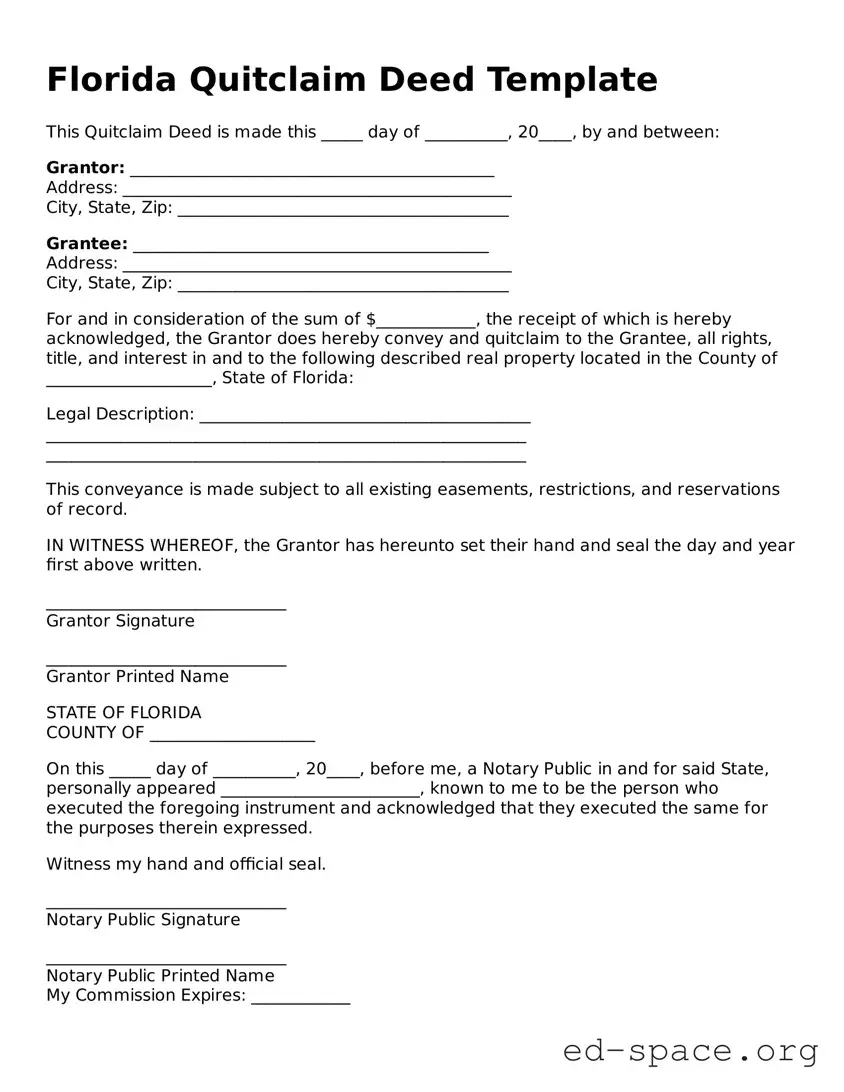
The Florida Quitclaim Deed form is an important legal document that allows property owners to transfer their interest in real estate to another person or entity without making any guarantees about the title. This form is particularly useful in situations where the property is being given as a gift, transferred between family members, or when the owner wants to clear up any potential claims on the property. Unlike other types of deeds, a quitclaim deed does not provide warranties or assurances regarding the property's title, which means the recipient receives whatever interest the grantor has, if any. It’s essential to understand that while this form is straightforward and often used for simple transactions, it should still be completed with care to ensure that all necessary information is included. This includes the names of the parties involved, a legal description of the property, and the signatures of the grantor and two witnesses. Additionally, the deed must be recorded with the local county clerk's office to be legally effective. By knowing how to properly use the Florida Quitclaim Deed form, individuals can navigate property transfers more smoothly and with confidence.
Florida Quitclaim Deed Template
This Quitclaim Deed is made this _____ day of __________, 20____, by and between:
Grantor: ____________________________________________
Address: _______________________________________________
City, State, Zip: ________________________________________
Grantee: ___________________________________________
Address: _______________________________________________
City, State, Zip: ________________________________________
For and in consideration of the sum of $____________, the receipt of which is hereby acknowledged, the Grantor does hereby convey and quitclaim to the Grantee, all rights, title, and interest in and to the following described real property located in the County of ____________________, State of Florida:
Legal Description: ________________________________________
__________________________________________________________
__________________________________________________________
This conveyance is made subject to all existing easements, restrictions, and reservations of record.
IN WITNESS WHEREOF, the Grantor has hereunto set their hand and seal the day and year first above written.
_____________________________
Grantor Signature
_____________________________
Grantor Printed Name
STATE OF FLORIDA
COUNTY OF ____________________
On this _____ day of __________, 20____, before me, a Notary Public in and for said State, personally appeared ________________________, known to me to be the person who executed the foregoing instrument and acknowledged that they executed the same for the purposes therein expressed.
Witness my hand and official seal.
_____________________________
Notary Public Signature
_____________________________
Notary Public Printed Name
My Commission Expires: ____________
| Fact Name | Description |
|---|---|
| Definition | A Florida Quitclaim Deed is a legal document used to transfer ownership of real estate without guaranteeing the title's validity. |
| Governing Law | The use of Quitclaim Deeds in Florida is governed by Chapter 689 of the Florida Statutes. |
| Parties Involved | The form involves at least two parties: the grantor (seller) and the grantee (buyer). |
| No Warranty | This deed provides no warranties or guarantees about the property’s title, meaning the grantor is not responsible for any issues that arise. |
| Common Uses | Quitclaim Deeds are often used for transfers between family members, divorce settlements, or clearing up title issues. |
| Filing Requirements | After signing, the Quitclaim Deed must be recorded with the county clerk's office where the property is located. |
| Tax Implications | While transferring property via a Quitclaim Deed, it’s important to consider potential tax implications, such as documentary stamp taxes. |
Once you have the Florida Quitclaim Deed form in hand, you are ready to start filling it out. This document is essential for transferring property ownership, and accuracy is key. After completing the form, it will need to be signed, notarized, and filed with the appropriate county office to ensure the transfer is official.
What is a Quitclaim Deed in Florida?
A Quitclaim Deed is a legal document used to transfer ownership of real property from one person to another without making any guarantees about the property title. In Florida, this type of deed is often used between family members or in situations where the parties know each other well. It allows the grantor to relinquish any claim they may have to the property, but it does not ensure that the title is clear or free of liens.
How do I complete a Quitclaim Deed in Florida?
To complete a Quitclaim Deed in Florida, you will need to gather the necessary information, including the names of the grantor and grantee, a legal description of the property, and the date of the transfer. The document must be signed by the grantor in the presence of a notary public. Once completed, it should be filed with the county clerk's office where the property is located to ensure proper recording.
Do I need an attorney to create a Quitclaim Deed?
Are there any fees associated with filing a Quitclaim Deed in Florida?
Yes, there are fees associated with filing a Quitclaim Deed in Florida. The exact amount can vary by county, so it is essential to check with your local county clerk’s office for the specific filing fees. Additionally, there may be costs for obtaining a notary and any additional documentation required.
Can a Quitclaim Deed be revoked in Florida?
Once a Quitclaim Deed is executed and recorded, it generally cannot be revoked unilaterally. However, if both parties agree, they can execute a new deed to reverse the transfer. It is crucial to understand that a Quitclaim Deed does not provide any warranties, so if there are issues with the title, the grantee may have limited recourse.
What happens if there are liens on the property?
Since a Quitclaim Deed does not guarantee a clear title, any existing liens or encumbrances on the property remain attached to it after the transfer. The grantee assumes responsibility for any liens or debts associated with the property. It is advisable to conduct a title search before executing a Quitclaim Deed to understand any potential issues.
Can a Quitclaim Deed be used to transfer property to a trust?
Yes, a Quitclaim Deed can be used to transfer property into a trust. This is a common practice for estate planning purposes. The grantor would execute the Quitclaim Deed, naming the trust as the grantee. It is important to ensure that the trust is properly established and that the deed complies with Florida laws to avoid complications.
Is a Quitclaim Deed the same as a Warranty Deed?
No, a Quitclaim Deed is not the same as a Warranty Deed. A Warranty Deed provides a guarantee that the grantor holds clear title to the property and has the right to sell it. In contrast, a Quitclaim Deed offers no such assurances. It is essential to choose the appropriate type of deed based on the circumstances of the property transfer.
Incomplete Information: One common mistake is failing to provide all required information. Each section of the form must be filled out completely to ensure the deed is valid.
Incorrect Names: Using incorrect or misspelled names can lead to issues with ownership. It’s essential to verify that all names are spelled correctly and match official documents.
Improper Signatures: All parties involved must sign the deed. Sometimes, people forget to sign or have the wrong individuals sign, which can invalidate the document.
Missing Notarization: Many states, including Florida, require notarization for the Quitclaim Deed to be legally binding. Failing to have the document notarized can lead to complications.
Incorrect Property Description: The property description must be accurate and detailed. Errors in this section can create confusion regarding the property being transferred.
Not Recording the Deed: After filling out the form, it must be recorded with the county clerk. Neglecting this step means the transfer may not be recognized legally.
Failure to Understand Tax Implications: Some individuals overlook the potential tax consequences of transferring property. Consulting a tax professional can provide clarity on this matter.
Ignoring Local Regulations: Each county may have specific requirements for Quitclaim Deeds. It’s important to check local regulations to ensure compliance.
Not Seeking Legal Advice: Some individuals attempt to complete the deed without professional guidance. Seeking legal advice can help prevent mistakes and ensure the process is handled correctly.
When dealing with real estate transactions in Florida, the Quitclaim Deed is a key document used to transfer ownership of property. However, there are several other forms and documents that often accompany the Quitclaim Deed to ensure a smooth and legal transfer process. Below is a list of these important documents.
Understanding these additional documents can help facilitate a successful real estate transaction. Each plays a vital role in ensuring that both the buyer and seller are protected throughout the process.
A Quitclaim Deed is a legal document used to transfer ownership of real estate from one party to another without making any guarantees about the property’s title. While it serves a specific purpose, several other documents share similarities in function or intent. Here are six documents that are comparable to a Quitclaim Deed:
Each of these documents serves a unique purpose but shares a common thread with the Quitclaim Deed in facilitating the transfer of property rights or interests. Understanding their distinctions can help individuals navigate real estate transactions more effectively.
When filling out the Florida Quitclaim Deed form, it is important to follow certain guidelines to ensure accuracy and legality. Below is a list of things you should and shouldn't do.
The Florida Quitclaim Deed form is often misunderstood. Here are five common misconceptions about this legal document:
Many people believe that a quitclaim deed transfers full ownership of a property. While it does transfer whatever interest the grantor has, it does not guarantee that the grantor has any ownership interest at all. If the grantor has no claim to the property, the recipient receives nothing.
While quitclaim deeds are often used in family transactions, they are not limited to such situations. They can be used in various contexts, including sales, gifts, or even to clear up title issues. Anyone can use a quitclaim deed to transfer property.
Some individuals think that quitclaim deeds are the best choice for any property transfer. However, this is not always true. For transactions involving significant value or where the buyer needs assurance of clear title, a warranty deed may be a better option, as it offers more protection.
Another common misconception is that a quitclaim deed removes any liens or encumbrances on the property. This is incorrect. The new owner takes on any existing liens or claims against the property, which can lead to unexpected financial burdens.
While it is true that notarization can help validate a quitclaim deed, it is not strictly required in all cases. However, having the document notarized can provide additional legal protection and may be necessary for recording the deed with the county.
Filling out and using a Florida Quitclaim Deed form can be a straightforward process, but it is essential to understand the key elements involved. Here are some important takeaways to keep in mind:
Understanding these points can help individuals navigate the process of using a Quitclaim Deed in Florida with confidence.