In the vibrant landscape of Florida's financial agreements, the Promissory Note form stands as a vital instrument for individuals and businesses alike. This legally binding document outlines the terms of a loan, detailing the borrower's promise to repay a specified amount to the lender within a predetermined timeframe. It encompasses essential elements such as the principal amount, interest rate, payment schedule, and any applicable late fees. Additionally, the form may include provisions for collateral, which serves as security for the lender in case of default. By clearly delineating the rights and responsibilities of both parties, the Promissory Note helps foster transparency and trust in financial transactions. Understanding this form is crucial for anyone looking to navigate the complexities of lending and borrowing in Florida, ensuring that all parties are protected and aware of their obligations.
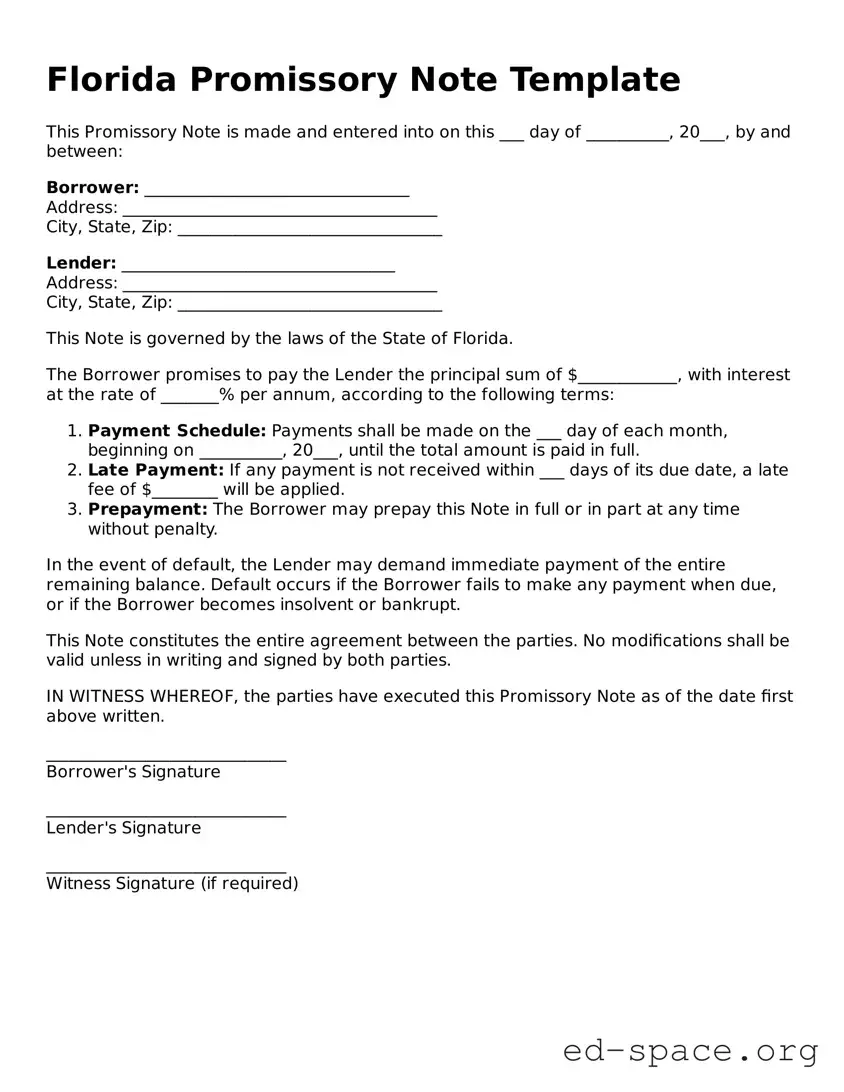
Florida Promissory Note Template
This Promissory Note is made and entered into on this ___ day of __________, 20___, by and between:
Borrower: ________________________________
Address: ______________________________________
City, State, Zip: ________________________________
Lender: _________________________________
Address: ______________________________________
City, State, Zip: ________________________________
This Note is governed by the laws of the State of Florida.
The Borrower promises to pay the Lender the principal sum of $____________, with interest at the rate of _______% per annum, according to the following terms:
In the event of default, the Lender may demand immediate payment of the entire remaining balance. Default occurs if the Borrower fails to make any payment when due, or if the Borrower becomes insolvent or bankrupt.
This Note constitutes the entire agreement between the parties. No modifications shall be valid unless in writing and signed by both parties.
IN WITNESS WHEREOF, the parties have executed this Promissory Note as of the date first above written.
_____________________________
Borrower's Signature
_____________________________
Lender's Signature
_____________________________
Witness Signature (if required)
| Fact Name | Description |
|---|---|
| Definition | A Florida Promissory Note is a written promise to pay a specified amount of money to a designated party at a defined time. |
| Governing Law | The Florida Promissory Note is governed by the Florida Uniform Commercial Code (UCC), specifically Chapter 673. |
| Parties Involved | The note typically involves two parties: the borrower (maker) and the lender (payee). |
| Interest Rate | The interest rate can be fixed or variable, as agreed upon by both parties in the note. |
| Payment Terms | Payment terms must be clearly defined, including the due date, installment amounts, and payment methods. |
| Default Conditions | Conditions under which the borrower may default must be specified, along with potential remedies for the lender. |
| Enforceability | A properly executed Florida Promissory Note is legally enforceable in court, provided it meets all legal requirements. |
After obtaining the Florida Promissory Note form, individuals will need to complete it accurately to ensure it reflects the terms of the agreement. Following these steps will help facilitate the process of filling out the form correctly.
Once the form is completed, it should be reviewed for accuracy. Both parties should retain a copy for their records. This ensures that all terms are understood and agreed upon moving forward.
What is a Florida Promissory Note?
A Florida Promissory Note is a legal document that outlines a borrower's promise to repay a specified amount of money to a lender. It includes essential details such as the loan amount, interest rate, repayment schedule, and any consequences for default. This document serves as a formal agreement and can be used in various situations, including personal loans, business loans, or real estate transactions.
What information do I need to include in a Florida Promissory Note?
When creating a Florida Promissory Note, you should include the following information: the names and addresses of both the borrower and lender, the principal amount of the loan, the interest rate (if applicable), the repayment schedule, and the due date for the final payment. Additionally, it’s important to outline any late fees or penalties for missed payments, as well as the governing law of Florida.
Is a Florida Promissory Note legally binding?
Yes, a Florida Promissory Note is legally binding as long as it meets the necessary legal requirements. Both parties must sign the document, and it should clearly state the terms of the agreement. To enhance its enforceability, consider having the document notarized. This adds an extra layer of authenticity and can help in case of disputes.
Can I modify a Florida Promissory Note after it has been signed?
Yes, you can modify a Florida Promissory Note after it has been signed, but both parties must agree to the changes. It's best to document any modifications in writing and have both parties sign the amended note. This ensures clarity and helps avoid misunderstandings in the future. Always keep a copy of the original note and any amendments for your records.
Incomplete Information: One common mistake is failing to provide all necessary information. Ensure that all fields are filled out, including names, addresses, and loan amounts. Leaving any section blank can lead to confusion or disputes later on.
Incorrect Dates: It’s crucial to accurately enter the date on which the note is signed. An incorrect date can affect the enforceability of the note and may lead to complications in repayment terms.
Ambiguous Terms: Vague language can create misunderstandings. Clearly define the repayment terms, including the interest rate, payment schedule, and any penalties for late payments. Ambiguity can lead to disputes down the line.
Failure to Sign: A promissory note is not valid unless it is signed by the borrower. Forgetting to sign can render the document useless, so double-check that all required signatures are present.
Not Considering State Laws: Each state may have specific requirements for promissory notes. Ignoring Florida’s regulations can lead to invalidation of the note. Familiarize yourself with local laws to ensure compliance.
Not Keeping Copies: After filling out the form, it’s important to keep copies for your records. Failing to do so can create issues if disputes arise regarding the terms of the loan.
When entering into a loan agreement in Florida, the Promissory Note is a key document. However, several other forms and documents often accompany it to ensure clarity and legal protection for both parties involved. Below is a list of commonly used documents in conjunction with a Florida Promissory Note.
These documents work together with the Promissory Note to create a comprehensive framework for the loan. Understanding each document's purpose can help both lenders and borrowers navigate the lending process with confidence.
A Promissory Note is a financial document that outlines a promise to pay a specific amount of money to a designated party under agreed-upon terms. Several other documents share similarities with a Promissory Note, primarily in their function or structure. Below is a list of ten such documents, each with a brief explanation of how they relate to a Promissory Note.
Understanding these documents can help individuals navigate financial agreements more effectively. Each serves a unique purpose but shares the common thread of outlining payment obligations, making them essential in various financial contexts.
When filling out the Florida Promissory Note form, it’s important to follow certain guidelines to ensure accuracy and compliance. Here’s a list of things you should and shouldn’t do:
Understanding the Florida Promissory Note form can be confusing, and several misconceptions may lead to misunderstandings. Here are five common misconceptions clarified:
Many people believe that all promissory notes are identical. In reality, each note can vary significantly based on the terms agreed upon by the parties involved. Factors such as interest rates, repayment schedules, and collateral can differ widely.
Some individuals think that notarization is a requirement for a promissory note to be valid. While notarization can add a layer of authenticity and may be required by some lenders, it is not a legal necessity for the note to be enforceable in Florida.
This misconception suggests that only banks or financial institutions can draft promissory notes. In fact, any individual or entity can create a promissory note as long as it meets the necessary legal requirements.
Many people think promissory notes are exclusively used for loans. However, they can also serve various purposes, such as formalizing agreements for services rendered or other financial obligations.
Some believe that a verbal agreement suffices in place of a written promissory note. While verbal agreements can be legally binding, they are often difficult to enforce. Having a written note provides clear evidence of the terms and intentions of both parties.
Understanding these misconceptions can help you navigate the complexities of promissory notes more effectively. Ensure you have the right information to protect your interests.
When dealing with a Florida Promissory Note, understanding its components is crucial for both lenders and borrowers. Here are some key takeaways:
Understanding these elements can help avoid confusion and ensure a smoother transaction for everyone involved.