The Florida Procedure form, specifically Form 12.900(h), serves an essential role in family law cases by ensuring that all related legal matters are properly disclosed to the court. This form is required under Florida Rule of Judicial Administration 2.545(d), which mandates that petitioners file a notice of any related cases when initiating a family law action. A case is deemed related if it involves the same parties, children, or issues, is pending at the time the family law case is filed, or if any orders from related cases could potentially conflict with orders in the new case. This form not only helps to clarify jurisdictional concerns but also prevents conflicting rulings that could arise from simultaneous cases. When completing the form, it is important to provide accurate details about any related cases, including their status and the nature of the proceedings. Additionally, the form must be filed with the circuit court clerk alongside the initial pleading and served to the presiding judges and all parties involved in the related cases. Keeping a personal copy of this document is also advisable for your records. Understanding the nuances of this form and its requirements is crucial for anyone navigating the complexities of family law in Florida.
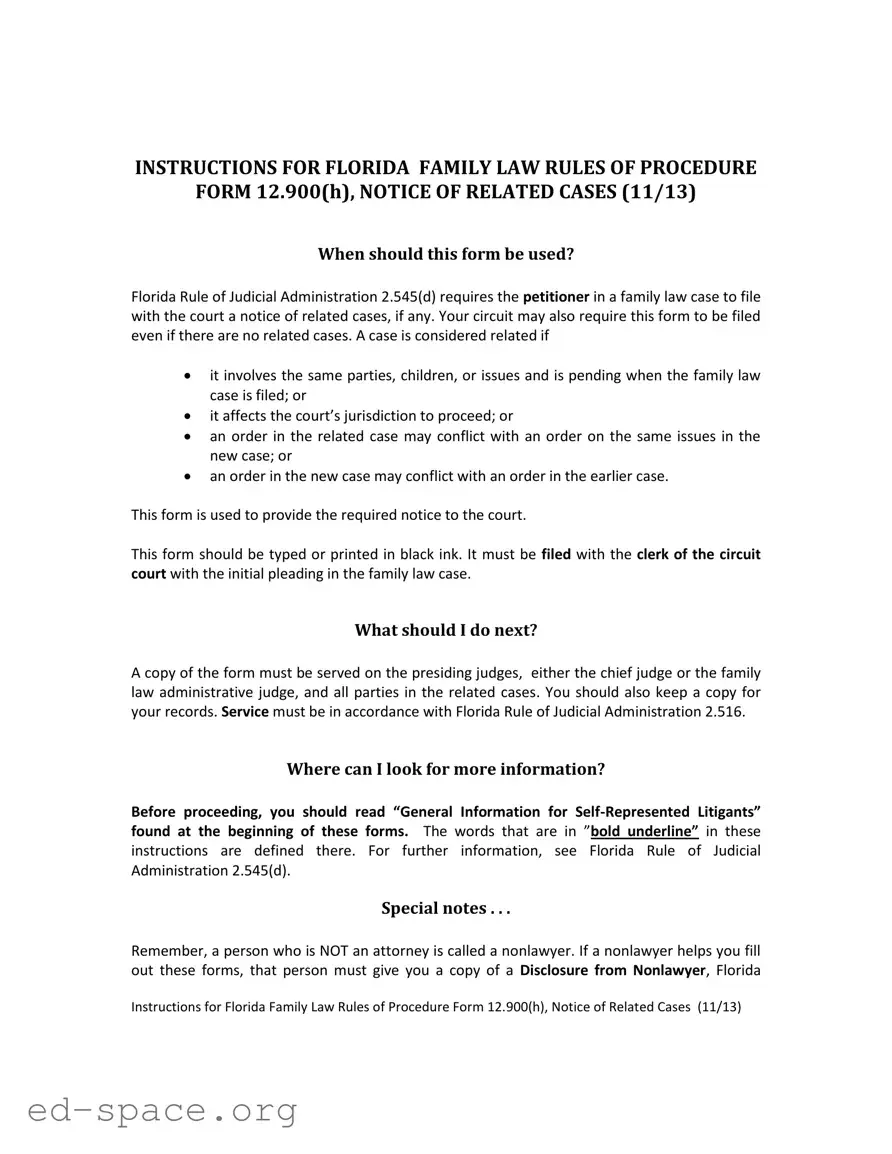
INSTRUCTIONS FOR FLORIDA FAMILY LAW RULES OF PROCEDURE
FORM 12.900(h), NOTICE OF RELATED CASES (11/13)
When should this form be used?
Florida Rule of Judicial Administration 2.545(d) requires the petitioner in a family law case to file with the court a notice of related cases, if any. Your circuit may also require this form to be filed even if there are no related cases. A case is considered related if
it involves the same parties, children, or issues and is pending when the family law case is filed; or
it affects the court’s jurisdiction to proceed- or
an order in the related case may conflict with an order on the same issues in the new case; or
an order in the new case may conflict with an order in the earlier case.
This form is used to provide the required notice to the court.
This form should be typed or printed in black ink. It must be filed with the clerk of the circuit court with the initial pleading in the family law case.
What should I do next?
A copy of the form must be served on the presiding judges, either the chief judge or the family law administrative judge, and all parties in the related cases. You should also keep a copy for your records. Service must be in accordance with Florida Rule of Judicial Administration 2.516.
Where can I look for more information?
Before proceeding, you should read “General Information for
Special notes . . .
Remember, a person who is NOT an attorney is called a nonlawyer. If a nonlawyer helps you fill out these forms, that person must give you a copy of a Disclosure from Nonlawyer, Florida
Instructions for Florida Family Law Rules of Procedure Form 12.900(h), Notice of Related Cases (11/13)
Family Law Rules of Procedure Form 12.900(a), before he or she helps you. A nonlawyer helping you fill out these forms must also put his or her name, address, and telephone number on the bottom of the last page of every form he or she helps you complete.
Instructions for Florida Family Law Rules of Procedure Form 12.900(h), Notice of Related Cases (11/13)
IN THE CIRCUIT COURT OF THE |
|
|
|
|
JUDICIAL CIRCUIT, |
|
IN AND FOR |
|
|
COUNTY, FLORIDA |
|||
|
|
Case No.: |
|
|||
|
|
Division: |
||||
_____________________________, |
|
|
|
|
|
|
Petitioner, |
|
|
|
|
|
|
and |
|
|
|
|
|
|
_____________________________, |
|
|
|
|
|
|
Respondent. |
|
|
|
|
|
|
NOTICE OF RELATED CASES
1.Petitioner submits this Notice of Related Cases as required by Florida Rule of Judicial Administration 2.545(d). A related case may be an open or closed civil, criminal, guardianship, domestic violence, juvenile delinquency, juvenile dependency, or domestic relations case. ! case is “related” to this family law case if it involves any of the same parties, children, or issues and it is pending at the time the party files a family case- if it affects the court’s jurisdiction to proceed- if an order in the related case may conflict with an order on the same issues in the new case; or if an order in the new case may conflict with an order in the earlier litigation.
[check one only]
___ There are no related cases.
___ The following are the related cases (add additional pages if necessary):
Related Case No. 1
Case Name(s): _____________________________________________________________________
Petitioner ________________________________________________________________________
Respondent _______________________________________________________________________
Case No.: _________________________________ Division: ________________________________
Type of Proceeding: [check all that apply] |
|
____ Dissolution of Marriage |
____ Paternity |
____ Custody |
____ Adoption |
____ Child Support |
____ Modification/Enforcement/Contempt Proceedings |
____ Juvenile Dependency |
____ Juvenile Delinquency |
____ Termination of Parental Rights |
____ Criminal |
____ Domestic/Sexual/Dating/Repeat |
____ Mental Health |
Violence or Stalking Injunctions |
____ Other {specify}___________________________ |
Florida Family Law Rules of Procedure Form 12.900(h), Notice of Related Cases (11/13)
State where case was decided or is pending: ____ Florida ____ Other: {specify} _________________
Name of Court where case was decided or is pending (for example, Fifth Circuit Court, Marion County, Florida): __________________________________________________________________
Title of last Court Order/Judgment (if any): ______________________________________________
Date of Court Order/Judgment (if any): _________________________________________________
Relationship of cases check all that apply]:
____ pending case involves same parties, children, or issues;
____ may affect court’s jurisdiction-
____ order in related case may conflict with an order in this case;
____ order in this case may conflict with previous order in related case.
Statement as to the relationship of the cases: ____________________________________________
__________________________________________________________________________________
__________________________________________________________________________________
Related Case No. 2
Case Name(s): _____________________________________________________________________
Petitioner ________________________________________________________________________
Respondent _______________________________________________________________________
Case No.: _________________________________ Division: ________________________________
Type of Proceeding: [check all that apply] |
|
____ Dissolution of Marriage |
____ Paternity |
____ Custody |
____ Adoption |
____ Child Support |
____ Modification/Enforcement/Contempt Proceedings |
____ Juvenile Dependency |
____ Juvenile Delinquency |
____ Termination of Parental Rights |
____ Criminal |
____ Domestic/Sexual/Dating/Repeat |
____ Mental Health |
Violence or Stalking Injunctions |
____Other {specify}__________________________ |
State where case was decided or is pending: ____ Florida ____ Other: {specify} _________________
Name of Court where case was decided or is pending (for example, Fifth Circuit Court, Marion County, Florida): __________________________________________________________________
Title of last Court Order/Judgment (if any): ______________________________________________
Date of Court Order/Judgment (if any): _________________________________________________
Relationship of cases check all that apply]:
____ pending case involves same parties, children, or issues;
Florida Family Law Rules of Procedure Form 12.900(h), Notice of Related Cases (11/13)
____ may affect court’s jurisdiction-
____ order in related case may conflict with an order in this case;
____ order in this case may conflict with previous order in related case.
Statement as to the relationship of the cases: ____________________________________________
__________________________________________________________________________________
__________________________________________________________________________________
Related Case No. 3
Case Name(s): _____________________________________________________________________
Petitioner ________________________________________________________________________
Respondent _______________________________________________________________________
Case No.: _________________________________ Division: ________________________________
Type of Proceeding: [check all that apply] |
|
____ Dissolution of Marriage |
____ Paternity |
____ Custody |
____ Adoption |
____ Child Support |
____ Modification/Enforcement/Contempt Proceedings |
____ Juvenile Dependency |
____ Juvenile Delinquency |
____ Termination of Parental Rights |
____ Criminal |
____ Domestic/Sexual/Dating/Repeat |
____ Mental Health |
Violence or Stalking Injunctions |
____Other {specify} __________________________ |
State where case was decided or is pending: ____ Florida ____ Other: {specify} _________________
Name of Court where case was decided or is pending (for example, Fifth Circuit Court, Marion County, Florida): __________________________________________________________________
Title of last Court Order/Judgment (if any): ______________________________________________
Date of Court Order/Judgment (if any): _________________________________________________
Relationship of cases check all that apply]:
____ pending case involves same parties, children, or issues;
____ may affect court’s jurisdiction-
____ order in related case may conflict with an order in this case;
____ order in this case may conflict with previous order in related case.
Statement as to the relationship of the cases: ____________________________________________
__________________________________________________________________________________
__________________________________________________________________________________
2.[check one only]
____ I do not request coordination of litigation in any of the cases listed above.
Florida Family Law Rules of Procedure Form 12.900(h), Notice of Related Cases (11/13)
____ I do request coordination of the following cases: _____________________________________
______________________________________________________________________________
______________________________________________________________________________
3.[check all that apply]
____ Assignment to one judge
____ Coordination of existing cases
will conserve judicial resources and promote an efficient determination of these cases because:_______________________________________________________________________.
4.The Petitioner acknowledges a continuing duty to inform the court of any cases in this or any other state that could affect the current proceeding.
Dated: _________________ |
________________________________________ |
|
Petitioner’s Signature |
|
Printed Name: ______________________________ |
|
Address: ________________________________ |
|
City, State, Zip: ___________________________ |
|
Telephone Number: _______________________ |
|
Fax Number: ____________________________ |
|
CERTIFICATE OF SERVICE
I CERTIFY that I delivered a copy of this Notice of Related Cases to the _____________________ County
Sheriff’s Department or a certified process server for service on the Respondent, and [check all used]
( )
[check all that apply] ( ) judge assigned to new case, ( ) chief judge or family law administrative judge, ( ) {name}__________________________________ a party to the related case, ( ) {name}
____________________________, a party to the related case on {date} _________________________.
____________________________________
Signature of Petitioner/Attorney for Petitioner Printed Name:________________________
Address:____________________________
City, State, Zip:________________________
Telephone Number:____________________
Fax Number:__________________________
Florida Bar Number:_____________________
Florida Family Law Rules of Procedure Form 12.900(h), Notice of Related Cases (11/13)
IF A NONLAWYER HELPED YOU FILL OUT THIS FORM, HE/SHE MUST FILL IN THE BLANKS BELOW: [fill in all blanks] This form was prepared for the {choose only one}: ( ) Petitioner ( ) Respondent. This form was completed with the assistance of:
{name of individual} ______________________________________________________________,
{name of business}_______________________________________________________________,
{address}______________________________________________________________________,
{city} _______________________{state} __________, {telephone number} ___________________.
Florida Family Law Rules of Procedure Form 12.900(h), Notice of Related Cases (11/13)
| Fact Name | Description |
|---|---|
| Purpose of the Form | This form is used to notify the court of any related cases in family law matters, as required by Florida Rule of Judicial Administration 2.545(d). |
| Filing Requirements | The form must be filed with the clerk of the circuit court alongside the initial pleading in the family law case. |
| Service of the Form | A copy of the form must be served to presiding judges and all parties involved in the related cases, following Florida Rule of Judicial Administration 2.516. |
| Definition of Related Cases | A case is considered related if it involves the same parties, children, or issues and is pending at the time the family law case is filed. |
Completing the Florida Procedure Form 12.900(h) requires careful attention to detail. This form is essential for notifying the court of any related cases in family law matters. Once the form is filled out, it must be filed with the circuit court and served on the appropriate judges and parties involved in the related cases.
After completing the form, make sure to keep a copy for your records. The next step involves serving the completed form to the presiding judges and all parties in the related cases, adhering to the service rules outlined in Florida law.
1. When should I use the Florida Procedure form?
This form should be used when you are involved in a family law case in Florida and there are related cases. According to Florida Rule of Judicial Administration 2.545(d), you must file this notice if your case involves the same parties, children, or issues as another pending case. Additionally, if an order in one case might conflict with an order in another, this form is necessary.
2. What qualifies as a "related case"?
A case is considered related if it meets any of the following criteria: it involves the same parties, children, or issues and is pending at the time you file your family law case; it affects the court’s jurisdiction; or an order in one case may conflict with an order in the other. This includes civil, criminal, guardianship, and domestic relations cases.
3. What should I do after completing the form?
Once you have filled out the form, you need to serve a copy to the presiding judges and all parties involved in the related cases. You must also file the form with the clerk of the circuit court along with your initial pleading. Remember to keep a copy for your records.
4. How do I serve the form?
Service must be done according to Florida Rule of Judicial Administration 2.516. This typically involves delivering the form to the relevant parties either through mail or in person. Ensure that you follow the specific requirements for serving documents in your jurisdiction.
5. Can a nonlawyer assist me with this form?
Yes, a nonlawyer can help you fill out the form, but they must provide you with a Disclosure from Nonlawyer. Additionally, they must include their name, address, and phone number at the bottom of the last page of the form they assist you with.
6. Where can I find more information about this process?
For more details, you should read “General Information for Self-Represented Litigants” found at the beginning of the forms. This document provides definitions and further instructions. You can also refer to Florida Rule of Judicial Administration 2.545(d) for additional guidance.
7. What if I have no related cases?
If you do not have any related cases, you still need to complete the form. Simply check the box indicating that there are no related cases. It’s essential to provide this information to the court to ensure clarity and proper handling of your family law case.
Neglecting to identify related cases: Many individuals fail to check for any existing related cases that might affect their family law case. It is crucial to disclose all related cases, as they can impact the outcome.
Using incorrect ink: The form must be filled out in black ink or typed. Using colored ink can lead to rejection of the form by the court.
Not serving the form properly: After filling out the form, it is essential to serve copies to the presiding judges and all parties involved. Failure to do this can result in delays or complications in the case.
Ignoring the instructions: Some people skip reading the instructions thoroughly. Each section of the form has specific requirements that must be followed to avoid mistakes.
Failing to keep a copy: It is important to retain a copy of the filed form for personal records. Not doing so can lead to confusion or disputes later on.
Missing deadlines: Submitting the form late can hinder the progress of the case. Timeliness is crucial in family law matters.
Not including all necessary information: Omitting details such as case numbers, names, or court titles can render the form incomplete. Every piece of information is vital for clarity.
Overlooking the need for nonlawyer disclosure: If a nonlawyer assists in completing the form, they must provide a disclosure. This requirement is often overlooked, leading to further complications.
Failing to check the relationship of cases: Individuals sometimes neglect to indicate how the cases are related. This information is essential for the court's understanding of the situation.
The Florida Procedure form is an essential document used in family law cases. However, several other forms and documents often accompany it. Each of these documents serves a specific purpose in ensuring that the legal process runs smoothly. Below is a list of commonly used forms and documents in conjunction with the Florida Procedure form.
These forms and documents work together to facilitate the legal process in family law cases. It is important to complete and file them accurately to ensure that your case proceeds without unnecessary delays. If you have any questions about these forms, it may be helpful to consult with a legal professional.
The Florida Procedure form, specifically the Notice of Related Cases, shares similarities with several other legal documents. Here are five such documents and how they relate to the Florida Procedure form:
When filling out the Florida Procedure form, it is important to follow certain guidelines to ensure accuracy and compliance. Here are five things you should and shouldn't do:
By following these guidelines, you can help ensure that your form is completed correctly and submitted on time.
This form must be filed even if there are no related cases. It serves to inform the court of any potential connections between cases.
Anyone involved in a family law case can file this form, including self-represented litigants. It is designed for use by all parties.
The instructions specify that the form must be typed or printed in black ink. Using any other color may lead to issues with acceptance by the court.
A copy of the form must be served on the presiding judges and all parties involved in the related cases. This is crucial for proper legal procedure.
Filing this form is a requirement under Florida Rule of Judicial Administration 2.545(d). Failing to file it can have legal consequences.
The form can also apply to closed cases. It is important to disclose any related cases, regardless of their status.
If a nonlawyer helps fill out the form, they must provide a Disclosure from Nonlawyer and include their contact information on the form.
It is essential to follow the specific instructions provided for this form. Ignoring them can lead to mistakes that may delay your case.
Here are some key takeaways about filling out and using the Florida Procedure form:
Make sure to follow these steps carefully to ensure proper compliance with the rules.