In the vibrant state of Florida, couples embarking on the journey of marriage often consider the practicalities of their financial futures. A prenuptial agreement, commonly known as a prenup, serves as a proactive tool to outline the division of assets and responsibilities should the relationship encounter difficulties. This legally binding document can address a range of important issues, from property rights to debt obligations, ensuring that both parties have a clear understanding of their financial landscape before saying "I do." Importantly, Florida law requires that certain criteria be met for a prenup to be enforceable, including full disclosure of assets and the absence of coercion. Couples can also use this agreement to protect family inheritances or business interests, making it a versatile option for many. By engaging in open discussions about financial matters and establishing a prenup, partners can foster trust and transparency, laying a solid foundation for their marriage while safeguarding their individual interests.
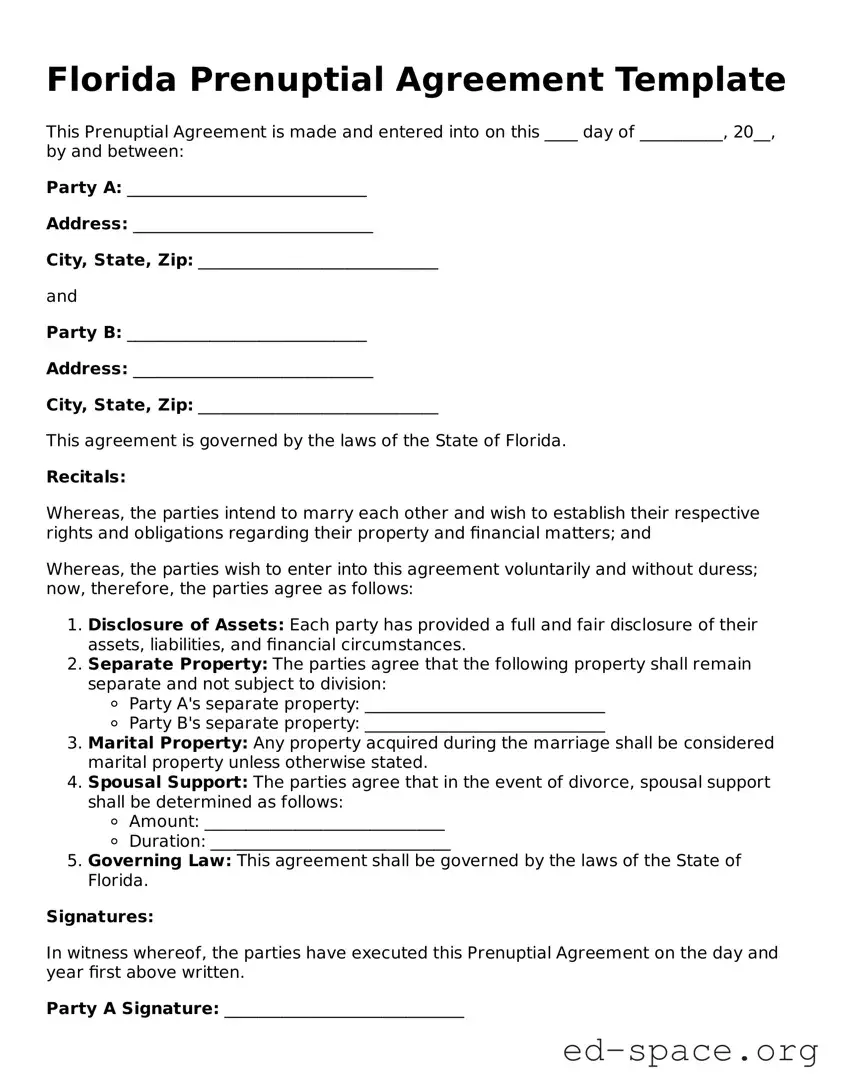
Florida Prenuptial Agreement Template
This Prenuptial Agreement is made and entered into on this ____ day of __________, 20__, by and between:
Party A: _____________________________
Address: _____________________________
City, State, Zip: _____________________________
and
Party B: _____________________________
Address: _____________________________
City, State, Zip: _____________________________
This agreement is governed by the laws of the State of Florida.
Recitals:
Whereas, the parties intend to marry each other and wish to establish their respective rights and obligations regarding their property and financial matters; and
Whereas, the parties wish to enter into this agreement voluntarily and without duress; now, therefore, the parties agree as follows:
Signatures:
In witness whereof, the parties have executed this Prenuptial Agreement on the day and year first above written.
Party A Signature: _____________________________
Date: _____________________________
Party B Signature: _____________________________
Date: _____________________________
Witness Signature: _____________________________
Date: _____________________________
Witness Signature: _____________________________
Date: _____________________________
| Fact Name | Details |
|---|---|
| Governing Law | Florida Statutes, Chapter 61.079 |
| Purpose | A prenuptial agreement outlines the division of assets and financial responsibilities in the event of divorce or death. |
| Requirements | Both parties must voluntarily sign the agreement. Full disclosure of assets is also required. |
| Enforceability | The agreement is enforceable if it is in writing and signed by both parties, provided it is not deemed unconscionable. |
Filling out a Florida Prenuptial Agreement form requires careful attention to detail. This document will help you and your partner outline financial arrangements before marriage. Follow these steps to ensure the form is completed accurately.
After completing the form, review it carefully. Make sure all information is accurate and that both partners understand the terms. Keep copies for your records and consider having the agreement notarized for added security.
What is a Florida Prenuptial Agreement?
A Florida Prenuptial Agreement is a legal document that couples create before getting married. It outlines how assets and debts will be handled in the event of divorce or separation. This agreement can help clarify financial responsibilities and protect individual interests, making it a useful tool for many couples.
Why should I consider a Prenuptial Agreement?
There are several reasons to consider a prenuptial agreement. If you or your partner have significant assets, debts, or children from previous relationships, a prenup can provide clarity on financial matters. It can also help avoid lengthy and costly disputes in the event of a divorce, ensuring that both parties understand their rights and responsibilities from the outset.
What should be included in a Florida Prenuptial Agreement?
A comprehensive prenuptial agreement typically includes details about the division of property, the handling of debts, spousal support, and any other financial arrangements that may be relevant. Couples can also address how they wish to manage joint assets acquired during the marriage. It’s important to be thorough and clear to prevent misunderstandings later on.
Is a Prenuptial Agreement enforceable in Florida?
Yes, a prenuptial agreement is generally enforceable in Florida, provided it meets certain legal requirements. Both parties must voluntarily agree to the terms, and the agreement should be in writing and signed by both individuals. Additionally, it’s crucial that both parties fully disclose their financial situations to ensure fairness and transparency.
Can a Prenuptial Agreement be changed after marriage?
Yes, couples can modify a prenuptial agreement after marriage if both parties agree to the changes. This process typically involves creating a new written document that outlines the updated terms. It’s advisable to consult with a legal professional to ensure that any changes comply with Florida law and are enforceable.
Do I need a lawyer to create a Prenuptial Agreement?
While it is not legally required to have a lawyer to create a prenuptial agreement, it is highly recommended. A legal professional can help ensure that the agreement is fair, legally sound, and tailored to your specific needs. Having separate legal counsel for both parties can also help prevent any potential conflicts of interest.
How much does it cost to create a Prenuptial Agreement in Florida?
The cost of creating a prenuptial agreement can vary widely depending on several factors, including the complexity of the agreement and the attorney’s fees. On average, couples can expect to pay anywhere from a few hundred to a few thousand dollars. Investing in a well-drafted agreement can save significant time and money in the long run, should the need arise.
Failing to disclose all assets and liabilities. Transparency is crucial. Omitting any property can lead to complications later.
Not understanding the legal implications. Each section of the agreement carries weight. A lack of understanding can result in unintended consequences.
Using vague language. Specificity is key. Ambiguous terms can create confusion and disputes down the line.
Neglecting to consider future changes. Life circumstances evolve. Failing to account for potential changes can render the agreement ineffective.
Not having the agreement reviewed by a legal professional. Expert guidance can provide clarity. Skipping this step may lead to overlooking important details.
Forgetting to sign and date the agreement. A signed document is essential for enforceability. An unsigned agreement may not hold up in court.
Rushing the process. Taking time to carefully consider each provision is important. Hasty decisions can result in regrets.
Not discussing the agreement openly with the partner. Communication fosters understanding. Hiding intentions can lead to mistrust.
Ignoring state laws. Florida has specific requirements for prenuptial agreements. Failing to comply can invalidate the agreement.
A Florida Prenuptial Agreement is an important document for couples planning to marry, as it outlines the distribution of assets and responsibilities in the event of divorce or separation. However, several other forms and documents may also be relevant during the marriage planning process. Below is a list of commonly used documents that complement a prenuptial agreement.
Understanding these documents can help couples navigate their financial and legal responsibilities more effectively. Each plays a role in ensuring that both parties are protected and that their wishes are respected throughout their marriage and beyond.
The Prenuptial Agreement form shares similarities with several other legal documents. Each of these documents serves to outline agreements and expectations between parties, often in the context of financial or personal arrangements. Below is a list of documents that are comparable to a Prenuptial Agreement:
When filling out the Florida Prenuptial Agreement form, it's important to approach the process with care. Here are five things you should and shouldn't do:
When it comes to prenuptial agreements in Florida, several misconceptions can lead to confusion. Understanding these myths can help couples make informed decisions. Here are four common misconceptions:
Understanding these misconceptions can help couples approach their financial future with confidence and clarity.
When considering a Florida Prenuptial Agreement, it’s essential to understand the key aspects of the process. Here are some important takeaways to keep in mind:
By keeping these points in mind, couples can navigate the process of creating a prenuptial agreement more effectively.