The Florida Petitioner form, officially known as the Petition to Determine Paternity and for Related Relief, is a crucial document for individuals seeking to establish legal paternity for a child. This form is primarily utilized by a birth mother or father to request the court's assistance in determining the paternity of a minor child or children, which can also include provisions for time-sharing and child support. The form must be completed clearly, either by typing or using black ink, and requires the signature of the petitioner in the presence of a notary public or deputy clerk. Once completed, the original form should be filed with the clerk of the circuit court in the petitioner’s county of residence, while keeping a copy for personal records. In light of recent updates to the Florida Rules of Judicial Administration, electronic filing is now mandatory for most court documents, though self-represented litigants have the option to file in person if they choose. Additionally, the form outlines the necessary steps for notifying the respondent and provides guidance on what to do if the respondent fails to answer within the designated timeframe. The form also includes important information regarding the requirements for supporting documents, such as financial affidavits and parenting plans, which are essential for resolving matters of paternity and child support. Understanding the intricacies of this form is vital for ensuring that the legal process is followed correctly and efficiently.
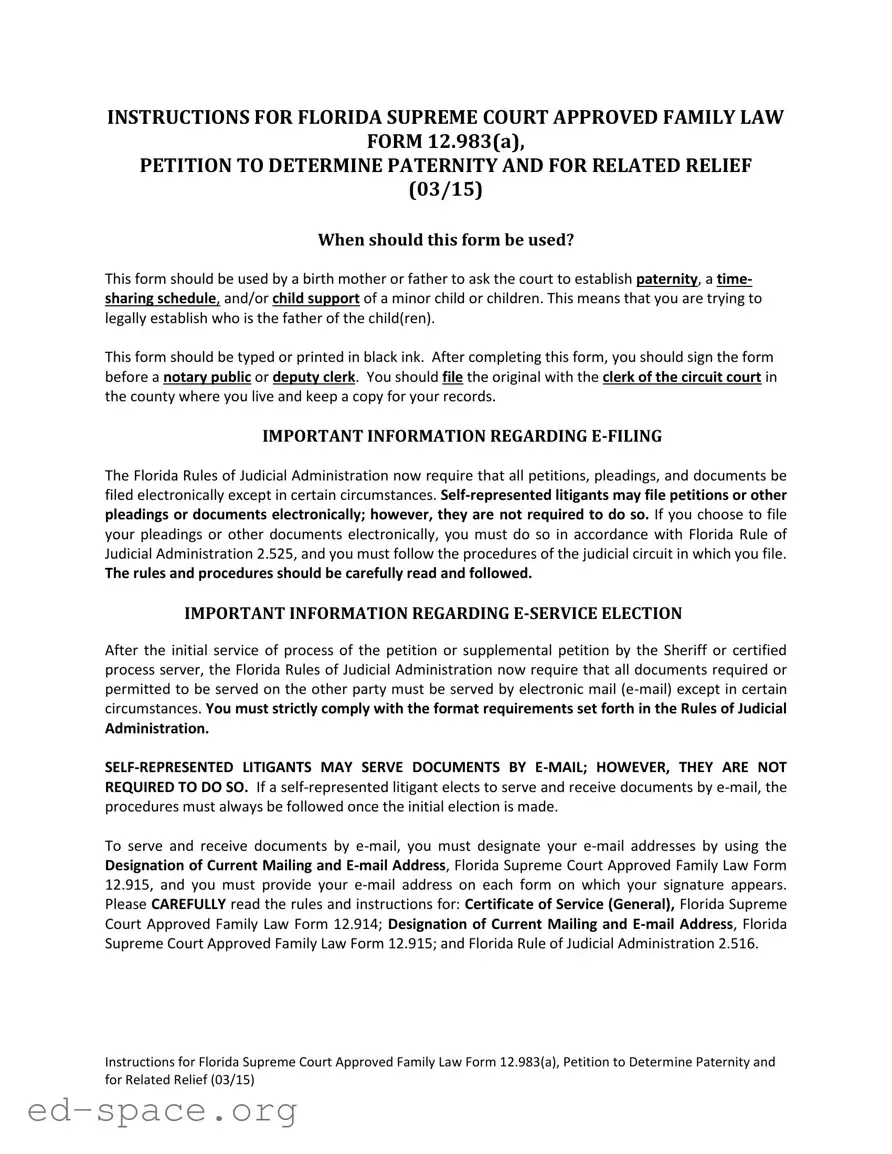
INSTRUCTIONS FOR FLORIDA SUPREME COURT APPROVED FAMILY LAW
FORM 12.983(a),
PETITION TO DETERMINE PATERNITY AND FOR RELATED RELIEF
(03/15)
When should this form be used?
This form should be used by a birth mother or father to ask the court to establish paternity, a time- sharing schedule, and/or child support of a minor child or children. This means that you are trying to legally establish who is the father of the child(ren).
This form should be typed or printed in black ink. After completing this form, you should sign the form before a notary public or deputy clerk. You should file the original with the clerk of the circuit court in the county where you live and keep a copy for your records.
IMPORTANT INFORMATION REGARDING
The Florida Rules of Judicial Administration now require that all petitions, pleadings, and documents be filed electronically except in certain circumstances.
The rules and procedures should be carefully read and followed.
IMPORTANT INFORMATION REGARDING
After the initial service of process of the petition or supplemental petition by the Sheriff or certified process server, the Florida Rules of Judicial Administration now require that all documents required or permitted to be served on the other party must be served by electronic mail
Administration.
To serve and receive documents by
Instructions for Florida Supreme Court Approved Family Law Form 12.983(a), Petition to Determine Paternity and for Related Relief (03/15)
What should I do next?
For your case to proceed, you must properly notify the respondent of the petition. If you know where he or she lives, you should use personal service. If you absolutely do not know where he or she lives, you may use constructive service. However, if constructive service is used, the court may only grant limited relief. You should seek legal advice on constructive service in a paternity case. For more information see chapter 49, Florida Statutes, or you may contact Child Support Enforcement at the Florida Department of Revenue if you need assistance with your case.
If personal service is used, the respondent has 20 days to answer after being served with your petition. Your case will then generally proceed in one of the following three ways:
DEFAULT... If after 20 days, no answer has been filed, you may file a Motion for Default, Florida Supreme Court Approved Family Law Form 12.922(a), with the clerk of court. Then, if you have filed all of the required papers, you may call the clerk, family law intake staff, or judicial assistant to set a final hearing. You must notify the other party of the hearing by using a Notice of Hearing (General), Florida Supreme Court Approved Family Law Form 12.923, or other appropriate notice of hearing form.
UNCONTESTED... If the respondent files an answer that agrees with everything in your petition or an answer and waiver, and you have complied with mandatory disclosure and filed all of the required papers, you may call the clerk, family law intake staff, or judicial assistant to set a final hearing. You must notify the other party of the hearing by using a Notice of Hearing (General), Florida Supreme Court Approved Family Law Form 12.923, or other appropriate notice of hearing form.
CONTESTED... If the respondent files an answer or an answer and counterpetition, which disagrees with or denies anything in your petition, and you are unable to settle the disputed issues, you should file a Notice for Trial, Florida Supreme Court Approved Family Law Form 12.924, after you have complied with mandatory disclosure, completed the scientific paternity testing, if necessary, and filed all of the required papers. Then you should contact the clerk, family law intake staff, or judicial assistant for instructions on how to set your case for trial (final hearing). If the respondent files an answer and counterpetition, you should answer the counterpetition within 20 days using an Answer to Counterpetition, Florida Supreme Court Approved Family Law Form 12.983(d).
Where can I look for more information?
Before proceedi g, you should read Ge eral I |
for atio for |
|
beginning of these forms. The words that are in |
bold underline |
in these instructions are defined |
there. For further information, see chapter 742, Florida Statutes. |
|
|
Instructions for Florida Supreme Court Approved Family Law Form 12.983(a), Petition to Determine Paternity and for Related Relief (03/15)
Special notes...
If you do not have the money to pay the filing fee, you may obtain an Application for Determination of Civil Indigent Status, fill it out, and the clerk will determine whether you are eligible to have filing fees deferred.
More than one child of the same alleged father may be listed on a single petition. However, if you are filing a paternity action involving more than one possible father, a separate petition must be filed for each alleged father.
If the respo de t files a a swer de yi g that the perso a ed i the petitio is the hild re ’s
father, one of you should file a Motion for Scientific Paternity Testing, Florida Supreme Court Approved
Family Law Form 12.983(e). This is used to ask the court to order a scientific test to determine who is the hild re ’s father.
If the father signed papers at the hospital acknowledging that he was the father, paternity was established as a matter of law. This should be indicated on page 2, section 9a on this form.
If the paternity of a child who was conceived or born during a marriage is at issue, the court may appoint a guardian ad litem to assist the court in this matter and to protect the rights of child.
With this petition, you must file the following and provide a copy to the other party:
Uniform Child Custody Jurisdiction and Enforcement Act (UCCJEA) Affidavit, Florida Supreme Court Approved Family Law Form 12.902(d).
Notice of Social Security Number, Florida Supreme Court Approved Family Law Form 12.902(j).
Family Law Financial Affidavit, Florida Family Law Rules of Procedure Form 12.902(b) or (c).
Certificate of Compliance with Mandatory Disclosure, Florida Family Law Rules of Procedure Form 12.932. (This must be filed within 45 days, if not filed with the petition, unless you and the other party have agreed not to exchange these documents.)
Child Support Guidelines Worksheet, Florida Family Law Rules of Procedure Form 12.902(e). (If
you do ot k ow the other party’s i o e, you ay file this worksheet after his or her fi a ial
affidavit has been filed.)
Parenting Plan, Florida Supreme Court Approved Family Law Form, 12.995(a), 12.995(b), or 12.995(c). If the parents have reached an agreement, a signed and notarized Parenting Plan should be attached. If the parents have not reached an agreement, a proposed Parenting Plan may be filed.
Parenting Plan and
whether there is an agreement between the parties, the court reserves jurisdiction to modify issues relating to minor or dependent child(ren).
The judge may request a parenting plan recommendation or appoint a guardian ad litem in your case. This means that a neutral person will review your situation and report to the judge concerning parenting
Instructions for Florida Supreme Court Approved Family Law Form 12.983(a), Petition to Determine Paternity and for Related Relief (03/15)
issues. The purpose of such intervention is to be sure that the best interests of the child(ren) are being served. For more information, you may consult sections
Listed below are some terms with which you should become familiar before completing your petition. If
you do not fully understand any of the terms below or their implications, you should speak with an attorney before going any further.
Shared Parental Responsibility
Sole Parental Responsibility
Supervised
No contact
•Parenting Plan
•Parenting Plan Recommendation
•
Many circuits require that parents of a minor or dependent child(ren) who are involved in dissolution or paternity actions attend mediation before being allowed to schedule a final hearing. A parenting course must be completed prior to entry of the final judgment. You should check with your local clerk of
ourt’s offi e, fa ily law i take staff, or judi ial assista t for ore i for atio o the pare ti g ourse and mediation requirements in your area.
Child Support. The court may order one parent to pay child support to assist the other parent in eeti g the hild re ’s aterial eeds. Both parents are required to provide financial support, but
one parent may be ordered to pay a portion of his or her support for the child(ren) to the other parent.
Florida has adopted guidelines for determining the amount of child support to be paid. These guidelines are based on the combined income of both parents and take into account the financial contributions of both parents. You should file a financial affidavit, and the other parent will be required to do the same. From your financial affidavits, you should be able to calculate the amount of child support that should be paid. Because the child support guidelines take several factors into consideration, change over time, and vary from state to state, your child support obligation may be more or less than that of other people in seemingly similar situations.
Final Judgments. These family law forms contain a Final Judgment of Paternity, Florida Supreme Court Approved Family Law Form 12.983(g), which the judge may use. You should check with the clerk, family
law intake staff, or judicial assistant to see if you need to bring it with you to the hearing. If so, you should type or print the heading, including the circuit, county, case number, divisio , a d the parties’
names, and leave the rest blank for the judge to complete at your hearing or trial.
Remember, a person who is NOT an attorney is called a nonlawyer. If a nonlawyer helps you fill out these forms, that person must give you a copy of a Disclosure from Nonlawyer, Florida Family Law Rules of Procedure Form 12.900 (a), before he or she helps you. A nonlawyer helping you fill out these forms also must put his or her name, address, and telephone number on the bottom of the last page of every form he or she helps you complete.
Instructions for Florida Supreme Court Approved Family Law Form 12.983(a), Petition to Determine Paternity and for Related Relief (03/15)
IN THE CIRCUIT COURT OF THE ________ JUDICIAL CIRCUIT,
IN AND FOR ______________________________ COUNTY, FLORIDA
Case No: ________________________
Division: ________________________
_________________________________,
Petitioner,
And
_________________________________,
Respondent.
PETITION TO DETERMINE PATERNITY AND FOR RELATED RELIEF
Petitioner, {full legal name}____________________________, being sworn, certifies that the following
information is true:
This is an action for paternity and to determine parental responsibility,
SECTION I.
1. Petitioner is the _____ Mother _____ Father of the following minor child(ren):
NameBirth Date
1.________________________________________________________________________
2.________________________________________________________________________
3.________________________________________________________________________
4.________________________________________________________________________
5.________________________________________________________________________
6.________________________________________________________________________
2.Petitio er’ s urre t address is: {street address, city, state} __________________________________
_________________________________________________________________________________.
3.Respo de t’s urre t address is: {street address, city, state} ______________________________
________________________________________________________________________________
4.Both parties are over the age of 18.
Florida Supreme Court Approved Family Law Form 12.983(a), Petition to Determine Paternity and for Related Relief (03/15)
5.Petitioner {Choose only ONE} _____ is _____ is not a member of the military service. Respondent {Choose only ONE} _____ is _____ is not a member of the military service.
6.Neither Petitioner nor Respondent is mentally incapacitated.
7.A completed Uniform Child Custody Jurisdiction and Enforcement Act (UCCJEA) Affidavit, Florida Supreme Court Approved Family Law Form 12.902(d), is filed with this petition.
8.A completed Notice of Social Security Number, Florida Supreme Court Approved Family Law Form 12.902(j), is filed with this petition.
9.A completed Family Law Financial Affidavit, Florida Family Law Rules of Procedure Form 12.902(b) or (c), is, or will be, filed.
10.Paternity Facts. {Choose only ONE}
a._____Paternity has previously been established as a matter of law.
b._____The parties engaged in sexual intercourse with each other in the month(s) of {list month(s) and year(s)} ____________________________________________________________________
in {city and state} ________________________________________________________________
As a result of the sexual intercourse, _____ Petitioner _____ Respondent conceived and gave birth to the minor child(ren) named in paragraph 1. _____ Petitioner _____Respondent is the natural father of the minor child(ren). The mother _____ was _____ was not married at the time of the conception and/or birth of the minor child(ren) named in paragraph 1. If the mother was married, the name and address of her husband at the time of conception and/or birth is:
______________________________________________________________________________
______________________________________________________________________________.
SECTION II. PARENTING PLAN ESTABLISHING PARENTAL RESPONSIBILITY AND
1.The minor child(ren) currently reside(s) with _____ Mother _____ Father _____ other: {explain}
_________________________________________________________________________________
_________________________________________________________________________________.
2. Parental Responsibility. It is i the hild re ’s est i terests that pare tal respo si ility e:
{Choose only ONE}
a._____ shared by both Father and Mother.
b.____awarded solely to _____ Father _____ Mother. Shared parental responsibility would be detrimental to the child(ren) because: ______________________________________________
______________________________________________________________________________
______________________________________________________________________________
______________________________________________________________________________.
Florida Supreme Court Approved Family Law Form 12.983(a), Petition to Determine Paternity and for Related Relief (03/15)
3.Parenting Plan and
a._____The attached proposed Parenting Plan should be adopted by the court. The parties _____ have _____ have not agreed to the Parenting Plan.
b._____ The court should establish a Parenting Plan with the following provisions:
1.____ |
No |
_____ Father |
_____ Mother |
2.____ |
Limited |
_____ Father |
_____ Mother |
3.____ |
Supervised |
_____ Father |
_____ Mother. |
4.____ |
Supervised or |
|
|
5.____ |
|
|
|
______________________________________________________________________________
______________________________________________________________________________
______________________________________________________________________________
Explain why this schedule is in the best interests of the child(ren): _______________________
______________________________________________________________________________
______________________________________________________________________________
______________________________________________________________________________
4. The minor child(ren) should
{Choose only ONE}
a. _____retain his/her (their) present name(s).
b. _____receive a change of name as follows: |
|
present name(s) |
be changed to |
(1). ____________________________________ |
(1). ___________________________________ |
(2). ____________________________________ |
(2). ___________________________________ |
(3). ____________________________________ |
(3). ___________________________________ |
(4). ____________________________________ |
(4). ___________________________________ |
(5). ____________________________________ |
(5). ___________________________________ |
(6). ____________________________________ |
(6). ___________________________________ |
c.The name change would be in the best interest of the child(ren) because:___________________
______________________________________________________________________________.
SECTION III. CHILD SUPPORT
{Indicate all that apply}
1._____Petitioner requests that the Court award child support as determined by Florida’s hild support guidelines, section 61.30, Florida Statutes. A completed Child Support Guidelines Worksheet, Florida Family Law Rules of Procedure Form 12.902(e), is, or will be, filed. Such support should be ordered retroactive to:
{Choose only ONE}
a._____the date when the parents did not reside together in the same household with the child, not to exceed a period of 24 months before the date of filing of this petition.
Florida Supreme Court Approved Family Law Form 12.983(a), Petition to Determine Paternity and for Related Relief (03/15)
b._____the date of the filing of this petition.
c._____other: {date}________________ {Explain} ________________________________
______________________________________________________________________________
2._____Petitioner requests that the Court award a child support amount that is more than or less than Florida’s hild support guideli es. Petitioner understands that a Motion to Deviate from Child Support Guidelines, Florida Supreme Court Approved Family Law Form 12.943, must be completed before the Court will consider this request.
3._____Petitioner requests that medical/dental insurance for the minor child(ren) be provided by: {Choose only ONE}
a._____Father.
b._____Mother.
4._____Petitioner requests that uninsured medical/dental expenses for the child(ren) be paid by: {Choose only ONE}
a._____Father.
b._____Mother.
c._____Father and Mother each pay
d._____Father and Mother each pay according to the percentages in the Child Support Guidelines Worksheet, Florida Family Law Rules of Procedure Form 12.902(e).
e._____Other {explain}: ___________________________________________________________
______________________________________________________________________________
______________________________________________________________________________
5._____Petitioner requests that life insurance to secure child support be provided by: [Choose only ONE]
a._____Father.
b._____Mother.
c._____Both
6._____ Petitioner _____ Respondent _____ Both has (have) incurred medical expenses in the amount of $__________ on behalf of the minor child(ren), including hospital and other expenses incidental to the birth of the minor child(ren). There should be an appropriate allocation or apportionment of these expenses.
7._____ Petitioner _____ Respondent _____ Both has (have) received past public assistance for this (these) minor child(ren).
PETITIONER’“ REQUE“T
1.Petitioner requests a hearing on this petition and understands that he or she must attend the hearing.
2.Petitioner requests that the Court enter an order that:
[Indicate ALL that apply]
Florida Supreme Court Approved Family Law Form 12.983(a), Petition to Determine Paternity and for Related Relief (03/15)

a.____establishes paternity of the minor child(ren), ordering proper scientific testing, if necessary;
b._____adopts or establishes a Parenting Plan containing provisions for parental responsibility and
c._____awards child support, including medical/dental insurance coverage for the minor child(ren);
d._____determines the appropriate allocation or apportionment of all expenses incidental to the birth of the child(ren), including hospital and medical expenses;
e._____determines the appropriate allocation or apportionment of all other past, present, and future medical and dental expenses incurred or to be incurred on behalf of the minor
child(ren);
f. _____ ha ges the hild re ’s a e s ;
g._____other relief as follows: ______________________________________________________
______________________________________________________________________________
______________________________________________________________________________
___________________________________________________________________________ and grants such other relief as may be appropriate and in the best interests of the minor child(ren).
I understand that I am swearing or affirming under oath to the truthfulness of the claims made in this petition and that the punishment for knowingly making a false statement includes fines and/or imprisonment.
Dated: ______________________ |
_____________________________________________ |
|
Signature of PETITIONER |
|
Printed Name: _________________________________ |
|
Address: _____________________________________ |
|
City, State, Zip: ________________________________ |
|
Telephone Number: _____________________________ |
|
Fax Number: __________________________________ |
|
Designated |
|
____________________________________________ |
STATE OF FLORIDA |
|
COUNTY OF ____________________ |
|
Sworn to or affirmed and signed before me on ____________ by _______________________________.
_____________________________________________
NOTARY PUBLIC or DEPUTY CLERK
_____________________________________________
{Print, type, or stamp commissioned name of notary or deputy clerk.}
_____ Personally known
_____ Produced identification
_____ Type of identification produced ________________________________
Florida Supreme Court Approved Family Law Form 12.983(a), Petition to Determine Paternity and for Related Relief (03/15)
IF A NONLAWYER HELPED YOU FILL OUT THIS FORM, HE/SHE MUST FILL IN THE BLANKS BELOW: [fill in all blanks] This form was prepared for the Petitioner.
This form was completed with the assistance of:
{name of individual} ________________________________,
{name of business}________________________________________________________________,
{address} ___________________________________________,
{city} _______________,{state} _______,{zip code}_________, {telephone number} _______________,
.
Florida Supreme Court Approved Family Law Form 12.983(a), Petition to Determine Paternity and for Related Relief (03/15)
| Fact Name | Details |
|---|---|
| Purpose of Form | This form is used by a birth mother or father to establish paternity, time-sharing schedules, and child support for minor children. |
| Filing Requirements | The original must be filed with the circuit court clerk in the county of residence, and a copy should be retained for personal records. |
| Electronic Filing | All petitions and documents must be filed electronically, as mandated by Florida Rule of Judicial Administration 2.525, unless exceptions apply. |
| Service of Process | After initial service, subsequent documents must be served electronically via email, following the format requirements outlined in the Florida Rules of Judicial Administration. |
| Response Time | The respondent has 20 days to respond after being served with the petition. Failure to respond may lead to a Motion for Default. |
| Governing Law | This form is governed by Chapter 742 of the Florida Statutes, which addresses paternity actions and related matters. |
Completing the Florida Petitioner form is a crucial step in establishing paternity and related matters. After filling out the form, you will need to ensure that the other party is properly notified of the petition. This process can involve personal service or, in certain cases, constructive service. Be prepared to follow the necessary legal steps to move your case forward.
Following these steps will help you properly complete the Florida Petitioner form. Be diligent in notifying the other party and gathering any additional required documents to ensure your case progresses smoothly.
What is the purpose of the Florida Petitioner form?
The Florida Petitioner form is used by a birth mother or father to establish legal paternity for a minor child or children. This includes requests for a time-sharing schedule and child support. By filing this form, you are formally asking the court to recognize who the legal father is, which is crucial for determining parental rights and responsibilities.
How do I complete the Florida Petitioner form?
To complete the form, you should type or print it in black ink. Fill in all required sections accurately. Once finished, sign the form in front of a notary public or deputy clerk. After signing, file the original form with the clerk of the circuit court in your county. Keep a copy for your records to ensure you have a reference for your case.
What happens after I file the petition?
After filing, you must notify the respondent (the other parent) about the petition. If you know their address, use personal service to deliver the documents. If you do not know their address, you may need to use constructive service, which has limitations on the relief the court can grant. The respondent has 20 days to respond. Depending on their response, your case can proceed as a default, uncontested, or contested case.
Are there any fees associated with filing the petition?
Yes, there are filing fees associated with submitting the petition. If you cannot afford these fees, you can fill out an Application for Determination of Civil Indigent Status. The clerk will assess your eligibility to have the fees waived or deferred based on your financial situation.
What additional documents must I file with the petition?
You must file several additional documents along with your petition. These include the Uniform Child Custody Jurisdiction and Enforcement Act (UCCJEA) Affidavit, Notice of Social Security Number, Family Law Financial Affidavit, and a Child Support Guidelines Worksheet. If applicable, a Parenting Plan should also be included. Make sure to provide copies of these documents to the other party as required.
Incomplete Information: Many people forget to fill in all required fields. Each section needs to be completed accurately to avoid delays.
Incorrect Signatures: Failing to sign the form in front of a notary public or deputy clerk is a common mistake. This step is crucial for the form's validity.
Not Following Filing Procedures: Some individuals neglect to file the original petition with the correct clerk of the circuit court. Ensure you know your local filing requirements.
Missing Supporting Documents: Forgetting to attach necessary documents, like the UCCJEA Affidavit or Child Support Guidelines Worksheet, can lead to complications. Always double-check your attachments.
Improper Service of Process: Many fail to properly notify the respondent. Understanding whether to use personal or constructive service is essential for your case to proceed.
Ignoring E-Filing Requirements: With the shift towards electronic filing, some individuals overlook the rules governing e-filing. Familiarize yourself with these rules to avoid issues.
The Florida Petitioner form is a crucial document used to establish paternity and related issues. Along with this form, several other documents are commonly required to ensure a smooth legal process. Below is a list of these documents, each accompanied by a brief description.
Understanding these documents is vital for anyone navigating the paternity process in Florida. Each form plays a significant role in ensuring that the rights and responsibilities of all parties, especially the child, are adequately addressed. It is advisable to seek assistance if there are any uncertainties regarding the completion or submission of these forms.
When filling out the Florida Petitioner form, there are several important dos and don'ts to keep in mind. Following these guidelines can help ensure a smoother process.
This form can be filed by either the birth mother or father. Both parents have the right to establish paternity and seek related relief.
The process can take time. After filing, the respondent has 20 days to respond, and the case may proceed as default, uncontested, or contested, which affects the timeline.
While e-filing is encouraged, self-represented litigants are not required to file electronically. They can choose to file in person if preferred.
If there are multiple possible fathers, separate petitions must be filed for each alleged father. This ensures clarity in the legal process.
While the court may order child support, both parents must provide financial affidavits. The amount is calculated based on guidelines that consider both parents' incomes.
The Florida Petitioner form is essential for establishing paternity, time-sharing, and child support for minor children. It is primarily used by either the birth mother or father.
When filling out the form, ensure it is typed or printed in black ink. After completion, sign the form in front of a notary public or deputy clerk.
Filing the form requires submission of the original to the clerk of the circuit court in your county, while retaining a copy for personal records.
Electronic filing is now mandatory for most petitions and documents. If you opt to file electronically, adhere to Florida Rule of Judicial Administration 2.525 and local circuit procedures.
Proper notification of the respondent is crucial for your case to proceed. Depending on whether personal or constructive service is used, different processes and timelines apply.