The Florida Petition Emancipation form serves as a crucial legal tool for minors seeking independence from parental control. This form allows individuals aged 16 and older to petition the court to remove the legal limitations associated with being a minor. The process begins with the petitioner, typically the minor or their legal guardian, filling out the form with essential information, including the minor's name, age, and residency details. Notarization of the completed petition is required, ensuring the authenticity of the signatures. Filing the petition with the Clerk of the Circuit Court in the county of residence is the next step, along with paying any applicable fees. If financial constraints exist, an Application for Indigence can be submitted to potentially waive these fees. After filing, the case manager will reach out within a few weeks to provide updates or request additional documents. A court hearing will follow, where the judge assesses whether emancipation is in the minor's best interest. If granted, the order will officially recognize the minor's adult status, allowing them to make independent decisions regarding their life. Obtaining certified copies of this order is essential, as they may be needed for various institutions, such as schools and banks, marking a significant transition in the minor's life.
Rev. 09/28/2009
Emancipation
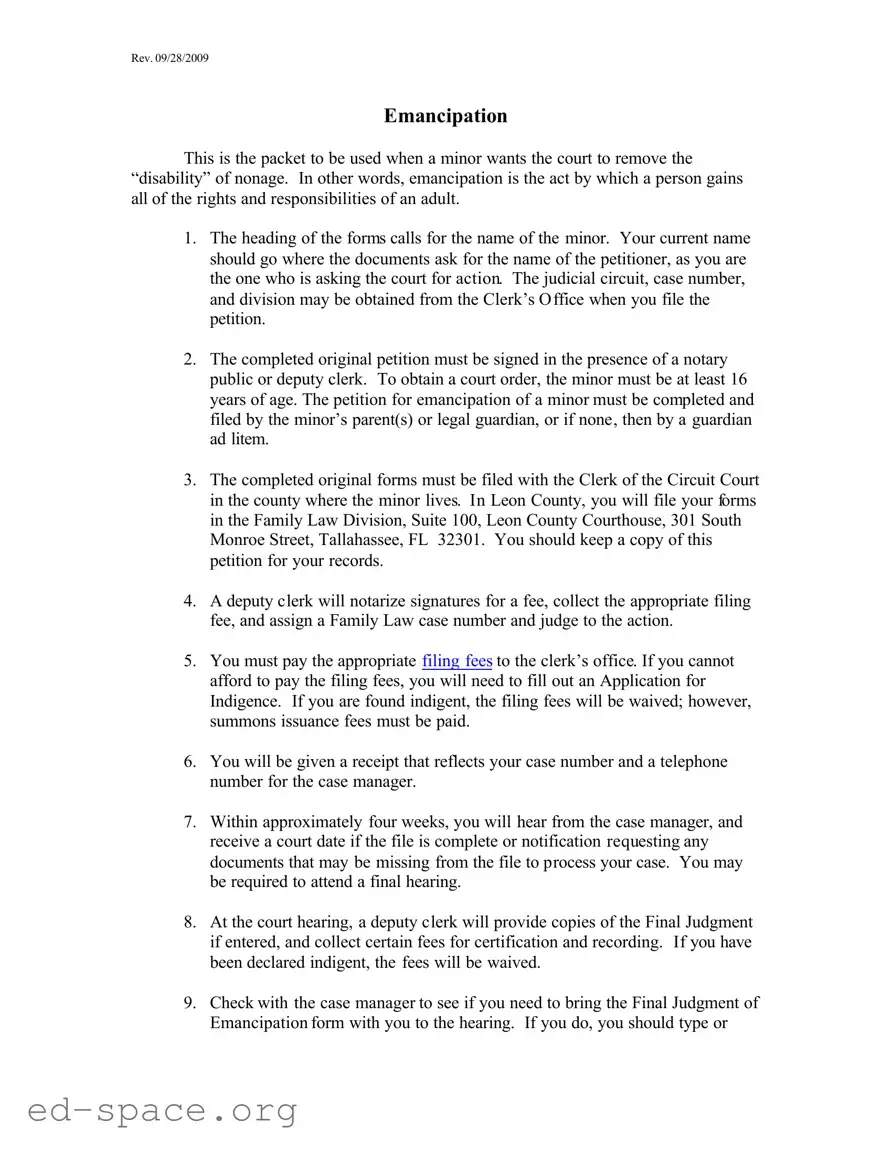
This is the packet to be used when a minor wants the court to remove the
“disability” of nonage. In other words, emancipation is the act by which a person gains all of the rights and responsibilities of an adult.
1.The heading of the forms calls for the name of the minor. Your current name should go where the documents ask for the name of the petitioner, as you are the one who is asking the court for action. The judicial circuit, case number, and division may be obtained from the Clerk’s Office when you file the petition.
2.The completed original petition must be signed in the presence of a notary public or deputy clerk. To obtain a court order, the minor must be at least 16 years of age. The petition for emancipation of a minor must be completed and filed by the minor’s parent(s) or legal guardian, or if none, then by a guardian ad litem.
3.The completed original forms must be filed with the Clerk of the Circuit Court in the county where the minor lives. In Leon County, you will file your forms in the Family Law Division, Suite 100, Leon County Courthouse, 301 South Monroe Street, Tallahassee, FL 32301. You should keep a copy of this petition for your records.
4.A deputy clerk will notarize signatures for a fee, collect the appropriate filing fee, and assign a Family Law case number and judge to the action.
5.You must pay the appropriate filing fees to the clerk’s office. If you cannot afford to pay the filing fees, you will need to fill out an Application for Indigence. If you are found indigent, the filing fees will be waived; however, summons issuance fees must be paid.
6.You will be given a receipt that reflects your case number and a telephone number for the case manager.
7.Within approximately four weeks, you will hear from the case manager, and receive a court date if the file is complete or notification requesting any documents that may be missing from the file to process your case. You may be required to attend a final hearing.
8.At the court hearing, a deputy clerk will provide copies of the Final Judgment if entered, and collect certain fees for certification and recording. If you have been declared indigent, the fees will be waived.
9.Check with the case manager to see if you need to bring the Final Judgment of Emancipation form with you to the hearing. If you do, you should type or
print the heading, including the circuit, county, case number, division, and the parties’ names, and leave the rest blank for the judge to complete at your hearing or trial.
10.If the court is satisfied that emancipation is in the minor’s best interest, it will enter an order removing the disabilities of nonage and authorize the minor to perform all acts that the minor could do if he or she were 18 years of age. The order will be recorded in the public records of the county where the action is filed. The minor will need to obtain certified copies of the order to show proof of his or her emancipation.
11.It may be helpful to compile a list of all of the people and/or places that will need a copy of your final judgment. This list may include the driver’s license office, social security office, banks, schools, etc. A list will help you know how many copies of your order you should get from the clerk's office after your hearing.
IN THE CIRCUIT COURT OF THE SECOND JUDICIAL CIRCUIT
IN AND FOR LEON COUNTY, STATE OF FLORIDA
IN RE: EMANCIPATION OF: |
|
________________________________, |
Case #: _______________________ |
a minor. |
|
PETITION FOR EMANCIPATION OF A MINOR
1.Petitioner, ______________________________, whose address is
_____________________________________________________________________,
and whose relationship to the above minor is _________________________________,
petitions this Court to remove the disabilities of nonage of the above minor.
2.The minor, ______________________________, is 16 years of age or older. The minor’s date of birth is ________________.
3.The minor currently resides at ______________________________________, and has a mailing address of ________________________________________.
4.The minor is a resident of ____________________ County, Florida.
5.The parents of the above minor are ___________________________, Father, whose residence is ______________________________________________ and
whose mailing address is: _________________________________________________,
and _____________________________, Mother, whose residence is ______________
________________________ and whose mailing address is: _____________________
_____________________________.
6.The name, date of birth, custody and location of any children born to the minor
are as follows:
Name: ___________________________________________________
Date of Birth: _____________________________________________
Custody and location: _______________________________________
(Attach extra sheet if there are additional children.)
7.The minor’s character, habits, education, income, and mental capacity for
business are as follows:
8.The minor’s needs with respect to food, shelter, clothing, medical care, and
other necessities will be met as follows:
9.With respect to whether the minor is a party to or subject of a pending judicial proceeding in this State or any other jurisdiction or the subject of a judicial order
of any description issued in connection with such judicial proceeding, such as a child
support order, custody or visitation order or guardianship: (check only ONe)
____ The minor is not a party or subject to pending judicial proceedings.
____ The minor is a party to or subject to a pending judicial proceeding,
namely, _________________________________________________________________
________________________________________________________________________
________________________________________________________________________
(note the nature of proceedings, case number, court/jurisdiction where case is pending, and names and address of parties).
10.The disabilities of nonage should be removed from the minor for the following
reason:
11.The above minor has joined in this petition and consents to the Court granting
an Order of Emancipation as indicated and evidenced by the minor’s signature on this
petition.
WHEREFORE, the Petitioner and the Minor request that this Court enter an Order of Emancipation removing the disabilities of nonage of said Minor.
Signed this ______ day of _______________, 20___.
___________________________________
Signature of Petitioner
___________________________________
Printed name of Petitioner
___________________________________
Street Address of Petitioner
___________________________________
City/State/Zip of Petitioner
STATE OF FLORIDA,
COUNTY OF _________________.
BEFORE ME, the undersigned authority, personally appeared _______________
___________________________, who has acknowledged before me that he/she is the
Petitioner in the above Petition for Emancipation of a Minor and executed the same, and said person is ___ personally known to me OR ___ produced identification: _________
____________________________________.
Witness my hand and official seal this _____ day of ______________, 20___.
____________________________________
Notary Public/Deputy Clerk
CONSENT BY MINOR
I, ___________________________, the above named minor, consent to the entry
by this Court of an Order of Emancipation and I am fully ready to assume my
responsibilities as an adult.
Signed this ______ day of ____________, 20___.
____________________________________
Minor’s signature
____________________________________
Minor’s printed name
____________________________________
Minor’s street address
____________________________________
Minor’s City/State/Zip
STATE OF FLORIDA
COUNTY OF _________________
BEFORE ME, the undersigned authority, personally appeared _______________
_________________________, who has acknowledged before me that he/she is the
Minor that is the subject of the Petition for Emancipation of a Minor and that he/she executed the foregoing Consent, and said person is ___ personally known OR ___
produced identification: ___________________________________________________.
Witness my hand and official seal this ______ day of _____________, 20___.
___________________________________
Notary Public/Deputy Clerk
IN THE CIRCUIT COURT OF THE SECOND JUDICIAL CIRCUIT
IN AND FOR LEON COUNTY, STATE OF FLORIDA
IN RE: EMANCIPATION OF: |
|
________________________________, |
Case #: _______________________ |
a minor. |
|
FINAL JUDGMENT OF EMANCIPATION
THIS CAUSE was heard on the Petition for Emancipation of a Minor filed by the Petitioner. The Court, having jurisdiction over the subject matter, and being fully advised in the premises, finds as follows:
1.The minor is capable of being an adult, bearing the responsibilities and privileges of being an adult.
2.The minor has demonstrated the maturity of managing her own affairs, without the supervision of a parent or legal guardian.
3.The minor and the parent or legal guardian have agreed for the parent or legal
guardian to relinquish his/her rights to control of the minor child. It is, therefore, ORDERED AND ADJUDGED:
The minor child is adjudged to be emancipated upon this Final Judgment becoming final. The minor child will be emancipated and enjoy the privileges and responsibilities of being an adult as defined by Florida Statute.
DONE AND ORDERED this _____ day of _______________________,
20_____, in Tallahassee, Leon County, Florida.
______________________________
Circuit Judge
Copies to:
Petitioner
Respondent
Minor
| Fact Name | Details |
|---|---|
| Purpose of the Form | The Florida Petition for Emancipation allows a minor to request the court to remove the legal limitations of being underage. |
| Eligibility Age | A minor must be at least 16 years old to file for emancipation. |
| Filing Authority | The petition must be filed with the Clerk of the Circuit Court in the county where the minor resides. |
| Signature Requirement | The original petition must be signed in front of a notary public or deputy clerk. |
| Filing Fees | Filing fees are required, but if a minor cannot afford them, they can apply for a fee waiver. |
| Notification Timeline | Within about four weeks, the minor will receive communication from the case manager regarding the status of the petition. |
| Court Hearing | A court hearing may be required, where the deputy clerk will provide copies of the Final Judgment if granted. |
| Final Judgment Copies | It is advisable to create a list of entities that will need a copy of the Final Judgment, such as schools and banks. |
| Legal Authority | The process is governed by Florida Statutes, specifically Chapter 743, which addresses the emancipation of minors. |
Filling out the Florida Petition for Emancipation is a straightforward process. By following these steps, you can ensure that all necessary information is included and presented correctly. Once the form is completed, it will be filed with the court, and you will await further instructions regarding your case.
What is the Florida Petition for Emancipation?
The Florida Petition for Emancipation is a legal document that allows a minor, aged 16 or older, to request the court to remove the legal disabilities associated with being a minor. This process grants the minor the rights and responsibilities of an adult, enabling them to make decisions independently.
Who can file a Petition for Emancipation?
The petition must be filed by the minor themselves, or if they are unable to do so, by their parent(s), legal guardian, or a guardian ad litem. It is essential that the minor is at least 16 years old at the time of filing.
Where do I file the Petition for Emancipation?
The completed original forms must be filed with the Clerk of the Circuit Court in the county where the minor resides. For those in Leon County, the forms should be submitted to the Family Law Division at the Leon County Courthouse, located at 301 South Monroe Street, Tallahassee, FL 32301.
What are the filing fees associated with the petition?
A filing fee is required when submitting the petition. If the minor cannot afford these fees, they can complete an Application for Indigence. If approved, the court may waive the filing fees, although any fees for summons issuance must still be paid.
What happens after I file the petition?
After filing, a deputy clerk will notarize signatures and assign a Family Law case number and judge. Within approximately four weeks, the case manager will contact you regarding a court date or request any missing documents needed to process your case.
Will I need to attend a court hearing?
Yes, you may be required to attend a final hearing. At this hearing, the court will review the petition and determine whether emancipation is in the minor's best interest. If the court approves the petition, a Final Judgment will be entered.
What should I bring to the court hearing?
It is advisable to check with the case manager to see if you need to bring the Final Judgment of Emancipation form. If required, ensure you have the heading filled out, including the circuit, county, case number, division, and parties' names, leaving the rest blank for the judge to complete.
What happens if the court grants the emancipation?
If the court finds that emancipation is in the minor's best interest, it will issue an order removing the disabilities of nonage. This order will be recorded in the public records of the county where the petition was filed. The minor should obtain certified copies of this order as proof of their emancipation.
How can I prepare for the future after emancipation?
After receiving the Final Judgment, it may be helpful to compile a list of all entities that will need a copy, such as the driver's license office, social security office, banks, and schools. Knowing how many copies to obtain will streamline the process of proving your emancipation.
Incorrectly Filling Out the Petitioner Section: The form requires the name of the minor in the petitioner section. Many people mistakenly enter the name of a parent or guardian instead. Ensure that the name entered is that of the minor seeking emancipation.
Missing Notarization: The original petition must be signed in front of a notary public or deputy clerk. Some individuals overlook this requirement, thinking a simple signature is enough. Without notarization, the petition may be rejected.
Filing in the Wrong Location: The completed forms must be filed with the Clerk of the Circuit Court in the county where the minor resides. Failing to file in the correct location can delay the process significantly.
Neglecting to Pay Filing Fees: It's essential to pay the appropriate filing fees when submitting the petition. Some individuals forget this step, which can halt the processing of their case. If financial constraints exist, an Application for Indigence should be completed to potentially waive these fees.
Not Keeping Copies of the Petition: After filing, it's crucial to keep a copy of the petition for personal records. Many forget to do this, which can lead to complications later when needing to reference the original documents.
Failure to Communicate with the Case Manager: After filing, a case manager will be assigned. Some individuals neglect to check in with this person, missing important updates or documents that may be required for the case to proceed smoothly.
When filing a Florida Petition for Emancipation, several other forms and documents may be necessary to support the process. Each of these documents serves a specific purpose and can help ensure that the petition is complete and properly submitted. Below is a list of commonly used documents alongside the emancipation petition.
Having these documents ready can streamline the emancipation process and help avoid delays. It is essential to ensure that all forms are completed accurately and submitted in a timely manner to the appropriate court. This preparation can make a significant difference in the outcome of the petition.
When filling out the Florida Petition for Emancipation form, there are several important considerations to keep in mind. Below is a list of things you should and shouldn't do to ensure the process goes smoothly.
Understanding the Florida Petition Emancipation form can be challenging. Here are some common misconceptions that often arise:
Clarifying these misconceptions can help minors and their families navigate the emancipation process more effectively. If you have questions or need assistance, consider reaching out to a legal professional who specializes in family law.
The Florida Petition for Emancipation form is a critical document for minors seeking legal independence. Below are key takeaways regarding its completion and use.
Understanding these points can facilitate a smoother process when filing for emancipation in Florida.