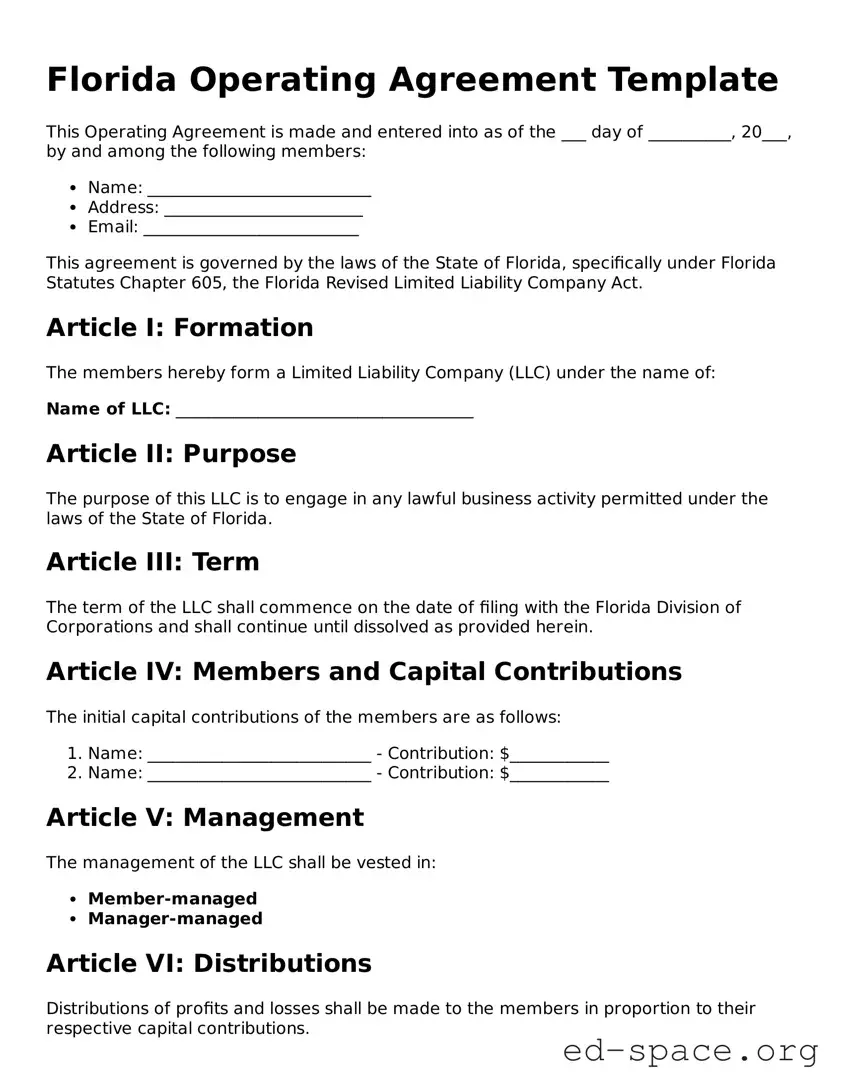
In Florida, an Operating Agreement serves as a vital document for Limited Liability Companies (LLCs), outlining the internal structure and operational guidelines of the business. This form addresses key aspects such as ownership percentages, member roles, and decision-making processes, ensuring clarity among members. Additionally, it often includes provisions for profit distribution, management responsibilities, and procedures for adding or removing members. By establishing these parameters, the Operating Agreement helps prevent disputes and provides a framework for the LLC’s operations. It is important for members to understand that this document is not just a formality; it plays a crucial role in defining the relationship between members and the company itself. Having a well-drafted Operating Agreement can contribute to the overall success and stability of the business, making it an essential component of any LLC formation in Florida.
Florida Operating Agreement Template
This Operating Agreement is made and entered into as of the ___ day of __________, 20___, by and among the following members:
This agreement is governed by the laws of the State of Florida, specifically under Florida Statutes Chapter 605, the Florida Revised Limited Liability Company Act.
Article I: Formation
The members hereby form a Limited Liability Company (LLC) under the name of:
Name of LLC: ____________________________________
Article II: Purpose
The purpose of this LLC is to engage in any lawful business activity permitted under the laws of the State of Florida.
Article III: Term
The term of the LLC shall commence on the date of filing with the Florida Division of Corporations and shall continue until dissolved as provided herein.
Article IV: Members and Capital Contributions
The initial capital contributions of the members are as follows:
Article V: Management
The management of the LLC shall be vested in:
Article VI: Distributions
Distributions of profits and losses shall be made to the members in proportion to their respective capital contributions.
Article VII: Amendments
This Operating Agreement may be amended only by a written agreement signed by all members.
Article VIII: Governing Law
This agreement shall be governed by and construed in accordance with the laws of the State of Florida.
Signatures
By signing below, the members agree to the terms of this Operating Agreement:
______________________________
Name: ___________________________
______________________________
Name: ___________________________
Date: __________________________
| Fact Name | Details |
|---|---|
| Definition | A Florida Operating Agreement outlines the management structure and operating procedures of a limited liability company (LLC). |
| Governing Law | The Florida Operating Agreement is governed by the Florida Statutes, specifically Chapter 605, which pertains to LLCs. |
| Purpose | This document serves to clarify the rights and responsibilities of members, as well as the operational guidelines of the LLC. |
| Flexibility | Florida law allows LLC members to customize their Operating Agreement to suit their specific business needs. |
| Not Mandatory | While an Operating Agreement is not legally required in Florida, having one is highly recommended for clarity and legal protection. |
After gathering the necessary information, you can proceed to fill out the Florida Operating Agreement form. This document will require details about your business and its members. Follow the steps below to ensure you complete the form accurately.
Once the form is filled out and signed, you can proceed to file it with the appropriate state authorities. Keep a copy for your records, as it will be an important document for your LLC's operations.
What is a Florida Operating Agreement?
A Florida Operating Agreement is a legal document that outlines the management structure and operating procedures of a limited liability company (LLC) in Florida. It serves as an internal guideline for the members of the LLC, detailing how the company will be run, the responsibilities of its members, and how profits and losses will be shared. While not required by law, having an Operating Agreement is highly recommended as it can help prevent disputes among members and provide clarity on various operational aspects.
Is an Operating Agreement required in Florida?
No, Florida law does not mandate that LLCs have an Operating Agreement. However, having one is beneficial. It can establish clear rules for the business, protect members’ interests, and enhance the credibility of the LLC. In the absence of an Operating Agreement, the LLC will be governed by Florida's default LLC laws, which may not align with the members' intentions or preferences.
Who should draft the Operating Agreement?
What key elements should be included in the Operating Agreement?
An effective Operating Agreement should include several important components. These typically cover the following areas: the formation of the LLC, the roles and responsibilities of members, the process for making decisions, how profits and losses will be allocated, and procedures for adding or removing members. It may also address how the LLC can be dissolved. Tailoring these elements to fit the specific needs of the business is crucial.
Can the Operating Agreement be changed after it is created?
Yes, the Operating Agreement can be amended after its initial creation. Changes may be necessary due to shifts in business operations, membership, or other circumstances. Typically, the agreement will outline the process for making amendments, which often requires a vote among members or written consent. Keeping the Operating Agreement updated ensures that it continues to reflect the current state of the business and the intentions of its members.
One common mistake is failing to include all members in the agreement. It is essential that every individual or entity involved in the business is named. Omitting a member can lead to disputes and confusion about ownership and responsibilities.
Another frequent error is not specifying the management structure. The Operating Agreement should clearly outline whether the business will be managed by members or by appointed managers. Without this clarity, operational decisions can become contentious.
People often neglect to address profit and loss distribution. It is vital to detail how profits and losses will be shared among members. This ensures that everyone understands their financial stake and helps prevent disagreements in the future.
Finally, overlooking the amendment process can be a significant oversight. The agreement should include a clear procedure for making changes. This flexibility is crucial as businesses evolve and circumstances change.
When forming a Limited Liability Company (LLC) in Florida, the Operating Agreement is a crucial document that outlines the management structure and operational procedures. However, several other forms and documents are often used alongside the Florida Operating Agreement to ensure compliance with state regulations and to provide a clear framework for the business. Here’s a list of those important documents:
In summary, while the Florida Operating Agreement is a vital component of your LLC formation, these additional documents play significant roles in establishing a solid foundation for your business. Having them in order will help ensure a smoother operation and adherence to legal requirements.
The Operating Agreement is a crucial document for businesses, particularly limited liability companies (LLCs). It outlines the management structure and operating procedures. Several other documents serve similar purposes in different contexts. Below is a list of seven documents that share similarities with an Operating Agreement:
When filling out the Florida Operating Agreement form, it is essential to approach the task with care and attention to detail. Here is a list of ten things to consider, including both what to do and what to avoid.
By following these guidelines, you can ensure that your Florida Operating Agreement is filled out correctly and serves its intended purpose effectively.
Understanding the Florida Operating Agreement form is essential for business owners. However, several misconceptions can lead to confusion. Below is a list of five common misconceptions about this important document.
Many believe that single-member LLCs do not require an Operating Agreement. However, having one is beneficial as it clarifies the owner's intentions and protects the business's limited liability status.
Some assume that the Operating Agreement must be filed with the state and is accessible to the public. In reality, this document is kept private and does not need to be submitted to any state agency.
There is a misconception that an Operating Agreement must be overly complex. While it should cover essential topics, it can be straightforward and tailored to the specific needs of the business.
Some individuals think that a verbal agreement is enough to govern the LLC's operations. However, having a written Operating Agreement is crucial for clarity and legal protection in case of disputes.
Many believe that an Operating Agreement is set in stone once it is signed. In fact, it can be amended as needed to reflect changes in the business or its ownership structure.
Addressing these misconceptions can help business owners make informed decisions about their LLC's structure and governance.
When filling out and using the Florida Operating Agreement form, it’s important to keep a few key points in mind. Here are some takeaways that can help you navigate the process effectively:
By keeping these points in mind, you can create an effective Operating Agreement that meets the needs of your business and its members.