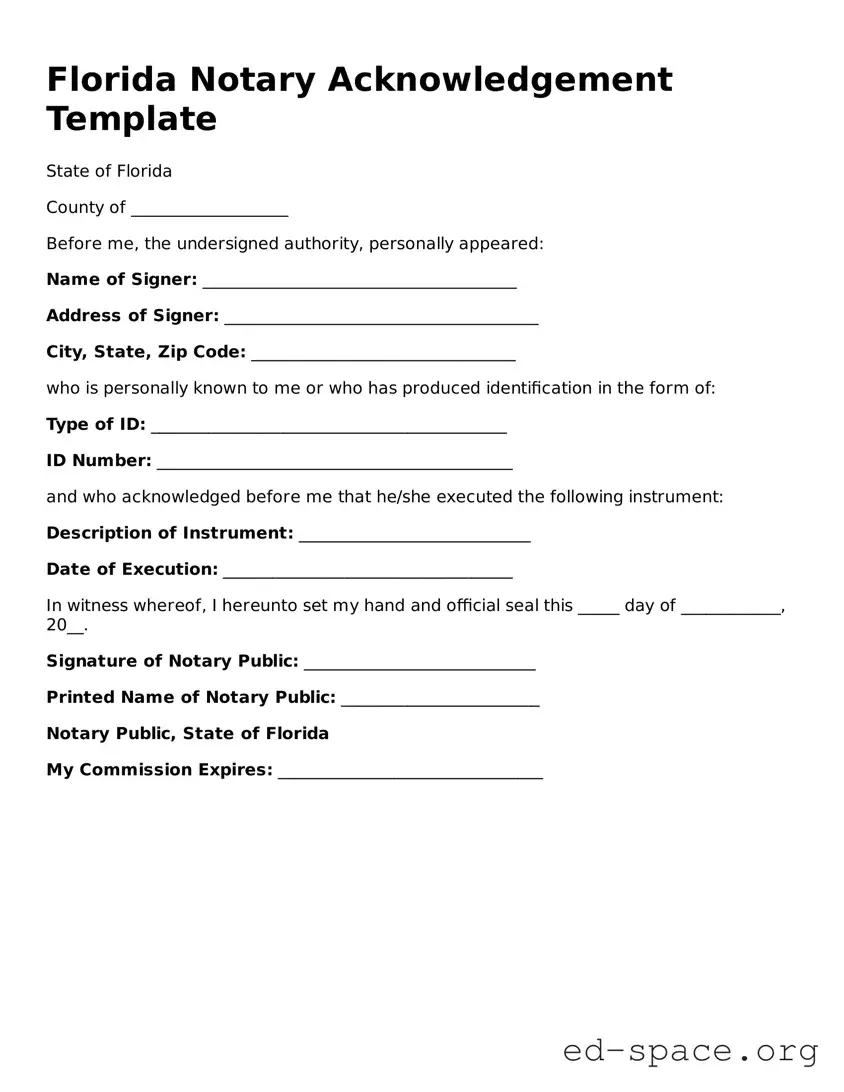
The Florida Notary Acknowledgment form plays a crucial role in the realm of legal documentation by providing a means for individuals to verify their identities and affirm the authenticity of their signatures. This form is essential in various transactions, including real estate deals, wills, and powers of attorney. It serves as a safeguard against fraud, ensuring that the signer is acting voluntarily and is aware of the contents of the document being signed. The form typically requires the notary public to witness the signing and to confirm the identity of the signer through acceptable forms of identification. Additionally, the acknowledgment includes specific details such as the date of the signing and the notary's official seal, which adds an extra layer of legitimacy to the document. By understanding the significance of this form, individuals can better navigate the complexities of legal transactions in Florida, ensuring that their documents are properly executed and recognized by the courts and other entities.
Florida Notary Acknowledgement Template
State of Florida
County of ___________________
Before me, the undersigned authority, personally appeared:
Name of Signer: ______________________________________
Address of Signer: ______________________________________
City, State, Zip Code: ________________________________
who is personally known to me or who has produced identification in the form of:
Type of ID: ___________________________________________
ID Number: ___________________________________________
and who acknowledged before me that he/she executed the following instrument:
Description of Instrument: ____________________________
Date of Execution: ___________________________________
In witness whereof, I hereunto set my hand and official seal this _____ day of ____________, 20__.
Signature of Notary Public: ____________________________
Printed Name of Notary Public: ________________________
Notary Public, State of Florida
My Commission Expires: ________________________________
| Fact Name | Description |
|---|---|
| Purpose | The Florida Notary Acknowledgement form is used to verify the identity of the signer and confirm that they signed a document willingly. |
| Governing Law | This form is governed by Florida Statutes, Chapter 117, which outlines the duties and powers of notaries public in Florida. |
| Signature Requirement | The signer must appear in person before the notary public to complete the acknowledgment. |
| Notary's Role | The notary public must complete the form by signing and sealing it after verifying the signer's identity. |
| Document Types | This acknowledgment can be used for various documents, including deeds, contracts, and affidavits. |
| Validity | The Florida Notary Acknowledgement form remains valid as long as it is properly completed and signed by the notary. |
After obtaining the Florida Notary Acknowledgement form, you will need to complete it accurately to ensure it serves its intended purpose. This form is often used in various legal and official documents to verify the identity of the signer and the authenticity of the signature. Follow the steps below to fill out the form correctly.
Once the form is completed, it is ready for the notary to witness the signature. The notary will then sign and seal the form, making it an official acknowledgment. Ensure that all parties involved understand the next steps in the process.
What is a Florida Notary Acknowledgement form?
The Florida Notary Acknowledgement form is a legal document that confirms a person's signature on a document. It serves as proof that the signer appeared before a notary public and acknowledged their signature willingly. This form is commonly used in various legal transactions, ensuring that the identity of the signer is verified and that they understand the contents of the document they are signing.
Who can serve as a notary public in Florida?
In Florida, a notary public must be at least 18 years old, a resident of the state, and must complete the required training and application process. Notaries can be individuals or businesses that have been appointed by the state to perform notarial acts. They play a crucial role in authenticating signatures and ensuring that documents are executed properly.
What is the purpose of the acknowledgment section in the form?
The acknowledgment section of the form is where the notary public verifies the identity of the signer. It includes details such as the date of the acknowledgment, the name of the signer, and the notary's signature and seal. This section is essential because it provides a layer of protection against fraud, ensuring that the document is valid and legally binding.
Is the Notary Acknowledgement form required for all documents?
No, not all documents require a Notary Acknowledgement. However, many legal documents, such as deeds, mortgages, and powers of attorney, often require notarization to be considered valid. It is important to check the specific requirements for each document to determine if a notary acknowledgment is necessary.
How do I find a notary public in Florida?
Finding a notary public in Florida is relatively easy. You can search online for local notaries, check with banks or law offices, or visit public libraries and government offices. Many notaries also offer mobile services, meaning they can come to your location to provide notarization, which can be convenient for busy individuals.
What happens if a document is not properly notarized?
If a document is not properly notarized, it may be considered invalid or unenforceable. This can lead to complications, especially if the document is needed for legal purposes. To avoid issues, it is crucial to ensure that the notary completes all necessary steps, including verifying the identity of the signer and properly filling out the acknowledgment section.
Can a notary public refuse to notarize a document?
Yes, a notary public can refuse to notarize a document if they believe that the signer is not acting willingly, if the document is incomplete, or if the notary cannot verify the signer's identity. Notaries have a responsibility to uphold the integrity of the notarial process, and they must exercise their judgment to prevent any potential fraud or misunderstanding.
How long is a Florida Notary Acknowledgement valid?
The validity of a Florida Notary Acknowledgement does not have a specific expiration date. However, the document itself may have its own validity period depending on the nature of the transaction. It is wise to check the requirements for the specific document to ensure that it remains valid for its intended purpose.
Not including the correct date. The date on the form must match the date when the notary acknowledges the signature. If it is left blank or filled incorrectly, it can cause issues.
Failing to provide the signer's name accurately. The name must be spelled correctly and should match the identification provided. Any discrepancies can lead to the acknowledgment being deemed invalid.
Omitting the notary's signature. The notary must sign the form to validate the acknowledgment. Without this signature, the document lacks the necessary authentication.
Not including the notary's seal. A notary seal is required to complete the acknowledgment. If the seal is missing or unclear, the document may not be accepted.
Using an outdated version of the form. Laws and requirements can change. It is essential to ensure that the most current version of the Florida Notary Acknowledgment form is used.
Neglecting to check for additional requirements. Some documents may have specific needs or additional information that must be included in the acknowledgment. Always review the requirements for the specific document being notarized.
When dealing with notary services in Florida, several other forms and documents may accompany the Florida Notary Acknowledgment form. Each of these documents serves a specific purpose and helps ensure that transactions are completed smoothly and legally. Below is a list of commonly used forms that you might encounter.
Understanding these documents and their purposes can help you navigate legal processes more effectively. Always ensure that the necessary forms are completed and notarized correctly to avoid any complications down the line.
The Notary Acknowledgement form serves an important role in verifying the identity of individuals signing documents. Several other documents share similarities in purpose and function. Here’s a look at nine such documents:
When filling out the Florida Notary Acknowledgment form, it’s essential to follow certain guidelines to ensure the document is valid and properly executed. Here’s a helpful list of things to do and avoid.
By following these guidelines, you can ensure that your Florida Notary Acknowledgment form is completed correctly and serves its intended purpose.
Understanding the Florida Notary Acknowledgement form is essential for anyone involved in legal documents. However, several misconceptions can lead to confusion. Here are six common misunderstandings:
Notaries can certify documents without the signer's presence. This is false. A notary must witness the signer’s signature to provide a valid acknowledgment. The signer must appear in person before the notary.
All notaries are lawyers. This is not true. While some notaries may be attorneys, many are not. Notaries can come from various professional backgrounds and do not need to have a law degree.
A notary can provide legal advice. This is incorrect. Notaries are not authorized to give legal advice or interpret the law. Their role is to verify identities and witness signatures.
Notary acknowledgments are only needed for real estate documents. This is a misconception. Acknowledgments can be required for various types of documents, including contracts, powers of attorney, and affidavits.
Once a document is notarized, it cannot be changed. This is misleading. While notarization confirms that a signature is genuine at the time of signing, changes can still be made to the document afterward. However, a new notarization may be required.
Notaries in Florida are the same as in other states. This is not entirely accurate. Each state has its own laws and regulations governing notaries. Florida has specific requirements that may differ from those in other states.
Being aware of these misconceptions can help individuals navigate the notary process more effectively. Always consult a qualified professional if you have questions about notarization and its requirements.
When filling out and using the Florida Notary Acknowledgement form, it’s essential to understand its purpose and requirements. Here are some key takeaways to keep in mind: