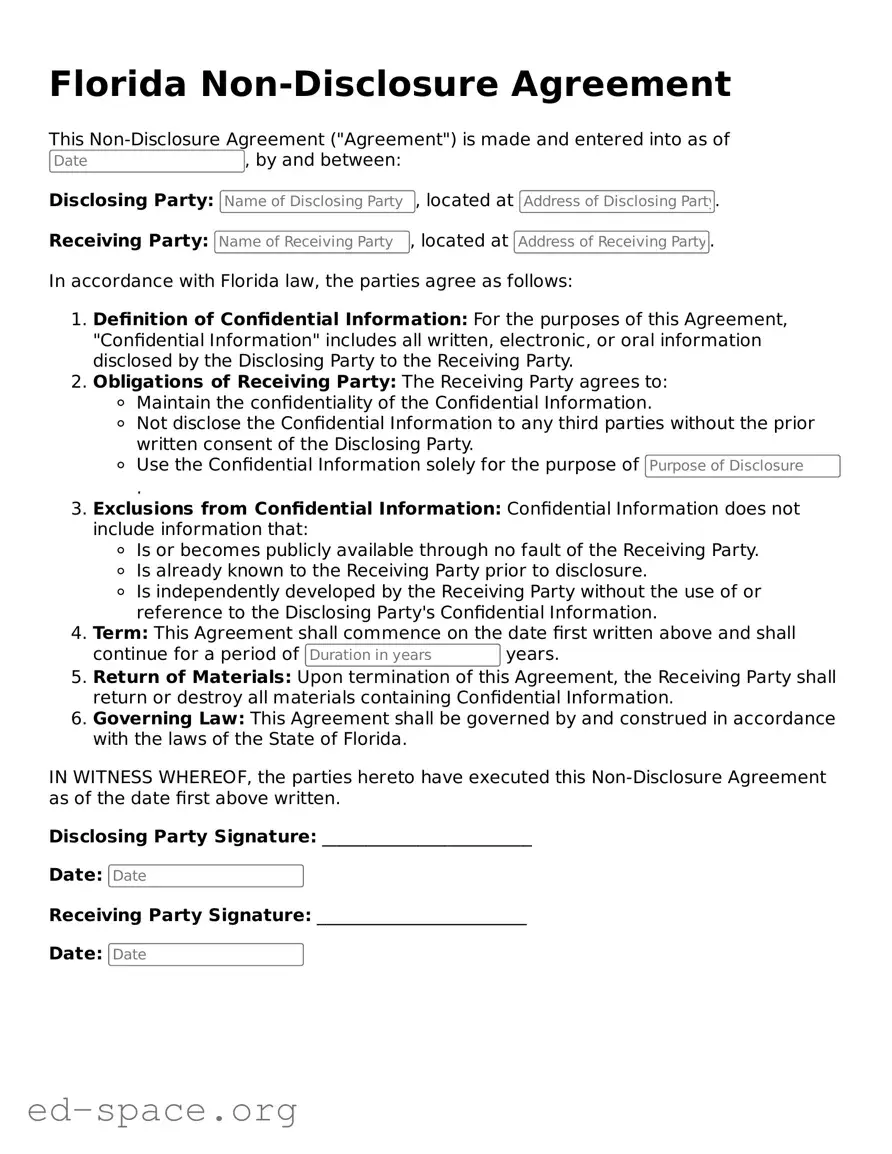
The Florida Non-disclosure Agreement (NDA) form serves as a crucial legal instrument designed to protect sensitive information shared between parties. This agreement is often utilized in various contexts, including business negotiations, employment relationships, and collaborative projects. By establishing clear guidelines regarding the handling of confidential information, the NDA helps to prevent unauthorized disclosure and misuse. Key elements of the form typically include definitions of what constitutes confidential information, the obligations of the parties involved, and the duration of confidentiality. Furthermore, it may outline the consequences of breach, thus providing a deterrent against potential violations. Whether for startups seeking to safeguard trade secrets or established companies aiming to protect proprietary data, the Florida NDA form plays an essential role in maintaining the integrity of sensitive information in a competitive environment.
Florida Non-Disclosure Agreement
This Non-Disclosure Agreement ("Agreement") is made and entered into as of , by and between:
Disclosing Party: , located at .
Receiving Party: , located at .
In accordance with Florida law, the parties agree as follows:
IN WITNESS WHEREOF, the parties hereto have executed this Non-Disclosure Agreement as of the date first above written.
Disclosing Party Signature: ________________________
Date:
Receiving Party Signature: ________________________
Date:
| Fact Name | Description |
|---|---|
| Purpose | The Florida Non-disclosure Agreement (NDA) is designed to protect confidential information shared between parties. |
| Governing Law | Florida law governs the terms and enforcement of NDAs in the state. |
| Parties Involved | Typically, the NDA involves at least two parties: the disclosing party and the receiving party. |
| Confidential Information | The NDA should clearly define what constitutes confidential information, ensuring both parties understand its scope. |
| Duration | NDAs can specify a duration for how long the information must remain confidential, often ranging from a few years to indefinitely. |
| Permitted Disclosures | The agreement may outline circumstances under which the receiving party can disclose the information, such as legal obligations. |
| Consequences of Breach | Breaching an NDA can lead to legal consequences, including potential lawsuits and financial damages. |
| Mutual vs. Unilateral | NDAs can be mutual, where both parties share confidential information, or unilateral, where only one party discloses information. |
| Enforceability | For an NDA to be enforceable in Florida, it must be reasonable in scope and not overly broad. |
| Signature Requirement | Typically, both parties must sign the NDA for it to be legally binding, indicating their agreement to the terms. |
After you have gathered all the necessary information, you can begin filling out the Florida Non-disclosure Agreement form. This document is essential for ensuring that confidential information remains protected. Follow these steps carefully to complete the form accurately.
Once you have completed the form, review it to ensure all information is accurate. After that, both parties should keep a copy for their records.
What is a Florida Non-disclosure Agreement (NDA)?
A Florida Non-disclosure Agreement is a legal contract designed to protect confidential information shared between parties. It prevents the receiving party from disclosing or using the information for any purpose other than what is specified in the agreement. This is particularly important in business contexts, where sensitive information, such as trade secrets or proprietary data, needs protection.
Who typically uses a Non-disclosure Agreement in Florida?
NDAs are commonly used by businesses, entrepreneurs, and individuals who need to share sensitive information. For instance, companies may require employees, contractors, or potential business partners to sign an NDA before discussing confidential information. This helps safeguard intellectual property and trade secrets.
What should be included in a Florida Non-disclosure Agreement?
An effective NDA should clearly outline the definition of confidential information, the obligations of both parties, the duration of the confidentiality obligation, and any exclusions from confidentiality. Additionally, it should specify the consequences of breaching the agreement. Clarity in these areas helps prevent misunderstandings and ensures both parties are aware of their responsibilities.
How long does the confidentiality obligation last under a Florida NDA?
The duration of the confidentiality obligation can vary based on the terms agreed upon by the parties involved. Typically, NDAs specify a time frame, which can range from a few years to indefinitely, depending on the nature of the information and the agreement. It is important to negotiate a duration that protects the interests of both parties.
Can a Non-disclosure Agreement be enforced in Florida?
Yes, NDAs can be enforced in Florida, provided they meet legal requirements. If a party breaches the agreement, the injured party may seek legal remedies, which can include monetary damages or injunctive relief. It is essential to ensure that the NDA is well-drafted and complies with Florida law to enhance its enforceability.
Are there any limitations to what can be protected under a Florida NDA?
Yes, certain types of information may not be eligible for protection under an NDA. For example, information that is already publicly available or that the receiving party independently develops without reference to the confidential information may not be protected. Additionally, information disclosed in compliance with legal obligations may not be covered. Understanding these limitations is crucial when drafting an NDA.
What are the consequences of breaching a Non-disclosure Agreement in Florida?
If a party breaches an NDA, they may face various consequences, including financial damages, legal fees, and potential loss of business relationships. In some cases, the injured party may seek a court order to prevent further disclosures. It is important for all parties to understand the seriousness of the agreement and the potential repercussions of a breach.
Is it advisable to consult a legal professional before signing an NDA?
Yes, consulting a legal professional before signing an NDA is highly advisable. A legal expert can help clarify the terms of the agreement, ensure it meets legal standards, and protect your interests. Taking this step can provide peace of mind and help prevent potential disputes in the future.
Not Identifying All Parties Clearly: One common mistake is failing to clearly identify all parties involved. Ensure that names, addresses, and roles are accurately listed. This helps avoid confusion later on.
Inadequate Definition of Confidential Information: Many people overlook the importance of defining what constitutes confidential information. Be specific about what information is protected under the agreement to prevent misunderstandings.
Leaving Out the Purpose of Disclosure: Not stating the purpose for sharing confidential information can lead to misuse. Clearly articulate why the information is being shared to maintain trust and accountability.
Ignoring the Duration of the Agreement: Some individuals forget to specify how long the confidentiality obligations last. It’s crucial to outline the duration to ensure that all parties understand their responsibilities over time.
Failing to Include Consequences for Breach: Many agreements lack clear consequences for breaching the terms. Specify what happens if someone violates the agreement to deter potential breaches.
Not Seeking Legal Review: Finally, some individuals skip having a legal professional review the agreement. Consulting with a lawyer can help identify potential issues and ensure that the document is enforceable.
A Florida Non-disclosure Agreement (NDA) is a vital tool for protecting sensitive information shared between parties. When entering into an NDA, several other documents may also be necessary to ensure a comprehensive understanding and protection of the involved parties' rights and responsibilities. Below is a list of common forms and documents that are often used alongside the Florida Non-disclosure Agreement.
Understanding these related documents can enhance the effectiveness of a Florida Non-disclosure Agreement. Each serves a unique purpose, contributing to a more secure and structured approach to managing sensitive information in various professional contexts.
When filling out the Florida Non-disclosure Agreement (NDA) form, it’s important to approach the process with care. Here are some key things to keep in mind:
By following these guidelines, you can ensure that your Non-disclosure Agreement is filled out correctly and effectively protects your interests.
When it comes to Non-disclosure Agreements (NDAs) in Florida, several misconceptions often lead to confusion. Understanding these misconceptions can help individuals and businesses navigate the process more effectively. Here are four common misunderstandings:
Many people assume that all NDAs are identical and can be used interchangeably. In reality, NDAs can vary significantly based on the specific needs of the parties involved. Tailoring the agreement to fit the particular situation is crucial for ensuring that it is enforceable and effective.
While businesses frequently use NDAs to protect trade secrets and sensitive information, individuals can also benefit from these agreements. For example, freelancers, consultants, and even employees may need to sign NDAs to safeguard confidential information they encounter in their work.
Some individuals believe that signing an NDA completely restricts them from discussing any aspect of their work or business. However, most NDAs only cover specific confidential information. Individuals can still discuss general topics or publicly available information without violating the agreement.
While NDAs can be powerful tools for protecting confidential information, they are not automatically enforceable. Courts may refuse to enforce an NDA if it is overly broad, vague, or if it imposes unreasonable restrictions. Ensuring that the NDA is well-drafted and reasonable is essential for its enforceability.
When it comes to using the Florida Non-disclosure Agreement (NDA) form, there are several important points to keep in mind. Here are some key takeaways to help you navigate the process smoothly:
By keeping these points in mind, you can effectively fill out and use the Florida Non-disclosure Agreement form to protect your interests.