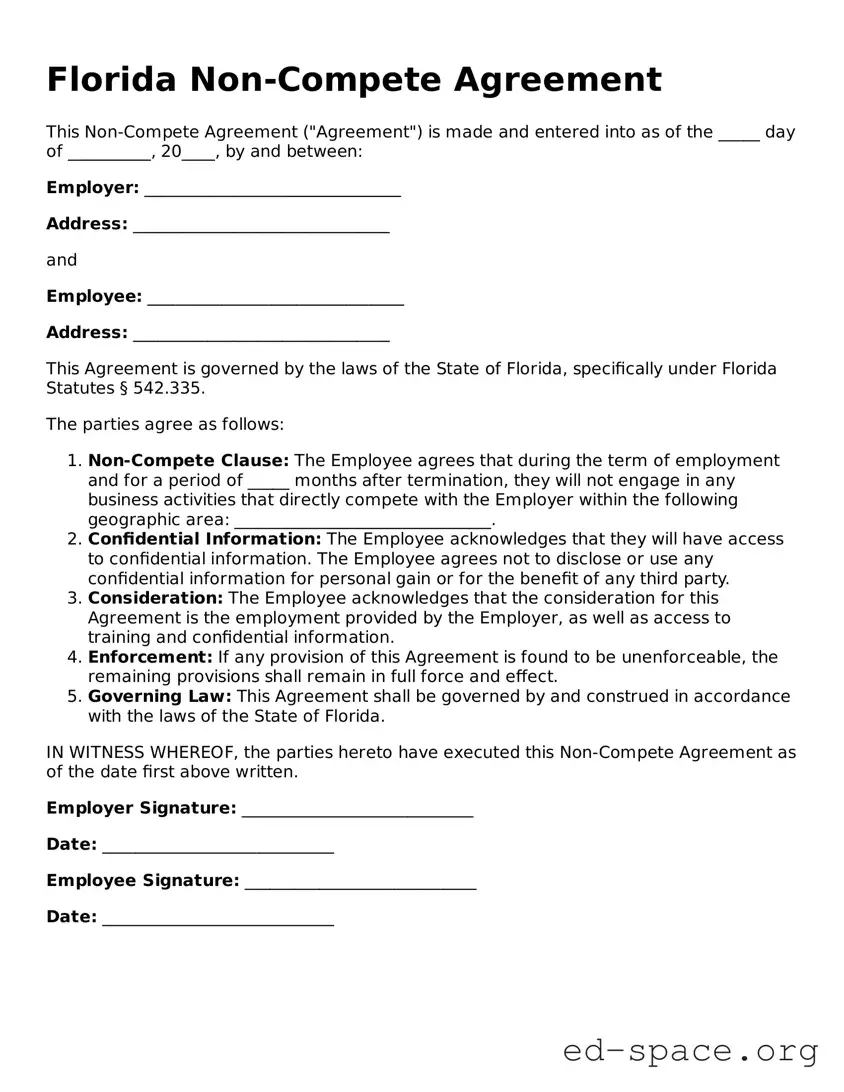
In Florida, the Non-compete Agreement form plays a crucial role in protecting business interests and trade secrets. This legal document outlines the terms under which an employee or contractor agrees not to engage in activities that directly compete with their employer's business for a specified period and within a defined geographical area. Key components of the form include the duration of the non-compete clause, the geographical scope, and the specific activities that are restricted. Employers often utilize this agreement to safeguard their proprietary information and maintain a competitive edge in the market. Conversely, employees must carefully consider the implications of signing such an agreement, as it may limit their future employment opportunities. Understanding the nuances of the Non-compete Agreement form is essential for both parties to ensure that their rights and interests are adequately protected.
Florida Non-Compete Agreement
This Non-Compete Agreement ("Agreement") is made and entered into as of the _____ day of __________, 20____, by and between:
Employer: _______________________________
Address: _______________________________
and
Employee: _______________________________
Address: _______________________________
This Agreement is governed by the laws of the State of Florida, specifically under Florida Statutes § 542.335.
The parties agree as follows:
IN WITNESS WHEREOF, the parties hereto have executed this Non-Compete Agreement as of the date first above written.
Employer Signature: ____________________________
Date: ____________________________
Employee Signature: ____________________________
Date: ____________________________
| Fact Name | Description |
|---|---|
| Governing Law | Florida Statutes, Chapter 542.335 governs non-compete agreements in Florida. |
| Purpose | Non-compete agreements are designed to protect legitimate business interests. |
| Enforceability | For a non-compete agreement to be enforceable, it must be reasonable in time, geographic area, and scope of activity. |
| Time Limit | Typically, non-compete agreements can last up to two years, depending on the nature of the business. |
| Geographic Limitations | The geographic scope must be limited to areas where the employer conducts business. |
| Consideration | There must be adequate consideration, such as employment or access to trade secrets, for the agreement to be valid. |
| Employee Rights | Employees have the right to challenge non-compete agreements that are overly broad or unreasonable. |
| Trade Secrets | Non-compete agreements can be used in conjunction with non-disclosure agreements to protect trade secrets. |
| Judicial Review | Courts in Florida may modify or invalidate non-compete agreements if they find them to be unreasonable. |
Filling out the Florida Non-compete Agreement form is straightforward. Follow these steps carefully to ensure all necessary information is provided accurately. Once completed, you can proceed with any additional requirements related to your agreement.
After filling out the form, review it for accuracy. Make sure all information is complete before submitting it to the relevant parties.
What is a Florida Non-compete Agreement?
A Florida Non-compete Agreement is a legal document that restricts an employee from engaging in certain competitive activities after leaving a job. This agreement aims to protect a company's trade secrets, proprietary information, and customer relationships by preventing former employees from joining or starting competing businesses within a specified timeframe and geographic area.
What are the requirements for a valid Non-compete Agreement in Florida?
For a Non-compete Agreement to be enforceable in Florida, it must be reasonable in terms of time, geographic area, and the scope of restricted activities. The agreement must also be supported by legitimate business interests, such as trade secrets or substantial relationships with customers. Additionally, both parties must voluntarily agree to the terms, and the employee should receive something of value in exchange, such as employment or access to confidential information.
How long can a Non-compete Agreement last in Florida?
Florida law does not specify an exact duration for Non-compete Agreements. However, the duration should be reasonable and tailored to the specific industry and circumstances. Generally, durations of six months to two years are considered acceptable, but longer periods may be scrutinized for reasonableness.
What geographic area can a Non-compete Agreement cover?
The geographic scope of a Non-compete Agreement must also be reasonable. It should reflect the area where the employer operates and where the employee had significant access to trade secrets or customer relationships. A narrow geographic area is more likely to be enforced than an overly broad one.
Can an employee negotiate a Non-compete Agreement?
Yes, employees can negotiate the terms of a Non-compete Agreement before signing. It's important for employees to fully understand the implications of the agreement and seek modifications if necessary. This can include negotiating the duration, geographic area, or specific activities that are restricted.
What happens if someone violates a Non-compete Agreement?
If an employee violates a Non-compete Agreement, the employer may take legal action. This could involve seeking an injunction to prevent the employee from continuing the competitive activities, as well as pursuing damages for any losses incurred due to the violation. Courts will consider the reasonableness of the agreement when making a ruling.
Are there any exceptions to Non-compete Agreements in Florida?
Yes, there are exceptions. For instance, if an employee is terminated without cause, the Non-compete Agreement may not be enforceable. Additionally, if the agreement is deemed overly restrictive or unreasonable, a court may refuse to enforce it. Employees should consult with a legal professional to understand their rights and options.
How can an employee protect themselves before signing a Non-compete Agreement?
Before signing a Non-compete Agreement, employees should carefully read and understand the terms. It’s advisable to seek legal advice to ensure the agreement is fair and reasonable. Employees can also consider negotiating terms that allow for flexibility, such as a shorter duration or a smaller geographic area, to better protect their future career opportunities.
Not Clearly Defining the Scope of Competition: Many individuals fail to specify what constitutes competition. Without clear definitions, the agreement may be unenforceable.
Ignoring Geographic Limitations: Some people overlook the importance of defining the geographic area where the non-compete applies. A vague or overly broad location can lead to legal challenges.
Neglecting Time Restrictions: Failing to set a reasonable duration for the non-compete can render the agreement invalid. Courts often look for a balance that protects the employer while allowing the employee to work.
Not Considering Employee Rights: Many individuals do not take into account the rights of employees. An agreement that is too restrictive may be deemed unfair and unenforceable.
The Florida Non-compete Agreement is a legal document that restricts an individual's ability to engage in certain competitive activities after leaving a job. Alongside this agreement, several other forms and documents are often utilized to ensure clarity and legal compliance in employment relationships. Below is a list of commonly used documents that complement the Florida Non-compete Agreement.
These documents work together to create a comprehensive framework that governs the relationship between employers and employees. They help protect both parties' interests and provide clear guidelines for behavior during and after employment.
When filling out the Florida Non-compete Agreement form, it’s important to approach the process with care. Here are some dos and don'ts to keep in mind:
Non-compete agreements are often misunderstood, leading to confusion among employees and employers alike. Here are five common misconceptions about the Florida Non-compete Agreement form:
In Florida, non-compete agreements must meet specific criteria to be enforceable. Factors include the duration of the restriction, geographic area, and the legitimate business interest being protected. If these criteria are not met, the agreement may not hold up in court.
While a non-compete agreement may restrict employment in certain areas or with specific companies, it does not necessarily prevent an individual from working in their field entirely. The scope of the restriction is critical.
Many believe that only executives or highly specialized employees are subject to non-compete agreements. However, these agreements can apply to employees at various levels, depending on the business interests involved.
Employers must provide adequate consideration, such as a job offer or a promotion, when requiring an employee to sign a non-compete agreement. Simply presenting the agreement without any benefit does not make it enforceable.
Employees have the right to challenge the validity of a non-compete agreement in court. If an employee believes the agreement is overly broad or unjust, they can seek legal counsel to explore their options.
When filling out and using the Florida Non-compete Agreement form, keep these key takeaways in mind: