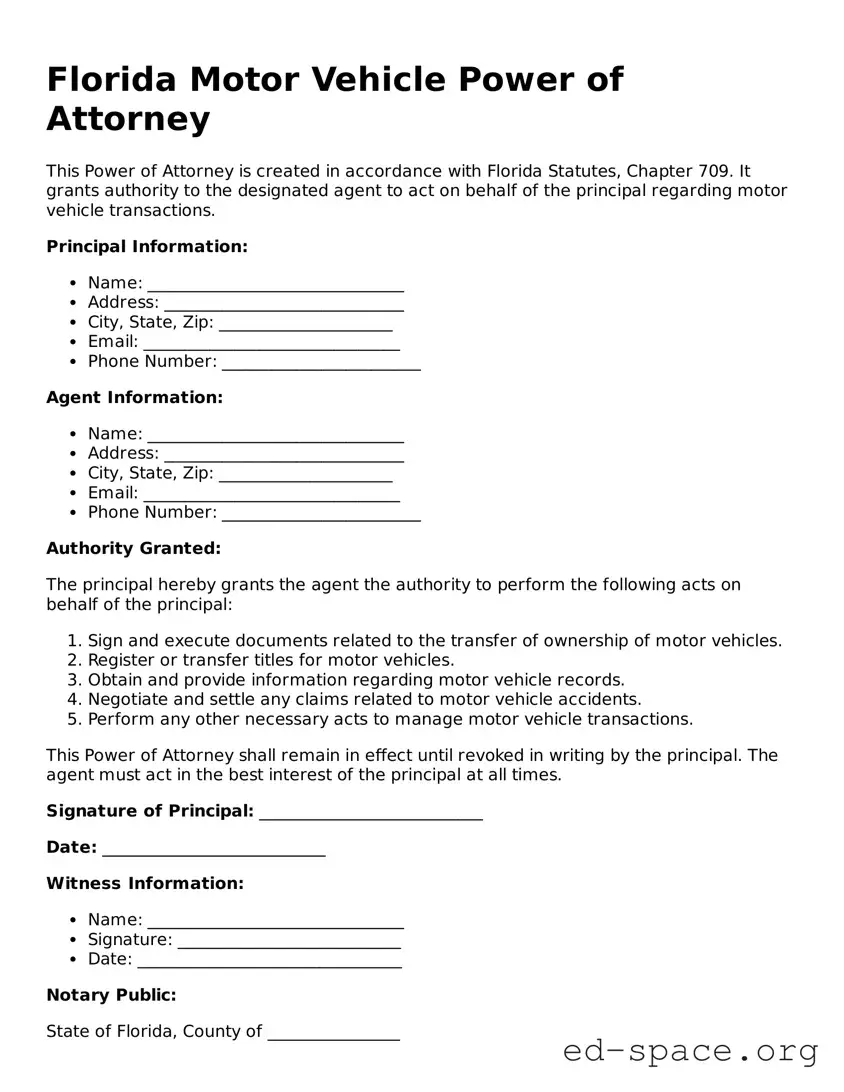
The Florida Motor Vehicle Power of Attorney form is a crucial legal document that allows individuals to designate another person to act on their behalf regarding motor vehicle transactions. This form is especially useful when the vehicle owner cannot be present for tasks such as title transfers, registration renewals, or the sale of a vehicle. By granting this authority, the vehicle owner ensures that their interests are represented, even in their absence. The form typically requires the vehicle owner's signature, the name of the designated agent, and specific details about the vehicle in question. Additionally, it may need to be notarized to enhance its validity. Understanding the implications of this document can simplify the process of managing motor vehicle-related affairs, making it easier for both the owner and the appointed agent to navigate the necessary legal requirements.
Florida Motor Vehicle Power of Attorney
This Power of Attorney is created in accordance with Florida Statutes, Chapter 709. It grants authority to the designated agent to act on behalf of the principal regarding motor vehicle transactions.
Principal Information:
Agent Information:
Authority Granted:
The principal hereby grants the agent the authority to perform the following acts on behalf of the principal:
This Power of Attorney shall remain in effect until revoked in writing by the principal. The agent must act in the best interest of the principal at all times.
Signature of Principal: ___________________________
Date: ___________________________
Witness Information:
Notary Public:
State of Florida, County of ________________
On this ______ day of ____________, 20___, before me, a Notary Public, personally appeared __________________________, who is known to me or has produced identification, and acknowledged that they executed this Power of Attorney.
Notary Signature: ___________________________
My Commission Expires: ___________________
| Fact Name | Description |
|---|---|
| Purpose | The Florida Motor Vehicle Power of Attorney form allows an individual to authorize another person to act on their behalf regarding motor vehicle transactions. |
| Governing Law | This form is governed by Florida Statutes, specifically Section 709.2101 et seq. |
| Principal | The individual granting authority is referred to as the principal. |
| Agent | The person receiving authority to act is known as the agent or attorney-in-fact. |
| Signature Requirement | The principal must sign the form in the presence of a notary public or two witnesses. |
| Duration | The power of attorney remains effective until revoked by the principal or until the principal's death. |
| Specific Powers | The form can specify particular powers, such as transferring ownership or registering a vehicle. |
| Revocation | The principal can revoke the power of attorney at any time, provided they notify the agent. |
Filling out the Florida Motor Vehicle Power of Attorney form requires careful attention to detail. After completing the form, you will need to submit it to the appropriate authority to ensure that the designated person can act on your behalf regarding your motor vehicle matters.
What is a Florida Motor Vehicle Power of Attorney form?
The Florida Motor Vehicle Power of Attorney form is a legal document that allows one person to authorize another person to act on their behalf regarding motor vehicle transactions. This can include buying, selling, registering, or transferring ownership of a vehicle. The person granting the authority is known as the principal, while the person receiving the authority is the agent or attorney-in-fact.
Who can use the Florida Motor Vehicle Power of Attorney form?
Any individual who owns a motor vehicle in Florida can use this form. It is particularly useful for those who may be unable to handle vehicle-related tasks due to time constraints, health issues, or being out of state. Both individuals and businesses can appoint an agent to manage their vehicle transactions.
How do I complete the Florida Motor Vehicle Power of Attorney form?
To complete the form, you will need to provide specific information, including the names and addresses of both the principal and the agent. You must also describe the powers you are granting. After filling out the necessary information, both parties must sign the document. It is recommended to have the signatures notarized to ensure its validity.
Is it necessary to notarize the Florida Motor Vehicle Power of Attorney form?
While notarization is not strictly required, it is highly recommended. Having the form notarized adds an extra layer of authenticity and can help prevent disputes regarding the authority granted. Some institutions, such as the Department of Motor Vehicles, may require notarization to process the transactions effectively.
How long is the Florida Motor Vehicle Power of Attorney form valid?
The validity of the form generally lasts until the principal revokes it or until the specific transaction is completed. If you wish to cancel the power of attorney, you must do so in writing and inform the agent. It is important to keep a copy of the revocation for your records.
Can I revoke the Florida Motor Vehicle Power of Attorney form?
Yes, you can revoke the Florida Motor Vehicle Power of Attorney at any time. To do this, you must create a written notice of revocation and provide it to your agent. It is also advisable to inform any third parties who may have relied on the original power of attorney that it has been revoked.
Not Specifying the Powers Granted: Many individuals fail to clearly outline the specific powers they wish to grant to the agent. It is crucial to detail whether the agent can buy, sell, or transfer the vehicle, as vague language may lead to confusion or misuse.
Forgetting to Sign and Date: A common oversight is neglecting to sign and date the form. Without a signature, the document is not legally binding, rendering it ineffective in granting authority.
Not Including the Vehicle Identification Number (VIN): Some people overlook the importance of including the VIN of the vehicle in question. This number uniquely identifies the vehicle and is essential for clarity and legal purposes.
Failing to Have the Document Notarized: In Florida, notarization is often required for the Power of Attorney to be valid. Skipping this step can lead to the document being rejected by authorities or institutions.
The Florida Motor Vehicle Power of Attorney form allows an individual to authorize another person to handle specific motor vehicle transactions on their behalf. This form is often accompanied by other documents to ensure that all legal requirements are met. Here are some commonly used forms and documents that complement the Power of Attorney.
Each of these documents plays a crucial role in the vehicle transaction process. Ensuring you have the correct forms can help streamline the process and avoid potential legal issues.
The Motor Vehicle Power of Attorney form allows one person to authorize another to act on their behalf regarding vehicle-related matters. Several other documents serve similar purposes, providing authority or designating responsibilities. Here are six such documents:
When filling out the Florida Motor Vehicle Power of Attorney form, it's essential to follow specific guidelines to ensure the document is valid and effective. Here are some important dos and don'ts:
Understanding the Florida Motor Vehicle Power of Attorney form is essential for those needing to delegate authority regarding vehicle transactions. However, several misconceptions exist. Below is a list of ten common misconceptions and clarifications about the form.
This form can be used for various transactions, including registering a vehicle, transferring ownership, and obtaining title documents.
Individuals can fill out the form themselves, as long as they understand the requirements and have the necessary information.
The authority granted can be limited in time and scope, depending on the specific needs outlined in the document.
While notarization is recommended for added security, it is not a strict requirement for the form to be legally valid in Florida.
This form is specifically designed for motor vehicles and may not be appropriate for other types of assets.
The agent can act on behalf of the principal even if the principal is not physically present, provided the form is properly executed.
Written documentation is necessary to ensure clarity and legality in the delegation of authority.
The principal retains the right to revoke the Power of Attorney at any time, as long as they are mentally competent.
While it is specific to Florida, similar forms exist in other states, but they may have different requirements.
Agents are legally obligated to act in the best interest of the principal and can be held accountable for any misuse of authority.
Clarifying these misconceptions can help individuals make informed decisions regarding the Florida Motor Vehicle Power of Attorney form.
Filling out and using the Florida Motor Vehicle Power of Attorney form can be straightforward if you keep a few key points in mind. Here are some important takeaways to consider:
By following these guidelines, you can effectively use the Florida Motor Vehicle Power of Attorney form to manage your vehicle-related affairs with ease.