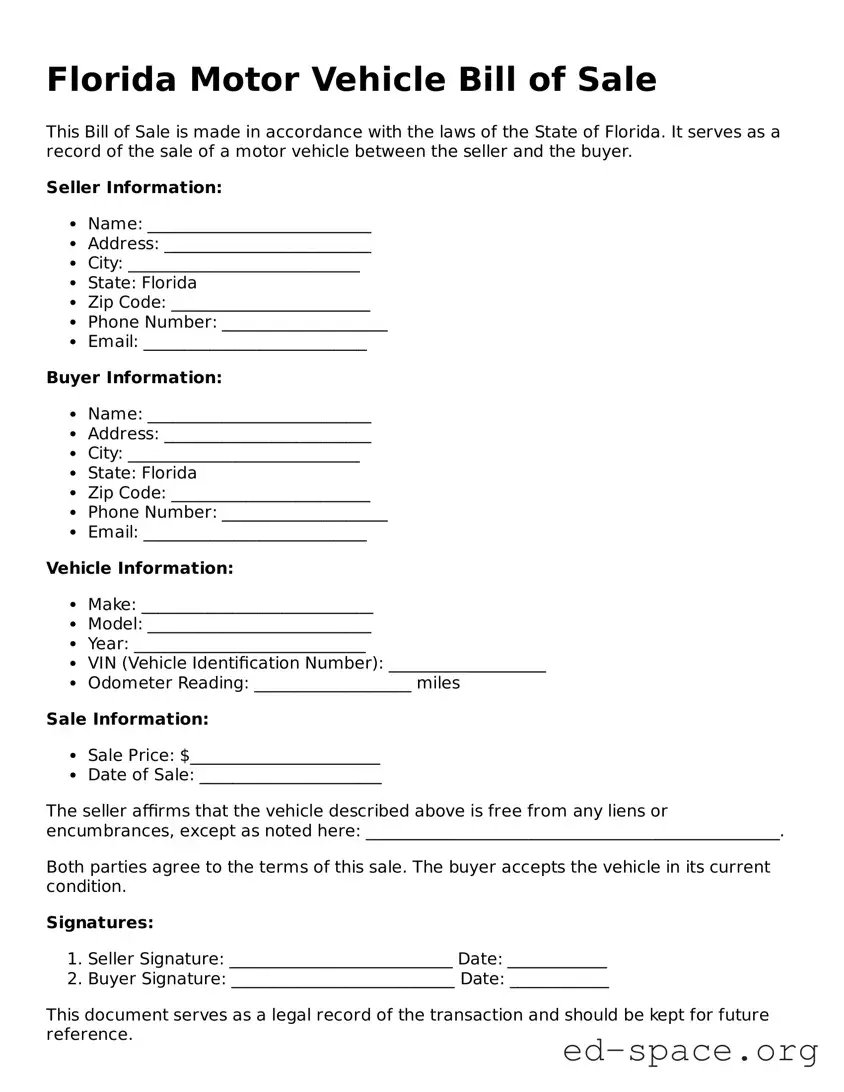
The Florida Motor Vehicle Bill of Sale form serves as a crucial document in the process of transferring ownership of a vehicle from one party to another. This form provides essential details, including the names and addresses of both the seller and the buyer, as well as the vehicle’s identification number (VIN), make, model, and year. It is important to accurately record the sale price and any conditions of the sale to ensure clarity and protect the interests of both parties involved. Additionally, the form may include information about the odometer reading at the time of sale, which is vital for transparency regarding the vehicle's usage. By completing this document, both the seller and buyer create a legal record of the transaction, which can be beneficial for future reference, especially when it comes to registration and title transfer. Furthermore, this form can help prevent disputes that may arise after the sale, providing peace of mind to both parties as they finalize the exchange of ownership.
Florida Motor Vehicle Bill of Sale
This Bill of Sale is made in accordance with the laws of the State of Florida. It serves as a record of the sale of a motor vehicle between the seller and the buyer.
Seller Information:
Buyer Information:
Vehicle Information:
Sale Information:
The seller affirms that the vehicle described above is free from any liens or encumbrances, except as noted here: __________________________________________________.
Both parties agree to the terms of this sale. The buyer accepts the vehicle in its current condition.
Signatures:
This document serves as a legal record of the transaction and should be kept for future reference.
| Fact Name | Description |
|---|---|
| Purpose | The Florida Motor Vehicle Bill of Sale form serves as a legal document to record the sale of a vehicle between a buyer and a seller. |
| Governing Law | This form is governed by Florida Statutes, specifically Chapter 319, which relates to the regulation of motor vehicles. |
| Required Information | The form must include details such as the vehicle identification number (VIN), make, model, year, and the sale price. |
| Signatures | Both the buyer and seller must sign the document to validate the transaction. |
| Notarization | While notarization is not mandatory, it is recommended for added legal protection. |
| Transfer of Ownership | The Bill of Sale acts as proof of ownership transfer, which is necessary for the buyer to register the vehicle. |
| Tax Implications | Sales tax may apply based on the sale price listed in the Bill of Sale, and this must be reported to the Florida Department of Revenue. |
| Record Keeping | Both parties should keep a copy of the Bill of Sale for their records, as it may be required for future reference. |
| Vehicle Condition | The form can include a section for the seller to disclose the vehicle's condition, which can help protect both parties. |
| Additional Documents | Other documents, such as the title and maintenance records, may also be exchanged during the sale. |
Filling out the Florida Motor Vehicle Bill of Sale form is a straightforward process that requires specific information about the vehicle and the parties involved in the transaction. Once the form is completed, it serves as a legal document to confirm the sale and transfer of ownership. Below are the steps to effectively fill out the form.
After completing the form, it is advisable for both parties to keep a copy for their records. This ensures that there is a reference available should any questions arise in the future regarding the transaction.
What is a Florida Motor Vehicle Bill of Sale?
A Florida Motor Vehicle Bill of Sale is a legal document that records the transfer of ownership of a motor vehicle from one party to another. It serves as proof of the transaction and includes essential details about the vehicle and the parties involved. This document is crucial for both buyers and sellers to ensure a smooth transfer of ownership.
What information is required on the Bill of Sale?
The Bill of Sale must include specific information to be valid. This includes the names and addresses of both the buyer and seller, the vehicle identification number (VIN), the make and model of the vehicle, the year of manufacture, the sale price, and the date of the transaction. Additionally, both parties should sign the document to acknowledge the sale.
Is a Bill of Sale required in Florida?
While a Bill of Sale is not legally required to complete a vehicle sale in Florida, it is highly recommended. This document provides a clear record of the transaction, which can be beneficial if disputes arise in the future. It also helps the buyer prove ownership when registering the vehicle with the Florida Department of Highway Safety and Motor Vehicles.
Can I create my own Bill of Sale?
Yes, you can create your own Bill of Sale as long as it contains all the necessary information. However, using a standard form can simplify the process and ensure that you do not miss any critical details. Several templates are available online, or you can obtain a form from the Florida Department of Highway Safety and Motor Vehicles.
Do I need to have the Bill of Sale notarized?
In Florida, notarization of the Bill of Sale is not required. However, having the document notarized can add an extra layer of authenticity and may be beneficial in case of any future disputes. It can also serve as a safeguard for both parties involved in the transaction.
What should I do with the Bill of Sale after the sale?
After the sale, both the buyer and seller should keep a copy of the Bill of Sale for their records. The buyer will need it when registering the vehicle in their name, while the seller should retain it as proof of the sale. This documentation can be important for tax purposes or in the event of any legal issues that may arise later.
Can I use a Bill of Sale for a vehicle purchased from a dealership?
Typically, when purchasing a vehicle from a dealership, the dealer will provide the necessary paperwork, including a Bill of Sale. However, if you are buying a vehicle from a private seller, you will need to use a Bill of Sale to document the transaction. Always ensure that you receive this document when completing a private sale.
What if the vehicle has a lien on it?
If the vehicle has a lien, it is essential to address this before completing the sale. The seller should provide proof that the lien has been satisfied, or the buyer should ensure that the lien will be cleared upon payment. The Bill of Sale should indicate the status of the lien to protect both parties involved in the transaction.
What happens if there are discrepancies in the Bill of Sale?
Discrepancies in the Bill of Sale can lead to complications in the ownership transfer. If any information is incorrect, it is advisable to correct it before finalizing the sale. Both parties should review the document carefully to ensure accuracy. If issues arise after the sale, having a well-documented Bill of Sale can help resolve disputes more effectively.
Where can I obtain a Florida Motor Vehicle Bill of Sale form?
You can obtain a Florida Motor Vehicle Bill of Sale form from various sources. The Florida Department of Highway Safety and Motor Vehicles provides downloadable forms on their website. Additionally, many legal websites offer templates that you can customize. Local auto dealerships may also have copies available for their customers.
Failing to include all required information. The form requires specific details such as the vehicle identification number (VIN), make, model, and year. Omitting any of these can lead to complications.
Incorrectly recording the VIN. The VIN is a unique identifier for the vehicle. A single mistake in this number can render the document invalid and create issues during registration.
Not signing the document. Both the seller and buyer must sign the bill of sale. Without signatures, the document lacks legal validity.
Using outdated forms. The Florida Department of Highway Safety and Motor Vehicles may update forms periodically. Using an old version can result in rejection.
Neglecting to provide a purchase price. The bill of sale should clearly state the amount paid for the vehicle. Leaving this blank can lead to misunderstandings.
Forgetting to include the date of sale. The date is crucial for record-keeping and can affect the transfer of ownership.
Not providing a copy to the buyer. After completing the form, the seller should give a copy to the buyer for their records. This ensures both parties have proof of the transaction.
Misrepresenting the vehicle's condition. Accurately describing the vehicle's condition is essential. Misleading information can lead to disputes later on.
Overlooking state-specific requirements. Each state may have additional requirements for a bill of sale. Familiarizing oneself with Florida's specific rules is important to avoid issues.
When buying or selling a vehicle in Florida, several documents complement the Motor Vehicle Bill of Sale. These forms help ensure a smooth transaction and provide necessary information for both parties involved. Here’s a list of commonly used documents:
Having these documents ready can simplify the transaction process and help avoid potential issues down the road. Always ensure that all forms are completed accurately to protect both the buyer and the seller.
The Motor Vehicle Bill of Sale form serves a specific purpose in documenting the sale of a vehicle. However, it shares similarities with several other important documents. Here’s a list of seven documents that are similar to the Motor Vehicle Bill of Sale, along with explanations of their similarities:
Each of these documents plays a vital role in ensuring that transactions are clear, legal, and binding. Understanding their similarities can help individuals navigate the complexities of buying, selling, or transferring ownership of a vehicle.
When filling out the Florida Motor Vehicle Bill of Sale form, it’s important to be thorough and accurate. Here are some dos and don’ts to guide you through the process:
By following these guidelines, you can help ensure a smooth transaction when buying or selling a vehicle in Florida.
When dealing with the Florida Motor Vehicle Bill of Sale form, several misconceptions can lead to confusion. Understanding these common misunderstandings is crucial for ensuring a smooth transaction. Here are five misconceptions:
Many people believe that a Bill of Sale is optional. In reality, this document serves as a vital record of the transaction, providing proof of ownership transfer and protecting both the buyer and seller.
While notarization can add an extra layer of security, it is not a requirement in Florida. The form is valid as long as both parties sign it, making it easier to complete without the need for a notary.
Another common misconception is that only the seller's signature is necessary. Both the buyer and seller should sign the document to ensure that both parties acknowledge the terms of the sale.
This is not true. A Bill of Sale can be used for both new and used vehicles. It provides essential documentation regardless of the vehicle's age, ensuring clarity in ownership transfer.
Completing the Bill of Sale is just one step in the process. Buyers must still register the vehicle and pay any applicable taxes. Sellers should also keep a copy for their records to protect against future disputes.
By addressing these misconceptions, both buyers and sellers can navigate the vehicle transaction process more effectively. Always ensure that you have the correct documentation and understand the requirements involved in your specific situation.
When dealing with the Florida Motor Vehicle Bill of Sale form, it's essential to understand its significance and how to fill it out correctly. Here are some key takeaways: