The Florida Motion to Terminate Income Deduction Order form serves as a crucial tool for individuals seeking to modify or eliminate income deduction orders related to child support or other financial obligations. This form is designed to facilitate the legal process of terminating an existing order that may no longer be applicable due to changes in circumstances, such as a change in employment status or financial hardship. By submitting this motion, individuals can request that the court review their situation and make a determination regarding the continuation of income deductions. The form requires specific information, including the case number, details about the current income deduction order, and any relevant changes in financial circumstances. Properly completing this form is essential for ensuring that the court has all necessary information to make an informed decision. Furthermore, understanding the implications of terminating an income deduction order is vital, as it may affect ongoing financial responsibilities. Therefore, individuals should approach this process with careful consideration and clarity.
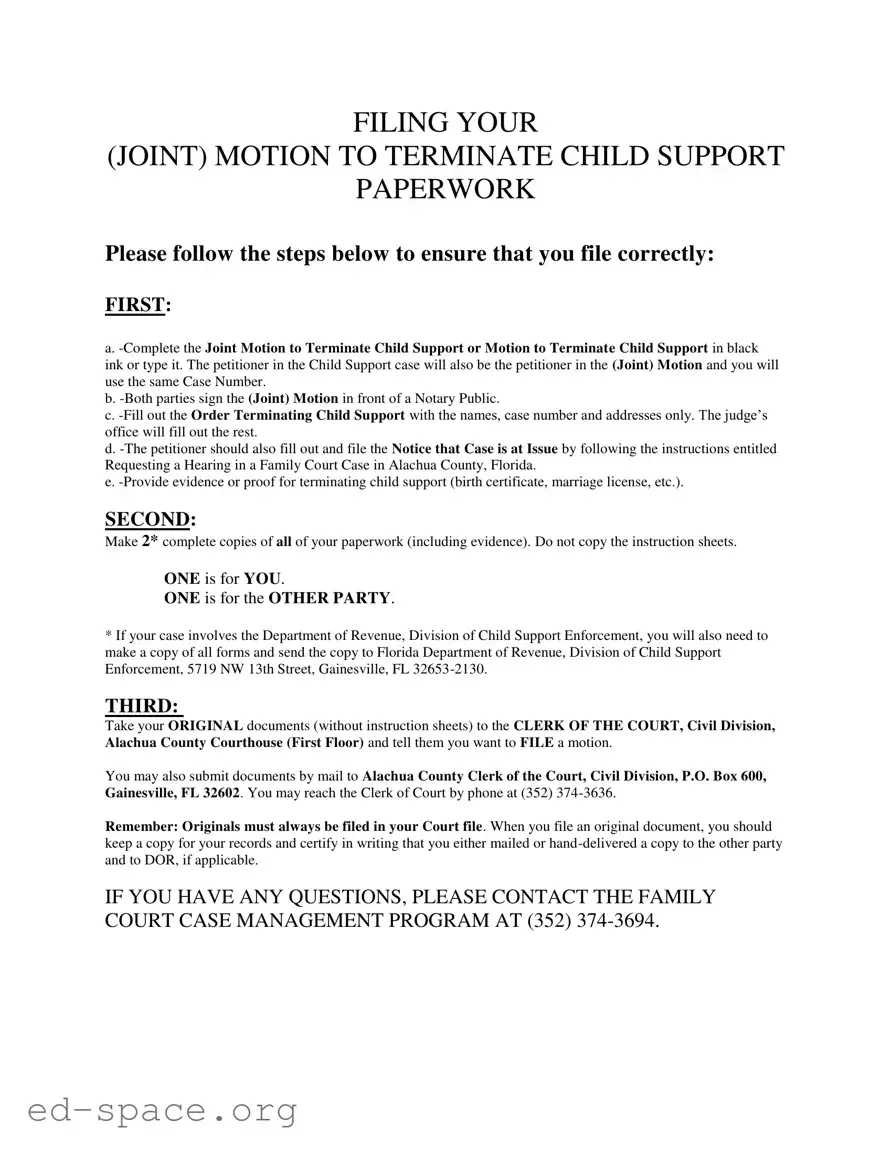
FILING YOUR
(JOINT) MOTION TO TERMINATE CHILD SUPPORT
PAPERWORK
Please follow the steps below to ensure that you file correctly:
FIRST:
a.
b.
c.
d.
e.
SECOND:
Make 2* complete copies of all of your paperwork (including evidence). Do not copy the instruction sheets.
ONE is for YOU.
ONE is for the OTHER PARTY.
*If your case involves the Department of Revenue, Division of Child Support Enforcement, you will also need to make a copy of all forms and send the copy to Florida Department of Revenue, Division of Child Support Enforcement, 5719 NW 13th Street, Gainesville, FL
THIRD:
Take your ORIGINAL documents (without instruction sheets) to the CLERK OF THE COURT, Civil Division, Alachua County Courthouse (First Floor) and tell them you want to FILE a motion.
You may also submit documents by mail to Alachua County Clerk of the Court, Civil Division, P.O. Box 600, Gainesville, FL 32602. You may reach the Clerk of Court by phone at (352)
Remember: Originals must always be filed in your Court file. When you file an original document, you should keep a copy for your records and certify in writing that you either mailed or
IF YOU HAVE ANY QUESTIONS, PLEASE CONTACT THE FAMILY COURT CASE MANAGEMENT PROGRAM AT (352)

IN THE CIRCUIT COURT OF THE EIGHTH JUDICIAL CIRCUIT
IN AND FOR ALACHUA COUNTY, FLORIDA
CASE NO:
DIVISION:
Petitioner,
vs.
Respondent.
/
JOINT MOTION TO TERMINATE CHILD SUPPORT
The parties to this action file this Motion to Terminate Child Support for the following child,
, and state:
1. The child has reached the age of majority and is not enrolled in high school.
2. The child has reached the age of majority and does not intend to graduate from high school before reaching the age of nineteen.
3. The child has been emancipated (for example
4. The child has been legally adopted.
5. The child is deceased.
6. The parties have reconciled/remarried and reside together.
7. Child is
WHEREFORE, the parties ask the Court to enter an order terminating child support.
DATED this |
|
day of |
|
, 20 |
|
. |
||
|
|
|
|
|
|
|
||
Petitioner Signature |
|
|
|
|
|
Respondent Signature |
||
|
|
|
|
|
|
|
||
Address |
|
|
|
|
|
Address |
||
|
|
|
|
|
|
|
|
|

Page 2 JOINT MOTION TO TERMINATE CHILD SUPPORT
Notarized Signatures:
STATE OF FLORIDA
COUNTY OF
Sworn to or affirmed and signed before me on |
|
by |
|
. |
NOTARY
[Print, type, or stamp commissioned name of notary.]
Personally known
Produced identification: Type of identification produced
STATE OF FLORIDA
COUNTY OF
Sworn to or affirmed and signed before me on |
|
by |
|
. |
NOTARY
[Print, type, or stamp commissioned name of notary.]
Personally known
Produced identification: Type of identification produced
| Fact Name | Description |
|---|---|
| Purpose | The Florida Motion to Terminate Income Deduction Order form is used to request the termination of an income deduction for child support or alimony. |
| Governing Law | This form is governed by Florida Statutes, specifically Chapter 61, which pertains to dissolution of marriage and related matters. |
| Eligibility | Individuals who have experienced a significant change in circumstances, such as a change in income or employment status, may be eligible to file this motion. |
| Filing Process | The completed form must be filed with the appropriate Florida court, and copies should be served to all involved parties. |
| Potential Outcomes | If granted, the court will terminate the income deduction order, which can relieve the individual from automatic deductions for support payments. |
After completing the Florida Motion Terminate Income Deduction Order form, you will need to submit it to the appropriate court. This is an important step in ensuring your request is processed. Make sure to keep a copy for your records.
What is the Florida Motion to Terminate Income Deduction Order form?
The Florida Motion to Terminate Income Deduction Order form is a legal document used to request the court to end an income deduction order. This order typically directs an employer to withhold a portion of an individual's income for child support or alimony payments. When circumstances change, such as a change in employment or financial situation, this motion can be filed to stop the deductions.
Who can file this motion?
Either party involved in the income deduction order can file this motion. This includes the person making the payments (the obligor) or the person receiving the payments (the obligee). It is important to have valid reasons for filing, such as a change in income or a change in the custody arrangement.
What reasons can I provide for terminating the income deduction order?
Common reasons for terminating the income deduction order include losing a job, a significant decrease in income, or changes in the child support agreement. You may also cite changes in the child's living situation or needs. It's crucial to provide clear and compelling evidence to support your request.
How do I fill out the form correctly?
To fill out the form, ensure you provide accurate information regarding your case number, the parties involved, and the specifics of the income deduction order. Follow the instructions carefully, and double-check your entries for accuracy. If you're unsure, consider seeking assistance from a legal professional or a document preparer.
Where do I file the motion?
The motion should be filed in the same court that issued the original income deduction order. This ensures that the court has jurisdiction over the case and can make a ruling based on the existing order.
Is there a fee to file the motion?
Yes, there is typically a filing fee associated with submitting the motion to the court. The fee can vary by county, so it is advisable to check with your local court for the exact amount. If you cannot afford the fee, you may be able to request a fee waiver.
What happens after I file the motion?
Once the motion is filed, the court will schedule a hearing. Both parties will be notified of the hearing date. During the hearing, you will have the opportunity to present your case, and the other party can respond. The judge will then make a decision based on the evidence and arguments presented.
Do I need to attend the court hearing?
Yes, it is important to attend the court hearing. Failing to appear may result in the court dismissing your motion. Being present allows you to explain your situation directly to the judge and answer any questions that may arise.
Can I represent myself in court?
Yes, you can represent yourself in court, known as "pro se" representation. However, it is advisable to seek legal counsel or assistance from a document preparer to ensure that you understand the process and can effectively present your case.
What if the motion is denied?
If the court denies your motion to terminate the income deduction order, you may still have options. You can consider appealing the decision or filing a new motion in the future if circumstances change. It's essential to stay informed about your rights and options in such situations.
Failing to provide accurate personal information. Ensure that names, addresses, and case numbers are correct. Incorrect details can lead to delays or rejections.
Neglecting to sign the form. A signature is essential for the form to be considered valid. Without it, the motion cannot proceed.
Not including supporting documentation. Attach any necessary documents that support your request to terminate the income deduction order. This may include proof of changed circumstances.
Using unclear language. Be specific and concise in your explanations. Ambiguous language can confuse the reader and undermine your request.
Missing deadlines. Submit the form within the required time frame. Late submissions may result in denial of your motion.
Overlooking the court's requirements. Each court may have specific rules regarding motions. Familiarize yourself with these to avoid unnecessary complications.
Failing to keep copies of submitted documents. Always retain copies of what you submit for your records. This is crucial for future reference or if any issues arise.
Ignoring the need for a hearing. In some cases, a hearing may be necessary to finalize the motion. Be prepared to attend and present your case if required.
When dealing with the Florida Motion to Terminate Income Deduction Order, several other forms and documents may be necessary to support your case. Each of these documents serves a specific purpose in the legal process, ensuring that all relevant information is presented effectively. Here’s a list of commonly used forms that accompany this motion:
Having these documents prepared and organized can significantly impact the outcome of your motion. Each plays a vital role in presenting a clear and comprehensive case to the court, which can ultimately lead to a favorable resolution.
The Florida Motion Terminate Income Deduction Order form shares similarities with several other legal documents. Each of these documents serves a specific purpose related to income deductions, family law, or financial obligations. Here is a list of seven such documents:
When filling out the Florida Motion Terminate Income Deduction Order form, it is important to follow certain guidelines to ensure accuracy and compliance. Here are eight things to keep in mind:
Following these guidelines can help ensure that your motion is processed smoothly. Take your time and double-check your work to avoid any complications.
Understanding the Florida Motion Terminate Income Deduction Order form can be challenging. Here are ten common misconceptions about this form, along with clarifications.
Addressing these misconceptions can help individuals navigate the process more effectively. Understanding the facts is crucial for achieving the desired outcome.
Filling out and using the Florida Motion Terminate Income Deduction Order form is an important step for individuals seeking to end an income deduction related to child support or alimony. Here are some key takeaways to keep in mind: