The Florida Motion for Civil Contempt/Enforcement, officially known as Form 12.960, serves a crucial role in family law proceedings. This form allows individuals to request the court's intervention when a party fails to comply with a prior court order or final judgment. It is essential for those seeking enforcement of such orders to understand the proper procedures involved. Completing the form requires clear explanations of what the other party has failed to do, along with the specifics of the original court order. Once filled out, the motion must be signed in front of a notary public or deputy clerk and filed with the clerk of the circuit court. The rules also emphasize the importance of personal service of the motion to ensure that the other party is adequately notified. Additionally, the form outlines various relief options that a petitioner can request, such as monetary judgments or enforcement of compliance. With the increasing use of electronic filing and service, understanding the nuances of these requirements is vital for self-represented litigants. This article will explore the intricacies of the form, the steps involved in filing it, and the potential outcomes of a civil contempt proceeding.
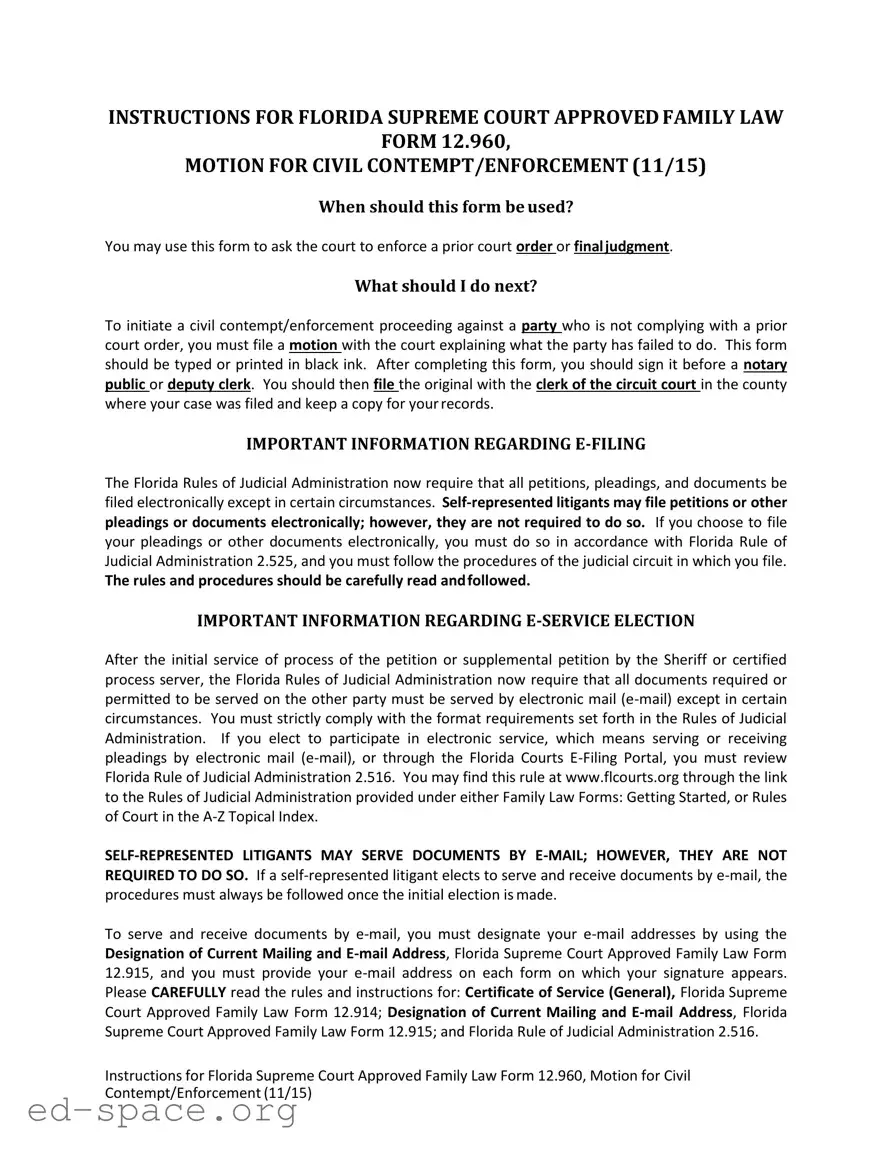
INSTRUCTIONS FOR FLORIDA SUPREME COURT APPROVED FAMILY LAW
FORM 12.960,
MOTION FOR CIVIL CONTEMPT/ENFORCEMENT (11/15)
When should this form be used?
You may use this form to ask the court to enforce a prior court order or final judgment.
What should I do next?
To initiate a civil contempt/enforcement proceeding against a party who is not complying with a prior court order, you must file a motion with the court explaining what the party has failed to do. This form should be typed or printed in black ink. After completing this form, you should sign it before a notary public or deputy clerk. You should then file the original with the clerk of the circuit court in the county where your case was filed and keep a copy for your records.
IMPORTANT INFORMATION REGARDING
The Florida Rules of Judicial Administration now require that all petitions, pleadings, and documents be filed electronically except in certain circumstances.
The rules and procedures should be carefully read andfollowed.
IMPORTANT INFORMATION REGARDING
After the initial service of process of the petition or supplemental petition by the Sheriff or certified process server, the Florida Rules of Judicial Administration now require that all documents required or permitted to be served on the other party must be served by electronic mail
To serve and receive documents by
Instructions for Florida Supreme Court Approved Family Law Form 12.960, Motion for Civil Contempt/Enforcement (11/15)
A copy of this form must be personally served by a sheriff or private process server or mailed,* e- mailed*, or hand delivered to any other party(ies) in your case. *Please note that if notice is mailed or
The court will then set a hearing. You should check with the clerk of court, judicial assistant, or family law intake staff for information on the local procedure for scheduling a hearing. Once you know the time and date of the hearing, you will need to complete Notice of Hearing on Motion for Contempt/Enforcement, Florida Supreme Court Approved Family Law Form 12.961, or, if applicable, Notice of Hearing (Child Support Enforcement Hearing Officer), Florida Supreme Court Approved Family Law Form 12.921, or [Notice of Hearing Before] General Magistrate, Florida Family Law Rules of Procedure Form 12.920[(c)], which will specify a time and place for a hearing on the issue. A copy of this form must be mailed,
At the hearing, as in any other civil proceeding, you, as the moving party, will have the burden of proving the other party has not obeyed a prior court order. Once noncompliance is established, the other party will have an opportunity to show an inability to comply with the prior court order. If he or she is unable
to do so, the judge may find the other party to be in contempt. If so, the judge may order appropriate sanctions to compel compliance by the other party, including jail, payment of attorneys’ fees, suit
money, or costs, and coercive or compensatory fines, and may order any other relief permitted by law.
Where can I look for more information?
Before proceeding, you should read General Information for
Remember, a person who is NOT an attorney is called a nonlawyer. If a nonlawyer helps you fill out these forms, that person must give you a copy of Disclosure from Nonlawyer, Florida Family Law Rules of Procedure Form 12.900(a), before he or she helps you. A nonlawyer helping you fill out these forms also must put his or her name, address, and telephone number on the bottom of the last page of every form he or she helps you complete.
Instructions for Florida Supreme Court Approved Family Law Form 12.960, Motion for Civil Contempt/Enforcement (11/15)

IN THE CIRCUIT COURT OF THE _____________________ JUDICIAL CIRCUIT,
IN AND FOR __________________________ COUNTY, FLORIDA
Case No: _________________________
Division: _________________________
____________________________________,
Petitioner, and
____________________________________,
Respondent.
MOTION FOR CIVIL CONTEMPT/ENFORCEMENT
_____ Petitioner _____ Respondent requests that the Court enter an order of civil
contempt/enforcement against _____ Petitioner _____ Respondent in this case because:
1.A final judgment or order {title of final judgment or order} _______________________
in this case was entered on {date} _______________, by {court, city, and state} ______________
______________________________________________________________________________
_____ Please indicate here if the judgment or order is not from this Court and attach a copy.
2.This order of the Court required the other party in this case to do or not do thefollowing: {Explain what the other party was ordered to do or not do.} ______________________________
______________________________________________________________________________
______________________________________________________________________________
______________________________________________________________________________
______________________________________________________________________________
______________________________________________________________________________
______________________________________________________________________________
_____ Please indicate here if additional pages are attached.
3.The other party in this case has willfully failed to comply with this order of the Court: {Explain what the other party has or has not done.} ___________________________________________
______________________________________________________________________________
______________________________________________________________________________
______________________________________________________________________________
______________________________________________________________________________
______________________________________________________________________________
______________________________________________________________________________
______________________________________________________________________________
______________________________________________________________________________
_____ Please indicate here if additional pages are attached.
4.I respectfully request that the Court issue an order holding the
a. _____ enforcing or compelling compliance with the prior order or judgment;
Florida Supreme Court Approved Family Law Form 12.960, Motion for Civil Contempt/Enforcement (11/15)
b._____ awarding a monetary judgment;
c._____ if a monetary judgment was included in the prior order, issuing a writ of execution or garnishment or other appropriate process;
d._____ awarding prejudgment interest;
e._____ requiring the other party to pay costs and fees in connection with this motion;
f._____ if the other party is found to be in civil contempt, ordering a compensatory fine;
g._____ if the other party is found to be in civil contempt, ordering a coercive fine;
h._____ if the other party is found to be in civil contempt, ordering incarceration of the other party with a purge;
i._____ issuing a writ of possession for real property, writ for possession of personal property, or other appropriate writ;
j._____ issuing a writ of bodily attachment if the other party fails to appear at the hearing set on this motion;
k._____ requiring the other party to make payments through the central governmental depository;
l._____ requiring the support payments to be automatically deducted from the other party’s income or funds;
m._____ requiring the other party to seek employment;
n._____ awarding
______________________________________________________________________________
______________________________________________________________________________
______________________________________________________________________________
__________________________________________________________________________; and
o._____ awarding other relief {explain}: _____________________________________________
______________________________________________________________________________
______________________________________________________________________________
______________________________________________________________________________
______________________________________________________________________________
Florida Supreme Court Approved Family Law Form 12.960, Motion for Civil Contempt/Enforcement (11/15)

I certify that a copy of this document was ( ) mailed ( ) faxed and mailed ( )
Other party or his/her attorney:
Printed Name: _________________________________
Address: ______________________________________
City, State, Zip: _________________________________
Telephone Number: _____________________________
Fax Number: ___________________________________
Designated
_____________________________________________
I understand that I am swearing or affirming under oath to the truthfulness of the claims made in this motion and that the punishment for knowingly making a false statement includes fines and/or imprisonment.
Dated: ______________________ |
____________________________________________ |
|
Signature of Party or his/her attorney |
|
Printed Name: _________________________________ |
|
Address: ______________________________________ |
|
City, State, Zip: _________________________________ |
|
Telephone Number: _____________________________ |
|
Fax Number: ___________________________________ |
|
Designated |
|
_____________________________________________ |
STATE OF FLORIDA |
|
COUNTY OF ____________________ |
|
Sworn to or affirmed and signed before me on ____________ by _______________________________.
_____________________________________________
NOTARY PUBLIC or DEPUTY CLERK
|
_____________________________________________ |
|
[Print, type, or stamp commissioned name of notary or |
|
deputy clerk.] |
____ |
Personally known |
____ |
Produced identification |
|
Type of identification produced ________________________________ |
IF A NONLAWYER HELPED YOU FILL OUT THIS FORM, HE/SHE MUST FILL IN THE BLANKS BELOW: [fill in all blanks] This form was prepared for the: {choose only one} ( ) Petitioner ( ) Respondent This form was completed with the assistance of:
{name of individual} ____________________________________________________________________,
{name of business} _____________________________________________________________________,
{address} _____________________________________________________________________________,
{city} _________________,{state} _____, {zip code} _________ {telephone number} _________________.
Florida Supreme Court Approved Family Law Form 12.960, Motion for Civil Contempt/Enforcement (11/15)
| Fact Name | Description |
|---|---|
| Purpose | This form is used to request the court to enforce a prior court order or final judgment when a party is not complying. |
| Filing Requirements | The completed motion must be filed with the circuit court clerk in the county where the case was initiated. It should be typed or printed in black ink and signed in front of a notary public or deputy clerk. |
| E-Filing Mandate | Under Florida Rules of Judicial Administration, most documents must be filed electronically, though self-represented litigants are not required to do so. |
| Service of Documents | After initial service, all subsequent documents must be served electronically unless otherwise specified. Personal service is recommended for adequate notice. |
| Burden of Proof | During the hearing, the moving party must prove that the other party has failed to comply with the court order. If proven, the court may impose sanctions. |
Filling out the Florida Motion form requires careful attention to detail to ensure that all necessary information is accurately provided. Once the form is completed, it must be signed and filed with the appropriate court. Following these steps will help facilitate the process of initiating a civil contempt/enforcement proceeding.
After completing these steps, file the original motion with the clerk of the circuit court in your county. Keep a copy for your records. If you choose to file electronically, make sure to follow the local procedures and rules regarding e-filing. The next steps will involve scheduling a hearing and notifying the other party, which can be done through additional forms as outlined in the instructions.
1. When should I use the Florida Motion form?
This form is used to ask the court to enforce a prior court order or final judgment. If another party is not complying with an existing court order, you can file this motion to initiate a civil contempt or enforcement proceeding.
2. How do I file the Motion for Civil Contempt/Enforcement?
To file this motion, you need to complete the form, ensuring that it is typed or printed in black ink. After signing the form in front of a notary public or deputy clerk, you will file the original with the clerk of the circuit court in your county. Remember to keep a copy for your records.
3. What is the process for e-filing the motion?
Most petitions and documents must be filed electronically under the Florida Rules of Judicial Administration. While self-represented litigants can choose to e-file, it is not mandatory. If you opt for e-filing, make sure to comply with Rule 2.525 and the specific procedures of your judicial circuit.
4. How should I serve the motion to the other party?
The motion must be personally served by a sheriff or private process server, or it can be mailed, e-mailed, or hand-delivered to the other party. However, if you choose to mail or e-mail the motion, the court may not consider this adequate notice in some cases. To ensure proper notice, personal service is recommended.
5. What happens after I file the motion?
Once the motion is filed, the court will schedule a hearing. It is essential to check with the clerk of court or family law intake staff for local procedures regarding scheduling. You will also need to complete a Notice of Hearing form and serve it to the other party, following the same service methods as the motion.
6. What should I expect at the hearing?
At the hearing, you will need to demonstrate that the other party has not complied with the court order. If you can establish noncompliance, the other party will have a chance to explain their inability to comply. If they cannot provide a valid reason, the judge may find them in contempt and impose sanctions, which could include fines or even jail time.
7. Where can I find additional information?
For more information, you should review the General Information for Self-Represented Litigants at the beginning of the forms. Additionally, you can refer to section 61.14 of the Florida Statutes and rule 12.615 of the Florida Family Law Rules of Procedure for further guidance.
Incomplete Information: Failing to provide all required details can lead to delays. Every section of the motion form must be filled out completely. Omitting information, such as the case number or the specific order being enforced, can result in rejection by the court.
Incorrect Formatting: The form must be typed or printed in black ink. Submitting the form in a different format, such as using colored ink or handwritten notes, may cause the court to refuse the document.
Not Signing Before a Notary: It's crucial to sign the form in front of a notary public or deputy clerk. If the signature is missing or not properly notarized, the motion will be considered invalid.
Improper Service of Documents: After filing, the motion must be served correctly to the other party. Using methods other than personal service, such as only mailing or emailing, may not meet the court's requirements for adequate notice.
Ignoring E-Filing Rules: Many courts now require electronic filing of documents. Not adhering to these rules, such as failing to use the correct e-filing procedures, can lead to complications in your case.
Neglecting to Attach Necessary Documents: If the order being enforced is from a different court, a copy must be attached. Forgetting this step can result in the motion being dismissed or delayed.
When filing a Motion for Civil Contempt/Enforcement in Florida, several other forms and documents may be necessary to support your case or comply with court procedures. Understanding these forms can help streamline the process and ensure that you meet all legal requirements.
Being familiar with these forms and their purposes can greatly assist in navigating the legal process surrounding a Motion for Civil Contempt/Enforcement in Florida. Always ensure that you follow the specific rules and guidelines applicable to your situation and consider seeking legal advice if needed.
The Florida Motion for Civil Contempt/Enforcement form is similar to several other legal documents used in family law proceedings. Each of these forms serves a specific purpose, but they all share common elements, such as the need to request a court action or enforce a prior order. Here’s a breakdown of seven documents that are similar to the Florida Motion form:
Understanding these documents can help you navigate the legal process more effectively. Each form plays a crucial role in ensuring that court orders are upheld and that parties comply with their legal obligations.
When filling out the Florida Motion form, there are important steps to follow to ensure that your submission is complete and compliant. Here’s a list of things you should and shouldn’t do:
This form is specifically designed for enforcing prior court orders or final judgments in family law cases. It is not applicable for other legal matters.
All parties involved must be notified of the motion. This can be done through personal service, mailing, or e-mail, but personal service is often the safest method to ensure proper notice.
While the Florida Rules encourage electronic filing, self-represented litigants are not required to file electronically. They have the option to file in person if they prefer.
The moving party must demonstrate that the other party has failed to comply with the court order. This burden of proof is crucial for the court to consider the motion.
The motion must be signed before a notary public or deputy clerk. This step is essential for the form to be considered valid by the court.
Filing the motion does not guarantee a favorable outcome. The court will review the evidence and arguments presented before making a decision.
It is important to follow the formatting guidelines set forth in the Florida Rules of Judicial Administration. Failure to do so may result in delays or rejection of the motion.
When using the Florida Motion form for civil contempt/enforcement, it is essential to understand several key points to ensure proper completion and submission.
Understanding these points can significantly impact the effectiveness of your motion and the subsequent court proceedings.