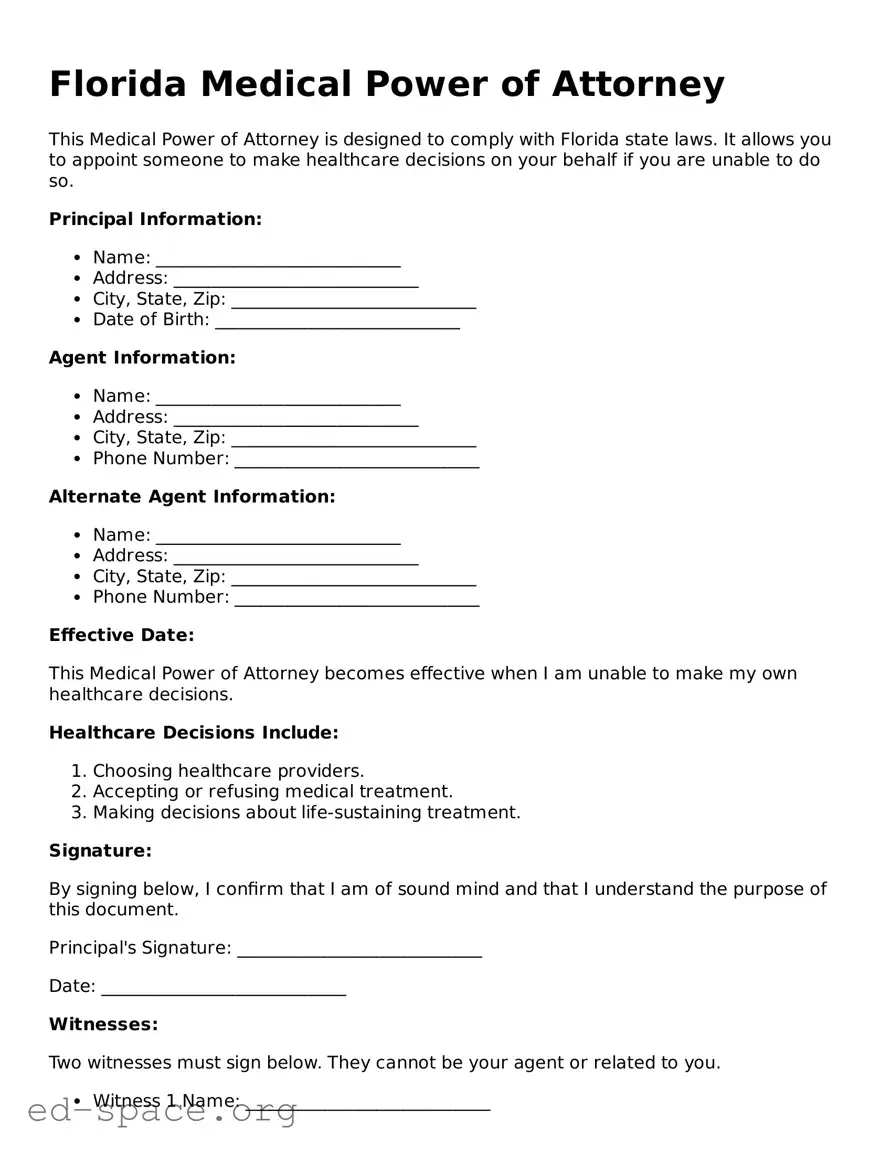
In Florida, the Medical Power of Attorney form plays a crucial role in healthcare decision-making for individuals who may become incapacitated. This legal document allows a person, known as the principal, to appoint a trusted individual, referred to as the agent, to make medical decisions on their behalf when they are unable to do so. The form outlines the specific powers granted to the agent, which may include the authority to consent to or refuse medical treatment, access medical records, and make decisions regarding end-of-life care. It is essential for the principal to clearly communicate their wishes regarding medical care, ensuring that the agent understands their preferences. Additionally, the form must be signed in the presence of witnesses and notarized to be legally valid. By establishing a Medical Power of Attorney, individuals can ensure that their healthcare choices are respected, even when they are not in a position to express them directly.
Florida Medical Power of Attorney
This Medical Power of Attorney is designed to comply with Florida state laws. It allows you to appoint someone to make healthcare decisions on your behalf if you are unable to do so.
Principal Information:
Agent Information:
Alternate Agent Information:
Effective Date:
This Medical Power of Attorney becomes effective when I am unable to make my own healthcare decisions.
Healthcare Decisions Include:
Signature:
By signing below, I confirm that I am of sound mind and that I understand the purpose of this document.
Principal's Signature: ____________________________
Date: ____________________________
Witnesses:
Two witnesses must sign below. They cannot be your agent or related to you.
This document should be kept in a safe place and copies should be provided to your agent and healthcare providers.
| Fact Name | Description |
|---|---|
| Definition | A Florida Medical Power of Attorney allows an individual to appoint someone else to make healthcare decisions on their behalf if they become unable to do so. |
| Governing Law | The form is governed by Florida Statutes, specifically Chapter 765, which outlines advance directives and healthcare decision-making. |
| Requirements | The document must be signed by the principal (the person granting authority) and witnessed by two adults who are not related to the principal or designated as agents. |
| Durability | The authority granted in this form remains effective until revoked by the principal or until the principal regains the capacity to make their own decisions. |
| Revocation | A principal can revoke the Medical Power of Attorney at any time, as long as they are competent. This can be done verbally or in writing. |
Filling out the Florida Medical Power of Attorney form is an important step in ensuring your healthcare decisions are made according to your wishes. Once you have completed the form, you can provide copies to your designated agent and healthcare providers, ensuring everyone is aware of your preferences.
What is a Florida Medical Power of Attorney?
A Florida Medical Power of Attorney is a legal document that allows you to appoint someone to make healthcare decisions on your behalf if you become unable to do so. This trusted person, known as your agent or proxy, will have the authority to make medical choices based on your wishes and best interests when you cannot communicate them yourself.
Who can be my agent in a Medical Power of Attorney?
Your agent can be anyone you trust to make healthcare decisions for you. This person should be at least 18 years old and mentally competent. Common choices include family members, close friends, or even a trusted advisor. It’s essential to discuss your wishes with your chosen agent beforehand to ensure they are comfortable with the responsibility.
How do I create a Medical Power of Attorney in Florida?
To create a Medical Power of Attorney in Florida, you must complete a specific form that meets state requirements. You can find these forms online or through legal offices. Once completed, the document must be signed in the presence of two witnesses or a notary public to be legally valid. Make sure to keep copies for yourself and provide one to your agent and your healthcare providers.
Can I change or revoke my Medical Power of Attorney?
Yes, you can change or revoke your Medical Power of Attorney at any time as long as you are mentally competent. To revoke it, you can simply create a new document stating your intention to revoke the previous one or destroy the old document. Inform your agent and any healthcare providers about the changes to avoid confusion.
What happens if I do not have a Medical Power of Attorney?
If you do not have a Medical Power of Attorney and become unable to make your own healthcare decisions, medical professionals may turn to your family members or seek court intervention to determine who will make decisions on your behalf. This process can be lengthy and may not reflect your personal wishes, making it crucial to have a plan in place.
Is a Medical Power of Attorney the same as a Living Will?
No, a Medical Power of Attorney and a Living Will serve different purposes. A Medical Power of Attorney appoints someone to make decisions for you, while a Living Will outlines your preferences for medical treatment in specific situations, such as end-of-life care. Many people choose to have both documents to ensure comprehensive healthcare planning.
What should I discuss with my agent before signing the document?
Before signing the Medical Power of Attorney, have an open conversation with your agent about your healthcare preferences, values, and any specific wishes you may have. Discuss scenarios that might arise and how you would like them handled. This dialogue will help your agent make informed decisions that align with your desires when the time comes.
Failing to specify the agent clearly. It's crucial to identify the person you trust to make medical decisions on your behalf. Ambiguity can lead to confusion and disputes.
Not discussing your wishes with the chosen agent. A lack of communication can result in your agent making decisions that do not align with your values or preferences.
Overlooking the need for witnesses. In Florida, two witnesses must sign the form. Failing to do so can render the document invalid.
Neglecting to date the form. A date is essential to ensure that the document reflects your most current wishes.
Using outdated forms. Laws and requirements can change. Always ensure that you are using the most current version of the Florida Medical Power of Attorney form.
Not considering alternate agents. Life is unpredictable. Designating a backup agent can provide additional security in case your primary choice is unavailable.
Failing to review the document regularly. Your health care preferences may change over time. Regularly revisiting the form ensures it still reflects your wishes.
Ignoring state-specific requirements. Each state has unique rules regarding medical powers of attorney. Familiarizing yourself with Florida's specific requirements is essential.
When preparing a Florida Medical Power of Attorney, it's helpful to consider additional documents that can complement your healthcare planning. These forms can provide clarity and ensure that your wishes are respected in various situations.
These documents work together to create a comprehensive plan for your healthcare and financial decisions. Having them in place can provide peace of mind, knowing that your wishes will be honored when you cannot speak for yourself.
When filling out the Florida Medical Power of Attorney form, it is essential to follow specific guidelines to ensure that the document is valid and effective. Here are five things you should and shouldn't do:
Many people have misunderstandings about the Florida Medical Power of Attorney form. Here are four common misconceptions:
Some individuals believe that a Medical Power of Attorney is only useful during emergencies. In reality, this document can be used in various situations where a person is unable to make their own medical decisions, not just in urgent scenarios.
While it is true that you can choose someone you trust, not everyone is eligible. In Florida, the person you appoint must be at least 18 years old and must not be your healthcare provider or an employee of your healthcare provider, unless they are a family member.
Another misconception is that the Medical Power of Attorney can override all medical decisions. However, this form only grants authority when the person is unable to make decisions themselves. If the individual is still capable of making their own choices, those decisions take precedence.
Many believe that once a Medical Power of Attorney is signed, it cannot be changed. This is not true. Individuals can revoke or update their Medical Power of Attorney at any time, as long as they are competent to do so.
Filling out and using the Florida Medical Power of Attorney form is an important step in ensuring that your healthcare decisions are made according to your wishes. Here are some key takeaways to consider:
Taking these steps can help ensure that your healthcare preferences are respected and that your agent is prepared to act in your best interest.