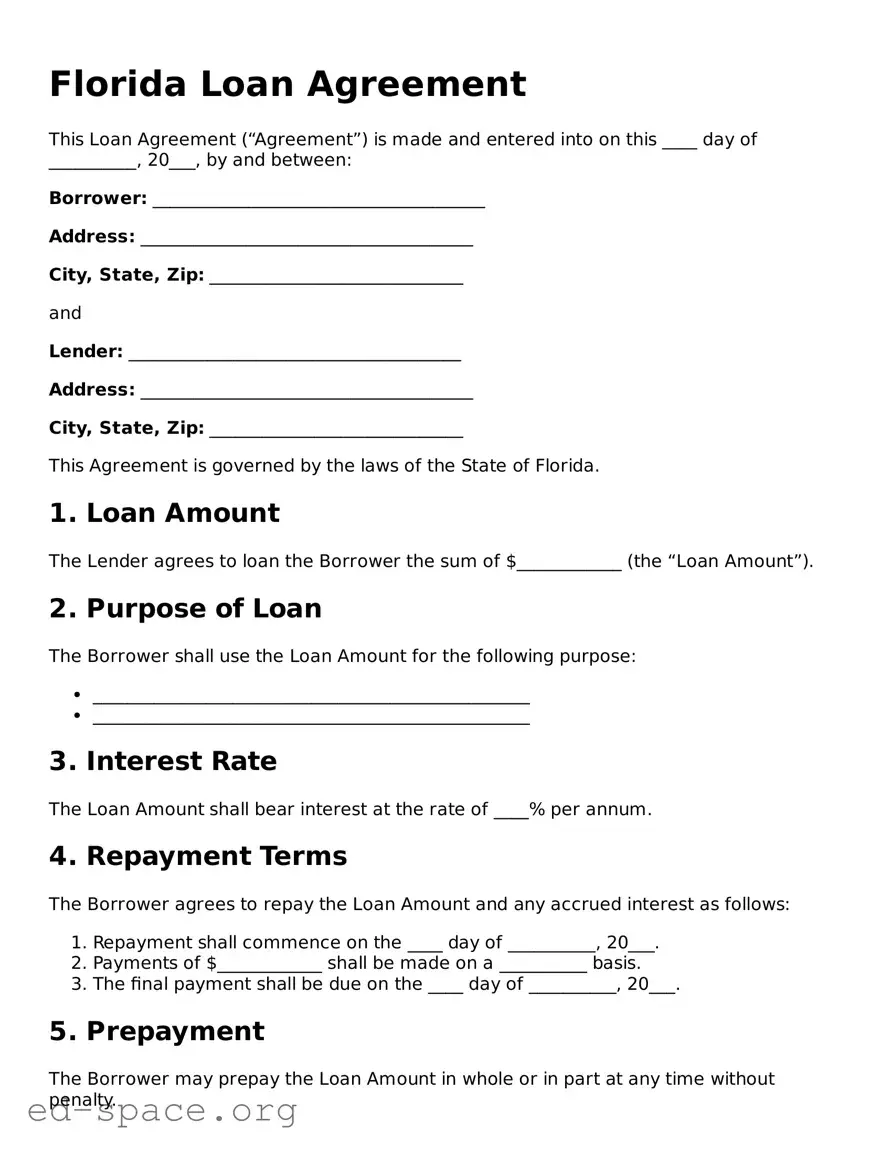
The Florida Loan Agreement form serves as a crucial document in the lending process, providing a clear framework for both lenders and borrowers. This form outlines the terms of the loan, including the principal amount, interest rate, repayment schedule, and any applicable fees. It ensures that both parties understand their obligations and rights, reducing the risk of misunderstandings. Additionally, the agreement may specify collateral, if required, to secure the loan, offering protection to the lender. By detailing the consequences of default, the form also helps borrowers grasp the seriousness of their commitments. Overall, the Florida Loan Agreement form is designed to facilitate a smooth transaction while safeguarding the interests of all involved parties.
Florida Loan Agreement
This Loan Agreement (“Agreement”) is made and entered into on this ____ day of __________, 20___, by and between:
Borrower: ______________________________________
Address: ______________________________________
City, State, Zip: _____________________________
and
Lender: ______________________________________
Address: ______________________________________
City, State, Zip: _____________________________
This Agreement is governed by the laws of the State of Florida.
1. Loan Amount
The Lender agrees to loan the Borrower the sum of $____________ (the “Loan Amount”).
2. Purpose of Loan
The Borrower shall use the Loan Amount for the following purpose:
3. Interest Rate
The Loan Amount shall bear interest at the rate of ____% per annum.
4. Repayment Terms
The Borrower agrees to repay the Loan Amount and any accrued interest as follows:
5. Prepayment
The Borrower may prepay the Loan Amount in whole or in part at any time without penalty.
6. Default
If the Borrower fails to make any payment when due, the Lender may declare the entire unpaid balance of the Loan Amount and accrued interest immediately due and payable.
7. Governing Law
This Agreement shall be governed by and construed in accordance with the laws of the State of Florida.
8. Miscellaneous
This Agreement constitutes the entire agreement between the parties. Any amendments must be in writing and signed by both parties.
IN WITNESS WHEREOF, the parties hereto have executed this Loan Agreement as of the date first above written.
Borrower Signature: ___________________________
Date: _______________________________________
Lender Signature: ____________________________
Date: _______________________________________
| Fact Name | Details |
|---|---|
| Purpose | The Florida Loan Agreement form is designed to outline the terms of a loan between a lender and a borrower. |
| Governing Law | This agreement is governed by the laws of the State of Florida. |
| Key Components | It typically includes details such as loan amount, interest rate, repayment schedule, and any collateral involved. |
| Signatures | Both parties must sign the agreement to validate the terms and conditions outlined within it. |
| Enforceability | Once signed, the Florida Loan Agreement is legally binding and enforceable in a court of law. |
Completing the Florida Loan Agreement form requires careful attention to detail. Each section must be filled out accurately to ensure clarity and enforceability of the agreement. Follow the steps below to successfully complete the form.
What is a Florida Loan Agreement form?
A Florida Loan Agreement form is a legal document that outlines the terms and conditions under which one party lends money to another. This form specifies important details such as the loan amount, interest rate, repayment schedule, and any collateral involved. It serves to protect both the lender and the borrower by clearly defining their rights and obligations. By having a written agreement, both parties can avoid misunderstandings and have a reference point in case any disputes arise.
Who should use a Florida Loan Agreement form?
Anyone who is lending or borrowing money in Florida should consider using a Loan Agreement form. This includes individuals, businesses, or organizations. Whether it’s a personal loan between friends or a business loan for expansion, having a formal agreement helps ensure that everyone is on the same page. It’s particularly important for larger sums of money or longer repayment periods, where the potential for disputes may increase.
What are the key components of a Florida Loan Agreement?
A comprehensive Florida Loan Agreement typically includes several key components. First, it should identify the parties involved, including their full names and addresses. Next, the loan amount must be clearly stated, along with the interest rate and any fees associated with the loan. The repayment terms, including the due date and payment frequency, should also be outlined. Additionally, any collateral securing the loan should be described. Finally, it’s important to include provisions for default, which outline what happens if the borrower fails to repay the loan as agreed.
Is a Florida Loan Agreement form legally binding?
Yes, a Florida Loan Agreement form is legally binding as long as it meets certain requirements. For the agreement to be enforceable, it should be in writing and signed by both parties. It’s also advisable for the terms to be clear and specific. While verbal agreements can sometimes be enforced, having a written document provides stronger legal protection. If disputes arise, a written agreement serves as evidence of what both parties agreed to, making it easier to resolve any issues in court if necessary.
Failing to provide accurate personal information. It is crucial to ensure that names, addresses, and contact details are correct.
Not specifying the loan amount clearly. The amount should be written numerically and spelled out to avoid confusion.
Overlooking the interest rate. Borrowers must clearly state the interest rate, whether it is fixed or variable.
Ignoring the repayment terms. It is essential to outline the repayment schedule, including due dates and payment methods.
Neglecting to include any fees or penalties. Any additional costs associated with the loan should be explicitly stated.
Not signing the agreement. All parties involved must sign the document for it to be legally binding.
Using unclear or ambiguous language. Clarity is key; vague terms can lead to misunderstandings later.
Failing to include a default clause. This clause outlines what happens if the borrower fails to make payments.
Not keeping a copy of the signed agreement. Both parties should retain a copy for their records.
Ignoring state-specific regulations. Borrowers should familiarize themselves with Florida laws that may affect the loan agreement.
When entering into a loan agreement in Florida, several other forms and documents may accompany the main agreement. These documents help clarify terms, establish security, and provide necessary disclosures. Below is a list of commonly used forms in conjunction with a Florida Loan Agreement.
These documents collectively support the loan process, ensuring clarity and legal protection for both the lender and the borrower. Properly completing and understanding each form is essential for a smooth transaction.
When filling out the Florida Loan Agreement form, it’s essential to be thorough and accurate. Follow these guidelines to ensure a smooth process.
Things You Should Do:
Things You Shouldn't Do:
Completing the form correctly is critical for processing your loan efficiently. Take your time and ensure everything is in order.
When it comes to the Florida Loan Agreement form, several misconceptions can lead to confusion. Understanding these misconceptions can help borrowers and lenders navigate the process more effectively.
While both documents serve similar purposes, they are not identical. A promissory note is a promise to repay a specific amount, while a loan agreement outlines the terms of the loan, including interest rates and repayment schedules.
This is not always true. Notarization is not a requirement for all loan agreements. However, having a notary can provide an additional layer of security and authenticity.
This is misleading. The form can be used for various loan amounts, whether small or large. The key is that both parties agree on the terms, regardless of the loan size.
This is incorrect. Loan agreements can be amended if both parties consent to the changes. It’s important to document any modifications in writing to avoid future disputes.
When dealing with a Florida Loan Agreement form, it’s important to understand several key aspects to ensure that the document serves its intended purpose effectively. Here are some essential takeaways to consider:
By paying attention to these key elements, both lenders and borrowers can create a solid foundation for their financial agreement, reducing the likelihood of disputes down the line.