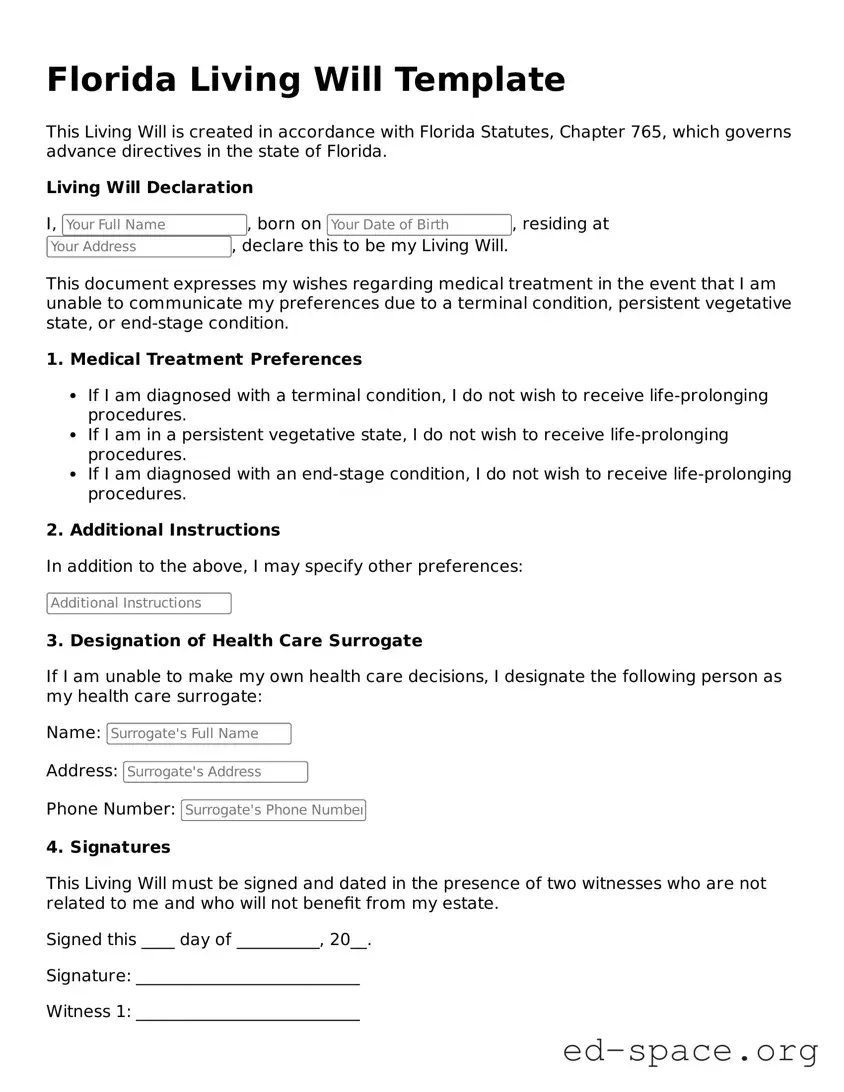
In the state of Florida, the Living Will form serves as a crucial document for individuals who wish to express their preferences regarding medical treatment in the event they become unable to communicate their wishes due to a serious illness or injury. This legal instrument allows a person to outline their desires concerning life-sustaining procedures, including the use of ventilators, feeding tubes, and other interventions that may prolong life. By completing this form, individuals can ensure that their healthcare providers and loved ones understand their values and choices, thus alleviating the burden of decision-making during emotionally challenging times. The Living Will must be signed in the presence of two witnesses or a notary public to be valid, emphasizing the importance of proper execution. Additionally, it is important to note that this document can be revoked at any time, allowing individuals to maintain control over their healthcare decisions as circumstances change. Understanding the nuances of the Living Will form empowers Floridians to take charge of their medical futures, fostering peace of mind for themselves and their families.
Florida Living Will Template
This Living Will is created in accordance with Florida Statutes, Chapter 765, which governs advance directives in the state of Florida.
Living Will Declaration
I, , born on , residing at , declare this to be my Living Will.
This document expresses my wishes regarding medical treatment in the event that I am unable to communicate my preferences due to a terminal condition, persistent vegetative state, or end-stage condition.
1. Medical Treatment Preferences
2. Additional Instructions
In addition to the above, I may specify other preferences:
3. Designation of Health Care Surrogate
If I am unable to make my own health care decisions, I designate the following person as my health care surrogate:
Name:
Address:
Phone Number:
4. Signatures
This Living Will must be signed and dated in the presence of two witnesses who are not related to me and who will not benefit from my estate.
Signed this ____ day of __________, 20__.
Signature: ___________________________
Witness 1: ___________________________
Witness 2: ___________________________
This Living Will is valid in the state of Florida and may be revoked at any time by me.
| Fact Name | Details |
|---|---|
| Definition | A Florida Living Will is a legal document that outlines a person's wishes regarding medical treatment in the event they become incapacitated. |
| Governing Law | The Florida Living Will is governed by Chapter 765 of the Florida Statutes. |
| Requirements | To be valid, the document must be signed by the individual and witnessed by two adults who are not related to the individual or beneficiaries of the estate. |
| Revocation | A Living Will can be revoked at any time by the individual, either verbally or in writing. |
| Health Care Proxy | A Living Will does not appoint a health care proxy. For that purpose, a separate document called a Health Care Surrogate Designation is needed. |
| Storage | It is advisable to keep the Living Will in an accessible location and share copies with family members and healthcare providers. |
After you’ve gathered your thoughts and decided to complete the Florida Living Will form, you’re ready to begin the process. This form allows you to express your wishes regarding medical treatment in case you are unable to communicate them in the future. Follow these steps carefully to ensure your document is filled out correctly.
Once you’ve completed the form and shared it with the necessary parties, you’ve taken an important step in ensuring your healthcare preferences are known and respected. Keeping copies handy will help in case you need to refer back to your wishes in the future.
What is a Florida Living Will?
A Florida Living Will is a legal document that allows individuals to express their wishes regarding medical treatment in the event they become incapacitated and unable to communicate their preferences. This document specifically addresses end-of-life care and can provide guidance to healthcare providers and loved ones about the type of medical interventions one would want or not want in critical situations.
Who should create a Living Will in Florida?
Any adult who wishes to have a say in their medical treatment should consider creating a Living Will. It is particularly important for individuals with serious health conditions, those undergoing major surgery, or anyone who wants to ensure their preferences are known in case of a medical emergency. Having a Living Will can alleviate the burden on family members during difficult times.
How does a Living Will differ from a Durable Power of Attorney for Health Care?
A Living Will specifically outlines an individual's wishes regarding medical treatment, while a Durable Power of Attorney for Health Care designates a person to make healthcare decisions on behalf of someone else if they become incapacitated. Both documents serve important roles in healthcare planning, but they focus on different aspects of decision-making.
What are the requirements for a valid Living Will in Florida?
To be valid in Florida, a Living Will must be signed by the individual creating it in the presence of two witnesses. These witnesses must be adults who are not related to the individual and cannot be entitled to any part of the individual's estate. Alternatively, the document can be notarized. It is essential to ensure that the document complies with these requirements to be enforceable.
Can I change or revoke my Living Will once it is created?
Yes, individuals have the right to change or revoke their Living Will at any time, as long as they are of sound mind. To revoke a Living Will, one can simply destroy the document or create a new one that explicitly states the previous document is no longer valid. It is advisable to inform healthcare providers and family members of any changes made.
Is a Living Will only for terminal illnesses?
No, a Living Will is not limited to situations involving terminal illnesses. It can address a variety of medical scenarios where a person may be unable to communicate their wishes, such as severe accidents, strokes, or other critical health situations. The document provides clarity on the individual’s preferences for life-sustaining treatments, regardless of the specific medical condition.
Where should I keep my Living Will?
It is important to keep the Living Will in a safe yet accessible location. Individuals should consider providing copies to their healthcare providers, family members, and anyone designated as a healthcare surrogate. Additionally, keeping a copy in a medical alert system or with other important documents can ensure it is available when needed.
What happens if I do not have a Living Will?
If an individual does not have a Living Will and becomes incapacitated, medical decisions may be made by family members or healthcare providers without clear guidance on the individual's wishes. This can lead to uncertainty and potential conflicts among family members. Having a Living Will can help avoid these situations by clearly stating one's preferences.
Failing to specify treatment preferences clearly. Individuals often overlook the importance of detailing their wishes regarding specific medical treatments, which can lead to confusion for healthcare providers.
Not signing the document in the presence of witnesses. Florida law requires that a Living Will be signed by the individual in the presence of two witnesses, who must also sign the document. Neglecting this step can render the document invalid.
Choosing witnesses who do not meet legal requirements. Witnesses must be at least 18 years old and cannot be related to the individual or have any financial interest in the individual's estate. Selecting inappropriate witnesses can invalidate the form.
Using outdated forms. Laws and requirements can change. Individuals should ensure they are using the most current version of the Florida Living Will form to avoid legal issues.
Not reviewing the completed form for accuracy. Mistakes or omissions can occur during the filling out process. A thorough review helps ensure that all information is correct and reflects the individual’s true wishes.
Overlooking the importance of discussing wishes with family. Failing to communicate intentions with family members can lead to disputes or misunderstandings when the time comes to make medical decisions.
Neglecting to update the Living Will as circumstances change. Major life events, such as marriage, divorce, or changes in health, may necessitate updates to the Living Will. Keeping the document current is crucial.
Not storing the document in an accessible location. After completing the Living Will, individuals should ensure it is stored in a place where family members and healthcare providers can easily access it when needed.
When considering end-of-life decisions, individuals often prepare a variety of documents to ensure their wishes are respected and to guide their loved ones. In Florida, the Living Will form is one important piece of this puzzle. However, several other documents can complement a Living Will, each serving a unique purpose in the realm of healthcare and estate planning.
Understanding these documents can empower individuals to make informed decisions about their healthcare and estate planning. Each form plays a crucial role in ensuring that personal wishes are honored and that loved ones are supported during difficult times. By taking the time to prepare these documents, individuals can provide clarity and comfort for themselves and their families.
A Living Will is an important document that outlines your wishes regarding medical treatment in case you become unable to communicate your preferences. Several other documents serve similar purposes in ensuring your healthcare decisions are respected. Here are eight documents that share similarities with a Living Will:
Each of these documents plays a crucial role in making sure your healthcare choices are honored. It is essential to consider which documents best suit your needs and to discuss them with your loved ones and healthcare providers.
When filling out the Florida Living Will form, it is important to follow certain guidelines to ensure that your wishes are clearly communicated. Below is a list of things you should and shouldn't do.
By following these guidelines, you can help ensure that your Living Will accurately reflects your wishes and is legally valid in Florida.
Understanding the Florida Living Will form is essential for making informed decisions about end-of-life care. However, several misconceptions often arise regarding this important document. Here are six common misconceptions:
A Living Will specifically addresses medical treatment preferences in situations where an individual cannot communicate their wishes. In contrast, a Last Will and Testament deals with the distribution of assets after death.
Anyone over the age of 18 can create a Living Will, regardless of their current health status. It is a proactive measure to ensure one's wishes are known in advance.
While it primarily addresses end-of-life care, a Living Will can also specify preferences for medical treatment in other serious health situations, such as being in a coma or having severe cognitive impairment.
A Living Will can be amended or revoked at any time as long as the individual is competent. Regular reviews are advisable to ensure it reflects current wishes.
Healthcare providers are generally required to follow the directives outlined in a Living Will, as long as the document meets legal requirements and is valid.
A Living Will does not mean that all medical treatment will be denied. It simply outlines specific preferences regarding the types of treatment an individual wants or does not want under certain circumstances.
Addressing these misconceptions can help individuals better understand the significance of a Living Will and encourage them to create a document that accurately reflects their healthcare preferences.
Filling out a Florida Living Will form is an important step in ensuring that your healthcare preferences are honored. Here are some key takeaways to keep in mind:
By taking these steps, you can create a Living Will that effectively communicates your healthcare preferences and provides peace of mind for you and your loved ones.