In the vibrant landscape of Florida's economy, independent contractors play a crucial role, providing flexibility and specialized services across various industries. To establish a clear understanding between parties, the Florida Independent Contractor Agreement form serves as an essential tool. This document outlines the expectations, responsibilities, and rights of both the contractor and the hiring party. Key components of the agreement include the scope of work, payment terms, and duration of the contract. Additionally, it addresses confidentiality, ownership of work products, and dispute resolution methods. By laying out these details, the agreement not only protects the interests of both sides but also fosters a professional relationship built on transparency and trust. Understanding this form is vital for anyone looking to engage in independent contracting in Florida, ensuring that all parties are on the same page from the outset.
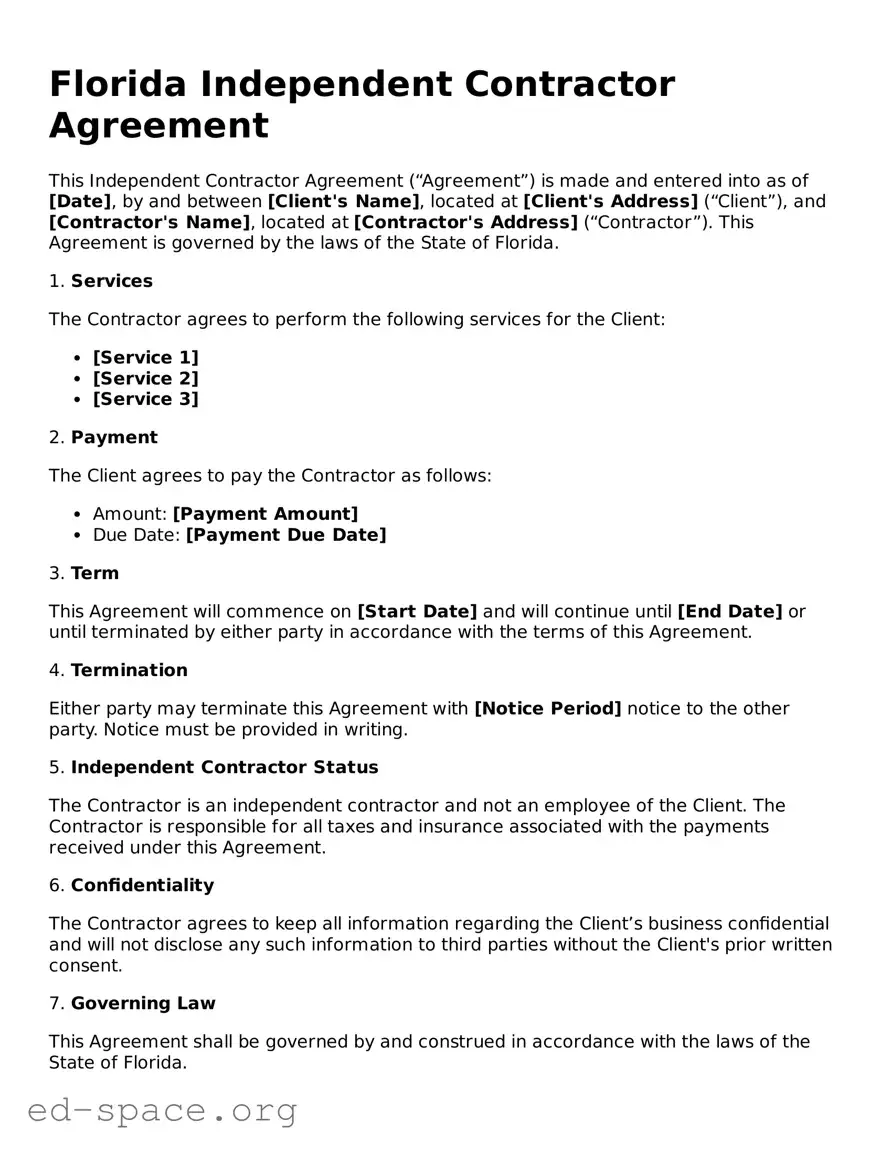
Florida Independent Contractor Agreement
This Independent Contractor Agreement (“Agreement”) is made and entered into as of [Date], by and between [Client's Name], located at [Client's Address] (“Client”), and [Contractor's Name], located at [Contractor's Address] (“Contractor”). This Agreement is governed by the laws of the State of Florida.
1. Services
The Contractor agrees to perform the following services for the Client:
2. Payment
The Client agrees to pay the Contractor as follows:
3. Term
This Agreement will commence on [Start Date] and will continue until [End Date] or until terminated by either party in accordance with the terms of this Agreement.
4. Termination
Either party may terminate this Agreement with [Notice Period] notice to the other party. Notice must be provided in writing.
5. Independent Contractor Status
The Contractor is an independent contractor and not an employee of the Client. The Contractor is responsible for all taxes and insurance associated with the payments received under this Agreement.
6. Confidentiality
The Contractor agrees to keep all information regarding the Client’s business confidential and will not disclose any such information to third parties without the Client's prior written consent.
7. Governing Law
This Agreement shall be governed by and construed in accordance with the laws of the State of Florida.
IN WITNESS WHEREOF, the parties hereto have executed this Independent Contractor Agreement as of the date first above written.
Client Signature: ___________________________ Date: _______________
Contractor Signature: ________________________ Date: _______________
| Fact Name | Details |
|---|---|
| Definition | A Florida Independent Contractor Agreement outlines the terms between a business and an independent contractor. |
| Governing Law | This agreement is governed by the laws of the State of Florida. |
| Key Components | Typically includes payment terms, scope of work, and confidentiality clauses. |
| Independent Status | It clarifies that the contractor is not an employee and is responsible for their own taxes. |
| Termination Clause | The agreement often specifies how either party can terminate the contract and under what conditions. |
Filling out the Florida Independent Contractor Agreement form is a straightforward process. This agreement outlines the working relationship between you and the contractor, ensuring that both parties understand their rights and responsibilities. Follow these steps to complete the form accurately.
Once you have completed the form, ensure that both you and the contractor keep a signed copy for your records. This agreement helps protect both parties and provides a clear framework for your working relationship.
What is a Florida Independent Contractor Agreement?
A Florida Independent Contractor Agreement is a legal document that outlines the terms and conditions between a business and an independent contractor. This agreement defines the scope of work, payment terms, and other important details. It helps clarify the relationship between the contractor and the business, ensuring both parties understand their rights and responsibilities.
Why is it important to have an Independent Contractor Agreement?
Having an Independent Contractor Agreement is crucial for several reasons. First, it protects both parties by clearly outlining expectations and deliverables. This can prevent misunderstandings and disputes down the line. Additionally, it helps establish the contractor as an independent entity, which is important for tax purposes and liability issues.
What key elements should be included in the agreement?
Key elements of a Florida Independent Contractor Agreement typically include the scope of work, payment terms, deadlines, confidentiality clauses, and termination conditions. It’s also important to specify whether the contractor will provide their own tools and equipment. Including these details helps ensure clarity and reduces the risk of future conflicts.
Can an Independent Contractor Agreement be modified?
Yes, an Independent Contractor Agreement can be modified, but changes must be agreed upon by both parties. It’s best to document any modifications in writing to avoid confusion. This can be done through an amendment to the original agreement, which should also be signed by both the business and the contractor.
What happens if there is a dispute regarding the agreement?
If a dispute arises, the first step is usually to refer back to the terms outlined in the Independent Contractor Agreement. Many agreements include a dispute resolution clause, which may require mediation or arbitration before taking legal action. If the issue cannot be resolved, either party may need to seek legal advice or pursue litigation.
Failing to include the correct names of both the contractor and the hiring party. Ensure that all parties are accurately identified to avoid confusion.
Not specifying the scope of work. Clearly outline the tasks and responsibilities to prevent misunderstandings later on.
Omitting payment terms. Be explicit about how and when payments will be made to ensure timely compensation.
Using vague language. Avoid terms that can be interpreted in multiple ways. Clarity is key to a successful agreement.
Neglecting to include a termination clause. This is crucial for outlining how either party can end the agreement if necessary.
Forgetting to address confidentiality. If sensitive information will be shared, include a clause to protect it.
Not considering liability issues. Clearly define who is responsible for what to avoid legal complications down the road.
Failing to include dispute resolution methods. Specify how disputes will be handled to streamline conflict resolution.
Not having the agreement signed and dated by both parties. An unsigned agreement is not legally binding.
Ignoring state-specific laws. Familiarize yourself with Florida laws that may affect the agreement to ensure compliance.
When engaging an independent contractor in Florida, several other forms and documents often accompany the Independent Contractor Agreement. These documents help clarify the relationship, protect both parties, and ensure compliance with relevant laws. Below is a list of commonly used forms that may be relevant in such agreements.
Understanding these additional documents can help ensure a smooth working relationship between the contractor and the client. They provide clarity and protection, allowing both parties to focus on the tasks at hand without unnecessary concerns.
The Independent Contractor Agreement form shares similarities with several other legal documents. Each of these documents serves a specific purpose in defining relationships and expectations between parties. Here are six documents that are comparable:
When filling out the Florida Independent Contractor Agreement form, it's essential to approach the task with care. Here are some guidelines to help ensure that the process goes smoothly.
Many people have misunderstandings about the Florida Independent Contractor Agreement form. Here are four common misconceptions:
When filling out and using the Florida Independent Contractor Agreement form, there are several important points to keep in mind. This agreement serves as a crucial document to outline the relationship between the contractor and the hiring party.
By paying attention to these key elements, both parties can ensure a smoother working relationship and reduce the likelihood of disputes.