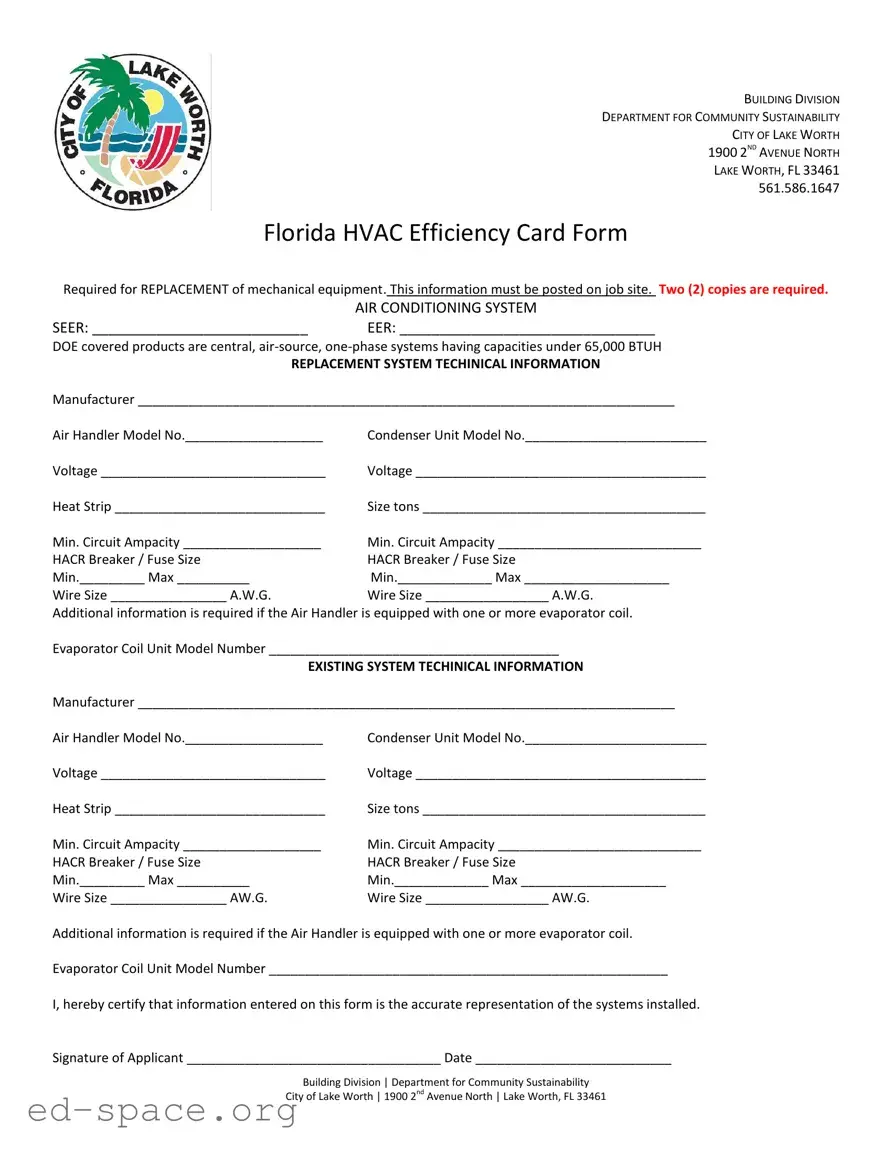
The Florida HVAC Efficiency Card form plays a crucial role in the process of replacing mechanical equipment in air conditioning systems, particularly in the city of Lake Worth. This form is not just a bureaucratic requirement; it ensures that essential information regarding the efficiency and specifications of both existing and replacement systems is documented and accessible. For compliance, two copies of the completed form must be posted at the job site. Key details include the Seasonal Energy Efficiency Ratio (SEER) and Energy Efficiency Ratio (EER) of the air conditioning system, as well as technical specifications for both the replacement and existing systems. Information such as the manufacturer, model numbers, voltage, and circuit ampacity are vital for evaluating the systems' compatibility and efficiency. Furthermore, if the air handler includes one or more evaporator coils, additional information is required to ensure a comprehensive understanding of the system's performance. The form also requires the applicant's signature, certifying that the provided information accurately reflects the installed systems, thereby fostering accountability and transparency in HVAC installations.

BUILDING DIVISION
DEPARTMENT FOR COMMUNITY SUSTAINABILITY
CITY OF LAKE WORTH
1900 2ND AVENUE NORTH
LAKE WORTH, FL 33461 561.586.1647
Florida HVAC Efficiency Card Form
Required for REPLACEMENT of mechanical equipment. This information must be posted on job site. Two (2) copies are required.
|
AIR CONDITIONING SYSTEM |
SEER: ___________________________ |
EER: ________________________________ |
DOE covered products are central,
REPLACEMENT SYSTEM TECHINICAL INFORMATION
Manufacturer __________________________________________________________________________
Air Handler Model No.___________________ |
Condenser Unit Model No._________________________ |
Voltage _______________________________ |
Voltage ________________________________________ |
Heat Strip _____________________________ |
Size tons _______________________________________ |
Min. Circuit Ampacity ___________________ |
Min. Circuit Ampacity ____________________________ |
HACR Breaker / Fuse Size |
HACR Breaker / Fuse Size |
Min._________ Max __________ |
Min._____________ Max ____________________ |
Wire Size ________________ A.W.G. |
Wire Size _________________ A.W.G. |
Additional information is required if the Air Handler is equipped with one or more evaporator coil.
Evaporator Coil Unit Model Number ________________________________________
EXISTING SYSTEM TECHINICAL INFORMATION
Manufacturer __________________________________________________________________________
Air Handler Model No.___________________ |
Condenser Unit Model No._________________________ |
Voltage _______________________________ |
Voltage ________________________________________ |
Heat Strip _____________________________ |
Size tons _______________________________________ |
Min. Circuit Ampacity ___________________ |
Min. Circuit Ampacity ____________________________ |
HACR Breaker / Fuse Size |
HACR Breaker / Fuse Size |
Min._________ Max __________ |
Min._____________ Max ____________________ |
Wire Size ________________ AW.G. |
Wire Size _________________ AW.G. |
Additional information is required if the Air Handler is equipped with one or more evaporator coil.
Evaporator Coil Unit Model Number _______________________________________________________
I, hereby certify that information entered on this form is the accurate representation of the systems installed.
Signature of Applicant ___________________________________ Date ___________________________
Building Division | Department for Community Sustainability
City of Lake Worth | 1900 2nd Avenue North | Lake Worth, FL 33461
| Fact Name | Description |
|---|---|
| Purpose | The Florida HVAC Efficiency Card form is required for the replacement of mechanical equipment in air conditioning systems. |
| Job Site Requirement | This form must be posted on the job site during the installation process to ensure compliance and transparency. |
| Copies Needed | Two copies of the completed form are necessary for record-keeping and inspection purposes. |
| Technical Information | The form requires detailed technical information about both the replacement and existing HVAC systems, including model numbers and electrical specifications. |
| Governing Law | This form is governed by the regulations set forth by the Florida Building Code, specifically relating to energy efficiency standards for HVAC systems. |
Filling out the Florida HVAC Efficiency Card form is a straightforward process. This form is essential for replacing mechanical equipment in your HVAC system. Once completed, it ensures that the necessary information is available for inspection and compliance. Below are the steps to fill out the form accurately.
What is the Florida HVAC Efficiency Card Form?
The Florida HVAC Efficiency Card Form is a document required for the replacement of mechanical equipment, specifically for air conditioning systems. This form must be filled out and posted at the job site during the installation process. It ensures that all necessary technical information about the new system is documented and accessible.
Who needs to fill out this form?
This form needs to be completed by contractors or technicians who are replacing existing HVAC systems. It is essential for anyone involved in the installation of new air conditioning units to ensure compliance with local regulations.
What information is required on the form?
The form requires detailed technical information about both the existing and replacement systems. This includes the manufacturer's name, model numbers for the air handler and condenser unit, voltage specifications, size of the heat strip, circuit ampacity, breaker or fuse sizes, and wire sizes. Additionally, if the air handler has evaporator coils, that information must also be provided.
How many copies of the form are needed?
Two copies of the Florida HVAC Efficiency Card Form are required. One copy should be posted at the job site, while the other may need to be submitted to the local building division or kept for records.
Where should I submit the completed form?
The completed form should be submitted to the Building Division Department for Community Sustainability in Lake Worth, Florida. The address is 1900 2nd Avenue North, Lake Worth, FL 33461. It is advisable to check if there are any additional submission requirements or procedures.
What happens if I do not submit this form?
Failing to submit the Florida HVAC Efficiency Card Form can lead to complications with the installation process. This may result in delays, potential fines, or issues with inspections. Compliance with this requirement is crucial to ensure that the installation meets local codes and standards.
Is there a certification required on the form?
Yes, the form requires a certification from the applicant. By signing the form, the applicant certifies that all the information provided is accurate and represents the systems being installed. This certification is an important part of the compliance process.
How can I get assistance with filling out the form?
If you need help with completing the Florida HVAC Efficiency Card Form, you can reach out to the Building Division Department for Community Sustainability at the provided phone number, 561.586.1647. They can offer guidance and answer any questions you may have regarding the form and its requirements.
Incomplete Information: One common mistake is failing to fill out all required fields. Missing details can delay processing and approval.
Incorrect Model Numbers: Providing wrong model numbers for the air handler or condenser unit can lead to issues. Always double-check the model numbers before submitting.
Wrong Voltage Specifications: Entering incorrect voltage information is a frequent error. Ensure that the voltage matches the specifications of the equipment.
Signature and Date Missing: Not signing the form or forgetting to include the date can render the application invalid. Always review the form before submission.
Failure to Provide Additional Information: If the air handler has an evaporator coil, additional details are required. Neglecting to provide this can cause delays.
The Florida HVAC Efficiency Card form is a crucial document for anyone involved in the replacement of mechanical HVAC equipment. It ensures that the necessary information about the new system is documented and made available on the job site. However, this form is often accompanied by other important documents that help streamline the process and ensure compliance with local regulations. Below are some of the key forms and documents commonly used alongside the Florida HVAC Efficiency Card.
Each of these documents plays a vital role in the HVAC installation process, ensuring that everything from compliance to safety is addressed. Collectively, they contribute to a smoother project flow and help protect both the homeowner and the contractor involved.
The Florida HVAC Efficiency Card form is an essential document for the replacement of mechanical equipment in HVAC systems. It serves as a record of the efficiency and specifications of both existing and new systems. Similar documents also play a crucial role in various aspects of HVAC and construction projects. Here are ten documents that share similarities with the Florida HVAC Efficiency Card form:
Each of these documents plays a vital role in the HVAC industry, ensuring that installations are safe, efficient, and compliant with regulations. Understanding their similarities helps in navigating the complexities of HVAC projects.
When filling out the Florida HVAC Efficiency Card form, it is essential to ensure accuracy and completeness. Below is a list of things to do and avoid during this process.
There are several misconceptions about the Florida HVAC Efficiency Card form. Understanding these can help ensure compliance and efficiency in your HVAC projects. Here are seven common misconceptions:
Addressing these misconceptions can help streamline the HVAC replacement process and ensure compliance with local regulations.
When filling out the Florida HVAC Efficiency Card form, it's important to ensure accuracy and completeness. Here are some key takeaways to keep in mind:
By following these guidelines, you can help ensure that the form is filled out correctly and meets all necessary requirements.