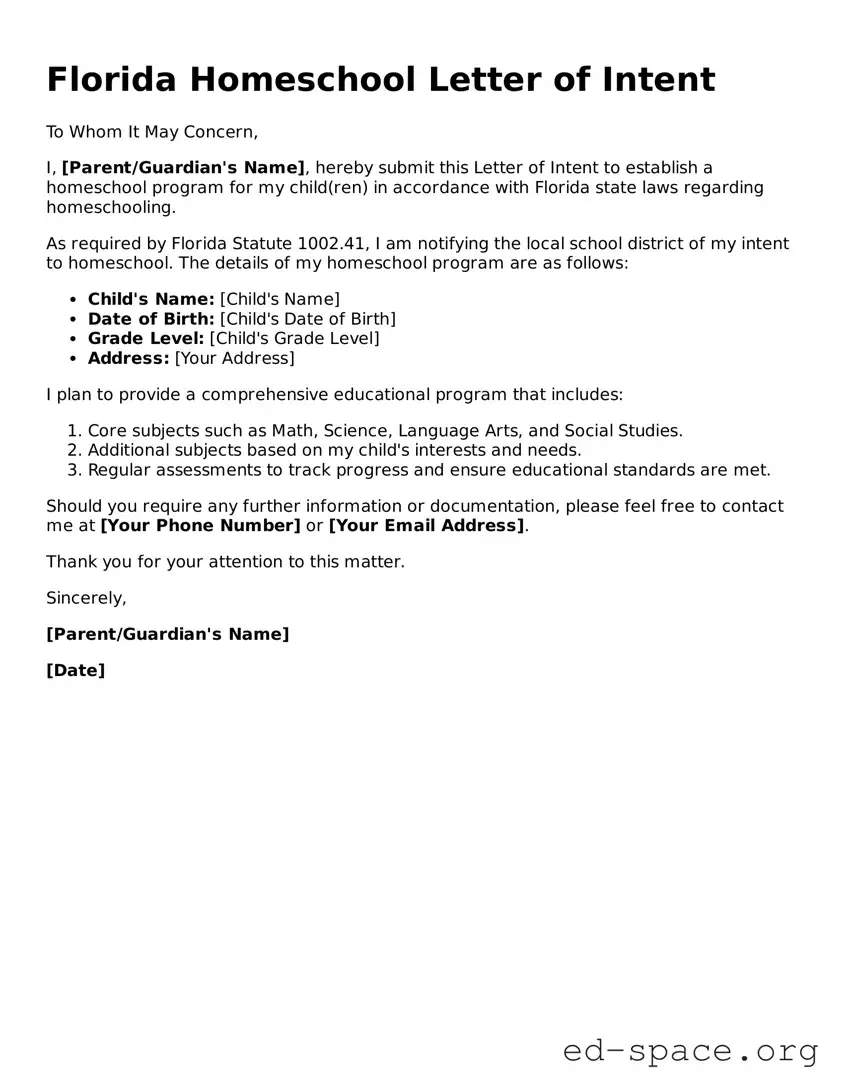
In Florida, families considering homeschooling their children must navigate several requirements, one of which is the Homeschool Letter of Intent form. This essential document serves as a formal notification to the local school district of a parent or guardian's decision to educate their child at home. The form typically includes basic information such as the student's name, the age of the child, and the address of the homeschooling family. Additionally, parents are required to indicate whether they intend to provide a full-time educational program or pursue an alternative educational approach. By submitting this letter, families not only comply with state regulations but also establish a clear record of their intent to homeschool. Understanding the importance of this form is crucial for a smooth transition into homeschooling, as it sets the stage for the educational journey ahead and ensures that families are aligned with Florida's legal framework for home education.
Florida Homeschool Letter of Intent
To Whom It May Concern,
I, [Parent/Guardian's Name], hereby submit this Letter of Intent to establish a homeschool program for my child(ren) in accordance with Florida state laws regarding homeschooling.
As required by Florida Statute 1002.41, I am notifying the local school district of my intent to homeschool. The details of my homeschool program are as follows:
I plan to provide a comprehensive educational program that includes:
Should you require any further information or documentation, please feel free to contact me at [Your Phone Number] or [Your Email Address].
Thank you for your attention to this matter.
Sincerely,
[Parent/Guardian's Name]
[Date]
| Fact Name | Details |
|---|---|
| Purpose | The Florida Homeschool Letter of Intent form is used to officially notify the local school district of a parent's decision to homeschool their child. |
| Governing Law | This form is governed by Florida Statutes, specifically Section 1002.41, which outlines the requirements for home education programs. |
| Submission Deadline | The letter must be submitted within 30 days of the start of the home education program. |
| Information Required | Parents must provide the child's name, age, and the address where the homeschooling will take place. |
| Annual Evaluation | Parents are required to submit an annual evaluation of the child's progress to the school district. |
| Record Keeping | It is essential for parents to keep records of educational materials and assessments for compliance with state regulations. |
Once the Florida Homeschool Letter of Intent form is filled out, it must be submitted to the appropriate school district. This step is crucial for formally notifying the district of your intent to homeschool your child. After submission, you will receive further instructions or information regarding the homeschooling process in your area.
What is the Florida Homeschool Letter of Intent?
The Florida Homeschool Letter of Intent is a formal document that parents or guardians must submit to notify their local school district of their intention to homeschool their children. This letter serves as an official declaration that the parent has chosen to provide education at home rather than through the public school system.
Who needs to submit the Letter of Intent?
Any parent or guardian who wishes to homeschool a child in Florida must submit the Letter of Intent. This includes families who are withdrawing their child from public or private school to begin homeschooling. It’s important to note that this applies to children of compulsory school age, typically between the ages of 6 and 16.
When should the Letter of Intent be submitted?
The Letter of Intent should be submitted as soon as you decide to homeschool your child. If you are withdrawing your child from a traditional school, it’s best to submit the letter before the start of the school year or as soon as possible to ensure compliance with state regulations.
What information is required in the Letter of Intent?
The Letter of Intent typically requires basic information such as the name and address of the parent or guardian, the names and ages of the children being homeschooled, and a statement indicating your intention to homeschool. Some districts may have specific requirements, so it’s wise to check with your local school district for any additional information they may need.
Is there a specific format for the Letter of Intent?
While there is no official state form for the Letter of Intent, it should be a clear and concise written document. Many families choose to draft their own letters, ensuring they include all necessary information. Some school districts may provide their own template, which can be helpful for ensuring you meet all requirements.
Do I need to renew the Letter of Intent each year?
Yes, the Letter of Intent must be submitted annually to your local school district. This ensures that the district is aware of your continued commitment to homeschooling. Each year, you may need to update the letter with any changes in your child's information or your educational plans.
What happens after I submit the Letter of Intent?
Once you submit the Letter of Intent, the school district will acknowledge receipt of your letter. They may provide you with additional information about homeschooling regulations, including record-keeping and assessment requirements. It’s crucial to stay informed about these guidelines to ensure compliance with state laws.
Can I change my mind after submitting the Letter of Intent?
Yes, you can change your mind about homeschooling at any time. If you decide to enroll your child back into a public or private school, simply notify the school district of your decision. It's a good practice to keep documentation of your homeschooling activities in case you need to provide proof of education during the transition back to a traditional school setting.
Failing to include all required information. The form requires specific details such as the name of the student, age, and address. Omitting any of these can lead to delays or rejection.
Not signing the form. A signature is essential to validate the intent to homeschool. Without it, the form is incomplete.
Incorrectly stating the start date of homeschooling. It is important to provide an accurate date to avoid confusion regarding the educational timeline.
Using outdated forms. Ensure that you are using the most current version of the Florida Homeschool Letter of Intent form, as requirements can change.
Neglecting to notify the school district promptly. The law requires that the intent to homeschool be submitted to the local school district within a specific timeframe.
Providing inaccurate information about the educational program. If you plan to use a particular curriculum or method, it should be clearly stated.
Not keeping a copy of the submitted form. It is advisable to retain a copy for personal records, as it may be needed for future reference.
Ignoring additional requirements. Some school districts may have specific requirements beyond the basic form, such as additional documentation or forms.
Submitting the form late. Adhering to submission deadlines is crucial to ensure compliance with state regulations.
When parents decide to homeschool their children in Florida, they must submit a Homeschool Letter of Intent. However, this form is often accompanied by other important documents that help to ensure compliance with state regulations. Below is a list of forms and documents commonly used alongside the Florida Homeschool Letter of Intent.
By preparing these documents, parents can ensure a smoother homeschooling experience and maintain compliance with Florida's educational regulations. Each document plays a vital role in documenting the educational journey and supporting the child's learning process.
The Homeschool Letter of Intent form serves as a crucial document for families choosing to educate their children at home. It shares similarities with several other important documents. Here’s a look at nine documents that resemble the Homeschool Letter of Intent:
Understanding these documents can help families navigate the homeschooling process more effectively. Each one plays a vital role in ensuring that educational choices are communicated clearly and in compliance with state laws.
When filling out the Florida Homeschool Letter of Intent form, there are several important steps to follow. Here’s a list of things you should and shouldn’t do:
In Florida, the Homeschool Letter of Intent form is a crucial document for families choosing to educate their children at home. However, several misconceptions about this form can lead to confusion. Below are five common misconceptions.
When considering the Florida Homeschool Letter of Intent form, it is essential to understand several key aspects to ensure a smooth homeschooling experience. Here are four important takeaways: