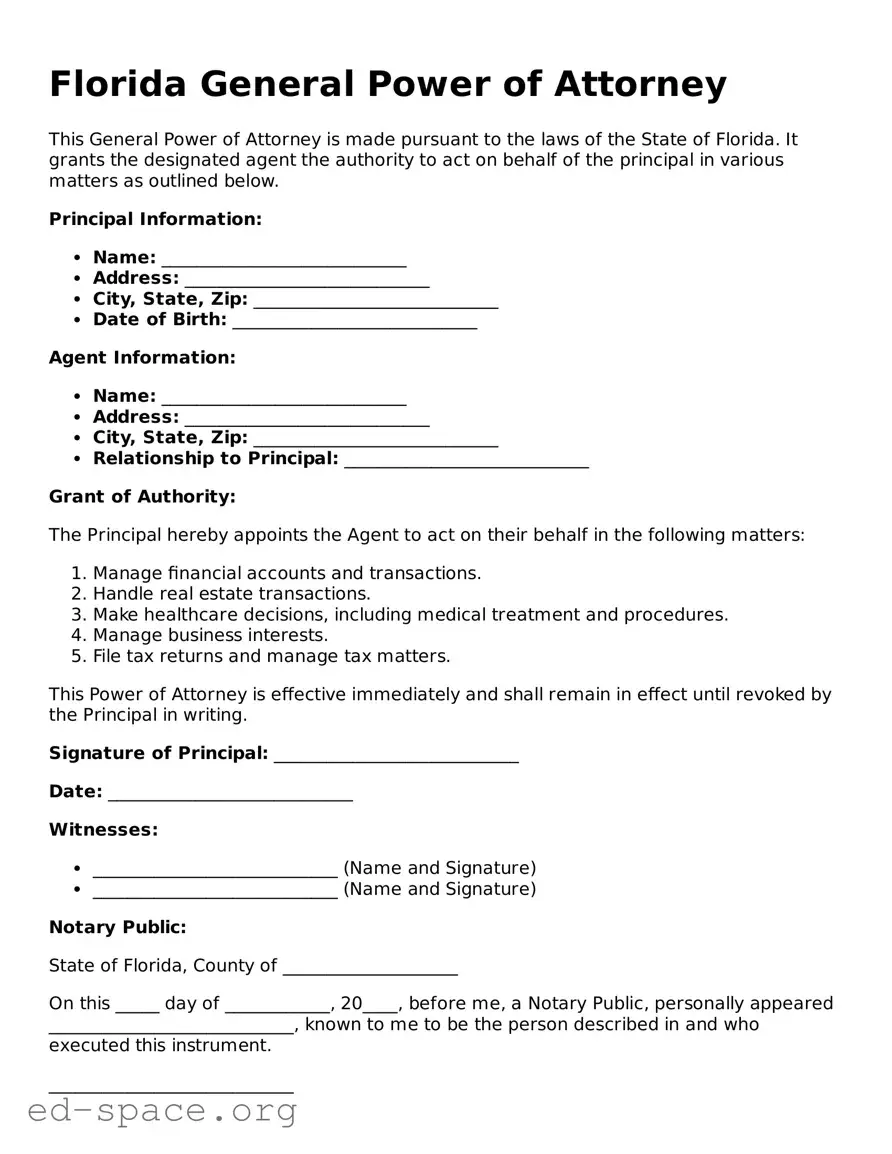
In Florida, a General Power of Attorney (GPOA) is a crucial legal document that empowers an individual, known as the agent or attorney-in-fact, to make decisions and take actions on behalf of another person, referred to as the principal. This form allows the agent to handle a wide range of financial and legal matters, from managing bank accounts and real estate transactions to filing taxes and making investment decisions. One of the significant advantages of a GPOA is its flexibility; it can be tailored to meet the specific needs of the principal, whether they require assistance for a limited period or an ongoing arrangement. Importantly, the GPOA can be effective immediately upon signing or can be set to activate only under certain conditions, such as the principal becoming incapacitated. Understanding the implications of granting such authority is essential, as it involves a high level of trust in the chosen agent. Furthermore, it is vital to consider the potential risks and safeguards associated with this powerful tool, ensuring that the principal's interests are protected while enabling the agent to act decisively when necessary.
Florida General Power of Attorney
This General Power of Attorney is made pursuant to the laws of the State of Florida. It grants the designated agent the authority to act on behalf of the principal in various matters as outlined below.
Principal Information:
Agent Information:
Grant of Authority:
The Principal hereby appoints the Agent to act on their behalf in the following matters:
This Power of Attorney is effective immediately and shall remain in effect until revoked by the Principal in writing.
Signature of Principal: ____________________________
Date: ____________________________
Witnesses:
Notary Public:
State of Florida, County of ____________________
On this _____ day of ____________, 20____, before me, a Notary Public, personally appeared ____________________________, known to me to be the person described in and who executed this instrument.
____________________________
Notary Public Signature
My Commission Expires: ________________
| Fact Name | Details |
|---|---|
| Definition | A Florida General Power of Attorney allows an individual (the principal) to appoint another person (the agent) to make decisions on their behalf regarding financial and legal matters. |
| Governing Law | This form is governed by Florida Statutes, Chapter 709, which outlines the rules and regulations for powers of attorney in the state. |
| Durability | The general power of attorney can be made durable, meaning it remains in effect even if the principal becomes incapacitated, provided it includes specific language to that effect. |
| Revocation | The principal can revoke the power of attorney at any time, as long as they are mentally competent. This can be done through a written notice to the agent. |
After obtaining the Florida General Power of Attorney form, you will need to complete it carefully to ensure it is valid and reflects your intentions. This form allows you to designate someone to act on your behalf in various matters. Follow these steps to fill out the form accurately.
What is a General Power of Attorney in Florida?
A General Power of Attorney in Florida is a legal document that allows one person, known as the principal, to appoint another person, called the agent or attorney-in-fact, to manage their financial and legal affairs. This can include tasks like handling bank transactions, signing contracts, and making decisions about property. The authority granted can be broad or limited, depending on the principal's wishes.
Why might someone need a General Power of Attorney?
People often create a General Power of Attorney to ensure that their financial and legal matters are handled according to their wishes, especially if they become incapacitated or unable to make decisions for themselves. It can be particularly useful for individuals who travel frequently, are undergoing medical treatment, or simply want to plan for the future.
Who can be appointed as an agent in a General Power of Attorney?
In Florida, any competent adult can be appointed as an agent. This could be a family member, friend, or even a professional, such as an attorney or financial advisor. It’s important to choose someone trustworthy, as this person will have significant control over the principal's affairs.
Does a General Power of Attorney need to be notarized?
Yes, in Florida, a General Power of Attorney must be signed in the presence of a notary public to be valid. Additionally, it is advisable to have witnesses present when signing the document. This helps to ensure that the document is legally binding and can be enforced when needed.
Can a General Power of Attorney be revoked?
Absolutely. The principal has the right to revoke a General Power of Attorney at any time, as long as they are mentally competent. To do so, they should create a written revocation document and notify the agent and any relevant institutions that may have relied on the original power of attorney.
What happens if the principal becomes incapacitated?
If the principal becomes incapacitated, the General Power of Attorney typically remains in effect unless it is specifically stated that it terminates under such circumstances. This means the agent can continue to act on behalf of the principal, making it crucial to choose someone who will act in the principal's best interests.
Is a General Power of Attorney the same as a Durable Power of Attorney?
No, they are not the same. A Durable Power of Attorney remains effective even if the principal becomes incapacitated, while a standard General Power of Attorney may not. In Florida, if a principal wants their power of attorney to remain effective during incapacity, they should specifically indicate that it is durable in the document.
Can a General Power of Attorney be used for healthcare decisions?
No, a General Power of Attorney is primarily for financial and legal matters. For healthcare decisions, a separate document called a Healthcare Power of Attorney or Advance Directive is necessary. This document allows someone to make medical decisions on behalf of the principal if they are unable to do so themselves.
How can I obtain a General Power of Attorney form in Florida?
General Power of Attorney forms can be obtained from various sources, including legal stationery stores, online legal services, or through an attorney. It’s important to ensure that the form complies with Florida laws and accurately reflects the principal's wishes.
Not specifying the powers granted. Individuals often overlook the importance of detailing the specific powers they wish to bestow upon the agent. This can lead to confusion and potential misuse of authority.
Failing to date the document. A common oversight is neglecting to include the date on which the power of attorney is signed. Without a date, the validity of the document may be questioned.
Choosing an unsuitable agent. Many people select an agent without considering their reliability or ability to act in their best interest. It’s crucial to choose someone trustworthy and capable.
Not having the document notarized. In Florida, notarization is often required for the power of attorney to be legally binding. Skipping this step can render the document ineffective.
Using outdated forms. Some individuals fill out old versions of the power of attorney form. Always ensure you are using the most current form to comply with state laws.
Neglecting to inform the agent. After designating an agent, people frequently forget to discuss the role and responsibilities with them. Clear communication is essential for effective representation.
Overlooking alternate agents. It is wise to name an alternate agent in case the primary agent is unable or unwilling to serve. Failing to do so can create complications.
Not reviewing the document periodically. Life circumstances change, and so do relationships. Regularly reviewing the power of attorney ensures it still reflects your wishes.
Ignoring state-specific requirements. Each state has unique laws regarding powers of attorney. People often forget to check Florida’s specific requirements, which can lead to invalidation.
Assuming the power of attorney is permanent. Many believe that a power of attorney remains effective indefinitely. However, it can be revoked or become invalid under certain circumstances.
When preparing a Florida General Power of Attorney, it is essential to consider additional documents that may be necessary to ensure comprehensive legal coverage. Each of these documents serves a specific purpose and can complement the power of attorney effectively.
These documents can provide a more robust framework for managing your affairs and ensuring your wishes are respected. It is advisable to review each form carefully and consult with a legal professional to determine which documents best meet your needs.
The General Power of Attorney (GPA) form allows one person to act on behalf of another in a wide range of matters. Here are eight documents that are similar to the General Power of Attorney, along with a brief explanation of each:
When filling out the Florida General Power of Attorney form, it is important to follow specific guidelines to ensure the document is valid and effective. Below is a list of things you should and shouldn't do:
When it comes to the Florida General Power of Attorney (GPOA) form, many people hold misconceptions that can lead to confusion or even legal issues. Here are four common misunderstandings:
Understanding these misconceptions can help you make informed decisions when creating a General Power of Attorney in Florida. Always consider consulting with a legal professional to ensure your document meets your needs and complies with state laws.
When considering the Florida General Power of Attorney form, it's essential to understand its significance and how to complete it effectively. Here are five key takeaways:
Understanding these key points can help you navigate the process of creating and using a Florida General Power of Attorney form effectively.