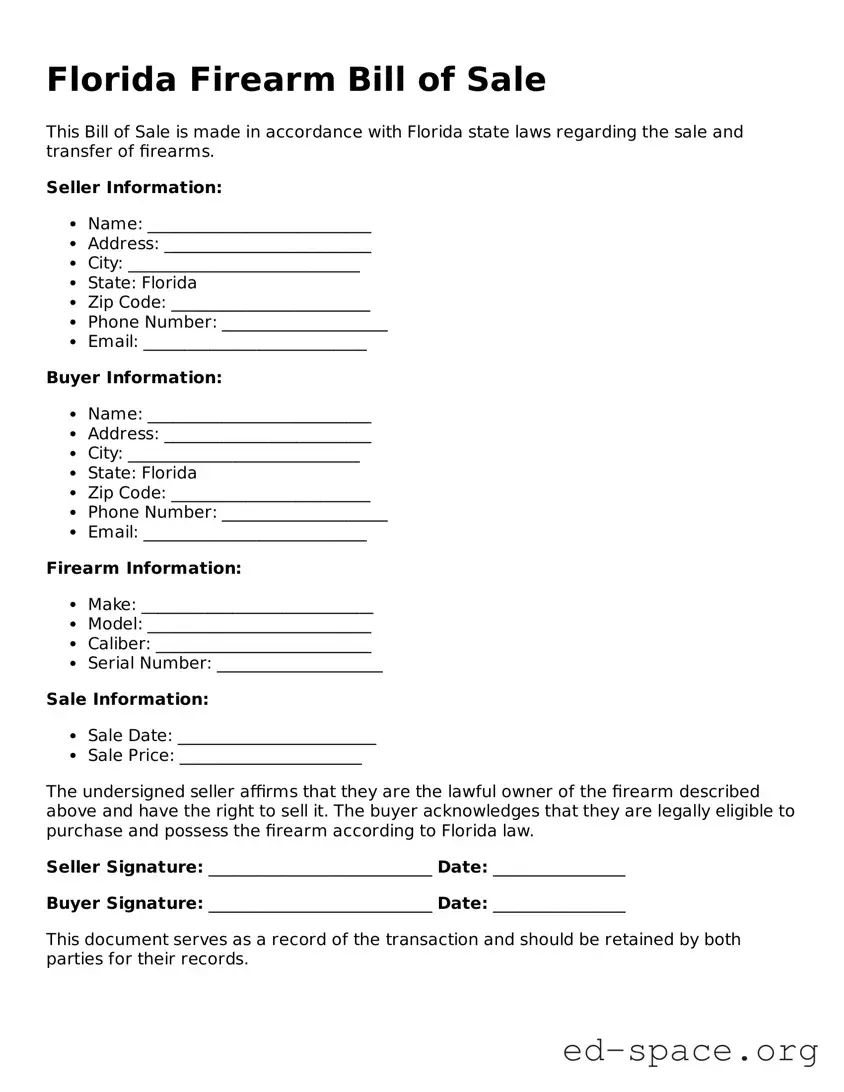
The Florida Firearm Bill of Sale form serves as a crucial document in the private sale of firearms, ensuring that both buyers and sellers have a clear record of the transaction. This form typically includes essential information such as the names and addresses of both parties, a detailed description of the firearm being sold—including its make, model, and serial number—and the date of the transaction. Additionally, the form may require both parties to affirm that they are legally permitted to engage in the sale under state and federal laws. By documenting the sale, the form not only provides legal protection for both the buyer and seller but also helps maintain a level of accountability in firearm transactions. It is important to note that while the form is not mandatory in all circumstances, having one can facilitate a smoother transfer process and serve as a safeguard against potential legal disputes in the future. Understanding the significance of this form is essential for anyone involved in the buying or selling of firearms in Florida.
Florida Firearm Bill of Sale
This Bill of Sale is made in accordance with Florida state laws regarding the sale and transfer of firearms.
Seller Information:
Buyer Information:
Firearm Information:
Sale Information:
The undersigned seller affirms that they are the lawful owner of the firearm described above and have the right to sell it. The buyer acknowledges that they are legally eligible to purchase and possess the firearm according to Florida law.
Seller Signature: ___________________________ Date: ________________
Buyer Signature: ___________________________ Date: ________________
This document serves as a record of the transaction and should be retained by both parties for their records.
| Fact Name | Description |
|---|---|
| Definition | A Florida Firearm Bill of Sale is a document that records the sale and transfer of a firearm between two parties. |
| Governing Law | The sale and transfer of firearms in Florida are governed by Florida Statutes Chapter 790. |
| Parties Involved | The form includes details about both the seller and the buyer, ensuring both parties are clearly identified. |
| Firearm Details | Specific information about the firearm, such as make, model, and serial number, must be included in the bill of sale. |
| Legal Protection | Using a bill of sale provides legal protection for both the buyer and seller, documenting the transaction. |
| No State Registration | Florida does not require firearm sales to be registered with the state, but a bill of sale is recommended. |
| Age Requirement | Both parties must be at least 18 years old to legally buy or sell a firearm in Florida. |
| Background Checks | While not mandatory for private sales, background checks are encouraged to ensure the buyer is legally eligible to own a firearm. |
| Witness Requirement | It is advisable to have a witness present during the transaction, although it is not legally required. |
| Retention of Record | Both the buyer and seller should keep a copy of the bill of sale for their records, in case of future disputes. |
Once you have the Florida Firearm Bill of Sale form ready, you can begin filling it out. This form is essential for documenting the sale or transfer of a firearm between parties. Follow these steps to ensure all necessary information is accurately provided.
After completing the form, both the buyer and seller should keep their copies in a safe place. This documentation is important for any future reference regarding the sale or ownership of the firearm.
What is a Florida Firearm Bill of Sale?
A Florida Firearm Bill of Sale is a legal document that records the transfer of ownership of a firearm from one individual to another. This form serves as proof that the buyer has purchased the firearm and that the seller has relinquished ownership. It is important for both parties to have a clear understanding of the transaction, and this document helps ensure that the process is transparent and legally recognized. While not always required by law, having a bill of sale can provide protection for both the buyer and the seller in case of any future disputes or legal issues regarding the firearm.
Do I need to have a bill of sale when buying or selling a firearm in Florida?
In Florida, it is not legally required to have a bill of sale when buying or selling a firearm between private parties. However, having one is highly recommended. A bill of sale can serve as a crucial record of the transaction, demonstrating that the buyer is the rightful owner and that the seller has completed the sale. This documentation can be particularly helpful if questions arise in the future about the firearm's ownership or if the firearm is involved in a legal matter.
What information should be included in a Florida Firearm Bill of Sale?
A comprehensive Florida Firearm Bill of Sale should include several key pieces of information. This includes the names and addresses of both the buyer and the seller, the date of the transaction, and a detailed description of the firearm being sold, such as the make, model, caliber, and serial number. Additionally, both parties should sign and date the document to validate the transaction. Including this information not only helps clarify the terms of the sale but also serves to protect both parties legally.
Is it necessary to have the bill of sale notarized?
No, it is not a requirement in Florida for a Firearm Bill of Sale to be notarized. However, having the document notarized can add an extra layer of security and authenticity to the transaction. A notary public can verify the identities of both the buyer and the seller, ensuring that both parties willingly entered into the agreement. This can be particularly beneficial if the transaction is ever questioned or challenged in the future.
What should I do if I lose my bill of sale?
If you lose your Firearm Bill of Sale, it is advisable to take steps to recreate the document as soon as possible. While the original bill of sale serves as the primary proof of ownership, having a copy can still be useful. If you cannot recreate it, consider reaching out to the seller to request a duplicate or to confirm the details of the transaction. Keeping a record of all communications and any related documentation can help establish ownership and protect your rights regarding the firearm.
Incomplete Information: Many people forget to fill out all required fields. This includes not only the buyer's and seller's names but also their addresses and contact information. Leaving any of these fields blank can lead to confusion or disputes later on.
Incorrect Firearm Details: It is crucial to provide accurate information about the firearm being sold. Mistakes in the make, model, or serial number can cause legal issues. Double-check these details before finalizing the sale.
Not Including Signatures: Both the buyer and seller must sign the bill of sale. Some individuals overlook this step, thinking it’s not necessary. Without signatures, the document may not hold up in case of a dispute.
Failure to Date the Document: The date of the transaction is essential. Omitting this information can create problems regarding the timeline of ownership. Always include the date when the sale occurs.
Not Keeping a Copy: After completing the bill of sale, it is important to keep a copy for your records. Some people neglect this step, which can lead to difficulties if questions arise about the sale in the future.
The Florida Firearm Bill of Sale form serves as a crucial document in the transfer of firearm ownership. However, several other forms and documents may accompany this bill of sale to ensure compliance with state laws and to provide additional protection for both the buyer and seller. Below is a list of related documents that are often used in conjunction with the Florida Firearm Bill of Sale.
These documents collectively enhance the process of firearm transactions, ensuring that all parties involved are protected and informed. Utilizing these forms can help mitigate risks and promote responsible firearm ownership in Florida.
Vehicle Bill of Sale: Similar to the Firearm Bill of Sale, this document records the transfer of ownership of a vehicle. It includes details like the buyer and seller's information, vehicle description, and sale price.
Boat Bill of Sale: This document serves to transfer ownership of a boat, similar to how a Firearm Bill of Sale transfers a firearm. It includes necessary details such as the boat's make, model, and hull identification number.
Personal Property Bill of Sale: This form is used for the sale of personal items, ranging from furniture to electronics. Like the Firearm Bill of Sale, it outlines the buyer and seller's information and the item being sold.
Business Bill of Sale: This document is used when selling a business or its assets. It details the terms of the sale and identifies the parties involved, similar to the way a Firearm Bill of Sale outlines the transaction.
Real Estate Purchase Agreement: While typically more complex, this agreement also serves to transfer ownership, much like the Firearm Bill of Sale. It includes details about the property, the buyer, and the seller.
Lease Agreement: Although primarily for rental arrangements, a lease agreement can also contain terms for purchase. It outlines the responsibilities of both parties, similar to how a Firearm Bill of Sale clarifies the transaction between the buyer and seller.
When filling out the Florida Firearm Bill of Sale form, it's important to follow certain guidelines to ensure accuracy and compliance. Here’s a list of what to do and what to avoid:
By following these guidelines, you can help ensure that your firearm transaction is legally sound and properly documented.
Many people have misunderstandings about the Florida Firearm Bill of Sale form. Here are ten common misconceptions, along with clarifications to help set the record straight.
While it is not legally required, having a Bill of Sale provides a record of the transaction and can protect both the buyer and seller.
In Florida, background checks are mandatory for sales conducted through licensed dealers, but private sales do not require them.
Notarization is not required for the Bill of Sale in Florida, but it can add an extra layer of verification if desired.
Private individuals can sell firearms without a license, as long as they comply with state and federal laws.
Florida does not require the registration of firearms, making the Bill of Sale an important document for tracking ownership.
Buyers must be at least 18 years old to purchase a long gun and 21 years old to buy a handgun in Florida.
The Bill of Sale can be used for all types of firearms, including rifles and shotguns.
While private sales have fewer regulations, federal laws still apply, and sellers must ensure they are not transferring firearms to prohibited individuals.
Sellers should ensure that the buyer is legally eligible to own a firearm to avoid potential legal issues later on.
While there is no official state form, it is important to include essential details in any Bill of Sale to ensure it is valid.
Understanding these misconceptions can help individuals navigate firearm transactions in Florida more effectively and responsibly.
When filling out and using the Florida Firearm Bill of Sale form, keep these key takeaways in mind: