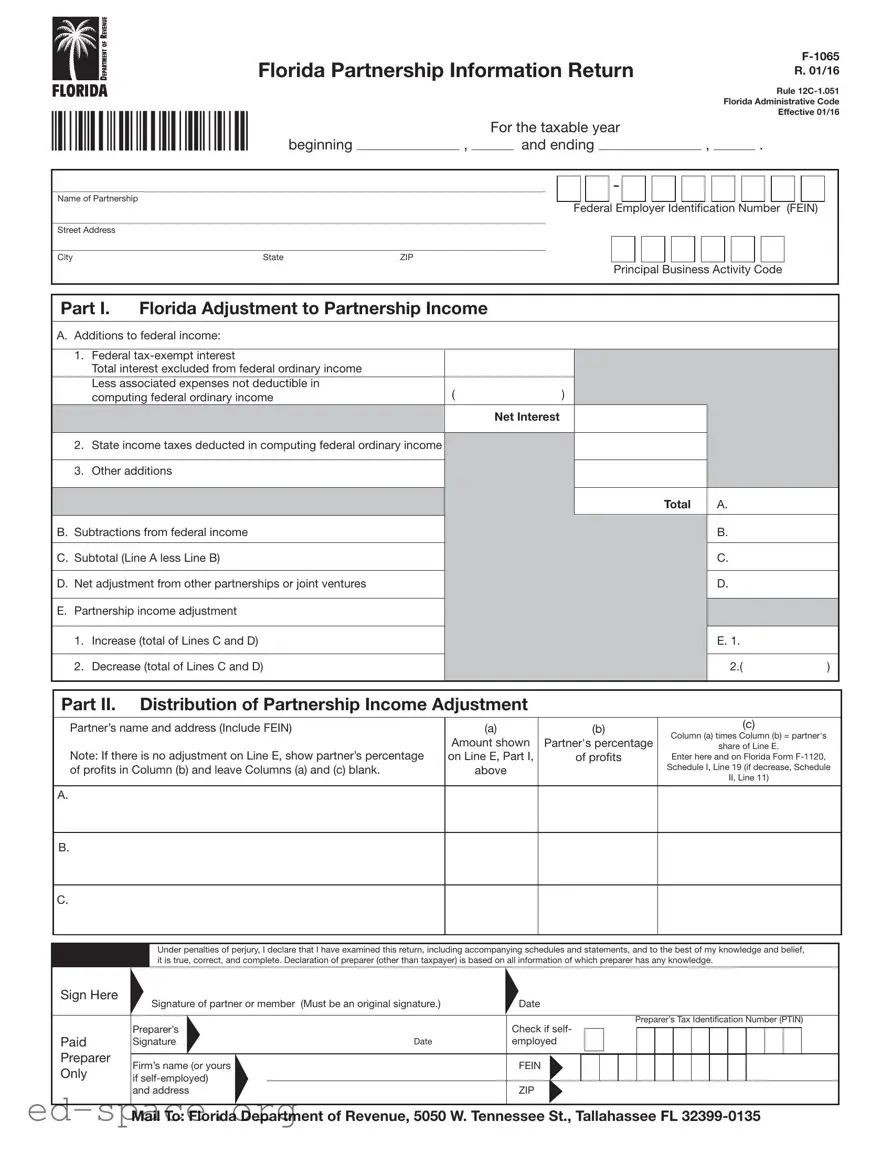
The Florida F 1065 form serves as the Partnership Information Return, a crucial document for partnerships operating within the state. This form is required for any Florida partnership that has partners subject to the Florida Corporate Income Tax Code, ensuring compliance with state tax regulations. It encompasses a variety of sections designed to capture essential financial information, including adjustments to partnership income and the distribution of income among partners. In particular, Part I focuses on making necessary additions and subtractions to federal income, allowing partnerships to accurately report their adjusted income. Part II facilitates the distribution of this income adjustment among partners, detailing each partner's share. Furthermore, Parts III and IV address apportionment information, which is vital for partnerships conducting business both within and outside Florida. This apportionment is calculated based on property, payroll, and sales factors, ensuring that income is fairly allocated according to where business activities occur. Understanding the nuances of the F 1065 form is essential for partnerships to fulfill their tax obligations while maximizing their financial accuracy and compliance.
Florida Partnership Information Return
|
|
|
|
|
|
|
|
Rule |
|
|
|
|
|
|
|
Florida Administrative Code |
|
|
|
|
|
|
|
|
|
Effective 01/16 |
|
|
|
For the taxable year |
|
|
|
||
beginning |
|
, |
|
and ending |
|
, |
|
. |
_________________________________________________________________________________________________________________ |
||
Name of Partnership |
|
|
_________________________________________________________________________________________________________________ |
||
Street Address |
|
|
_________________________________________________________________________________________________________________ |
||
City |
State |
ZIP |
-
Federal Employer Identification Number (FEIN)
Principal Business Activity Code
Part I. Florida Adjustment to Partnership Income
A.Additions to federal income:
1.Federal
Total interest excluded from federal ordinary income
Less associated expenses not deductible in |
|
|
computing federal ordinary income |
( |
) |
|
|
|
|
|
Net Interest |
|
|
|
2.State income taxes deducted in computing federal ordinary income
3.Other additions
Total
A.
B. Subtractions from federal income
B.
C. Subtotal (Line A less Line B)
C.
D. Net adjustment from other partnerships or joint ventures
D.
E. Partnership income adjustment
1. Increase (total of Lines C and D)
E. 1.
2. Decrease (total of Lines C and D)
2.()
Part II. |
Distribution of Partnership Income Adjustment |
|
|
||
|
|
|
|
|
|
Partner’s name and address (Include FEIN) |
(a) |
(b) |
(c) |
||
Column (a) times Column (b) = partner's |
|||||
|
|
Amount shown |
Partner's percentage |
||
|
|
share of Line E. |
|||
Note: If there is no adjustment on Line E, show partner’s percentage |
on Line E, Part I, |
of profits |
Enter here and on Florida Form |
||
of profits in |
Column (b) and leave Columns (a) and (c) blank. |
above |
|
Schedule I, Line 19 (if decrease, Schedule |
|
|
II, Line 11) |
||||
|
|
|
|
||
|
|
|
|
|
|
A. |
|
|
|
|
|
|
|
|
|
|
|
B. |
|
|
|
|
|
|
|
|
|
|
|
C. |
|
|
|
|
|
|
|
|
|
|
|
Under penalties of perjury, I declare that I have examined this return, including accompanying schedules and statements, and to the best of my knowledge and belief, it is true, correct, and complete. Declaration of preparer (other than taxpayer) is based on all information of which preparer has any knowledge.
Sign Here |
|
Signature of partner or member |
(Must be an original signature.) |
Date |
||||||||||||||||
|
|
|||||||||||||||||||
|
|
|
|
|
|
|
|
|
|
|
|
|
|
|
|
|
|
|
|
|
|
|
|
|
|
|
|
|
|
|
Preparer’s Tax Identification Number (PTIN) |
||||||||||
Paid |
Preparer’s |
|
Check if self- |
|
|
|
|
|
|
|
|
|
|
|
|
|
|
|||
|
|
|
|
|
|
|
|
|
|
|
|
|
|
|
||||||
Signature |
Date |
employed |
|
|
|
|
|
|
|
|
|
|
|
|
|
|
||||
Preparer |
|
|
|
|
|
|
|
|
|
|
|
|
|
|
|
|
|
|
|
|
|
|
|
|
|
|
|
|
|
|
|
|
|
|
|
|
|
|
|
|
|
Firm’s name (or yours |
|
FEIN |
|
|
|
|
|
|
|
|
|
|
|
|
|
|
|
|||
Only |
|
|
|
|
|
|
|
|
|
|
|
|||||||||
if |
|
|
|
|
|
|
|
|
|
|
|
|
|
|
|
|
|
|
||
|
|
|
|
|
|
|
|
|
|
|
|
|
|
|
|
|
|
|
||
|
and address |
|
ZIP |
|||||||||||||||||
|
|
|
|
|
|
|
|
|
|
|
|
|
|
|
|
|
|
|
|
|
Mail To: Florida Department of Revenue, 5050 W. Tennessee St., Tallahassee FL

R. 01/16
Page 2
NOTE: Please read instructions (Florida Form
Part III. |
Apportionment Information |
|
|
|
|
|
|||
|
|
|
|
|
|
|
|||
For use by partnerships doing business both within |
(a) Within Florida |
(b) Total Everywhere |
|||||||
|
|
and without Florida |
|||||||
|
|
|
|
|
|
|
|||
|
|
|
|
|
|
|
|||
1. |
Average value of property per Schedule |
|
|
|
|
|
|||
|
|
|
|
|
|
|
|||
2. |
Salaries, wages, commissions, and other compensation paid or accrued |
|
|
|
|
|
|||
|
in connection with trade or business for the period covered by this return |
|
|
|
|
|
|||
|
|
|
|
|
|
|
|
|
|
3. |
Sales |
|
|
|
|
|
|
|
|
|
|
|
|
|
|
|
|||
For use by partnerships providing transportation |
(a) Within Florida |
(b) Total Everywhere |
|||||||
|
|
services within and without Florida |
|||||||
|
|
|
|
|
|
|
|||
|
|
|
|
|
|
|
|||
1. |
Transportation services revenue miles (see instructions) |
|
|
|
|
|
|||
|
|
|
|
|
|||||
|
|
|
|
|
|
|
|
|
|
For use in computing average value of property |
Within Florida |
Total Everywhere |
|
||||||
|
|||||||||
|
|
|
|
|
|||||
a. Beginning of Year |
b. End of Year |
c. Beginning of Year |
d. End of Year |
||||||
|
|
|
|
||||||
|
|
|
|
|
|
|
|||
1. |
Inventories of raw material, work in process, finished goods |
|
|
|
|
|
|||
|
|
|
|
|
|
|
|||
2. |
Buildings and other depreciable assets (at original cost) |
|
|
|
|
|
|||
|
|
|
|
|
|
|
|||
3. |
Land owned (at original cost) |
|
|
|
|
|
|||
|
|
|
|
|
|
|
|||
4. |
Other tangible assets (at original cost) and intangible assets |
|
|
|
|
|
|||
|
(financial |
organizations only). Attach schedule. |
|
|
|
|
|
||
|
|
|
|
|
|
|
|||
5. |
Total (Lines 1 through 4). |
|
|
|
|
|
|||
|
|
|
|
|
|
|
|||
6. |
Average value of property in Florida (Within Florida), add |
|
|
|
|
|
|||
|
Line 5, Columns (a) and (b) and divide by 2. For average |
|
|
|
|
|
|||
|
value of property everywhere (Total Everywhere), add Line 5, |
|
|
|
|
|
|||
|
Columns (c) and (d) and divide by 2. |
|
|
|
|
|
|||
|
|
|
|
|
|
|
|||
7. |
Rented property - (8 times net annual rent) |
|
|
|
|
|
|||
|
|
|
|
|
|
|
|||
8. |
Total (Lines 6 and 7). Enter on Part |
_____________________________ |
_____________________________ |
|
|||||
|
and (b) |
|
|
||||||
|
|
Average Florida |
Average Everywhere |
||||||
|
|
|
|
||||||
Part IV. |
Apportionment of Partners' Share |
|
|
|
|
|||
|
|
|
|
|
|
|
|
|
Partner (Name and Address) |
Percent of |
Property Data |
Payroll Data |
Sales Data |
||||
Interest In |
|
|
|
|
|
|
||
|
|
Partnership |
Within Florida |
Everywhere |
Within Florida |
Everywhere |
Within Florida |
Everywhere |
|
|
|
|
|
|
|
|
|
A. |
|
|
|
|
|
|
|
|
|
|
|
|
|
|
|
|
|
B. |
|
|
|
|
|
|
|
|
|
|
|
|
|
|
|
|
|
C. |
|
|
|
|
|
|
|
|
|
|
|
|
|
|
|
|
|
NOTE: Transfer data to Schedule III - A, Florida Form

Instructions for Preparing Form
R. 01/19
Rule
Effective 01/19
Page 1 of 4
General Instructions
Who Must File Florida Form
Every Florida partnership having any partner subject to
the Florida Corporate Income Tax Code must file Florida
Form
partnership is a partnership doing business, earning income, or existing in Florida.
Note: A foreign
Florida joint venture is subject to the Florida Income Tax Code and must file a Florida Corporate Income/
Franchise Tax Return (Florida Form
A corporate taxpayer filing Florida Form
Where to File
Florida Department of Revenue
5050 W Tennessee St
Tallahassee FL
When to File
You must file Florida Form
day of the fourth month following the close of your taxable year.
If the due date falls on a Saturday, Sunday, or federal or state holiday, the return is considered to be filed on time if
postmarked on the next business day.
Extension of Time to File
To apply for an extension of time for filing Florida Form
You must file Florida Form
information on the requirements that must be met for your request for an extension of time to be valid.
Extensions are valid for six months. You are only
allowed one extension.
Attachments and Statements
You may use attachments if the lines on Florida Form
contain all the required information and follow the format of the schedules of the return. Do not attach a copy of the federal return.
Signature and Verification
An officer or person authorized to sign for the entity must
sign all returns. An original signature is required. We will not accept a photocopy, facsimile, or stamp. A receiver,
trustee, or assignee must sign any return required to be filed for any organization.
Any person, firm, or corporation who prepares a return for
compensation must also sign the return and provide:
•Federal employer identification number (FEIN).
•Preparer tax identification number (PTIN).
Rounding Off to
accompanying schedules. To round off dollar amounts,
drop amounts less than 50 cents to the next lowest dollar
and increase amounts from 50 cents to 99 cents to the
next highest dollar. If you use this method on the federal return, you must use it on the Florida return.
Taxable Year and Accounting Methods
The taxable year and method of accounting must be the same for Florida income tax as it is for federal income tax. If you change your taxable year or your method of accounting for federal income tax, you must also change the taxable year or method of accounting for Florida income tax.
Final Returns
If the partnership ceases to exist, write “FINAL RETURN”
at the top of the form.
General Information Questions
Enter the FEIN. If you do not have an FEIN, obtain one from the Internal Revenue Service (IRS). You can:
•Apply online at irs.gov
•Apply by mail with IRS Form
form, download or order it from irs.gov or call
Enter the Principal Business Activity Code that applies to Florida business activities. If the Principal Business Activity Code is unknown, see the IRS “Codes for
Principal Business Activity” section of federal Form 1065.
General Information
Both the income and the apportionment factors are
considered to “flow through” to the members of a
partnership or joint venture.
Use parts I and II of the Florida Partnership Information Return to determine each partner’s share of the Florida partnership income adjustment.
Parts III and IV are used to determine the adjustment that must be made to each partner’s apportionment factors. For example, a corporate partner’s share of the partnership’s sales within Florida will be added to the
corporation’s sales within Florida. The partner’s share of the partnership’s “everywhere sales” will be added to the corporation’s “everywhere sales.” The corporation’s sales apportionment factor, as reflected on Schedule III of Florida Form
(corporation’s Florida sales +
share of partnership’s Florida sales) (corporation’s everywhere sales + share of partnership’s everywhere sales)
Part I. Florida Adjustment to
Partnership Income
Line A. Additions to federal income
1.Federal
Enter the amount of interest which is excluded from ordinary income under section (s.) 103(a), Internal Revenue Code (IRC), or any other federal law, less
the associated expenses disallowed in computing ordinary income under s. 265, IRC, or any other law.
2.State income taxes deducted in computing federal ordinary income
Enter the sum of any tax on or measured by income,
which is paid or accrued as a liability to the District of Columbia or any state of the United States and is deductible from gross income in computing federal ordinary income for the taxable year. You should exclude taxes based on gross receipts or revenues.
3.Other additions
Enter any other items you are required to add as an adjustment to calculate adjusted federal income.
Line B. Subtractions from federal income
Enter any items required to be subtracted as an adjustment to calculate adjusted federal income.
For example, s. 220.13(1)(e), F. S., provides for a
subtraction taken equally over a seven year period corresponding to the add back to adjusted federal income for the special bonus depreciation.
Line C. Subtotal
Subtract Line B from Line A.
R. 01/19
Page 2 of 4
Line D. Net adjustment from other partnerships or joint ventures
If, because of Florida changes, the partnership’s share
of income from other partnerships or joint ventures is different from the amount included in federal taxable
income, you must make an appropriate adjustment on Line D. Attach a schedule explaining any adjustment.
Line E. Partnership income adjustment
Calculate the total partnership income adjustment (sum of Lines C and D). Enter net increases to income on Line 1. Enter net decreases to income on Line 2.
Part II. Distribution of Partnership
Income Adjustment
Distributing each partner’s share of the total partnership
income adjustment (Part I, Line E) is accomplished in
Part II.
Each corporate partner must enter its share of the adjustment in Column (c) on its Florida Corporate Income/ Franchise Tax Return (Florida Form
Part III. Apportionment Information
You must complete this part if either the partnership or any of the partners subject to the Florida Income Tax Code does business outside Florida.
Florida taxpayers doing business outside the state must apportion their business income to Florida based on a
taxpayers granted permission to use a single sales factor under s. 220.153, F.S., and taxpayers who were given
prior permission by the Department to apportion income using a different method under s. 220.152, F.S.
The
For more information about apportioning income see s. 220.15, F.S., and Rule
this fraction is the average value of real and tangible personal property owned or rented and used during the taxable year in Florida. The denominator is the average value of such property owned or rented and used
everywhere during the taxable year. The property factor for corporations included within the definition of financial organizations must also include intangible personal
property, except goodwill.
Property owned is valued at original cost, without regard to accumulated depreciation. Property rented is valued at eight times the net annual rental rate. You must reduce the net annual rental rate by the annual rental rate received from
In Part
Line 1, Column (a). Enter the average everywhere in Part
The payroll factor is a fraction. The numerator of this fraction is the total amount paid to employees in Florida during the taxable year for compensation. The denominator is the total compensation paid to employees
everywhere during the taxable year. Enter the numerator in Part
For purposes of this factor, compensation is paid within Florida if:
(a)The employee’s service is performed entirely within
Florida, or
(b)The employee’s service is performed both within and without Florida, but the service performed outside Florida is incidental to the employee’s service, or
(c)Some of the employee’s service is performed in
Florida and either the base of operations or the place from which the service is directed or controlled is in Florida, or the base of operations or place from which the service is controlled is not in any state in which some part of the service is performed and the employee’s residence is in Florida.
The partnership must attach a statement listing all
compensation paid or accrued for the taxable year other than that as shown on federal Form
the federal Form 1065.
R. 01/19
Page 3 of 4
The sales factor is a fraction. The numerator of this fraction is the total sales of the taxpayer in Florida during the taxable year. The denominator is the total sales of
the taxpayer everywhere during the taxable year. Enter the numerator in Part
Florida defines the term “sales” as gross receipts without regard to returns or allowances. The term “sales” is not
limited to tangible personal property, and includes:
(a)Rental or royalty income if such income is significant in the taxpayer’s business.
(b)Interest received on deferred payments of sales of real or tangible personal property.
(c)Sales of services.
(d)Income from the sale, licensing, or other use of intangible personal property such as patents and copyrights.
(e)For financial organizations, income from intangible personal property.
Sales will be attributable to Florida using these criteria:
(a)Sales of tangible personal property will be “Florida sales” if the property is delivered or shipped to a purchaser within Florida.
(b)Rentals will be “Florida sales” if the real or tangible personal property is in Florida.
(c)Interest received on deferred payments of sales of
real or tangible personal property will be included in
“Florida sales” if the sale of the property is in Florida.
(d)Sales of service organizations are within Florida if the services are performed in Florida.
For a financial organization, “Florida sales” will also
include:
(a)Fees, commissions, or other compensation for financial services rendered within Florida.
(b)Gross profits from trading in stocks, bonds, or other securities managed within Florida.
(c)Interest, other than interest from loans secured by mortgages, deeds of trust, or other liens on real or tangible personal property found outside Florida.
(d)Dividends received within Florida.
(e)Interest charged to customers at places of business maintained within Florida for carrying debit balances of margin accounts, without deduction of any costs incurred in carrying such accounts.

(f)Interest, fees, commissions, and other charges or gains from loans secured by mortgages, deeds of trust, or other liens on real or tangible personal property found in Florida or from installment sale agreements originally completed by a taxpayer or his agent to sell real or tangible personal property located in Florida.
(g)Any other gross income, including other interest resulting from the operation as a financial organization within Florida.
Special methods of apportioning income by taxpayers providing insurance or transportation services are provided. For example, the income attributable to transportation services is apportioned to Florida by
multiplying the adjusted federal income by a fraction.
The numerator is the “revenue miles” within Florida and the denominator is the “revenue miles” everywhere. For
transportation other than by pipeline, a revenue mile is the
R. 01/19
Page 4 of 4
transportation of one passenger or one net ton of freight the distance of one mile for a consideration.
Part IV. Apportionment of Partners’ Share
Each partner’s share of the apportionment factors is determined by multiplying the amount in Part
Lines 1, 2, and 3 by the percentage interest of each
partner. Amounts determined should be added to each partner’s apportionment factors included on its Florida
Form
Partnerships subject to a special industry apportionment fraction (for example, those engaged mainly in transportation services) should adjust this schedule to
report each partner’s share of the special apportionment fraction (for example, revenue miles for transportation companies).
Contact Us
Information, forms, and tutorials are available on the Department's website at floridarevenue.com
To speak with a Department representative, call Taxpayer Services at
Friday (excluding holidays).
To find a taxpayer service center near you, visit floridarevenue.com/taxes/servicecenters
For written replies to tax questions, write to:
Taxpayer Services - MS
Florida Department of Revenue
5050 W Tennessee St
Tallahassee FL
Subscribe to our tax publications to receive due date reminders or an email when we post:
•Tax Information Publications (TIPs).
•Proposed rules, notices of rule development workshops, and more. Visit floridarevenue.com/dor/subscribe
References
The following documents were mentioned in this form and are incorporated by reference in the rules indicated below.
The forms are available online at floridarevenue.com/forms.
Form |
Florida Partnership Information Return |
Rule |
Form |
Florida Corporate Income/Franchise Tax Return |
Rule |
Form |
Florida Tentative Income/Franchise Tax Return |
Rule |
|
and Application for Extension of Time to File Return |
|
| Fact Name | Details |
|---|---|
| Form Purpose | The Florida F-1065 form is used for reporting partnership income and adjustments for Florida partnerships. |
| Governing Law | This form is governed by Rule 12C-1.051 of the Florida Administrative Code. |
| Filing Requirement | Every Florida partnership with a partner subject to the Florida Corporate Income Tax Code must file this form. |
| Filing Deadline | The form must be filed on or before the first day of the fifth month following the close of the taxable year. |
| Signature Requirement | An original signature from a partner or authorized person is required; photocopies or stamps are not accepted. |
| Extension of Time | To request an extension, Florida Form F-7004 must be filed. A federal extension alone does not suffice. |
Filling out the Florida F 1065 form is a critical task for partnerships operating within the state. This form is essential for reporting partnership income and making necessary adjustments. Completing it accurately ensures compliance with state tax regulations. Below are the steps to guide you through the process of filling out the form.
What is the Florida F 1065 form?
The Florida F 1065 form is the Partnership Information Return that partnerships operating in Florida must file. It reports the partnership's income, deductions, and other tax-related information. Partnerships must complete this form to comply with Florida's Corporate Income Tax Code, especially if they have any partners subject to this tax.
Who is required to file the Florida F 1065 form?
Every Florida partnership must file the F 1065 form if it has any partner subject to the Florida Corporate Income Tax. This includes limited liability companies classified as partnerships for federal tax purposes. Foreign corporations that are partners in a Florida partnership must also file a Florida Corporate Income/Franchise Tax Return, using the F 1065 to report their share of partnership income.
When is the Florida F 1065 form due?
The F 1065 form is due on or before the first day of the fifth month following the close of the partnership's taxable year. If this date falls on a weekend or holiday, the form is considered timely if postmarked on the next business day.
How can a partnership apply for an extension to file the Florida F 1065 form?
To apply for an extension, partnerships must complete Florida Form F-7004, which is the Tentative Income/Franchise Tax Return and Application for Extension of Time to File. Simply having a federal extension does not extend the time for filing the Florida return. The extension is valid for five months, and only one extension is allowed.
What information is required to complete the Florida F 1065 form?
Partnerships need to provide their Federal Employer Identification Number (FEIN), the Principal Business Activity Code, and detailed financial information, including income adjustments and distributions to partners. If necessary, partnerships can use attachments to provide additional information. However, they should not attach a copy of the federal return.
What happens if a partnership ceases to exist?
If a partnership ceases operations, it must indicate this by writing “FINAL RETURN” at the top of the F 1065 form. This alerts the Florida Department of Revenue that the partnership is no longer active and should not be expected to file future returns.
Not entering the Federal Employer Identification Number (FEIN). This number is crucial for identification and must be included.
Failing to provide an original signature. Photocopies, facsimiles, or stamps will not be accepted.
Ignoring the Principal Business Activity Code. This code is necessary for accurate classification of business activities.
Leaving out important adjustments to income. Ensure all additions and subtractions from federal income are accurately reported.
Not completing the apportionment information if the partnership operates outside Florida. This is essential for determining tax liabilities.
Miscalculating the average value of property. This affects the property factor in the apportionment formula.
Providing incomplete or inaccurate partner information in Part II. Each partner's share must be clearly documented.
Missing the filing deadline. Form F-1065 must be filed by the first day of the fifth month following the close of the taxable year.
When filing the Florida F 1065 form, various other documents and forms may be required to ensure comprehensive reporting and compliance with state tax regulations. Each of these forms serves a specific purpose and may be necessary depending on the nature of the partnership's operations and income. Below is a list of commonly used documents that accompany the Florida F 1065 form.
In summary, understanding the various forms and documents associated with the Florida F 1065 form is essential for accurate tax reporting and compliance. Each document plays a vital role in ensuring that partnerships meet their obligations under Florida tax law. Proper preparation and timely submission of these forms can help avoid penalties and facilitate smoother business operations.
The Florida F 1065 form is designed for partnerships operating within the state to report their income and apportionment factors. It shares similarities with several other tax documents. Below are four forms that are comparable to the Florida F 1065, along with explanations of their similarities:
When completing the Florida F 1065 form, there are several important guidelines to follow. Below is a list of things you should and should not do to ensure a smooth filing process.
By adhering to these guidelines, you can help ensure that your filing is processed efficiently and accurately. Taking the time to review your information and follow the instructions carefully can make a significant difference in the outcome of your submission.
The Florida F 1065 form, used for reporting partnership income, is often misunderstood. Here are six common misconceptions about this form:
When filling out the Florida F-1065 form, there are several important points to keep in mind. Here are some key takeaways:
Filling out the F-1065 form correctly is crucial for compliance. Ensure all information is accurate and complete to avoid potential issues with the Florida Department of Revenue.