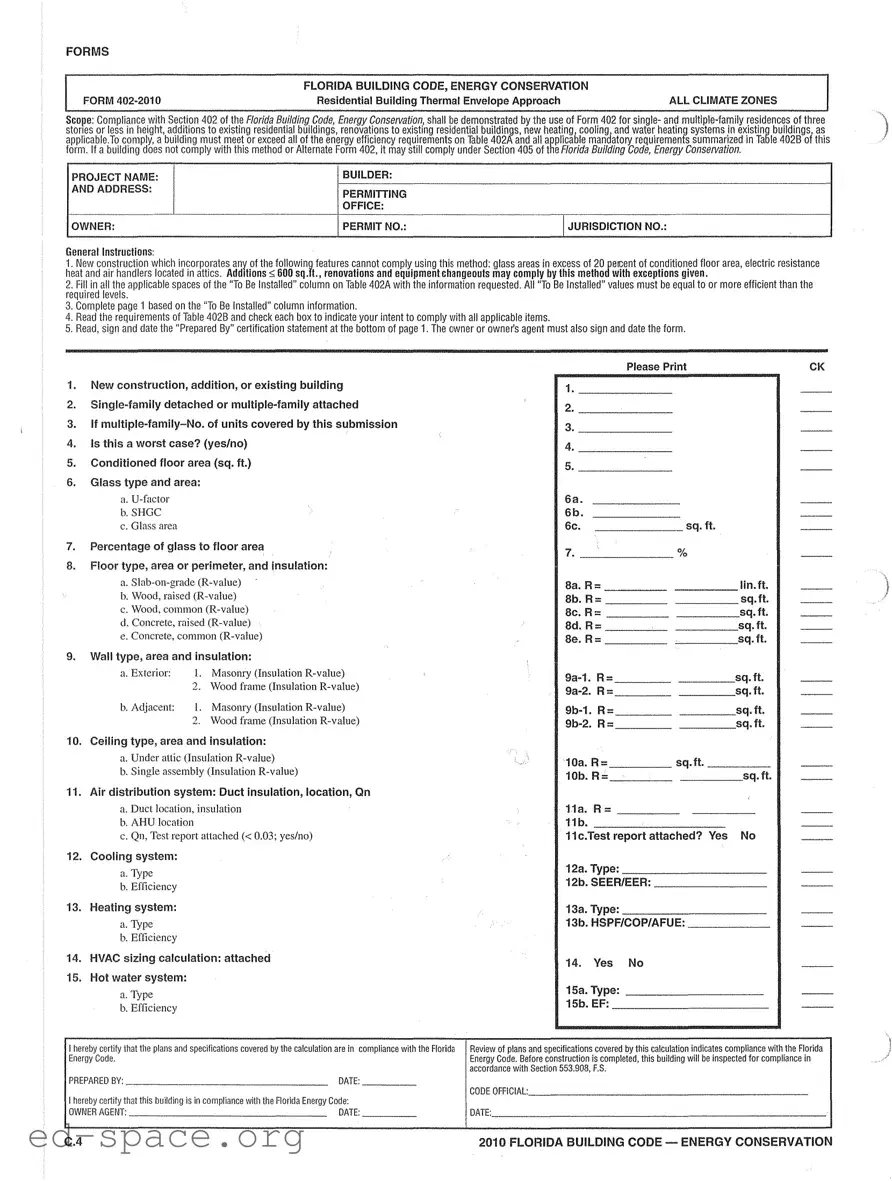
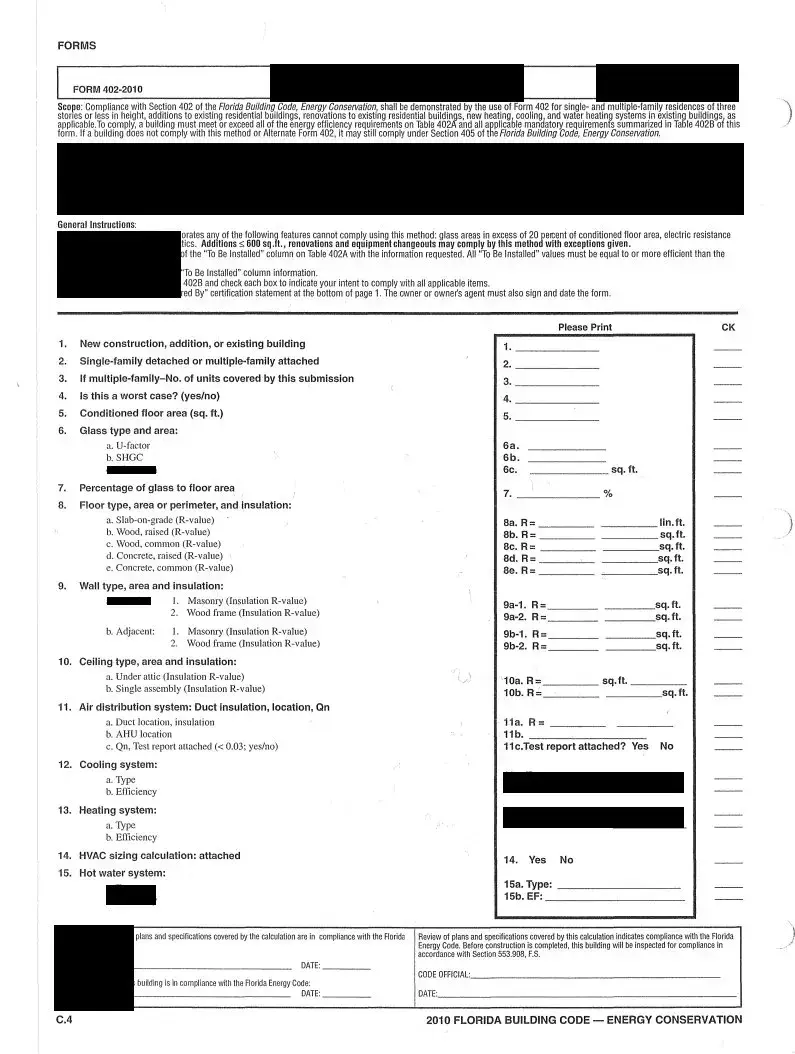
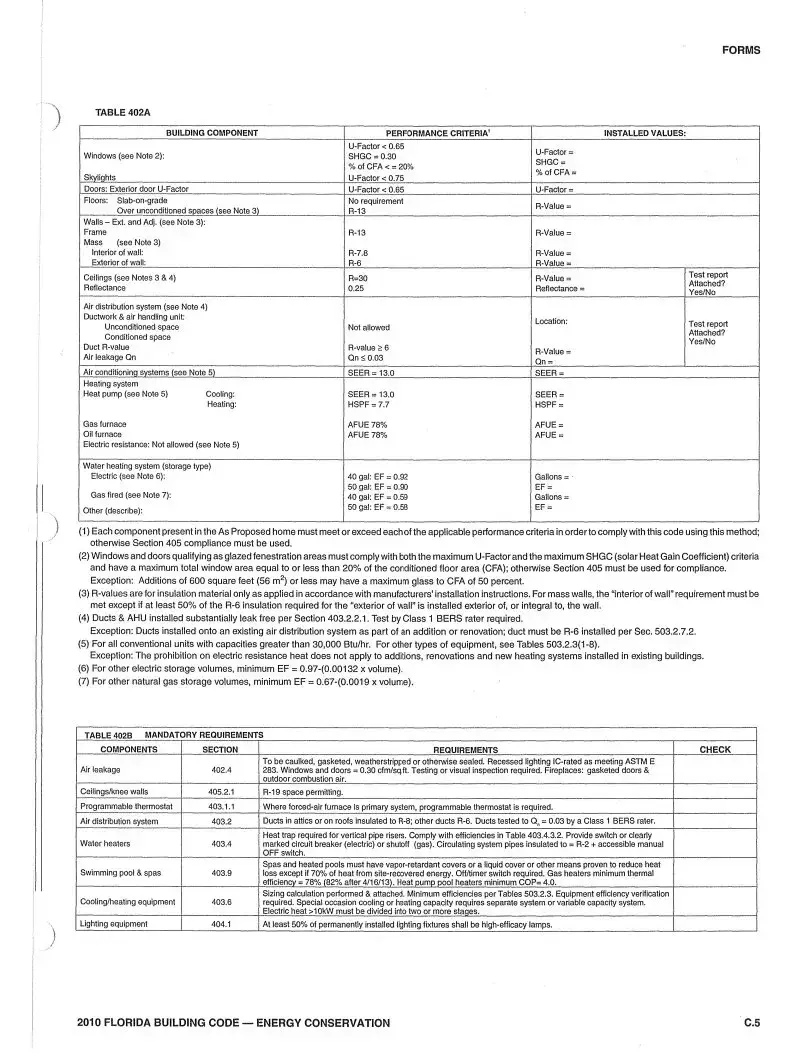
The Florida Energy form is a crucial document designed to ensure that residential buildings comply with the energy conservation standards set forth in the Florida Building Code. This form applies to various types of construction, including single-family homes and multi-family residences that are three stories or less. It is essential for new constructions, additions, and renovations, as well as for the installation of new heating, cooling, and water heating systems. To demonstrate compliance, builders must meet or exceed the energy efficiency requirements outlined in Table 402A and adhere to the mandatory requirements summarized in Table 402B. Notably, certain construction features, such as excessive glass areas or electric resistance heating in attics, disqualify a project from using this compliance method. The form requires detailed information about the building's components, including insulation types, window specifications, and HVAC systems, ensuring that all installed values align with the efficiency criteria. Furthermore, it mandates the owner's signature and a certification statement to confirm compliance, making it a vital step in the construction process for energy-efficient homes in Florida.
FORMS
Scope: Compliance with Section 402 of the Florida Building Code, Energy Conservation, shall be demonstrated by the use of Form 402 for single- and
General Instructions:
constrLJcti.<m which incorporates any of the following features cannot comply using this method: glass areas in excess of 20 pen:::ent of conditioned floor area, electric resistance located in attics. Additions:::; 600 sq .ft., renovations and equipment change outs may comply by this method with exceptions given.
applicable spaces of the "To Be Installed" column on Table 402A with the information requested. All "To Be Installed" values must be equal to or more efficient than the
"To Be Installed" column information.
402B and check each box to indicate your intent to comply with all applicable items.
"Prepared By" certification statement at the bottom of page 1. The owner or owner's agent must also sign and date the form.
1.New construction, addition, or existing building
2.
3.If
4.Is this a worst case? (yes/no)
5.Conditioned floor area (sq. ft.)
6.Glass type and area:
Please Print |
CK |
1.
2.
3.
4.
5.
b.SHGC
7.Percentage of glass to floor area
8.Floor type, area or perimeter, and insulation:
6a.
6b.
6c. |
sq. ft. |
7. |
% |
Wood, common
d.Concrete, raised
common
9.Wall type, area and insulation:
l. Masonry (Insulation
b. Adjacent: 1. Masonry (Insulation
10. Ceiling type, area and insulation:
Under attic (Insulation
Single assembly (Insulation
11.Air distribution system: Duct insulation, location, Qn
Duct location, insulation b. AHU location
Qn, Test report attached(< 0.03; yes/no)
12. Cooling system:
Type
b.Efficiency
13.Heating system:
Type
b. Efficiency
Sa. R::: |
lin. ft. |
|
8b. R::: |
sq. ft. |
|
ac. R= |
sq. ft. |
|
8d. R::::: |
sq. ft. |
|
ae. A= |
sq. ft. |
|
sq. ft. |
||
R= |
sq. ft. |
|
R:::: |
sq. ft. |
|
R:::: |
sq. ft. |
|
10a. R= |
sq. ft. |
|
10b. R- |
|
sq. ft. |
11a. R:::: ____ |
|
|
11b. |
|
|
11 c.Test report attached? Yes |
No |
|
14. |
HVAC sizing calculation: attached |
14. Yes No |
|
|
|
15. |
Hot water system: |
|
|
|
15a. |
|
|
15b. |
plans and specifications covered by the calculation are in compliance with the Florida Review of plans and specifications covered by this calculation indicates compliance with the Florida Energy Code. Before construction is completed, this building will be inspected for compliance in accordance with Section 553.908, F.S.
DATE: ____
CODE OFFICIAL:___________________.
rnrtiht エィセエエィゥッ@building is in compliance with the Florida Energy Code:
DATE: ____
C.4 |
2010 FLORIDA BUILDING CODE- ENERGY CONSERVATION |
FORMS
TABLE402A
BUILDING COMPONENT
Windows (see Note 2):
Skvliahts
セイウZ@Exterior door
Over unconditioned spaces (see Note 3) Walls- Ext. and Adj. (see Note 3):
Frame
Mass (see Note 3) Interior of wall: Exterior of wall:
Ceilings (see Notes 3 & 4)
Reflectance
Air distribution system (see Note 4)
Ductwork & air handling unit:
Unconditioned space
Conditioned space
Duct
Air leakage On
Air conditionina svstems (see Note 5) Heating system
Heat pump (see Note 5)Cooling: Heating:
Gas furnace Oil furnace
Electric resistance: Not allowed (see Note 5)
Water heating system (storage type)
Electric (see Note
Gas fired (see Note 7):
Other (describe):
PERFORMANCE CRITERIA'
R=30
0.25
Not allowed
On セPNPS@
SEER= 13.0
SEER 13.0
HSPF = 7.7
AFUE78%
AFUE78%
40 gal: EF = 0.92
50 gal: EF = 0.90
40 gal: EF = 0.59
50 gal: EF 0.58
INSTALLED VALUES:
SHGC=
%of CFA=
Test report |
||
Attached? |
||
Reflectance = |
||
Yes/No |
||
|
||
Location: |
Test report |
|
|
||
|
Attached? |
|
|
Yes/No |
|
|
||
On= |
|
|
SEER= |
|
|
SEER= |
|
|
HSPF= |
|
|
AFUE= |
|
|
AFUE= |
|
|
Gallons |
|
|
EF= |
|
|
Gallons= |
|
|
EF= |
|
(1)Each component present in the As Proposed home must meet or exceed each of the applicable performance criteria in order to comply with this code using this method; otherwise Section 405 compliance must be used.
(2)Windows and doors qualifying as glazed fenestration areas must comply with both the maximum
(3)
(4)Ducts & AHU installed substantially leak free per Section 403.2.2.1. Test by Class 1 BERS rater required.
Exception: Ducts installed onto an existing air distribution system as part of an addition or renovation; duct must be
(5) For all conventional units with capacities greater than 30,000 Btu/hr. For other types of equipment, see Tables
Exception: The prohibition on electric resistance heat does not apply to additions, renovations and new heating systems installed in existing buildings.
(6)For other electric storage volumes, minimum EF =
(7)For other natural gas storage volumes, minimum EF
TABLE 4028 MANDATORY REQUIREMENTS |
|
|
||
COMPONENTS |
SECTION |
REQUIREMENTS |
I |
CHECK |
|
|
To be caulked, gasketed, キ・。エィ・イウエイゥーセ・、@or otherwise sealed. Recessed lighting |
|
|
Air leakage |
402.4 |
283. Windows and doors= 0.30 cfm/sq.ft. Testing or visual inspection required. Fireplaces: gasketed doors & |
|
|
|
|
outdoor combustion air. |
|
|
Ceilings/knee walls |
405.2.1 |
|
|
|
Programmable thermostat |
403.1.1 |
Where |
|
|
Air distribution system |
403.2 |
Ducts in attics or on roofs insulated to |
|
|
|
|
Heat trap required for vertical pipe risers. Comply with efficiencies in Table 403.4.3.2. Provide switch or clearly |
|
|
Water heaters |
403.4 |
marked circuit breaker (electric) or shutoff (gas). Circulating system pipes insulated to= |
|
|
|
|
OFF switch. |
|
|
|
|
Spas and heated pools must have |
|
|
Swimming pool &spas |
403.9 |
loss except if 70% of heat from |
|
|
|
|
efficiency- 78% (82% after 4/16/13). Heat pump pool heaters minimum COP- 4.0. |
|
|
|
|
Sizing calculation performed &attached. Minimum efficiencies per Tables 503.2.3. Equipment efficiency verification |
|
|
Cooling/heating equipment |
403.6 |
required. Special occasion cooling or heating capacity requires separate system or variable capacity system. |
|
|
|
|
Electric heat >10kW must be divided into two or more stages. |
|
|
Lighting equipment |
404.1 |
At least 50% of permanently installed lighting fixtures shall be |
|
|
2010 FLORIDA BUILDING CODE- ENERGY CONSERVATION |
C.5 |
| Fact Name | Details |
|---|---|
| Governing Law | Florida Building Code, Section 402, Energy Conservation |
| Scope of Application | Applicable to single- and multiple-family residences of three stories or less, including renovations and new systems. |
| Compliance Requirements | Must meet energy efficiency requirements in Table 402A and mandatory requirements in Table 402B. |
| Exclusions | Buildings with glass areas over 20% of conditioned floor area or electric resistance in attics cannot comply using this method. |
| Owner's Responsibility | The owner or agent must sign and date the form, confirming compliance. |
| Inspection Requirement | Buildings will be inspected for compliance before construction is completed, as per Section 553.908, F.S. |
Filling out the Florida Energy form is an important step in ensuring that your building project meets energy efficiency standards. This guide will help you navigate the form, making the process straightforward and manageable.
Once you have filled out the form, review all entries for accuracy. Ensure that all required attachments are included. After submitting the form, your building will be inspected for compliance with the Florida Energy Code.
What is the purpose of the Florida Energy form?
The Florida Energy form is designed to ensure compliance with Section 402 of the Florida Building Code, specifically regarding energy conservation. It applies to single- and multiple-family residences that are three stories or less in height. The form must be used for new constructions, additions, and renovations, as well as for new heating, cooling, and water heating systems in existing buildings. By completing this form, builders and homeowners demonstrate that their projects meet or exceed the energy efficiency requirements outlined in the code.
Who is required to complete the Florida Energy form?
The form must be completed by the owner or the owner's agent. This ensures that the individual responsible for the project is aware of the energy efficiency requirements and is actively participating in the compliance process. Both the preparer of the form and the owner must sign and date it, confirming their understanding and agreement to adhere to the necessary standards.
What information is needed to complete the Florida Energy form?
To complete the form, several details must be provided, including the type of construction (new, addition, or renovation), the number of units for multiple-family residences, the conditioned floor area, and the specifications for glass types and areas. Additionally, information about insulation values, wall types, and HVAC systems must be included. Each component must meet or exceed the performance criteria specified in the form to ensure compliance with the energy code.
What happens if my building does not comply with the Florida Energy form requirements?
If a building does not meet the compliance criteria set forth in the Florida Energy form or Alternate Form 402, there is still an option for compliance under Section 405 of the Florida Building Code. This alternative method allows for different compliance pathways, although it may require additional documentation and inspection. It is essential to consult with a qualified professional to explore these options if initial compliance is not achieved.
Are there any exceptions to the requirements outlined in the Florida Energy form?
Yes, certain exceptions apply. For instance, if the addition is 600 square feet or less, it may have a maximum glass area of 50% of the conditioned floor area. Additionally, electric resistance heating is generally not permitted, but exceptions are made for new heating systems installed in existing buildings. It is important to review the specific exceptions listed in the form to determine eligibility.
What is the significance of the "Prepared By" certification statement on the form?
The "Prepared By" certification statement at the bottom of the form serves as a declaration that the information provided is accurate and complete. This certification is crucial for accountability and ensures that the individual preparing the form has reviewed the project details thoroughly. It reinforces the commitment to comply with the Florida Energy Code and allows for a smoother inspection process once construction is completed.
Incomplete Information: Many individuals fail to provide all the necessary details on the Florida Energy form. Each section must be filled out completely, including specifics about the building type, conditioned floor area, and insulation values. Missing data can lead to compliance issues.
Incorrect Values: Some people enter values that do not meet the required standards. For example, the U-factor and SHGC must adhere to the maximum limits specified in Table 402A. Entering incorrect figures can result in non-compliance with the Florida Energy Code.
Failure to Sign: The form requires a signature from the owner or the owner's agent. Neglecting to sign and date the form at the bottom can invalidate the submission, causing delays in the approval process.
Ignoring Mandatory Requirements: Individuals often overlook the mandatory requirements summarized in Table 402B. Each checkbox must be reviewed and checked to indicate compliance. Failing to do so may lead to issues during inspections.
The Florida Energy form is an essential document that helps ensure compliance with energy conservation standards in residential buildings. However, several other forms and documents are often used in conjunction with this form to provide a comprehensive understanding of a building's energy efficiency and compliance with state regulations. Below is a list of these documents, along with brief descriptions of their purposes.
Each of these documents plays a crucial role in the overall process of ensuring that residential buildings in Florida adhere to energy conservation standards. Together, they help create a more energy-efficient environment while ensuring compliance with state regulations.
The Florida Energy Form is an essential document that ensures compliance with energy conservation standards in residential buildings. Several other documents share similarities with this form, each serving a specific purpose in the realm of building energy efficiency. Here are five such documents:
When filling out the Florida Energy form, it's important to follow specific guidelines to ensure compliance. Here’s a list of things you should and shouldn’t do:
Here are seven common misconceptions about the Florida Energy form:
Filling out and using the Florida Energy form is an essential step in ensuring compliance with the Florida Building Code, specifically regarding energy conservation. Here are some key takeaways to keep in mind: