In the state of Florida, a Durable Power of Attorney is an essential legal document that allows individuals to designate someone they trust to manage their financial and legal affairs when they are unable to do so themselves. This form is particularly valuable because it remains effective even if the person who created it becomes incapacitated. It covers a wide range of responsibilities, from handling banking transactions and managing real estate to making healthcare decisions and overseeing business operations. By appointing an agent, or attorney-in-fact, the principal can ensure that their wishes are honored and that their affairs are managed according to their preferences. Understanding the nuances of this form is crucial, as it not only outlines the powers granted to the agent but also establishes important safeguards to protect the principal's interests. The process of creating and executing a Durable Power of Attorney in Florida is straightforward, yet it requires careful consideration of whom to trust and what powers to grant. With the right information and guidance, individuals can take this important step to secure their future and provide peace of mind for themselves and their loved ones.
Florida Durable Power of Attorney
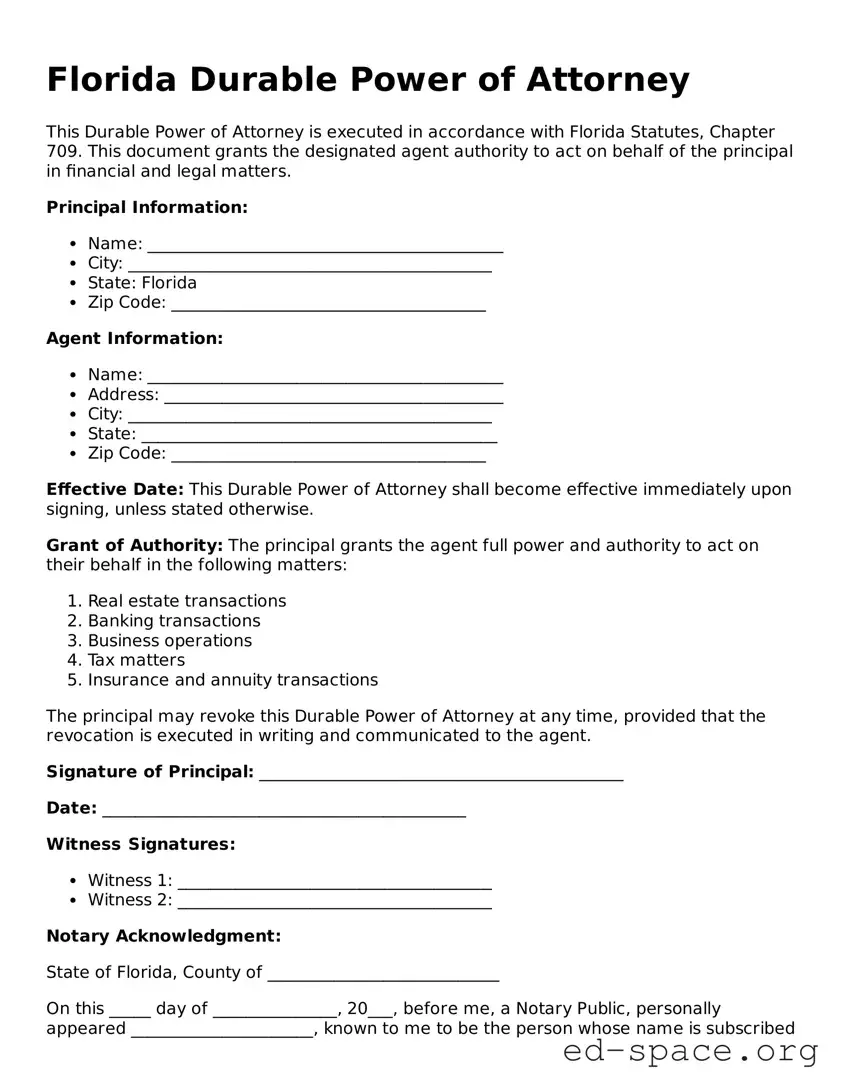
This Durable Power of Attorney is executed in accordance with Florida Statutes, Chapter 709. This document grants the designated agent authority to act on behalf of the principal in financial and legal matters.
Principal Information:
Agent Information:
Effective Date: This Durable Power of Attorney shall become effective immediately upon signing, unless stated otherwise.
Grant of Authority: The principal grants the agent full power and authority to act on their behalf in the following matters:
The principal may revoke this Durable Power of Attorney at any time, provided that the revocation is executed in writing and communicated to the agent.
Signature of Principal: ____________________________________________
Date: ____________________________________________
Witness Signatures:
Notary Acknowledgment:
State of Florida, County of ____________________________
On this _____ day of _______________, 20___, before me, a Notary Public, personally appeared ______________________, known to me to be the person whose name is subscribed to this Durable Power of Attorney.
______________________________
Notary Public Signature
My Commission Expires: ________________________
| Fact Name | Description |
|---|---|
| Definition | A Florida Durable Power of Attorney form allows an individual (the principal) to appoint someone else (the agent) to manage their financial and legal affairs, even if they become incapacitated. |
| Governing Law | This form is governed by Florida Statutes, specifically Chapter 709, which outlines the rules and requirements for powers of attorney in the state. |
| Durability | The term "durable" means that the power of attorney remains effective even if the principal becomes mentally incapacitated. This is a key feature that distinguishes it from a regular power of attorney. |
| Agent's Authority | The agent's authority can be broad or limited, depending on how the form is filled out. The principal can specify which powers the agent has, such as managing bank accounts or selling property. |
| Signing Requirements | For the form to be valid, it must be signed by the principal in the presence of two witnesses and a notary public. This ensures that the document is legally recognized. |
| Revocation | The principal can revoke the Durable Power of Attorney at any time, as long as they are mentally competent. This can be done through a written notice to the agent and any relevant third parties. |
Filling out the Florida Durable Power of Attorney form is an important step in ensuring that your financial and legal matters are handled according to your wishes if you become unable to manage them yourself. Follow these steps carefully to complete the form accurately.
What is a Florida Durable Power of Attorney?
A Florida Durable Power of Attorney is a legal document that allows an individual, known as the principal, to appoint another person, referred to as the agent, to make financial and legal decisions on their behalf. This document remains effective even if the principal becomes incapacitated, ensuring that their affairs can be managed without interruption. The agent's authority can be broad or limited, depending on the principal's preferences outlined in the document.
How do I create a Durable Power of Attorney in Florida?
To create a Durable Power of Attorney in Florida, the principal must be at least 18 years old and of sound mind. The document must be in writing and signed by the principal. It is also necessary for the principal's signature to be witnessed by two individuals who are not related to the principal or the agent, and who will not benefit from the principal's estate. Additionally, having the document notarized can provide extra validation, although it is not a strict requirement.
Can I revoke a Durable Power of Attorney in Florida?
Yes, a principal can revoke a Durable Power of Attorney at any time, as long as they are mentally competent. The revocation should be made in writing and should be communicated to the agent and any relevant financial institutions or parties that may rely on the original document. It is advisable to destroy any copies of the original Durable Power of Attorney to avoid confusion.
What happens if I do not have a Durable Power of Attorney?
If an individual does not have a Durable Power of Attorney and becomes incapacitated, their loved ones may need to go through a court process to obtain guardianship or conservatorship. This process can be time-consuming, costly, and may not align with the individual’s wishes. Having a Durable Power of Attorney in place allows for a smoother transition of decision-making authority and can help avoid potential disputes among family members.
Failing to specify the powers granted. It is crucial to clearly outline what decisions the agent can make on behalf of the principal.
Not signing the document in front of a notary public. A valid Durable Power of Attorney must be notarized to be legally binding in Florida.
Neglecting to date the form. Omitting the date can lead to confusion about when the authority begins.
Choosing an unreliable agent. Selecting someone without the necessary judgment or integrity can lead to misuse of power.
Forgetting to revoke previous Durable Powers of Attorney. If there are existing documents, they should be revoked to avoid conflicts.
Not discussing the decision with the chosen agent. It is important that the agent understands their responsibilities and agrees to take on the role.
Using outdated forms. Always ensure that the most current version of the Durable Power of Attorney form is being used.
Overlooking the need for witnesses. In some cases, having witnesses may be necessary to validate the document.
Failing to keep a copy of the signed document. The principal should retain a copy for their records and provide one to the agent.
Not reviewing the document periodically. Changes in circumstances may require updates to the powers granted or the agent chosen.
A Florida Durable Power of Attorney is an important document that allows someone to make decisions on your behalf if you become unable to do so. However, several other forms and documents often accompany it to ensure comprehensive planning and protection. Below is a list of commonly used documents that complement the Durable Power of Attorney.
Each of these documents plays a vital role in comprehensive estate planning. They work together to ensure that your wishes are respected and that your loved ones are equipped to make decisions on your behalf when necessary.
The Durable Power of Attorney (DPOA) is a significant legal document that allows one person to make decisions on behalf of another, particularly in financial or medical matters. Several other documents share similarities with the DPOA, each serving distinct but related purposes. Here are four such documents:
When filling out the Florida Durable Power of Attorney form, it's important to approach the task with care. Here are some helpful tips on what to do and what to avoid.
Understanding the Florida Durable Power of Attorney form is crucial for effective estate planning. However, several misconceptions can lead to confusion. Here are four common misunderstandings:
This is not entirely accurate. A Durable Power of Attorney can be effective immediately upon signing or can be set to activate only when the principal becomes incapacitated, depending on how it is drafted.
This is misleading. While a Durable Power of Attorney does give significant authority to the agent, the powers can be limited to specific tasks or areas, as outlined in the document.
While both documents allow an agent to act on behalf of the principal, a Durable Power of Attorney remains effective even if the principal becomes incapacitated. A regular Power of Attorney typically does not.
This is true, but it’s essential to clarify that the authority granted through a Durable Power of Attorney ceases immediately upon the principal's death. The agent can no longer act on behalf of the principal after that point.
Being aware of these misconceptions can help individuals make informed decisions about their legal documents and estate planning strategies.
Filling out and using the Florida Durable Power of Attorney form is an important step in ensuring that your financial and legal matters are managed according to your wishes in the event you become incapacitated. Here are some key takeaways to consider: