Homepage Blank Florida Dr 157 PDF Form
Article Guide

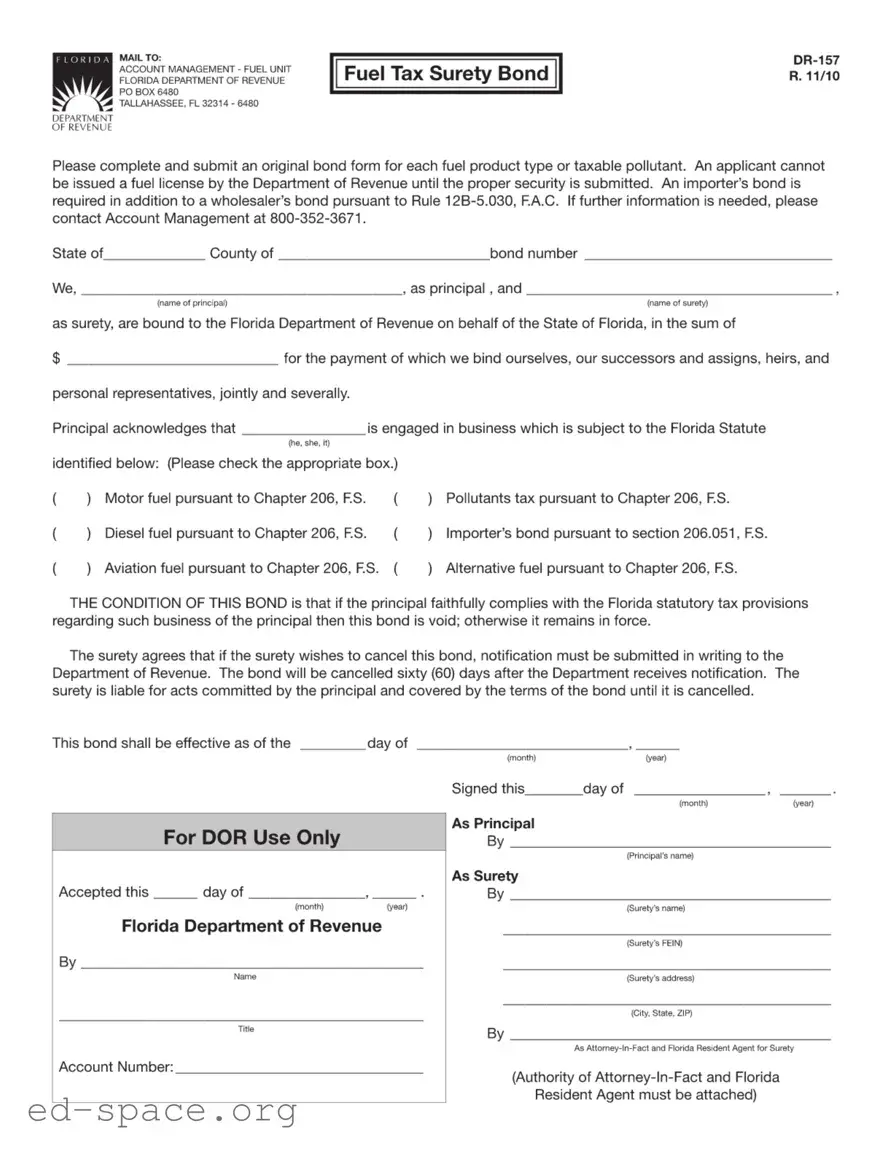
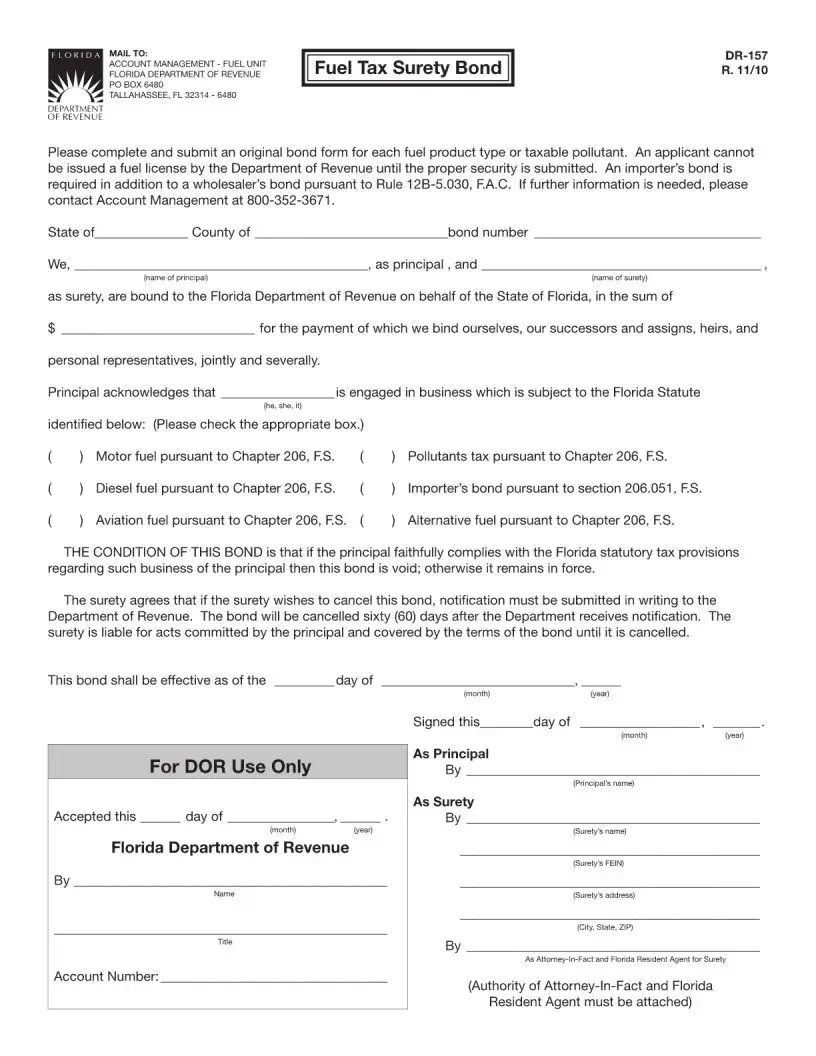
The Florida DR 157 form serves as a crucial document for businesses involved in the fuel industry, specifically concerning the submission of a fuel tax surety bond. This form must be completed and submitted in its original format for each type of fuel product or taxable pollutant that a business deals with. Before a fuel license can be issued by the Florida Department of Revenue, the appropriate security must be provided through this bond. It is important to note that an importer’s bond is a requirement in addition to a wholesaler’s bond, as stipulated by state regulations. The form outlines the obligations of the principal and the surety, detailing the amount of the bond and the specific business activities subject to Florida’s tax provisions, such as motor fuel, diesel fuel, and aviation fuel. The bond remains in effect as long as the principal adheres to the applicable statutory requirements, and provisions are included for the surety to cancel the bond with proper notification. Additionally, the form requires the signatures of both the principal and the surety, along with the necessary authority documentation for the surety's attorney-in-fact. Understanding the intricacies of the DR 157 form is essential for compliance and successful operation within Florida's fuel industry.
Document Preview

Form Specifications

Fact Name Description
Form Purpose The DR-157 form is used to submit a fuel tax surety bond to the Florida Department of Revenue.
Governing Law This form is governed by Florida Statutes, specifically Chapter 206.
Submission Requirement An original bond form is required for each type of fuel product or taxable pollutant.
License Issuance The Department of Revenue will not issue a fuel license until the proper security is submitted.
Bond Types Different bonds may be required, including an importer’s bond and a wholesaler’s bond.
Cancellation Process If a surety wants to cancel the bond, they must notify the Department of Revenue in writing.
Bond Effectiveness The bond remains in effect until the principal complies with the statutory tax provisions.

Florida Dr 157: Usage Guidelines

Completing the Florida DR 157 form is an essential step for those seeking to establish a fuel tax surety bond. This bond is necessary for obtaining a fuel license from the Department of Revenue. Following these steps will help ensure that the form is filled out accurately and submitted correctly.

  1. Begin by downloading the Florida DR 157 form from the official Florida Department of Revenue website.
  2. In the first section, fill in the State and County where the bond is being executed.
  3. Enter the bond number in the designated space.
  4. Identify the principal by providing the full name of the individual or business applying for the bond.
  5. Next, enter the name of the surety that will back the bond.
  6. Indicate the amount of the bond in the space provided.
  7. Check the appropriate box to specify the type of business engaged by the principal. Options include:
    • Motor fuel pursuant to Chapter 206, F.S.
    • Pollutants tax pursuant to Chapter 206, F.S.
    • Diesel fuel pursuant to Chapter 206, F.S.
    • Importer’s bond pursuant to section 206.051, F.S.
    • Aviation fuel pursuant to Chapter 206, F.S.
    • Alternative fuel pursuant to Chapter 206, F.S.
  8. In the next section, write the date of the bond's effectiveness by filling in the day, month, and year.
  9. Leave the section for the Department of Revenue's use blank, as it will be filled out by them upon acceptance.
  10. Sign the form as the Principal and include the date of signing.
  11. Have the Surety sign the form and provide their details, including the Surety's FEIN, address, and city, state, ZIP.
  12. Ensure that the Attorney-In-Fact and Florida Resident Agent for the Surety sign the form, and attach the necessary authority documentation.
  13. Once completed, send the original form to the Florida Department of Revenue at the provided address: PO Box 6480, Tallahassee, FL 32314-6480.

Your Questions, Answered

What is the Florida DR 157 form used for?

The Florida DR 157 form is a Fuel Tax Surety Bond required by the Florida Department of Revenue. It serves as a guarantee that businesses engaged in the sale or distribution of fuel products will comply with the relevant Florida tax statutes. This bond must be submitted for each type of fuel or taxable pollutant a business deals with, ensuring that the state is protected against potential tax liabilities arising from the principal's operations.

Who needs to submit the DR 157 form?

Any business that imports, wholesales, or distributes fuel products in Florida must submit the DR 157 form. This includes entities dealing with motor fuel, diesel fuel, aviation fuel, alternative fuels, or taxable pollutants. Importers specifically need to provide an additional bond, alongside a wholesaler’s bond, as per the state's regulations.

What happens if the bond is not submitted?

If a business fails to submit the DR 157 form and the accompanying bond, it cannot be issued a fuel license by the Florida Department of Revenue. This means that the business would be unable to legally operate in the state concerning the sale or distribution of fuel products, which could lead to penalties and legal complications.

How can the surety cancel the bond?

The surety can cancel the bond by providing written notification to the Florida Department of Revenue. Once the Department receives this notification, the bond will remain in effect for an additional sixty days. During this period, the surety remains liable for any actions committed by the principal that are covered by the bond until the cancellation becomes effective.

What information is required on the DR 157 form?

The DR 157 form requires specific information, including the name of the principal, the surety, and the bond number. Additionally, the principal must indicate the type of fuel or pollutant they are dealing with by checking the appropriate box. The bond amount, effective date, and signatures of both the principal and surety are also necessary for the form to be valid.

Common mistakes

  1. Incomplete Information: Failing to provide all required details can lead to delays. Each section of the form must be filled out completely to avoid processing issues.

  2. Incorrect Bond Amount: The bond amount must reflect the appropriate sum as required by the Department of Revenue. Errors in this figure can result in rejection of the application.

  3. Missing Signatures: Both the principal and surety must sign the form. Omitting one or both signatures will invalidate the bond.

  4. Wrong Contact Information: Providing incorrect or outdated contact information can hinder communication with the Department of Revenue. Ensure that all details are current.

  5. Failure to Check Appropriate Box: The form requires that applicants check the box corresponding to the type of fuel or pollutant. Neglecting this step may lead to confusion and delays.

  6. Not Including Required Attachments: Some submissions require additional documents, such as the authority of the Attorney-In-Fact. Missing these attachments can result in rejection.

  7. Submitting a Copy Instead of an Original: An original bond form must be submitted. Sending a copy will not be accepted and could delay your application.

  8. Ignoring Notification Requirements: If the surety wishes to cancel the bond, written notification must be sent to the Department of Revenue. Ignoring this requirement may result in continued liability.

Documents used along the form

The Florida DR-157 form is an essential document for those engaged in the fuel industry, particularly concerning fuel tax surety bonds. Along with this form, several other documents and forms are commonly used to ensure compliance with state regulations. Below is a list of these documents, each serving a specific purpose in the process.

  • Florida DR-156 Form: This form is used to apply for a fuel license. It collects information about the applicant's business and the types of fuel they intend to handle.
  • Florida DR-155 Form: This is a fuel tax return form. Businesses must file this periodically to report the amount of fuel sold and the associated taxes owed to the state.
  • Florida DR-159 Form: This document serves as an application for a refund of fuel taxes. Businesses can use it to claim refunds for overpaid taxes or taxes on exempt fuel sales.
  • Florida DR-140 Form: This is the application for a sales tax exemption. It is necessary for businesses that qualify for exemptions on certain fuel purchases.
  • Fuel Tax Surety Bond Agreement: This agreement outlines the terms and conditions under which the surety bond operates. It details the obligations of the principal and the surety.
  • Certificate of Insurance: This document proves that the business has the necessary insurance coverage as required by state law, protecting against potential liabilities.
  • Power of Attorney: This form allows an agent to act on behalf of the principal in legal matters related to the fuel license and bond. It must be completed and submitted alongside the DR-157 form.
  • Department of Revenue Correspondence: Any communication with the Florida Department of Revenue regarding the bond or fuel tax matters should be documented. This includes requests for information or clarifications.

Each of these documents plays a vital role in ensuring compliance with Florida's fuel tax regulations. Properly completing and submitting them can help avoid delays and potential penalties. Always consult with a professional if you have questions about the requirements or processes involved.

Similar forms

The Florida DR 157 form, which is a Fuel Tax Surety Bond, shares similarities with several other documents used in various financial and regulatory contexts. Below is a list of six documents that are comparable to the DR 157 form, along with descriptions of their similarities.

  • Surety Bond (General) - Like the DR 157, a general surety bond serves as a guarantee that the principal will fulfill their obligations. Both documents require a surety company to back the bond, ensuring compliance with legal or financial requirements.
  • Performance Bond - A performance bond, similar to the DR 157, is designed to protect against the failure of a contractor to complete a project as per the contract terms. Both bonds involve a principal and surety, ensuring that obligations are met.
  • License Bond - A license bond is required for businesses to operate legally, much like the DR 157 is necessary for obtaining a fuel license in Florida. Both documents ensure compliance with state regulations and protect the public from potential misconduct.
  • Payment Bond - A payment bond guarantees that a contractor will pay subcontractors and suppliers. Similar to the DR 157, it involves a surety and is focused on compliance with financial obligations within a specific industry.
  • Tax Bond - A tax bond, like the DR 157, is a form of surety that ensures payment of taxes owed to the government. Both documents serve to protect the state and ensure that financial obligations are met by the principal.
  • Customs Bond - A customs bond is required for importing goods, ensuring that duties and taxes are paid. Similar to the DR 157, it involves a surety and is essential for compliance with federal regulations regarding trade.

Dos and Don'ts

When filling out the Florida DR 157 form, it is essential to approach the task with care. Here are nine important things to keep in mind to ensure a smooth process.

  • Do use the most current version of the form to avoid any issues with outdated information.
  • Do provide complete and accurate information for all required fields. Incomplete forms can lead to delays.
  • Do check the appropriate box for the type of bond you are applying for. This is crucial for processing your application correctly.
  • Do submit the original bond form. Photocopies may not be accepted.
  • Do ensure that the bond is signed by both the principal and the surety. Missing signatures can invalidate the form.
  • Don't forget to include the bond number and the effective date. Omitting this information could result in complications.
  • Don't submit the form without verifying that all calculations and amounts are correct. Errors can lead to rejections.
  • Don't ignore the requirement for the Attorney-In-Fact and Florida Resident Agent authority to be attached. This is necessary for the surety's representation.
  • Don't hesitate to reach out to Account Management at 800-352-3671 if you have any questions or need clarification on any part of the form.

Taking the time to follow these guidelines can make a significant difference in the processing of your application. Ensure that you are thorough and attentive to detail.

Misconceptions

Understanding the Florida DR 157 form can be challenging, and there are several misconceptions that people often have. Here are six common misunderstandings:

  • Only one bond is needed for all fuel types. Many believe that a single bond suffices for different fuel products. In reality, an original bond form must be submitted for each fuel product type or taxable pollutant.
  • Once submitted, the bond cannot be canceled. Some think that once the bond is in place, it cannot be changed or canceled. However, the surety can cancel the bond by providing written notification to the Department of Revenue, which will take effect after sixty days.
  • The bond amount is fixed and cannot change. There is a misconception that the bond amount is set in stone. The amount can vary based on the specific requirements of the business and the type of fuel or pollutant involved.
  • Only wholesalers need to submit a bond. It's often assumed that only wholesalers are required to submit a bond. In fact, importers also need to provide a bond in addition to any wholesaler’s bond.
  • The bond is not necessary for compliance. Some individuals believe that the bond is optional. However, the Florida Department of Revenue requires the proper security in the form of a bond before issuing a fuel license.
  • Filing the bond is a one-time process. Many think that once the bond is filed, there are no further obligations. In reality, the principal must continue to comply with Florida's tax provisions to keep the bond valid.

By clearing up these misconceptions, individuals and businesses can better navigate the requirements associated with the Florida DR 157 form and ensure compliance with state regulations.

Key takeaways

Here are some key takeaways regarding the Florida DR 157 form:

  • Multiple Forms Required: You must complete and submit a separate bond form for each type of fuel product or taxable pollutant.
  • License Issuance: The Florida Department of Revenue will not issue a fuel license until the appropriate security is submitted.
  • Additional Bonds: If you are an importer, you need to provide an importer’s bond in addition to a wholesaler’s bond.
  • Compliance Condition: The bond remains in effect unless you comply with the Florida tax provisions related to your business.
  • Cancellation Process: If the surety wants to cancel the bond, they must notify the Department of Revenue in writing. The bond will be canceled 60 days after the Department receives this notification.