In Florida, the Do Not Resuscitate Order (DNRO) form plays a crucial role in end-of-life care decisions, allowing individuals to express their wishes regarding resuscitation efforts in the event of a medical emergency. This legally recognized document is designed for those who prefer to forgo cardiopulmonary resuscitation (CPR) and other life-sustaining treatments. It is essential for patients to understand that the DNRO must be completed and signed by a licensed physician, ensuring that it reflects informed consent. The form should be readily accessible, often kept in a visible location, such as on the refrigerator or with medical records, to ensure that emergency responders can easily find it. Additionally, the DNRO must be presented in a specific format, typically printed on bright yellow paper, to ensure its visibility and to distinguish it from other documents. Understanding the implications of this form can empower individuals to make informed decisions about their healthcare preferences, ultimately leading to a more personalized approach to medical treatment during critical moments.
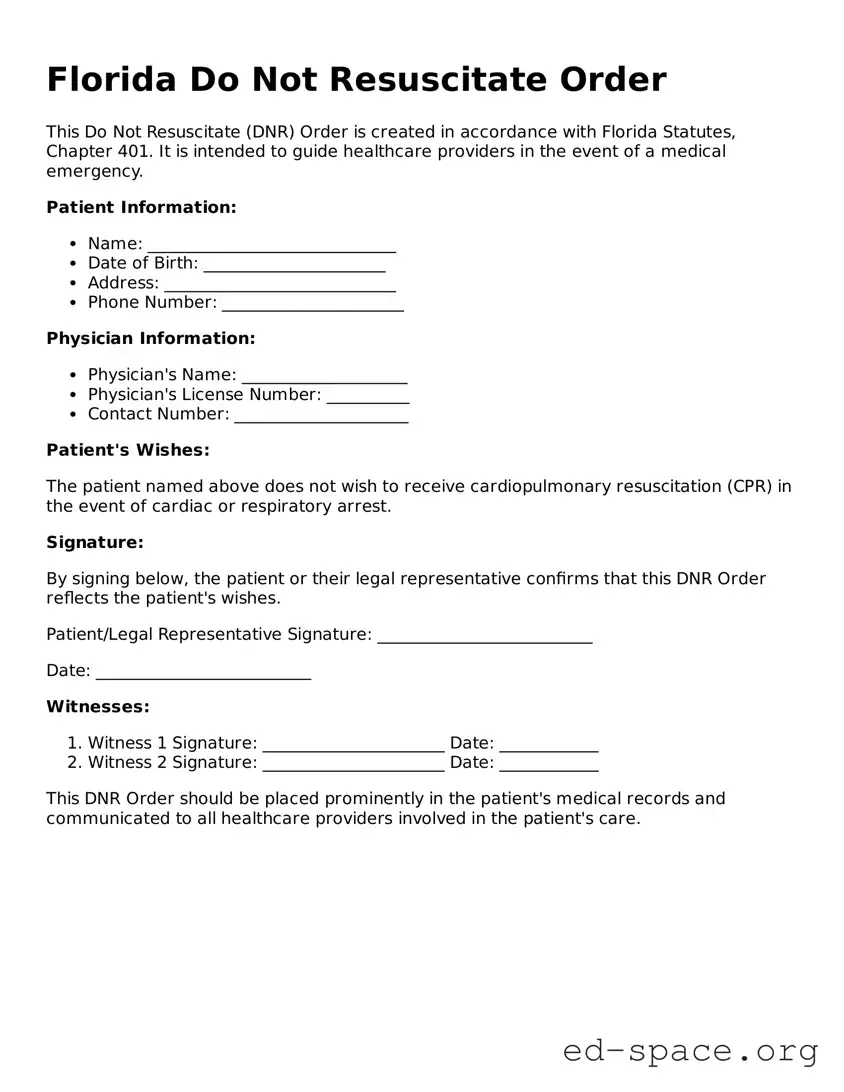
Florida Do Not Resuscitate Order
This Do Not Resuscitate (DNR) Order is created in accordance with Florida Statutes, Chapter 401. It is intended to guide healthcare providers in the event of a medical emergency.
Patient Information:
Physician Information:
Patient's Wishes:
The patient named above does not wish to receive cardiopulmonary resuscitation (CPR) in the event of cardiac or respiratory arrest.
Signature:
By signing below, the patient or their legal representative confirms that this DNR Order reflects the patient's wishes.
Patient/Legal Representative Signature: __________________________
Date: __________________________
Witnesses:
This DNR Order should be placed prominently in the patient's medical records and communicated to all healthcare providers involved in the patient's care.
| Fact Name | Description |
|---|---|
| Definition | A Florida Do Not Resuscitate (DNR) Order is a legal document that instructs medical personnel not to perform cardiopulmonary resuscitation (CPR) if a person's heart stops or they stop breathing. |
| Governing Law | The DNR Order is governed by Florida Statutes, specifically Chapter 401.45, which outlines the requirements and procedures for creating and implementing a DNR Order. |
| Eligibility | Any adult who is capable of making their own medical decisions can create a DNR Order, provided they understand the implications of the order. |
| Form Requirements | The DNR Order must be completed on a specific form provided by the Florida Department of Health and must be signed by the patient and their physician. |
| Revocation | A DNR Order can be revoked at any time by the patient or their legal representative. This can be done verbally or by destroying the document. |
| Emergency Medical Services (EMS) | Emergency medical personnel are required to honor a valid DNR Order. They will check for the presence of the order before initiating resuscitation efforts. |
| Placement of the Form | It is advisable to keep the DNR Order in an easily accessible location, such as on the refrigerator or with other important medical documents, to ensure it is readily available in an emergency. |
| Healthcare Proxy | Individuals may also designate a healthcare proxy to make medical decisions on their behalf, which can include the decision to issue a DNR Order. |
| Public Awareness | Public education about DNR Orders is crucial. Many people may not be aware of the option or the implications of having such an order in place. |
Completing the Florida Do Not Resuscitate Order form is an important step in ensuring your healthcare preferences are respected. This form allows individuals to express their wishes regarding resuscitation efforts in the event of a medical emergency. It is essential to approach this process thoughtfully and carefully.
After completing the form, it is advisable to discuss your wishes with your healthcare provider and loved ones. This ensures that everyone understands your preferences and can act accordingly in a medical situation.
What is a Florida Do Not Resuscitate Order (DNRO)?
A Florida Do Not Resuscitate Order is a legal document that allows a person to refuse resuscitation efforts in the event of a cardiac arrest or respiratory failure. This order must be signed by a physician and is intended for individuals who wish to avoid life-saving measures such as CPR, intubation, or other advanced life support interventions. It is important for this order to be clearly understood by both the patient and their healthcare providers.
Who can request a Do Not Resuscitate Order in Florida?
In Florida, any adult who is capable of making their own medical decisions can request a DNRO. This includes individuals with terminal illnesses, those in a persistent vegetative state, or anyone who wishes to avoid aggressive medical interventions. Additionally, a legal guardian or healthcare surrogate may also request a DNRO on behalf of an individual who is unable to make decisions for themselves.
How do I obtain a Do Not Resuscitate Order in Florida?
To obtain a DNRO, you must first consult with a physician. The physician will assess your medical condition and discuss your wishes regarding resuscitation. If you and your physician agree that a DNRO is appropriate, the physician will complete and sign the form. After it is signed, you should keep the original document in a safe place and provide copies to your healthcare providers and family members.
Is a Do Not Resuscitate Order valid in all healthcare settings?
Yes, a valid Florida DNRO is recognized in various healthcare settings, including hospitals, nursing homes, and emergency medical services. However, it is crucial to ensure that the DNRO is properly completed and signed by a physician. Emergency medical personnel are trained to honor these orders, but it is advisable to keep the document accessible and inform family members and caregivers about its existence to prevent any confusion during emergencies.
Can a Do Not Resuscitate Order be revoked?
Yes, a DNRO can be revoked at any time by the individual who created it. This can be done verbally or in writing. It is important to communicate your decision to revoke the order to your healthcare providers and family members. If you wish to create a new DNRO after revocation, you will need to follow the same process of consultation with a physician and completing the necessary paperwork.
Not signing the form. The Do Not Resuscitate Order must be signed by the patient or their legal representative to be valid.
Failing to date the form. A missing date can lead to confusion about the order's validity.
Using outdated forms. Ensure that the most current version of the Do Not Resuscitate Order form is being used.
Not providing clear identification. The form should include the patient's full name and any relevant identification numbers to avoid misinterpretation.
Overlooking witness signatures. In some cases, a witness signature may be required for the order to be enforceable.
Not discussing the order with healthcare providers. Communication with medical professionals is essential to ensure that everyone understands the patient's wishes.
Neglecting to review the order periodically. Changes in health status or personal wishes may necessitate updates to the order.
Assuming the form is only for terminal illnesses. The Do Not Resuscitate Order can apply in various medical situations, not just terminal conditions.
When considering end-of-life care options, it is important to be aware of various documents that can help ensure your wishes are respected. The Florida Do Not Resuscitate Order (DNRO) form is one such document, but it often works in conjunction with other forms. Below are several key documents that you might encounter or wish to consider alongside the DNRO.
Understanding these documents can provide peace of mind. They help ensure that your healthcare preferences are honored and that your loved ones are not left making difficult decisions during challenging times. It is advisable to discuss these options with family members and healthcare providers to ensure everyone is aligned with your wishes.
A Do Not Resuscitate (DNR) Order is an important document that outlines a person's wishes regarding resuscitation efforts in the event of cardiac arrest or respiratory failure. Several other documents serve similar purposes in expressing healthcare preferences. Here are six documents that are comparable to a DNR Order:
When filling out the Florida Do Not Resuscitate Order form, it is important to follow specific guidelines to ensure that your wishes are clearly communicated. Here are five key do's and don'ts to consider:
Understanding the Florida Do Not Resuscitate (DNR) Order form is crucial for individuals and families making end-of-life decisions. However, several misconceptions can lead to confusion. Here are nine common misconceptions about the Florida DNR Order:
This is not true. A DNR only indicates that resuscitation efforts should not be made in the event of cardiac arrest. Other medical treatments can still be administered.
While most healthcare providers are required to honor a DNR, there may be exceptions in certain situations, such as in hospitals where protocols differ.
This is a common misconception. Individuals of any age or health status can choose to have a DNR if they do not wish to undergo resuscitation.
In fact, individuals can revoke a DNR order at any time, as long as they are mentally competent to do so.
These documents serve different purposes. A living will outlines specific medical treatments you do or do not want, while a DNR specifically addresses resuscitation efforts.
This is a misunderstanding. A DNR reflects a personal choice about the nature of medical interventions, not a desire to end life.
A Florida DNR is recognized in other states, but it’s wise to check local laws, as some states may have different requirements or forms.
A DNR order is typically valid until it is revoked or until the individual’s condition changes significantly.
Only the individual or their legally authorized representative can sign a DNR order. This ensures that the person’s wishes are respected.
By clarifying these misconceptions, individuals can make informed decisions regarding their healthcare preferences. It’s essential to have open discussions with family and healthcare providers about DNR orders to ensure that everyone understands and respects your wishes.
Filling out a Do Not Resuscitate (DNR) Order form in Florida is an important step for individuals who wish to express their healthcare preferences. Here are some key takeaways to consider: