In Florida, homeowners facing financial difficulties and the prospect of foreclosure may consider a Deed in Lieu of Foreclosure as a potential solution. This legal document allows a homeowner to voluntarily transfer ownership of their property to the lender, effectively settling the mortgage debt without going through the lengthy and often stressful foreclosure process. By executing this form, the homeowner can avoid the negative impacts of foreclosure on their credit score and may also negotiate terms that allow for a smoother transition. The Deed in Lieu of Foreclosure form typically includes essential details such as the property description, the names of the parties involved, and the lender's acceptance of the deed. It is important for homeowners to understand that while this option can provide relief, it does not absolve them of all financial obligations, and certain conditions may apply. Engaging with the lender early in the process can lead to a more favorable outcome, making it crucial for homeowners to explore this option as a viable alternative to foreclosure.
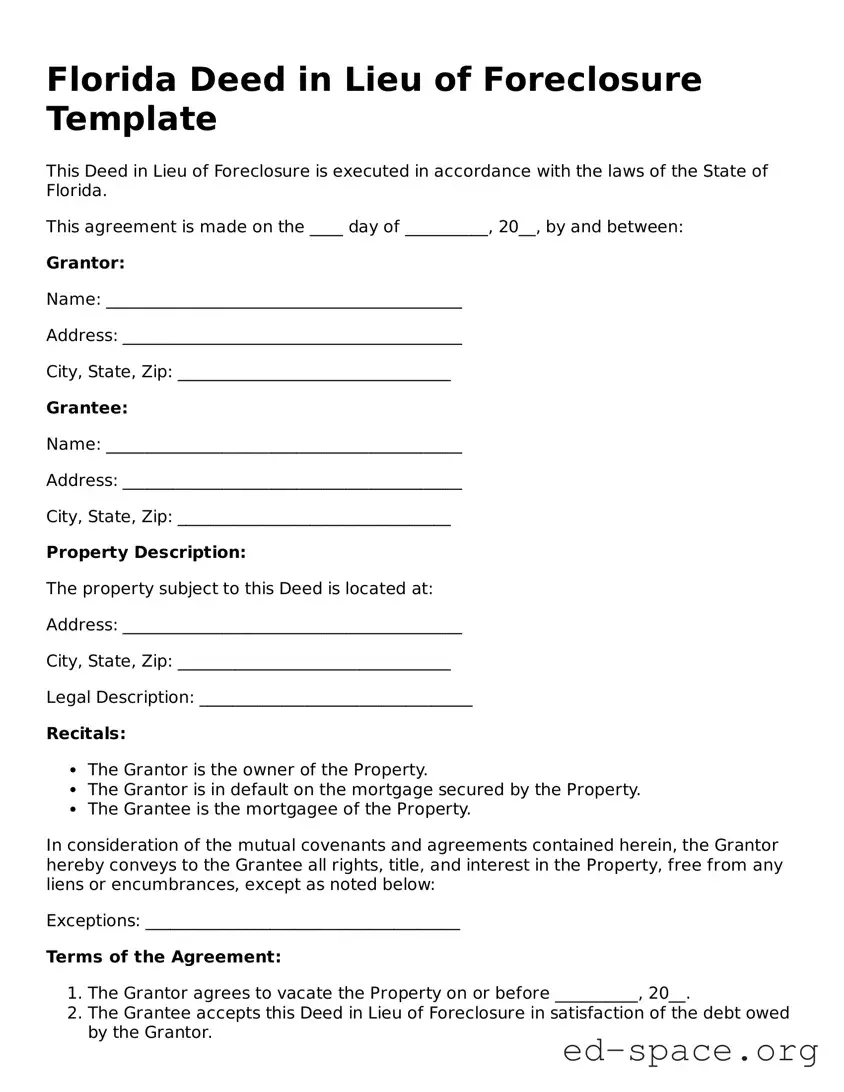
Florida Deed in Lieu of Foreclosure Template
This Deed in Lieu of Foreclosure is executed in accordance with the laws of the State of Florida.
This agreement is made on the ____ day of __________, 20__, by and between:
Grantor:
Name: ___________________________________________
Address: _________________________________________
City, State, Zip: _________________________________
Grantee:
Name: ___________________________________________
Address: _________________________________________
City, State, Zip: _________________________________
Property Description:
The property subject to this Deed is located at:
Address: _________________________________________
City, State, Zip: _________________________________
Legal Description: _________________________________
Recitals:
In consideration of the mutual covenants and agreements contained herein, the Grantor hereby conveys to the Grantee all rights, title, and interest in the Property, free from any liens or encumbrances, except as noted below:
Exceptions: ______________________________________
Terms of the Agreement:
This Deed in Lieu of Foreclosure is binding upon the parties and their respective successors and assigns.
IN WITNESS WHEREOF, the parties have executed this Deed in Lieu of Foreclosure as of the date first above written.
Grantor Signature: ___________________________
Date: ______________________________________
Grantee Signature: __________________________
Date: ______________________________________
Witnesses:
1. ___________________________________________
2. ___________________________________________
STATE OF FLORIDA
COUNTY OF _______________
On this ____ day of __________, 20__, before me, a Notary Public in and for said County and State, personally appeared ___________________________, known to me to be the person who executed the foregoing instrument.
Notary Public Signature: _________________________
My Commission Expires: _________________________
| Fact Name | Details |
|---|---|
| Definition | A deed in lieu of foreclosure is a legal document where a borrower voluntarily transfers ownership of their property to the lender to avoid foreclosure. |
| Governing Law | The process is governed by Florida Statutes, specifically Chapter 701. |
| Eligibility | Homeowners facing financial hardship and unable to keep up with mortgage payments may qualify for this option. |
| Benefits | This option can help homeowners avoid the lengthy and damaging foreclosure process. |
| Impact on Credit | A deed in lieu may have a less severe impact on credit scores compared to a foreclosure. |
| Deficiency Judgments | In some cases, lenders may still pursue deficiency judgments for the remaining balance owed after the deed transfer. |
| Negotiation | Homeowners can negotiate terms with lenders, including potential waivers on deficiency judgments. |
| Documentation | Proper documentation, including a formal agreement and property deed, is essential for the process. |
| Legal Advice | Consulting with a legal professional is advisable to understand the implications fully. |
Once you have the Florida Deed in Lieu of Foreclosure form, you will need to complete it carefully. This process involves providing accurate information about the property and the parties involved. After filling out the form, you will typically submit it to the lender for review and processing.
What is a Deed in Lieu of Foreclosure in Florida?
A Deed in Lieu of Foreclosure is a legal document that allows a homeowner to transfer ownership of their property to the lender to avoid foreclosure. In Florida, this process can help both parties. The homeowner can relieve themselves of the mortgage debt, while the lender can take possession of the property without going through the lengthy and costly foreclosure process.
What are the benefits of using a Deed in Lieu of Foreclosure?
There are several benefits to consider. First, it can be a quicker process than foreclosure, allowing homeowners to move on sooner. Second, it typically results in less damage to the homeowner's credit score compared to a foreclosure. Additionally, the lender may agree to forgive any remaining mortgage debt, providing financial relief to the homeowner. Lastly, it can save both parties time and money by avoiding the court system.
What are the requirements to complete a Deed in Lieu of Foreclosure?
To qualify for a Deed in Lieu of Foreclosure, homeowners must demonstrate financial hardship and be unable to keep up with mortgage payments. Lenders usually require that the homeowner is current on property taxes and insurance. It's also important to have the lender's approval before proceeding, as they will need to accept the deed transfer. Homeowners should review their mortgage documents and consult with a legal professional to understand their specific situation.
How does the process work?
The process begins with the homeowner contacting their lender to express interest in a Deed in Lieu of Foreclosure. After receiving approval, the homeowner will need to prepare the deed, which must be signed and notarized. Once completed, the deed is submitted to the county clerk's office for recording. This officially transfers ownership of the property to the lender. Homeowners should also ensure they receive a release of liability for any remaining mortgage debt.
Can a Deed in Lieu of Foreclosure affect my credit score?
Yes, a Deed in Lieu of Foreclosure can affect your credit score, but generally less severely than a foreclosure. While it will still be noted on your credit report, the impact may be less damaging. It’s crucial to understand that each lender may report it differently, so checking with your lender about how they will report the deed is advisable. Overall, it can be a more favorable option for those looking to recover from financial difficulties.
Failing to provide accurate property information. Ensure that the property address and legal description are correct. Any discrepancies can lead to delays or complications.
Not including all necessary parties. All owners of the property must sign the deed. Omitting a co-owner can invalidate the deed.
Overlooking the requirement for notarization. The deed must be signed in front of a notary public. Without this step, the document may not be legally recognized.
Neglecting to check for existing liens. Before completing the deed, confirm that there are no outstanding liens or claims against the property that could complicate the transfer.
Using incorrect legal terminology. While the form may seem straightforward, using the wrong terms can create confusion or lead to legal challenges.
Failing to understand the tax implications. A deed in lieu of foreclosure can have tax consequences. Consulting with a tax professional is advisable.
Not retaining copies of the completed form. Keep a signed copy for personal records. This can be important for future reference.
Submitting the form without confirming lender acceptance. Before proceeding, ensure that the lender has agreed to the deed in lieu of foreclosure.
Ignoring state-specific requirements. Each state may have different rules regarding deeds in lieu of foreclosure. Familiarize yourself with Florida's specific regulations.
A Deed in Lieu of Foreclosure can be a useful tool for homeowners facing financial difficulties. However, several other documents often accompany this form to ensure a smooth process. Below is a list of these documents, along with brief descriptions of their purposes.
Understanding these accompanying documents can help homeowners navigate the deed in lieu process more effectively. Each document serves a specific purpose and contributes to a clearer understanding of the transaction, ultimately aiding in a smoother resolution.
When filling out the Florida Deed in Lieu of Foreclosure form, it is essential to approach the process with care and attention to detail. Here are ten important do's and don'ts to keep in mind:
By adhering to these guidelines, you can navigate the process more effectively and make informed decisions regarding your property.
Understanding the Florida Deed in Lieu of Foreclosure can help homeowners make informed decisions during tough times. However, several misconceptions can cloud the reality of this process. Here are seven common misconceptions:
Being informed about these misconceptions can help you navigate your options more effectively. If you are considering this route, seek guidance to understand the implications fully.
When considering the Florida Deed in Lieu of Foreclosure form, it is important to keep the following key points in mind:
Taking these points into consideration can help homeowners navigate the process more effectively and make informed decisions.