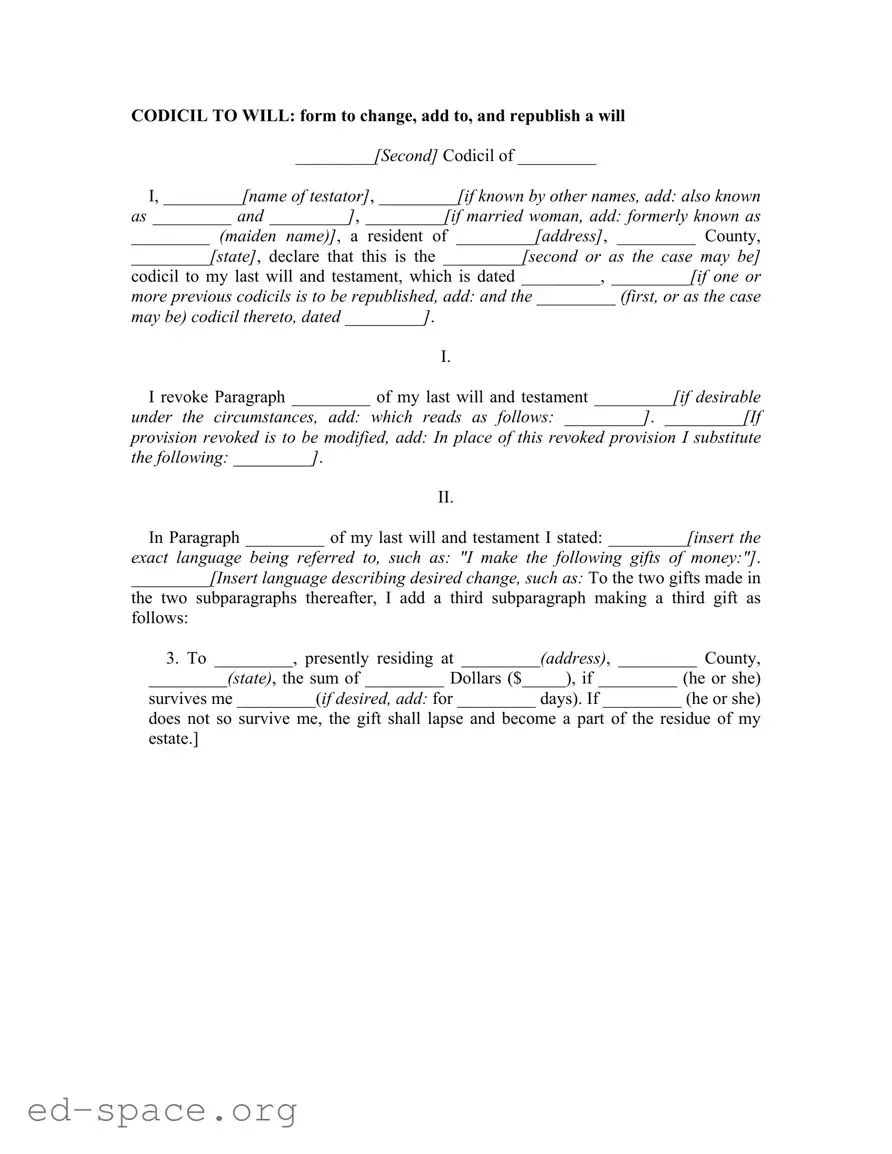
The Florida Codicil form serves as an important legal document for individuals wishing to make changes to their existing wills. This form allows a testator to modify specific provisions, add new gifts, or revoke previous directives without the need to create an entirely new will. Key elements of the codicil include the identification of the testator, the declaration of the codicil as a modification to the last will, and the specification of which paragraphs are being revoked or altered. The testator can also confirm and republish the original will, ensuring that all aspects remain valid except for those explicitly changed. Witnesses must sign the document, affirming that they observed the testator's signature and understood the nature of the codicil. This process provides a clear and organized method for individuals to update their estate plans as circumstances evolve.
CODICIL TO WILL: form to change, add to, and republish a will
_________[Second] Codicil of _________
I, _________[name of testator], _________[if known by other names, add: also known
as _________ and _________], _________[if married woman, add: formerly known as
_________ (maiden name)], a resident of _________[address], _________ County,
_________[state], declare that this is the _________[second or as the case may be]
codicil to my last will and testament, which is dated _________, _________[if one or
more previous codicils is to be republished, add: and the _________ (first, or as the case
may be) codicil thereto, dated _________].
I.
I revoke Paragraph _________ of my last will and testament _________[if desirable
under the circumstances, add: which reads as follows: _________]. _________[If
provision revoked is to be modified, add: In place of this revoked provision I substitute
the following: _________].
II.
In Paragraph _________ of my last will and testament I stated: _________[insert the
exact language being referred to, such as: "I make the following gifts of money:"].
_________[Insert language describing desired change, such as: To the two gifts made in
the two subparagraphs thereafter, I add a third subparagraph making a third gift as follows:
3.To _________, presently residing at _________(address), _________ County,
_________(state), the sum of _________ Dollars ($_____), if _________ (he or she) survives me _________(if desired, add: for _________ days). If _________ (he or she) does not so survive me, the gift shall lapse and become a part of the residue of my estate.]
III.
I hereby confirm and republish my will dated _________, _________[if previous
codicil is to be republished, add: and my codicil to that will dated _________] in all
respects other than those
I subscribe my name to this codicil on _________[date], at _________[address],
_________ County, _________[state], in the presence of _________, _________, and
_________, attesting witnesses, who subscribe their names to this codicil on
_________[date] at my request and in my presence.
[Signature]
ATTESTATION CLAUSE
On the date last above written, _________[testator's name], known to us to be the
person whose signature
page on which we have signed as witnesses, was the _________[number, such as:
second] codicil to _________[his or her] will dated _________. _________[He or She]
then signed the codicil in our presence and, at _________[his or her] request, in
_________[his or her] presence and in the presence of each other, we now sign our
names as witnesses. |
|
|
_________, |
residing at |
_________ |
[Signature] |
|
[Street, city, state] |
_________, |
residing at |
_________ |
[Signature] |
|
[Street, city, state] |
_________, |
residing at |
_________ |
[Signature] |
|
[Street, city, state] |
| Fact Name | Description |
|---|---|
| Purpose | The Florida Codicil form is used to change, add to, or republish an existing will. |
| Governing Law | This form is governed by Florida Statutes Chapter 732, which covers wills and estates. |
| Testator Requirements | The individual creating the codicil, known as the testator, must be at least 18 years old and of sound mind. |
| Witnesses | The codicil must be signed in the presence of at least two witnesses, who must also sign the document. |
| Revocation | The codicil can revoke specific paragraphs of the existing will, allowing for targeted changes. |
| Publication | By signing the codicil, the testator confirms and republishes their original will, maintaining its validity. |
| Address Requirement | The testator must provide their current address, which is included in the codicil for identification purposes. |
Filling out the Florida Codicil form is a straightforward process that allows you to make changes to your existing will. After completing the form, ensure it is signed and witnessed properly to maintain its validity.
What is a Florida Codicil form?
A Florida Codicil form is a legal document used to make changes, additions, or clarifications to an existing will. It allows you to modify specific provisions without having to create an entirely new will. This can be particularly useful for updating beneficiaries or altering specific bequests as your circumstances change.
Why would I need a Codicil?
You might need a Codicil if you want to change certain aspects of your will without starting from scratch. For example, if you’ve had a change in your relationships, such as a marriage, divorce, or the birth of a child, a Codicil can help you update your will to reflect these changes. It’s a straightforward way to ensure your wishes are current and accurately represented.
How do I complete a Florida Codicil form?
To complete a Florida Codicil form, you need to fill in your personal information, including your name and address. Specify which provisions of your will you are revoking or modifying. Clearly state any new provisions you wish to add. Finally, you must sign the document in front of at least two witnesses, who will also need to sign it, confirming they witnessed your signature.
Do I need witnesses for a Codicil?
Yes, you do need witnesses for a Florida Codicil. Florida law requires that the Codicil be signed in the presence of at least two witnesses. These witnesses must also sign the document, attesting that they witnessed you signing the Codicil. This step is crucial to ensure the validity of the document.
Can I revoke a Codicil?
Yes, you can revoke a Codicil. If you decide that you no longer want the changes made by the Codicil, you can create a new Codicil that explicitly revokes the previous one. Alternatively, you can revoke it by physically destroying it or by stating your intention to revoke it in a new will.
Is a Codicil legally binding?
Yes, a properly executed Codicil is legally binding in Florida, just like a will. As long as it meets all the legal requirements, including being signed and witnessed correctly, it will be enforceable. It’s essential to ensure that the Codicil is clear and unambiguous to avoid any potential disputes in the future.
Can I use a Codicil if my will is very old?
Yes, you can use a Codicil even if your will is old. However, it’s important to ensure that the language in the Codicil is clear and that it accurately reflects your current wishes. If your will is significantly outdated, you might want to consider drafting a new will instead, as it can provide a more comprehensive update to your estate plan.
What happens if I don't have a Codicil or a new will?
If you do not have a Codicil or a new will, your estate will be distributed according to Florida's intestacy laws upon your death. This means that your assets may not be distributed according to your wishes, as they will be divided among your heirs as determined by state law. To avoid this, it’s essential to keep your estate planning documents updated.
Failing to include the correct date of the original will or previous codicils. This can create confusion about the order of documents.
Not clearly identifying the testator. It's important to include the full name and any known aliases to avoid ambiguity.
Leaving out the specific paragraph numbers being revoked or modified. This can lead to misunderstandings about which provisions are affected.
Using vague language when describing changes. It’s essential to be precise to ensure the intentions are clear.
Not having the codicil witnessed properly. Florida law requires at least two witnesses, and they must sign in the presence of the testator.
Forgetting to include the address of the testator and witnesses. This information is necessary for verification purposes.
Failing to indicate whether gifts are contingent. If a beneficiary does not survive the testator, it should be clearly stated what happens to the gift.
Not confirming the republishing of the original will and any previous codicils. This is crucial to ensure the latest intentions are recognized.
Neglecting to sign and date the codicil. Without the testator's signature, the document may not be considered valid.
When dealing with estate planning in Florida, the Florida Codicil form is often accompanied by several other important documents. Each of these documents serves a specific purpose in ensuring that an individual's wishes regarding their estate are clearly articulated and legally binding. Below is a list of five common forms and documents that may be used alongside the Florida Codicil form.
Understanding these documents and how they interact with the Florida Codicil form is crucial for effective estate planning. Each plays a vital role in ensuring that a person's wishes are respected and legally upheld, providing peace of mind for both the individual and their loved ones.
The Florida Codicil form serves a specific purpose in estate planning, allowing individuals to modify their existing wills. Several other documents share similarities with the codicil, each serving unique functions in the realm of estate management. Here’s a breakdown of seven such documents:
Understanding these documents and their similarities can empower individuals to make informed decisions about their estate planning needs.
When filling out the Florida Codicil form, there are important guidelines to follow. Here is a list of things you should and shouldn't do:
Misconceptions about the Florida Codicil form can lead to confusion when making changes to a will. Here are nine common misunderstandings:
Understanding these misconceptions can help you navigate the process of updating your will more effectively. Always consider seeking professional guidance to ensure your wishes are clearly documented and legally binding.
When considering the Florida Codicil form, keep these key takeaways in mind: