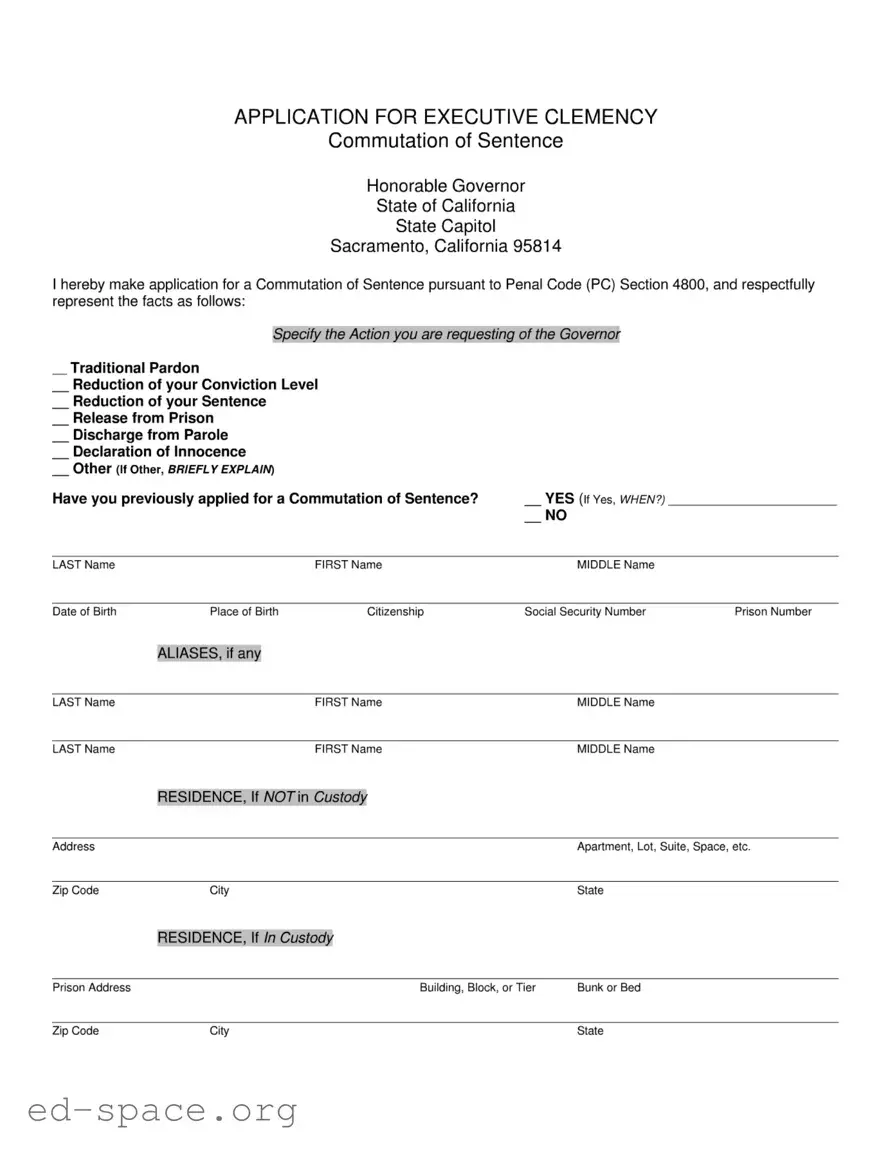
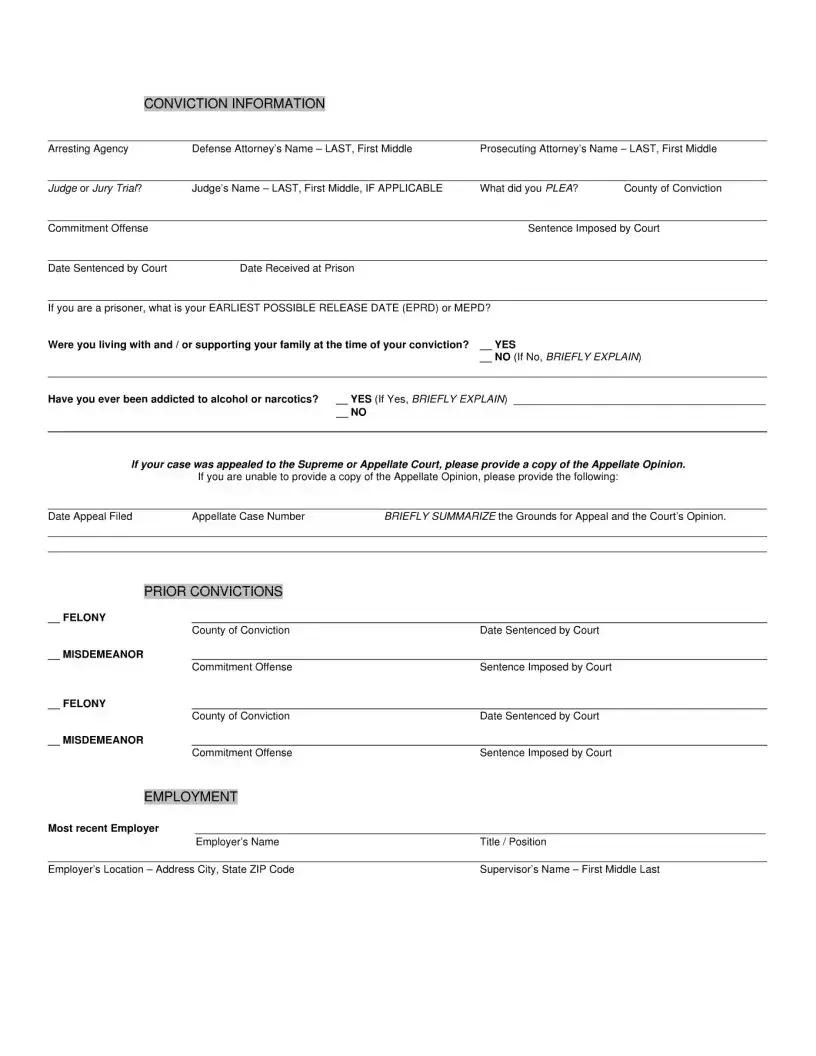
The Florida Clemency Application form serves as a crucial tool for individuals seeking to regain certain rights and privileges after a criminal conviction. This form outlines various types of clemency that applicants may request, including the Restoration of Civil Rights, which is available for both Florida and out-of-state convictions. Additionally, applicants can seek a Full Pardon or a Pardon Without Firearm Authority, with eligibility typically set at ten years post-sentence completion. For those wishing to possess firearms, a specific authority can be granted eight years after the sentence is completed. The application requires the inclusion of relevant court documents for each conviction, ensuring that the process is grounded in verified legal history. Personal information such as name, date of birth, and contact details must be provided, along with a detailed account of each conviction. Notably, applicants do not need to submit separate applications for multiple convictions, simplifying the process. It is essential to attach certified copies of necessary legal documents, as applications lacking these will be returned. The form emphasizes that individuals can navigate this process without legal representation, although they may choose to engage an attorney if preferred. This application represents a pathway to reclaiming lost rights and is an important step for many seeking a fresh start in Florida.
| Fact Name | Details |
|---|---|
| Types of Clemency | The application allows for several types of clemency, including Restoration of Civil Rights, Full Pardon, and Commutation of Sentence. |
| Eligibility Criteria | Eligibility for certain clemency types, such as Full Pardon and Pardon Without Firearm Authority, requires a waiting period of 10 years after completing the sentence. |
| Required Documentation | All applications must include proper court documents for each conviction. Missing documents will result in the application being returned. |
| Signature Requirement | The applicant must sign the form to acknowledge understanding of the clemency process and any actions taken. |
| Governing Law | The clemency process in Florida is governed by the Rules of Executive Clemency, which can be found on the Florida Office of Executive Clemency website. |
Filling out the Florida Clemency Application form is a crucial step in seeking clemency. Once you complete the form and gather the necessary documents, you will be ready to submit your application to the Office of Executive Clemency. Make sure to follow each step carefully to ensure your application is processed smoothly.
What is the Florida Clemency Application form used for?
The Florida Clemency Application form is utilized by individuals seeking various types of clemency, including the restoration of civil rights, full pardons, and specific authority to own or possess firearms. Each type of clemency has specific eligibility requirements and must be accompanied by the appropriate court documents.
What types of clemency can I apply for?
Applicants can choose from several types of clemency, including: Restoration of Civil Rights for Florida convictions, Restoration of Civil Rights for federal, military, or out-of-state convictions, Restoration of Alien Status under Florida law, Remission of Fine or Forfeiture, Specific Authority to Own, Possess or Use Firearms, Full Pardon, Pardon Without Firearm Authority, and Commutation of Sentence. Each type has its own eligibility criteria.
What documents must I attach to my application?
It is essential to attach certified copies of specific court documents for each felony conviction. These documents include the charging indictment or information, judgment, and sentence or community control/probation order. Applications submitted without these documents will be returned.
Is there a waiting period for certain types of clemency?
Yes, there are waiting periods for specific types of clemency. For instance, individuals must wait eight years after completing their sentence to apply for Specific Authority to Own, Possess or Use Firearms. Similarly, a Full Pardon or Pardon Without Firearm Authority requires a waiting period of ten years.
Can I submit one application for multiple convictions?
Yes, you do not need to fill out separate applications for each conviction. You can list multiple convictions on a single application, but you must provide the required court documents for each conviction listed.
Do I need an attorney to apply for clemency?
No, you do not need an attorney to submit a clemency application. However, if you choose to be represented by an attorney during the clemency process, you will need to provide their name, address, and phone number on the application.
What happens if my application is returned?
If your application is returned, it may be due to missing documents or not meeting eligibility requirements. For example, if you have already received Restoration of Civil Rights, your application will be returned along with a Certificate for Restoration of Civil Rights, and your signature will acknowledge this action.
Where can I find more information about the clemency process?
More information, including the application form and the Rules of Executive Clemency, can be found on the Florida Office of Executive Clemency website at https://foc.state.fl.us/Clemency.htm. This resource provides comprehensive details regarding the application process and requirements.
What is the mailing address for submitting my application?
Applications should be mailed to the Office of Executive Clemency at 4070 Esplanade Way, Tallahassee, FL 32399-2450. Ensure all required documents are included to avoid delays in processing.
Neglecting to Attach Required Court Documents: One of the most common mistakes is failing to include the necessary court documents. Each felony conviction requires specific documents like charging indictment, judgment, and sentence orders. Without these, the application will be returned.
Incorrectly Completing the Personal Information Section: Many applicants make errors in this section, such as misspelling their names or providing inaccurate dates of birth. These mistakes can lead to delays or rejections.
Not Checking the Correct Type of Clemency: The application form has various types of clemency. Failing to select the appropriate box can result in processing the application incorrectly or not at all.
Overlooking the Signature Requirement: Some applicants forget to sign the application. A missing signature can render the entire application invalid, causing unnecessary setbacks.
Listing More Convictions Than Necessary: While it’s essential to provide information on all convictions, applicants sometimes attach unnecessary documents or fill out separate applications for multiple convictions. This can complicate the process.
Failing to Provide Accurate Contact Information: Providing incorrect or outdated contact information can hinder communication from the clemency office. This mistake can lead to missed notifications or requests for additional information.
Ignoring Eligibility Requirements: Each type of clemency has specific eligibility criteria. Some applicants do not review these requirements carefully and submit applications for which they are not eligible, wasting time and resources.
When applying for clemency in Florida, several additional forms and documents are often required to support your application. Each document serves a specific purpose and is crucial for a complete submission. Below is a list of commonly used documents that should accompany the Florida Clemency Application form.
Submitting a complete and accurate application is vital for a successful clemency process. Ensure all required documents are included to avoid delays or rejections. Take the time to gather these materials carefully, as they can significantly impact the outcome of your application.
When filling out the Florida Clemency Application form, it is important to approach the process with care and attention. Here are some key dos and don’ts to keep in mind:
By following these guidelines, you can help ensure that your application is processed smoothly and efficiently. Take your time and approach each section thoughtfully.
Understanding the Florida Clemency Application can be challenging due to several misconceptions that often arise. Here are six common misunderstandings:
Clarifying these misconceptions can help applicants navigate the clemency process more effectively, ensuring they meet all necessary requirements and understand the steps involved.
Filling out the Florida Clemency Application form can be a straightforward process if you keep a few key points in mind. Understanding the requirements and ensuring that all necessary documents are included will help streamline your application. Here are some important takeaways:
By following these guidelines, you can enhance the chances of a successful clemency application. Take your time to ensure accuracy and completeness in your submission.