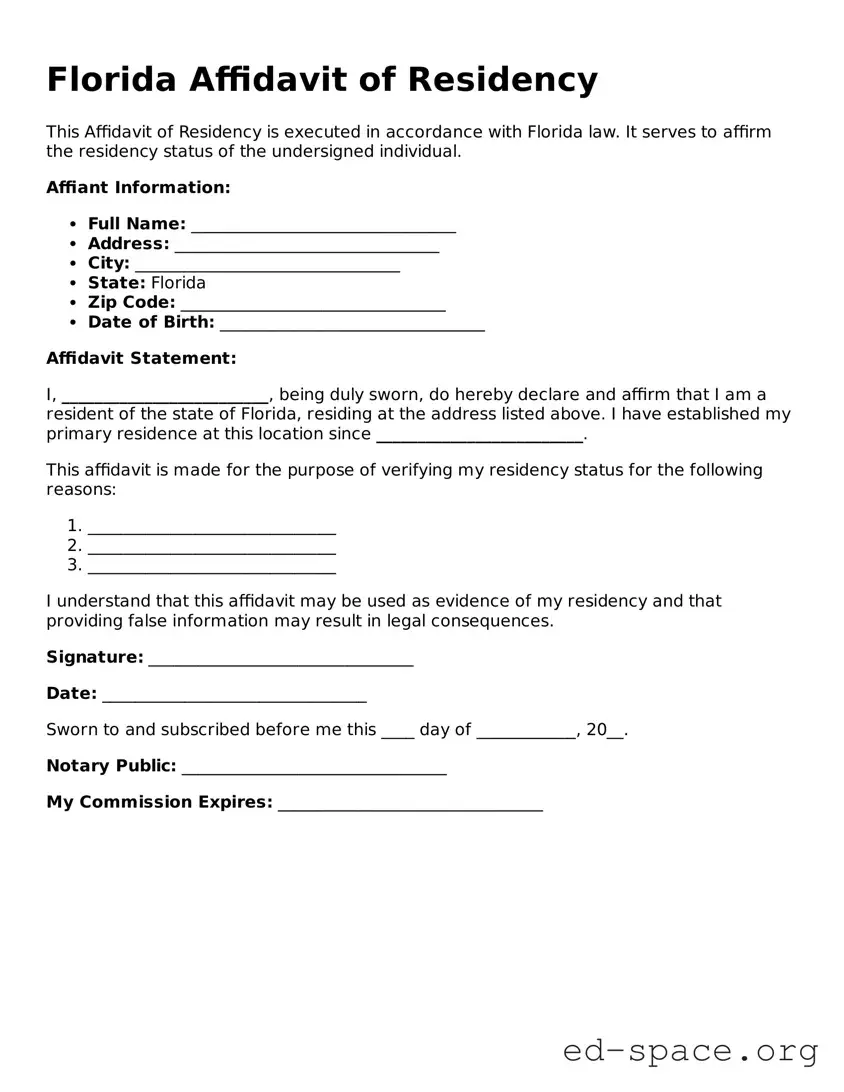
The Florida Affidavit of Residency form is an essential document for individuals seeking to establish proof of residency within the state. This form is often used in various situations, such as enrolling children in school, obtaining a driver's license, or registering to vote. It requires the individual to provide personal information, including their name, address, and the duration of their residency. Additionally, the form may ask for supporting documentation to verify the claimed residency, such as utility bills or lease agreements. Completing this affidavit accurately is crucial, as it serves to affirm one's legal residence and can impact eligibility for certain benefits and services. Understanding the requirements and implications of this form is vital for anyone looking to navigate the administrative processes in Florida effectively.
Florida Affidavit of Residency
This Affidavit of Residency is executed in accordance with Florida law. It serves to affirm the residency status of the undersigned individual.
Affiant Information:
Affidavit Statement:
I, _________________________, being duly sworn, do hereby declare and affirm that I am a resident of the state of Florida, residing at the address listed above. I have established my primary residence at this location since _________________________.
This affidavit is made for the purpose of verifying my residency status for the following reasons:
I understand that this affidavit may be used as evidence of my residency and that providing false information may result in legal consequences.
Signature: ________________________________
Date: ________________________________
Sworn to and subscribed before me this ____ day of ____________, 20__.
Notary Public: ________________________________
My Commission Expires: ________________________________
| Fact Name | Details |
|---|---|
| Purpose | The Florida Affidavit of Residency form is used to establish a person's residence in Florida. |
| Governing Law | This form is governed by Florida Statutes, Chapter 92.525. |
| Who Can Use It | Any individual who needs to prove their residency in Florida can use this form. |
| Filing Requirement | The affidavit must be signed in the presence of a notary public. |
| Supporting Documents | Applicants may need to provide additional documents, such as utility bills or lease agreements. |
| Validity | The affidavit is typically valid until the residency status changes. |
| Usage | This form is often required for school registration, voter registration, and other legal matters. |
| Submission | The completed form should be submitted to the appropriate agency or institution requiring proof of residency. |
Once you have your Florida Affidavit of Residency form ready, it’s time to fill it out. This form is important for establishing your residency in Florida. Follow these steps to complete it accurately.
After filling out the form, make sure to review it for any errors. Once you confirm that all information is correct, you can submit it according to the instructions provided with the form.
What is the Florida Affidavit of Residency form?
The Florida Affidavit of Residency form is a legal document used to verify a person's residence in Florida. It is often required for various purposes, such as enrolling a child in school or obtaining a driver's license. This affidavit serves as a sworn statement affirming that the individual resides at a specified address in Florida.
Who needs to complete the Affidavit of Residency?
This form is typically required for individuals who are establishing residency in Florida. Common scenarios include parents enrolling their children in public schools or students seeking in-state tuition rates at Florida colleges and universities. It may also be necessary for individuals applying for certain government benefits or services.
What information is required on the form?
The form generally requires the individual's name, current address, and the duration of residency at that address. Additionally, the individual may need to provide identification and possibly the names of any family members residing at the same address. It is important to ensure that all information is accurate and up-to-date.
How do I obtain the Affidavit of Residency form?
The Affidavit of Residency form can usually be obtained from various sources, including local school districts, county tax collector offices, or online from the Florida Department of Highway Safety and Motor Vehicles. It is advisable to check the specific requirements of the agency or institution requesting the affidavit.
Do I need to have the form notarized?
Yes, the Florida Affidavit of Residency typically needs to be notarized. This means that the individual completing the form must sign it in the presence of a notary public, who will then verify the identity of the signer and witness the signing of the document. Notarization adds an extra layer of authenticity to the affidavit.
What happens if I provide false information on the form?
Providing false information on the Affidavit of Residency can lead to serious consequences. This may include legal penalties, loss of eligibility for benefits or services, and potential criminal charges for fraud. It is crucial to be honest and accurate when completing the form to avoid these repercussions.
Where do I submit the completed form?
The completed Affidavit of Residency should be submitted to the agency or institution that requested it. This could be a school, government office, or other entity. Make sure to follow any specific submission guidelines provided by the requesting organization to ensure that the affidavit is processed correctly.
Failing to provide accurate personal information. It’s important to ensure that your name, address, and other details are correct.
Not signing the affidavit. A signature is necessary to validate the document.
Leaving out the date. Always include the date when you fill out the form.
Using an incorrect format for the address. Make sure to follow the proper format for your address to avoid confusion.
Not providing supporting documents. Some forms require proof of residency, like utility bills or lease agreements.
Ignoring the notary requirement. Many affidavits need to be notarized, so check if this applies to yours.
Rushing through the form. Take your time to read each section carefully and ensure all information is complete.
Not keeping a copy for personal records. Always make a copy of the completed affidavit for your own records.
Submitting the form to the wrong office. Verify where the affidavit needs to be sent to avoid delays.
The Florida Affidavit of Residency form is an important document that helps establish a person's residency in the state of Florida. When completing this form, several other documents may be required to support the claim of residency. Below is a list of common forms and documents that are often used alongside the Florida Affidavit of Residency.
In summary, when submitting the Florida Affidavit of Residency, it is essential to include supporting documents that verify identity and residency. Having these additional forms on hand can streamline the process and ensure that all necessary information is provided.
The Affidavit of Residency form serves a specific purpose in verifying an individual's residence. However, several other documents share similarities in function or intent. Here’s a list of nine documents that are comparable to the Affidavit of Residency:
Each of these documents can provide evidence of residency in various contexts, making them useful in situations where proof of address is required.
When filling out the Florida Affidavit of Residency form, it is important to follow certain guidelines to ensure accuracy and compliance. Here are some dos and don'ts to consider:
Understanding the Florida Affidavit of Residency form is essential for many residents. However, several misconceptions can lead to confusion. Here are five common misunderstandings:
Many believe the affidavit is exclusively for students living away from home. In reality, it can be used by anyone needing to establish residency in Florida for various purposes, such as voting or obtaining a driver's license.
Some think that simply filing the affidavit automatically grants residency. While it is an important step, other factors, such as time spent in the state and intent to remain, are also considered.
Many assume that notarization is a requirement for the affidavit. However, while notarization can add credibility, it is not a mandatory part of the process.
People often think that one affidavit can cover all residency needs. In truth, different agencies may require separate affidavits tailored to their specific requirements.
Some individuals believe they can file the affidavit whenever they choose. However, timing can be crucial, especially for voting or tuition purposes, so it’s important to check specific deadlines.
By clearing up these misconceptions, residents can navigate the residency process more effectively and ensure they meet all necessary requirements.
Filling out and using the Florida Affidavit of Residency form can be a straightforward process if you keep a few key points in mind. Here are some essential takeaways to guide you:
By following these takeaways, you can navigate the process of filling out the Florida Affidavit of Residency with confidence and ease.