Homepage Free Affidavit of Correction Form for Florida
Article Guide

In the state of Florida, the Affidavit of Correction serves as a vital tool for individuals and entities seeking to amend errors or omissions in previously recorded documents. This form is particularly useful when there are inaccuracies in legal instruments such as deeds, mortgages, or other official records. By utilizing the Affidavit of Correction, parties can clarify the intended information without the need for a complete re-recording of the original document. The process typically involves the person or entity that executed the original document affirming the correction under oath. This sworn statement is then filed with the appropriate county clerk, ensuring that the public record reflects the accurate information. Understanding how to properly complete and submit this form is essential for anyone looking to maintain the integrity of their legal documents in Florida. The Affidavit of Correction not only helps to rectify mistakes but also plays a crucial role in preventing future legal disputes that may arise from misinformation.

Document Preview

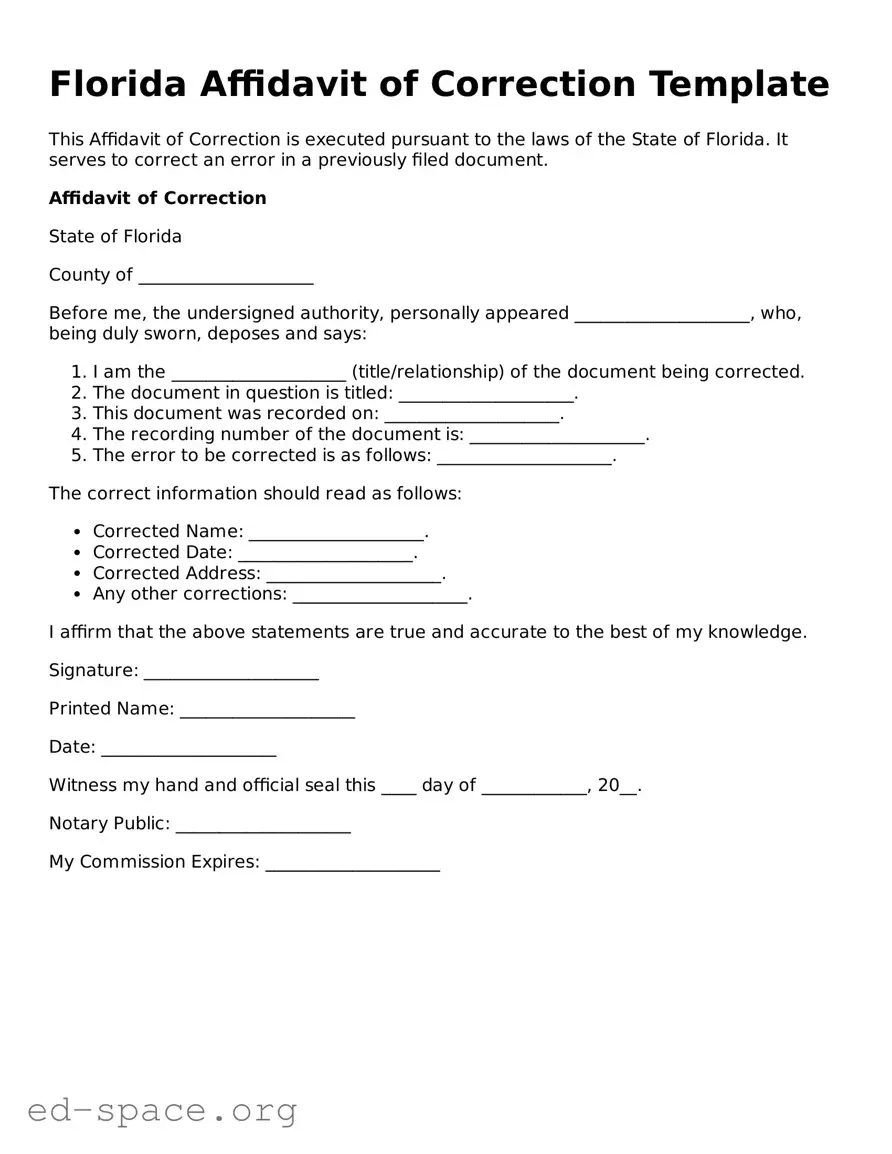
Florida Affidavit of Correction Template

This Affidavit of Correction is executed pursuant to the laws of the State of Florida. It serves to correct an error in a previously filed document.

Affidavit of Correction

State of Florida

County of ____________________

Before me, the undersigned authority, personally appeared ____________________, who, being duly sworn, deposes and says:

  1. I am the ____________________ (title/relationship) of the document being corrected.
  2. The document in question is titled: ____________________.
  3. This document was recorded on: ____________________.
  4. The recording number of the document is: ____________________.
  5. The error to be corrected is as follows: ____________________.

The correct information should read as follows:

  • Corrected Name: ____________________.
  • Corrected Date: ____________________.
  • Corrected Address: ____________________.
  • Any other corrections: ____________________.

I affirm that the above statements are true and accurate to the best of my knowledge.

Signature: ____________________

Printed Name: ____________________

Date: ____________________

Witness my hand and official seal this ____ day of ____________, 20__.

Notary Public: ____________________

My Commission Expires: ____________________

PDF Form Details

Fact Name Description
Purpose The Florida Affidavit of Correction is used to correct errors in public records.
Governing Law Florida Statutes, Section 695.26 governs the use of affidavits of correction.
Who Can File Any party with an interest in the document may file an affidavit of correction.
Common Errors Common errors include misspellings, incorrect dates, and misidentified parties.
Filing Process The affidavit must be signed, notarized, and filed with the appropriate county clerk.
Cost Filing fees vary by county but typically range from $10 to $50.
Effect on Original Document The affidavit does not invalidate the original document but clarifies its content.
Public Record Once filed, the affidavit becomes part of the public record.
Limitations The affidavit cannot be used to change the substantive rights of the parties involved.

Florida Affidavit of Correction: Usage Guidelines

Completing the Florida Affidavit of Correction form is a straightforward process that requires careful attention to detail. This document is essential for correcting specific errors in public records. After filling out the form, it will need to be submitted to the appropriate office for processing.

  1. Obtain the Florida Affidavit of Correction form. This can typically be found on the official state website or at your local county office.
  2. Begin by filling in your name and contact information at the top of the form. Ensure that all details are accurate and legible.
  3. Identify the specific document that contains the error you wish to correct. Provide the title, date, and any other relevant details to clearly reference the original document.
  4. Clearly state the nature of the error. Use concise language to describe what is incorrect and how it should be corrected.
  5. Include any necessary supporting information or documentation that validates the correction. This could be a copy of the original document or additional evidence.
  6. Sign the affidavit in the designated area. Your signature must be notarized, so make sure to do this in the presence of a notary public.
  7. Review the completed form for accuracy. Double-check all information to avoid any further issues.
  8. Submit the affidavit to the appropriate office. This may be the county clerk or another relevant authority, depending on the nature of the correction.

After submission, keep a copy of the completed form for your records. You may need to follow up with the office to confirm that the correction has been processed successfully.

Your Questions, Answered

What is a Florida Affidavit of Correction?

A Florida Affidavit of Correction is a legal document used to correct errors in official records. This can include mistakes in property deeds, mortgages, or other public records. By filing this affidavit, you can ensure that the correct information is recorded, which helps prevent future disputes or confusion.

Who can file an Affidavit of Correction in Florida?

Any individual or entity that has a vested interest in the record can file an Affidavit of Correction. This typically includes property owners, mortgage holders, or their authorized representatives. It’s important to ensure that you have the proper authority to make the correction to avoid complications.

What types of errors can be corrected with this affidavit?

The affidavit can address a variety of mistakes, such as typographical errors, incorrect names, or wrong legal descriptions. For example, if a property deed mistakenly lists the wrong name or has an incorrect address, an Affidavit of Correction can be used to fix these issues. However, it cannot change the substance of the original document; it only corrects factual inaccuracies.

How do I file a Florida Affidavit of Correction?

To file an Affidavit of Correction, you must complete the form accurately, including all necessary details about the correction. After signing the affidavit in the presence of a notary, you will submit it to the appropriate county office where the original document is recorded. Be sure to check if there are any specific filing fees or additional requirements in your county.

Common mistakes

  1. Not providing accurate information. Ensure all details are correct, as inaccuracies can lead to further complications.

  2. Failing to sign the affidavit. A signature is crucial for the document to be valid.

  3. Omitting necessary attachments. If supporting documents are required, include them to avoid delays.

  4. Using outdated forms. Always check for the most current version of the Affidavit of Correction.

  5. Not following the proper filing procedure. Understand the steps for submission to ensure acceptance.

  6. Neglecting to keep copies. Always retain a copy of the completed affidavit for your records.

  7. Ignoring deadlines. Submit the affidavit within the required time frame to avoid penalties.

  8. Failing to check for additional requirements. Some situations may have specific rules that must be followed.

  9. Not consulting with a professional. If unsure, seek advice to prevent mistakes that could be costly.

  10. Assuming the process is simple. Take the time to understand the form and its implications.

Documents used along the form

When filing an Affidavit of Correction in Florida, several other forms and documents may accompany it to ensure that the correction is properly processed and recognized. Each of these documents serves a specific purpose, contributing to the overall clarity and legality of the correction process. Below is a list of commonly used forms that may be relevant.

  • Notice of Intent to Correct: This document informs all interested parties about the intention to correct an error in a previously filed document. It helps ensure transparency and allows for any objections to be raised before the correction is finalized.
  • Certificate of Correction: This form is often used to officially document the changes made to the original filing. It serves as a formal acknowledgment of the correction and is typically recorded with the relevant government office.
  • Affidavit of Identity: In cases where there is confusion regarding the identity of the parties involved, this affidavit helps to clarify who is making the correction. It can be crucial for avoiding future disputes.
  • Release of Lien: If the correction pertains to a document that involves a lien, this form is necessary to officially release the lien once the correction is made. It protects the interests of all parties involved.
  • Power of Attorney: If someone is acting on behalf of another party to file the Affidavit of Correction, a Power of Attorney document may be required. This form grants legal authority to the representative to act in the best interests of the principal.
  • Statement of Claim: In some cases, a Statement of Claim may be needed to outline the reasons for the correction and to provide context for any disputes that may arise from the original document.
  • Proof of Service: This document verifies that all parties have been properly notified about the correction. It is essential for maintaining the integrity of the legal process and ensuring that everyone involved is informed.
  • Final Judgment or Order: If the correction is related to a court case, a final judgment or order may be necessary to finalize the changes. This document provides the legal backing for the correction and ensures compliance with court directives.

Understanding these associated forms can facilitate a smoother correction process. Each document plays a vital role in ensuring that the Affidavit of Correction is properly recognized and that all parties are informed and protected throughout the process.

Similar forms

  • Affidavit of Identity Theft: This document is used to declare that an individual’s identity has been misused. Like the Affidavit of Correction, it requires a sworn statement and is aimed at rectifying a record. Both documents serve as a formal way to clarify or amend information that is incorrect or misleading.
  • Declaration of Lost Document: Similar to the Affidavit of Correction, this declaration is utilized when an important document has been lost or destroyed. It provides a sworn statement to affirm the loss and seeks to prevent fraud. Both documents are legal tools that help establish clarity in records.
  • Affidavit of Support: This form is often used in immigration cases to demonstrate that a person has the financial means to support another individual. Like the Affidavit of Correction, it involves a sworn statement and is essential for ensuring accurate information is presented to authorities.
  • Certificate of Correction: This document is specifically used to correct errors in corporate filings or other official records. Similar to the Affidavit of Correction, it serves the purpose of amending a previously filed document to ensure the accuracy of information on record.

Dos and Don'ts

When filling out the Florida Affidavit of Correction form, it's essential to ensure accuracy and compliance with the requirements. Below are some key dos and don'ts to keep in mind:

  • Do read the instructions carefully before starting to fill out the form.
  • Do provide accurate information to avoid delays in processing.
  • Do sign and date the affidavit in the designated area.
  • Do keep a copy of the completed form for your records.
  • Don't leave any required fields blank; this could lead to rejection.
  • Don't use correction fluid or tape on the form; this may invalidate it.

By following these guidelines, you can help ensure that your Affidavit of Correction is processed smoothly and efficiently.

Misconceptions

When it comes to the Florida Affidavit of Correction form, many people have misunderstandings that can lead to confusion. Here are six common misconceptions:

  • It can be used for any type of correction. Many believe that the Affidavit of Correction can fix any mistake. However, it is specifically designed for correcting clerical errors in public records, not for substantive changes.
  • Anyone can file an Affidavit of Correction. Some think that anyone can submit this form. In reality, only the person who made the original filing or their legal representative can file an affidavit to correct it.
  • It is a lengthy and complicated process. Many fear that filing the form will be cumbersome. In truth, the process is relatively straightforward and can often be completed without legal assistance.
  • The form guarantees the correction will be accepted. Some individuals assume that filing the affidavit ensures the correction will automatically be made. However, the appropriate authority must review and approve the affidavit before any changes are officially recorded.
  • It can only be used for errors made by government officials. A common belief is that only government errors can be corrected. In fact, individuals can use the form to correct their own mistakes in public records as well.
  • Once filed, the correction is permanent and cannot be changed. Some people think that once an Affidavit of Correction is filed, it cannot be altered. However, if a new error occurs or further clarification is needed, additional affidavits can be filed.

Understanding these misconceptions can help you navigate the process of correcting public records in Florida more effectively. Always ensure you have the right information before proceeding.

Key takeaways

When dealing with the Florida Affidavit of Correction form, it is essential to understand its purpose and proper usage. Here are some key takeaways to consider:

  • The Affidavit of Correction is primarily used to correct clerical or typographical errors in public records.
  • Common errors that can be corrected include misspellings, incorrect dates, or wrong legal descriptions.
  • Only the person who made the original filing or a designated representative can file the affidavit.
  • Filing the affidavit does not change the original document's validity; it simply clarifies the record.
  • It is crucial to provide accurate information on the form to avoid further complications.
  • The affidavit must be signed in the presence of a notary public to ensure its legal standing.
  • Once filed, the corrected affidavit should be kept with the original document for reference.

Understanding these points can help ensure that the correction process goes smoothly and effectively addresses any errors in public records.