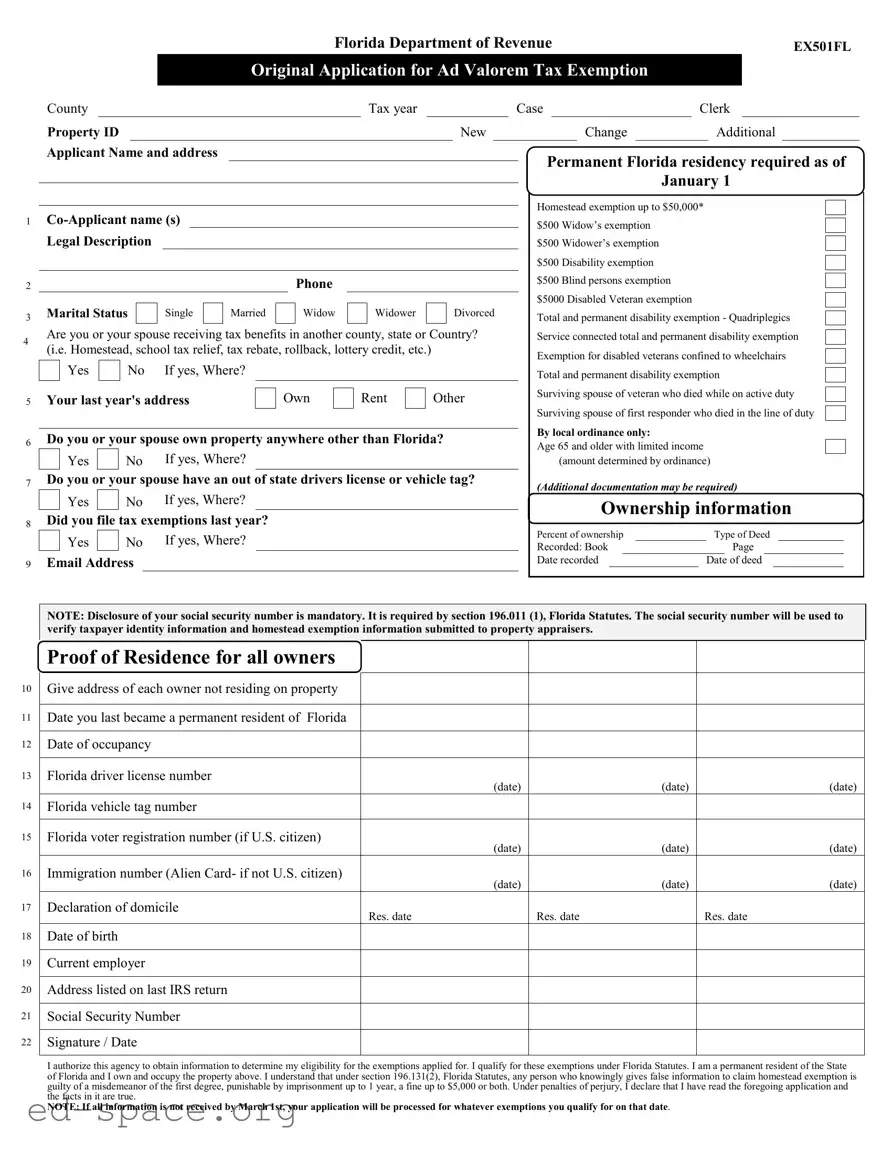
The Florida Department of Revenue's EX501FL form serves as a crucial tool for individuals seeking to apply for various ad valorem tax exemptions. This form captures essential information about the applicant, including their name, address, and marital status, as well as details about co-applicants and property ownership. Applicants must indicate whether they or their spouse receive tax benefits in other jurisdictions, which could influence their eligibility for exemptions in Florida. The form also requires applicants to provide proof of residency, ownership details, and any relevant documentation regarding previous tax exemptions. Additionally, it outlines specific exemptions available, such as the homestead exemption, widow and widower exemptions, and benefits for disabled veterans, among others. Applicants must disclose their Social Security number, as mandated by state law, to verify their identity and eligibility. The form emphasizes the importance of accuracy, warning applicants that providing false information can lead to severe penalties. Timeliness is also a key factor; applications must be submitted by March 1st to ensure consideration for the desired exemptions. Completing the EX501FL form accurately and thoroughly is essential for Florida residents aiming to take advantage of the tax relief opportunities available to them.
Florida Department of Revenue |
EX501FL |
|
|
Original Application for Ad Valorem Tax Exemption
County |
|
Tax year |
|
||
Property ID |
|
|
|
New |
|
Applicant Name and address |
|
|
|
||
1
2 |
|
|
|
|
|
|
|
Phone |
|
|
|
|
3 |
Marital Status |
|
Single |
|
Married |
|
|
Widow |
|
Widower |
|
Divorced |
|
|
|
|
|
|
Are you or your spouse receiving tax benefits in another county, state or Country?
4
(i.e. Homestead, school tax relief, tax rebate, rollback, lottery credit, etc.)
|
|
Yes |
|
No If yes, Where? |
|
|
|
|
|
|
|
|
|
|
|
|
Own |
|
Rent |
|
Other |
5 Your last year's address |
|
|
|
|||||||
|
|
|
||||||||
6Do you or your spouse own property anywhere other than Florida?
Yes |
|
No If yes, Where? |
7Do you or your spouse have an out of state drivers license or vehicle tag?
Yes |
|
No If yes, Where? |
8Did you file tax exemptions last year?
Yes |
|
No If yes, Where? |
9Email Address
CaseClerk
Change Additional
Permanent Florida residency required as of
January 1
Homestead exemption up to $50,000* $500 Widow’s exemption
$500 Widower’s exemption $500 Disability exemption $500 Blind persons exemption
$5000 Disabled Veteran exemption
Total and permanent disability exemption - Quadriplegics Service connected total and permanent disability exemption Exemption for disabled veterans confined to wheelchairs Total and permanent disability exemption
Surviving spouse of veteran who died while on active duty Surviving spouse of first responder who died in the line of duty
By local ordinance only:
Age 65 and older with limited income (amount determined by ordinance)
(Additional documentation may be required)
Ownership information
Percent of ownership |
|
|
Type of Deed |
|
|||||
Recorded: Book |
|
|
|
|
Page |
|
|||
Date recorded |
|
|
|
Date of deed |
|
||||
NOTE: Disclosure of your social security number is mandatory. It is required by section 196.011 (1), Florida Statutes. The social security number will be used to verify taxpayer identity information and homestead exemption information submitted to property appraisers.
Proof of Residence for all owners
10Give address of each owner not residing on property
11 |
Date you last became a permanent resident of Florida |
|
|
|
|
|
|
|
|
12 |
Date of occupancy |
|
|
|
|
|
|
|
|
13 |
Florida driver license number |
(date) |
(date) |
(date) |
|
|
|||
14 |
Florida vehicle tag number |
|
|
|
|
|
|
|
|
15 |
Florida voter registration number (if U.S. citizen) |
(date) |
(date) |
(date) |
|
|
|||
16 |
Immigration number (Alien Card- if not U.S. citizen) |
(date) |
(date) |
(date) |
|
|
|||
17 |
Declaration of domicile |
Res. date |
|
Res. date |
|
Res. date |
|
||
18 |
Date of birth |
|
|
|
|
|
|
|
|
19 |
Current employer |
|
|
|
|
|
|
|
|
20 |
Address listed on last IRS return |
|
|
|
|
|
|
|
|
21 |
Social Security Number |
|
|
|
|
|
|
|
|
22 |
Signature / Date |
|
|
|
I authorize this agency to obtain information to determine my eligibility for the exemptions applied for. I qualify for these exemptions under Florida Statutes. I am a permanent resident of the State of Florida and I own and occupy the property above. I understand that under section 196.131(2), Florida Statutes, any person who knowingly gives false information to claim homestead exemption is guilty of a misdemeanor of the first degree, punishable by imprisonment up to 1 year, a fine up to $5,000 or both. Under penalties of perjury, I declare that I have read the foregoing application and the facts in it are true.
NOTE: If all information is not received by March 1st, your application will be processed for whatever exemptions you qualify for on that date.
| Fact Name | Description |
|---|---|
| Governing Law | The application is governed by section 196.011(1) and section 196.131(2) of the Florida Statutes. |
| Application Purpose | This form is used to apply for Ad Valorem Tax Exemptions in Florida. |
| Eligibility Criteria | Applicants must be permanent residents of Florida and occupy the property for which they are applying. |
| Exemption Types | Exemptions include Homestead, Disability, and Widow/Widower exemptions, among others. |
| Deadline | All information must be submitted by March 1st for the application to be processed for available exemptions. |
| Social Security Number | Disclosure of the social security number is mandatory for identity verification. |
| False Information Penalty | Providing false information can result in criminal charges, including fines and imprisonment. |
| Proof of Residence | Proof of residence is required for all property owners listed on the application. |
Completing the Florida form for tax exemption is an important step in securing potential benefits. This form requires detailed personal and property information, which will be used to assess eligibility for various exemptions. Ensure that you have all necessary documents and information ready before you begin filling out the form.
What is the Florida EX501FL form?
The Florida EX501FL form is an application used to apply for various ad valorem tax exemptions in the state of Florida. These exemptions can provide significant savings on property taxes for eligible individuals, including homestead exemptions and exemptions for certain groups such as disabled veterans and the elderly.
Who is eligible to apply for tax exemptions using this form?
Eligibility for tax exemptions varies based on the type of exemption. Generally, individuals who are permanent residents of Florida and own and occupy the property can apply. Specific exemptions may have additional criteria, such as age, disability status, or veteran status.
What information do I need to provide on the form?
The form requires various pieces of information, including your name, address, property ID, marital status, and details about any other properties you or your spouse may own. You will also need to provide your social security number, proof of residence, and information about your employment and past tax filings.
What types of exemptions can I apply for with this form?
The EX501FL form allows you to apply for several types of exemptions, such as the homestead exemption, widow’s or widower’s exemptions, disability exemptions, and exemptions for disabled veterans. Each exemption has specific criteria that must be met for eligibility.
Is there a deadline for submitting the application?
Yes, the application must be submitted by March 1st of the tax year for which you are applying. If your application is not complete by this date, it will be processed for any exemptions you qualify for based on the information available at that time.
What happens if I provide false information on the form?
Providing false information on the EX501FL form can lead to serious consequences. Under Florida law, knowingly giving false information to claim a homestead exemption is considered a misdemeanor. This can result in penalties including imprisonment and fines.
Do I need to provide my social security number?
Yes, disclosing your social security number is mandatory on the EX501FL form. It is used to verify your identity and confirm your eligibility for the exemptions you are applying for.
Can I apply for exemptions if I own property in another state?
Yes, you can apply for exemptions in Florida even if you own property in another state. However, you will need to disclose information about any other properties you own and whether you or your spouse are receiving tax benefits elsewhere.
What if I have questions about filling out the form?
If you have questions while completing the EX501FL form, it is advisable to contact your local county property appraiser's office. They can provide guidance and assistance regarding the application process and eligibility requirements.
How do I submit the completed form?
Once you have completed the EX501FL form, you can submit it to your local county property appraiser's office. This can typically be done in person or by mail. Some counties may also offer online submission options.
Incomplete Information: Failing to provide all required details can lead to delays or denial of the application. Ensure that every section is filled out accurately, including personal information and property details.
Missing Signatures: Not signing the application or forgetting to date it is a common oversight. A signature is essential to validate the application and confirm your eligibility for the exemptions.
Incorrect or Outdated Information: Using old addresses or incorrect property IDs can cause confusion. Always double-check that the information matches current records to avoid complications.
Ignoring Deadlines: Submitting the application after the March 1st deadline can result in missed exemptions. Be mindful of all timelines and ensure your application is submitted on time.
When applying for ad valorem tax exemptions in Florida, several additional forms and documents may be required. Understanding these documents can help ensure a smooth application process. Below is a list of commonly used forms that accompany the Florida EX501FL application.
Gathering these documents ahead of time can expedite the application process and help avoid delays. Ensure that all forms are completed accurately and submitted by the required deadlines to maximize your chances of receiving the exemptions for which you qualify.
When filling out the Florida Department of Revenue's EX501FL form for Ad Valorem Tax Exemption, attention to detail is essential. Here are some guidelines to help you navigate the process effectively.
Following these guidelines will enhance your chances of a smooth application process and ensure you receive the exemptions you may qualify for.
Understanding the Florida form for Ad Valorem Tax Exemption can be challenging. Here are four common misconceptions that may lead to confusion:
This is not true. While many applicants are homeowners, renters may also qualify for certain tax benefits. It's essential to review eligibility requirements carefully.
New residents can apply for exemptions as soon as they establish permanent residency. The key factor is proving that you own and occupy the property as your primary residence.
This is incorrect. Each application is reviewed, and exemptions are granted based on eligibility criteria. Additional documentation may be required to support your claims.
In fact, disclosing your Social Security number is mandatory. It is necessary for verifying your identity and ensuring the integrity of the application process.